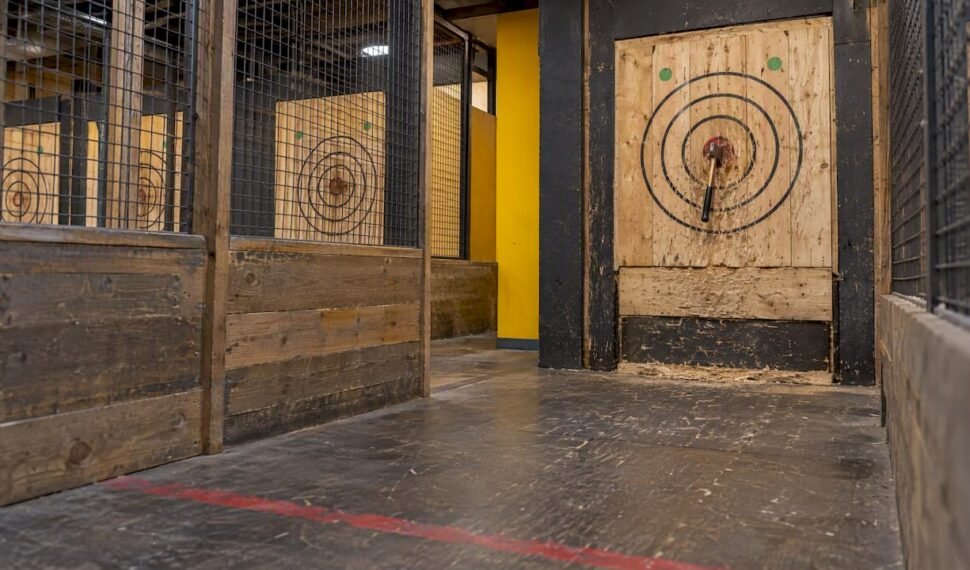
The essentials for axe throwing are short: closed-toe shoes with good grip, a loose top you can swing in, a supervised lane, and a basic grasp of how the target and scoring work. At a venue, the axes, targets and coaching are provided. If you plan to build your own lane, the list grows to include the target boards, a safe backstop, floor protection and a place to store the axes. This guide covers both, in the order you will need them.
TL;DR
- Wear closed-toe shoes with good traction and a loose-fitting top. Those two choices decide whether you are allowed on the lane at all.
- Beginners should throw in a supervised lane with a coach present, not in a backyard or park.
- A standard league target has a 1.5-inch bullseye worth 6 points, with rings worth 5 down to 1 and Killshots worth 7 or 8.
- Target boards are built in layers of OSB or plywood plus 2×10 lumber, and the lane around them needs real clearance.
- Most beginners do not need to buy anything. Book a session first, then decide whether gear is worth it.
Table of Contents
- What to wear before you step up to the lane
- The rules that matter most for beginners
- Lane and space requirements
- Axe throwing targets: layout and scoring
- Choosing a throwing axe
- Accessories: what is useful and what is optional
- What we have learned running group sessions
- Booking a session instead of buying gear
- A first-session checklist
- FAQ
- Sources
What to wear before you step up to the lane
Clothing is the one essential every thrower controls. A safety poster from a Canadian venue, Axe Throwing Calgary, makes closed-toe footwear mandatory, asks for shoes with good traction, and recommends a loose-fitting top so your upper body can move freely. That matches what most venues enforce at the door.
In practice:
- Shoes: sneakers or flat boots with a grippy sole. No sandals, flip-flops or open-toe flats. A dropped axe and bare toes are a bad combination, and a slick sole on a lane floor makes your stance unstable.
- Top: a t-shirt, light sweater or athletic top. Avoid tight jackets, stiff blazers and anything that restricts your shoulder. A throw is an overhead motion, and fabric that pulls across the chest changes your release.
- Bottoms: jeans, joggers or shorts are all fine. Choose what lets you plant your feet comfortably.
- Hair and accessories: tie back long hair. Dangling necklaces, loose scarves and bracelets that catch on your sleeve are better left in your bag.
If you are coming from the office for a team event, the same logic applies. Our corporate event dress code page explains how to keep check-in quick, and why dress shoes and tight blazers cause the most delays.
The rules that matter most for beginners
The safety rules are simple and consistent across venues. Learn them once and every lane feels familiar.
- Throw only under supervision. The Calgary poster says throwing is permitted only when an Event Leader is present and actively supervising the lane.
- Nobody between you and the target. The World Axe Throwing League (WATL) rules prohibit throwing while any person or live object is between the thrower and the target.
- Wait for your opponent. In head-to-head play, the same poster says you must wait until both opponents have thrown before crossing the throwing line to collect axes.
- Retrieve only when the lane is clear. Walk, never run, and keep your axes pointed down.
If you are new, avoid practicing in a public park or a friend’s yard until you have thrown in a proper lane. A coach corrects your grip and release in the first ten minutes, which prevents the bad habits that cause bounce-backs. Our guide to axe throwing techniques walks through grip, stance and release step by step.
Lane and space requirements
You do not need to measure anything at a venue, but it helps to know why a lane feels roomy. WATL rules say a lane should have at least 12 feet of clear ceiling height, 12 feet of width and 15 feet of length. That space gives the thrower room for a full overhead swing and keeps neighboring lanes separate.
That is why a backyard setup in a tight garage or under a low deck rarely works. If you cannot swing the axe overhead without a branch, beam or wall within reach, the space is too small.
Axe throwing targets: layout and scoring
The target is the most searched part of this topic, and the layout is more standardized than people expect.
How a standard target is scored
WATL-sanctioned targets have a center bullseye 1.5 inches in diameter, centered 60 inches from the ground. According to the WATL rules, the bullseye is worth 6 points, the surrounding rings are worth 5 down to 1, and Killshots placed in the 1 ring are worth 7 points (outer) or 8 points (inner).
| Zone | Points |
|---|---|
| Bullseye (1.5 in) | 6 |
| Ring 5 | 5 |
| Ring 4 | 4 |
| Ring 3 | 3 |
| Ring 2 | 2 |
| Ring 1 | 1 |
| Killshot, outer | 7 |
| Killshot, inner | 8 |
The Killshots are small, and you usually call them before you throw. For the full scoring walkthrough, including faults and judging, see our pages on axe throwing scoring and league rules.
What target types you will see
Two layouts show up most often. The first is the standard bullseye board described above, used in leagues and most casual games. The second is a game board: venues paint extra shapes or zones on the same wood for party games and tie-breakers. The wood and construction are the same, only the paint changes. If you want ideas, our list of axe throwing games shows how groups use those boards for something other than plain scoring.
What the target is made of
The WATL venue target specifications describe three layers: OSB or plywood on the wall, horizontal 2×10 backboards over it, and 4-foot 2×10 lumber for the targets, headers and footers. The layering lets the axe bite into soft wood while the backing absorbs force. Over time the boards wear out, and venues replace them, which is why a well-kept lane sticks axes more reliably than a worn one.
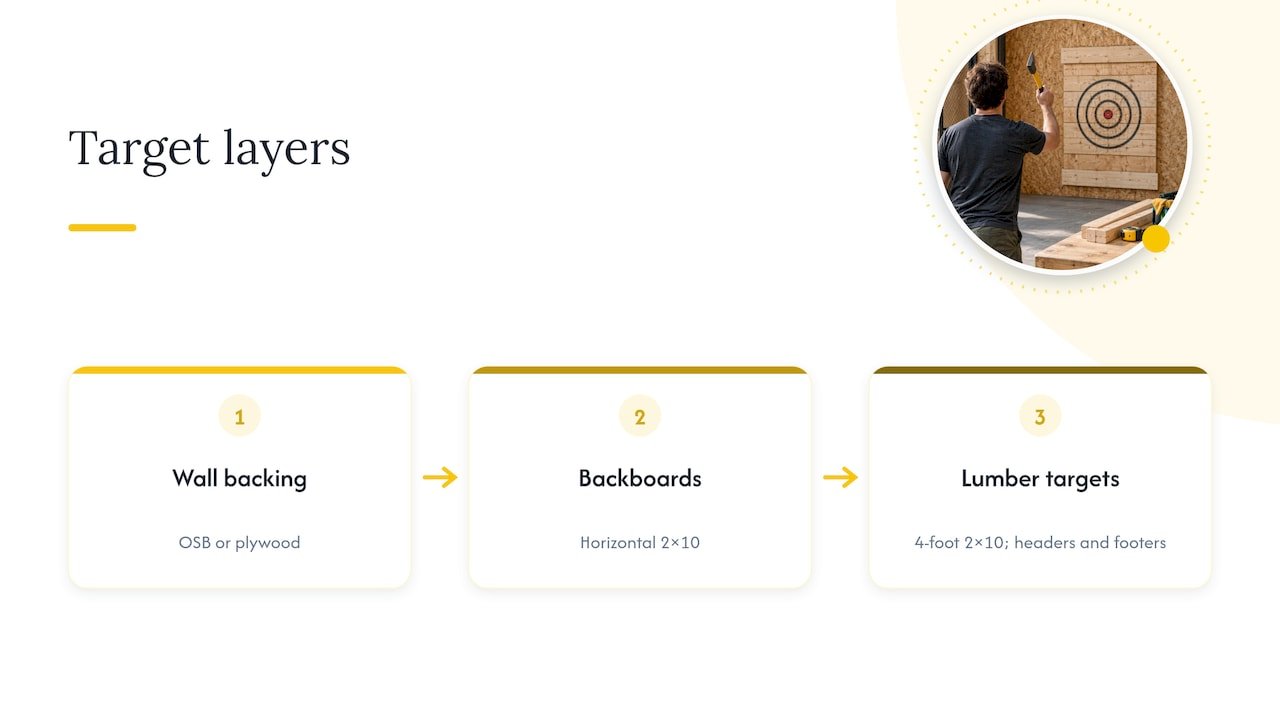
For a home build, the takeaway is that a target is a structure, not a sheet of wood nailed to a fence. If the boards are too thin, too dry or too hard, axes bounce instead of sticking.
Choosing a throwing axe
At a venue, the axes are chosen for you and they are suited to the game. If you are curious about gear, understand the basic split: purpose-built throwing axes designed for target play, and historical or tactical styles meant for different uses. Our breakdown of throwing axe types shows which meet league standards and which are historical designs.
When you handle a throwing axe for the first time, pay attention to three things:
- Balance: the head should feel stable as it rotates, not wobbly or nose-heavy.
- Handle length and grip: a handle you can hold securely with a relaxed hand. A slippery or splintered handle is a reason to put it back.
- Weight: heavier is not better. A weight that tires your wrist by the tenth throw will hurt accuracy.
A tomahawk or camping hatchet from a hardware store is not the same as a throwing axe, and it is not a good first purchase. Try several in a lane before buying anything.
Accessories: what is useful and what is optional
People searching for accessories usually find lists that mix venue equipment with home gear. Here is a sorted version.
Essential for everyone
- Closed-toe, grippy shoes
- A loose top
- A supervisor or coach, if you are new
Useful if you are building a lane at home
- Heavy-duty safety netting behind and beside the target, to catch misses
- Bounce-absorbing flooring, such as rubber mats or wood chips, under and around the target
- Soft protection above the target, so a high miss does not ricochet
- A rack or holder so axes are never left on the ground or in a pile
- A first aid kit within reach of the throwing area
Optional
- Safety glasses, a reasonable choice around splintering wood in a backyard setup
- Gloves with a textured palm, if you want grip in cold weather
- A chalk bag for sweaty hands
None of these replace supervision. If you have no experience, book a venue first and buy later. Many people discover they enjoy the social side more than the solo practice, and a session costs less than a stocked home lane.
What we have learned running group sessions
At Archers Battlefield we run group activities every week, from birthday parties to team events, and the same pattern shows up in every group. People worry about the axe and forget about the shoes. Check-in goes quickest when guests have read the footwear rule beforehand, and the first lesson goes best when the group is told the lane rules before anyone picks up an axe.
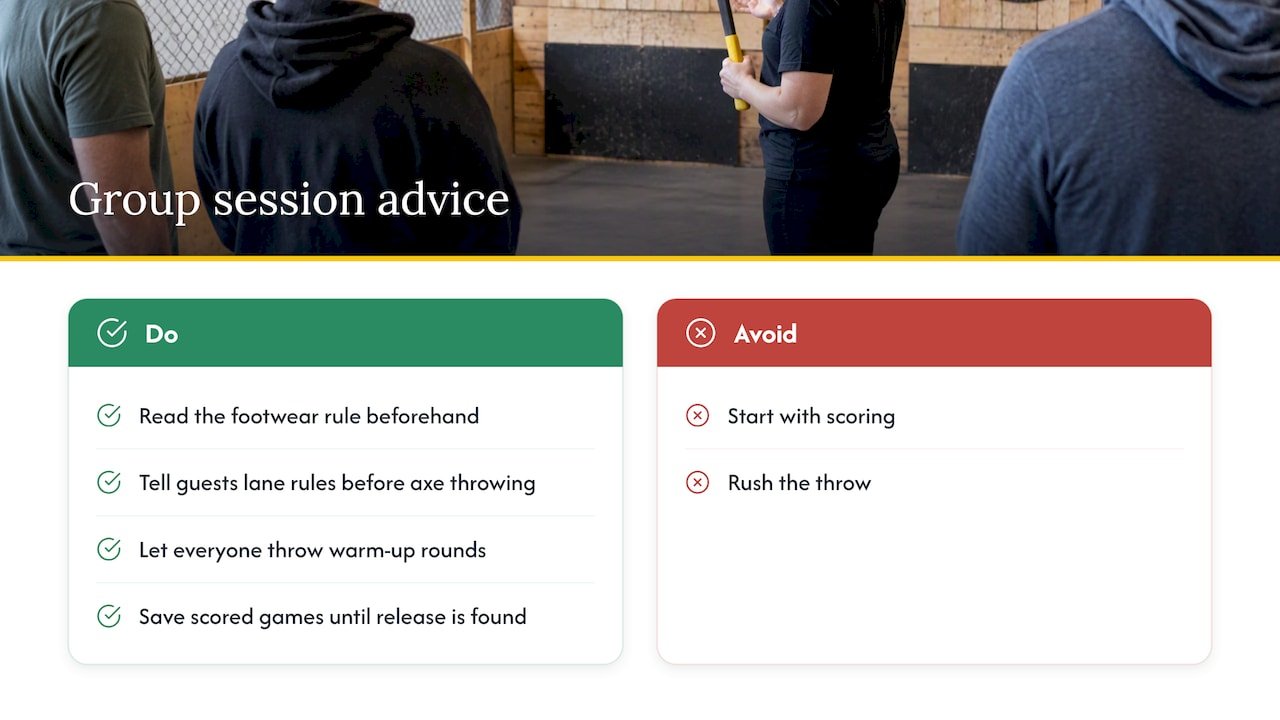
Our advice is to treat the first session as a skill-building afternoon, not a competition. Let everyone throw a few warm-up rounds, keep the groups small enough that a coach can watch every lane, and save the scored games for after the group has found its release. Beginners who start with scoring tend to rush the throw, and a rushed throw is the one that bounces.
We also recommend that mixed groups pair axe throwing with another activity. Our venue also offers combat archery, Nerf battles, dodgeball, ping pong and arcade games, so a group can alternate between a precision activity and a fast one, and nobody sits out for long.
— Archers
Booking a session instead of buying gear
If you want to try before you invest, booking a group session is the easiest way to learn what you like. We offer packages for birthdays, corporate events and sports teams, and you can see what is included on each page:
- Team building packages: the Collab Package starts from $699, the Ultimate Paddle Package from $799 and the Momentum Package from $2,395.
- Kids’ birthday party packages: Game On from $399, Epic from $499 and Momentum from $2,395.
- Event packages for adults and mixed groups, starting from $299.

Individual activities such as combat archery are priced per person at $35, and you can view the full list on our home page. Ask the planning team which activities fit your group size and age range. For ideas on pairing activities with a date, our guide to axe throwing date night covers how to book, and for corporate groups our Ontario team building page explains how an event runs.
A first-session checklist
Before you leave the house:
- Closed-toe shoes with good traction, on your feet, not in your bag.
- A top that lets you reach overhead.
- Long hair tied back, jewelry minimal.
- A rough idea of your group’s mix: first-timers, returning throwers, kids or adults.
- A plan for arrival time, so the safety briefing is not rushed.
Once there:
- Listen to the briefing, and ask about anything unclear.
- Warm up with easy throws, focused on a relaxed release.
- Stay behind the throwing line until the lane is clear.
- Retrieve axes only when your coach or the lane rules allow it.
- Move to scored games once most people are sticking the target.
FAQ
Do I need to bring my own axe?
No. At a venue the axes are supplied, along with the targets and a coach. Bringing your own is usually not needed and may not be allowed, so ask before you arrive.
What shoes are required for axe throwing?
Closed-toe shoes with good traction. Venues such as Axe Throwing Calgary make this mandatory. Sneakers are the safest choice.
What are the scoring zones on a target?
A standard league target has a 1.5-inch bullseye worth 6 points and rings worth 5 to 1. Killshots in the 1 ring are worth 7 or 8 points, according to the WATL rules.
What is a target made of?
League venue specifications call for OSB or plywood on the wall, horizontal 2×10 backboards, and 2×10 lumber for the targets, headers and footers, per the WATL target specifications. Softer wood helps axes stick.
Can beginners throw in a backyard?
We recommend starting in a supervised lane. A coach corrects grip and release early, and a proper lane has the clearance and backstop that a typical backyard does not.
Sources
- Official Rules, World Axe Throwing League
- Venue Target Specifications, World Axe Throwing League
- Axe Throwing Calgary safety poster


