
Axe throwing league rules come from two major bodies, the International Axe Throwing Federation (IATF) and the World Axe Throwing League (WATL). Their formats differ. In an IATF match you throw three rounds of five throws and need to win two rounds. In a WATL hatchet game you throw 10 times and the highest total wins. Which set you play depends on your league, so ask before your first night.
This guide covers what actually decides a league match: scoring, format, the throwing line, drops, challenges and the judge’s role. It ends with what to do if you’re organizing a league or a group night.
TL;DR
- IATF matches are 3 rounds of 5 throws, and you win the match by taking 2 rounds. WATL hatchet games are 10 throws, with the highest score winning.
- Scoring follows the majority of the blade in the target, so a small nick on a higher ring doesn’t earn the higher value.
- Don’t touch or move your axe until the score is called. Moving it after a challenge hands your opponent the lower value.
- Killshots (WATL) and the Clutch (IATF) are the high-risk, high-reward throws, and the rules about calling them differ.
- Rules get revised. WATL has both a 2026 rules update and a proposed 2027 update, so check the current rulebook before a season.
Table of Contents
- Two rulebooks, one sport
- How scoring works
- The throwing line and faults
- Drops, warm-ups and tie-breaks
- Judges, scorekeepers and challenges
- Equipment rules
- Rules are changing
- Our view: what new league players get wrong
- Run your own league night or team event
- FAQ
- Sources
Two rulebooks, one sport
Most leagues follow one of two playbooks. The IATF describes itself as a standardized playbook for leagues so throwers can compete no matter which league they play in. The WATL publishes official rules for hatchet, big axe and hatchet duals, the last being teams of two.
Some venues also write house rules on top. Those usually cover safety: closed-toe shoes, a signed waiver and who may be in the lane. Competitive rules, such as scoring and faults, come from the federation your league follows.
| IATF | WATL (hatchet) | |
|---|---|---|
| Match format | 3 rounds of 5 throws per player | 10 throws per game |
| Win condition | Win 2 of 3 rounds | Highest total after 10 throws |
| Bullseye | 5 points | 6 points |
| Top-value throw | Clutch, 7 points | Killshots, 7 to 8 points |
| Tie-break | Per the IATF rulebook | Sudden death Killshot round |
Format details come from the IATF’s match format page and the WATL rulebook linked above.
How scoring works
IATF point values
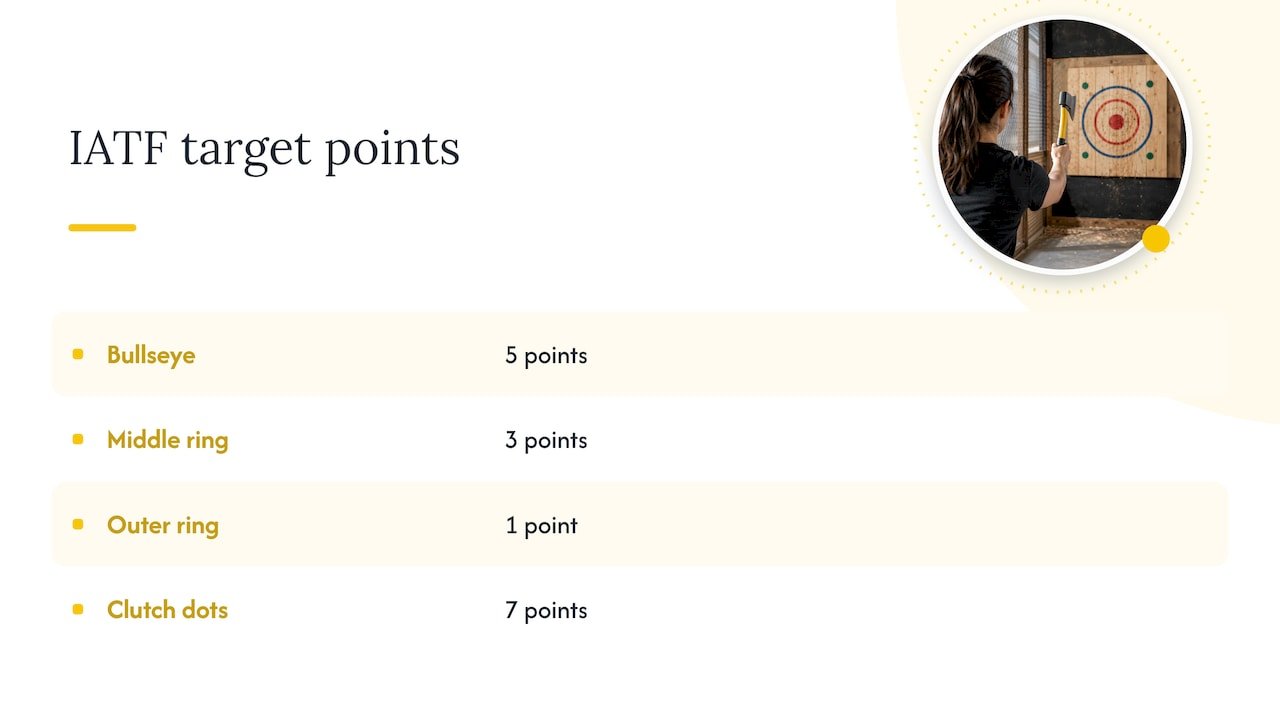
The IATF’s standard scoring rules give the bullseye (black ring) 5 points, the middle (red) ring 3 points and the outer (blue) ring 1 point. The green dot in each upper corner of the target, called the Clutch, is worth 7 points.
The bullseye is small. Under the IATF’s target dimensions it is 7 inches in diameter. That is why accuracy matters more than power in league play.
WATL point values
WATL scoring runs from 1 to 8 points per throw. Base rings go from 1 to 6, with the bullseye worth 6. Killshots add 7 and 8 point opportunities. Under the WATL rules, you get two Killshot calls per match, and you must call a Killshot before you throw it. In the app-based scoring flow, tapping a Killshot without calling it first triggers a warning. Some league formats award zero if you hit a bullseye while aiming for a Killshot you didn’t call.
If you want a quick-reference version of ring values and examples, see our axe throwing scoring guide.
The majority rule
In both systems the score is set by where the majority of the blade sits in the target. A blade that clips a higher ring at the edge doesn’t count as that ring. Most beginner disputes come from arguing for the higher value over a tiny nick. The judge looks at where most of the blade is and applies that value.
The throwing line and faults
The fault line is the line you can’t cross. The WATL hatchet fault line sits at 12 feet. Lanes should be at least 15 feet long, 12 feet wide and have 12 feet of clear ceiling height, so the thrower has safe space behind the line.
The IATF uses several lines. Its lane dimensions page describes a solid red foot fault line and a solid black hatchet throwing line, plus a dotted blue line for big axe throws.
A few fault rules to know, based on the WATL rulebook:
- If you touch the lane, equipment or building past the fault line while the lane is active and before all scores are called, that throw is a fault.
- A fault scores zero and earns no bonus.
- A fault can be dismissed at the Lane Judge’s discretion if it happens after all competitors have thrown and their axes have come to rest.
- Wheelchair users need one wheel behind the line. A cane or device may rest past it as long as the thrower’s feet stay behind.
- Throwers have ten seconds from the end of their opponent’s throw. A time fault can only be assessed if the judge is using a timer.
Drops, warm-ups and tie-breaks
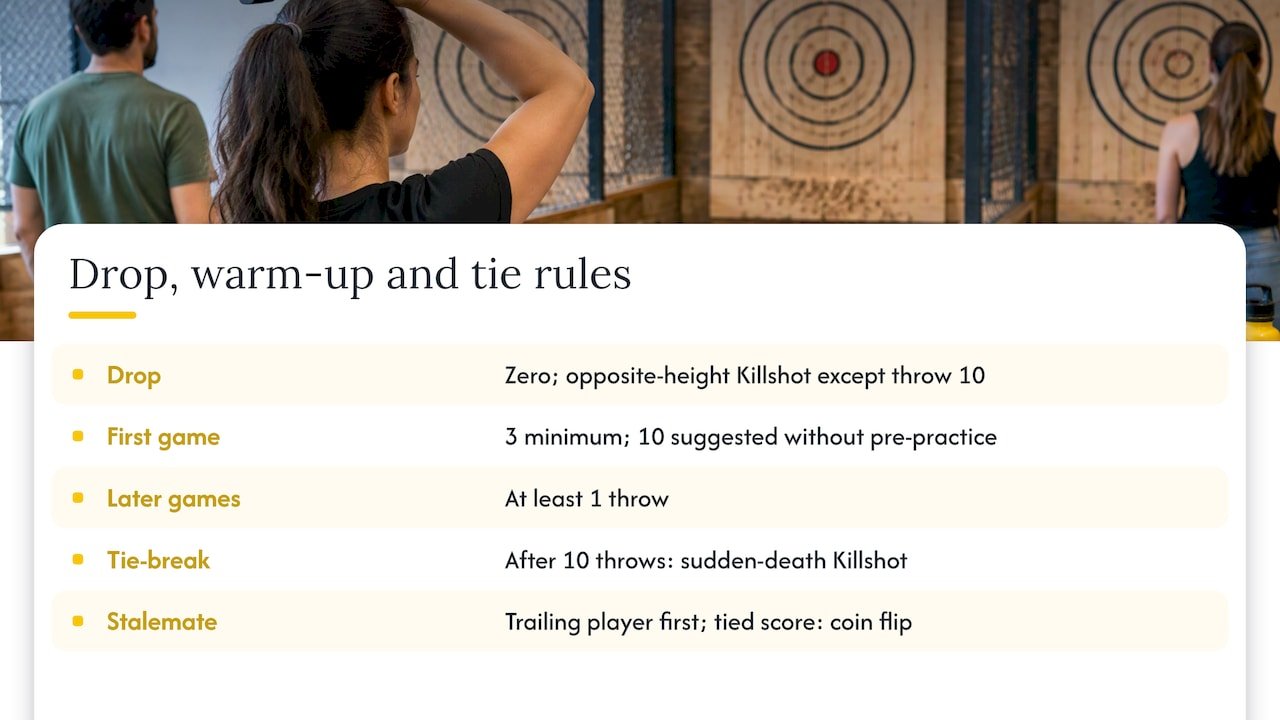
A drop happens when the axe doesn’t stick. Under the WATL rules a drop scores zero but earns an extra Killshot call at the opposite height, except on throw 10. That is a small comfort, so many throwers focus on clean releases rather than power. Our guide to grip, stance and release covers the mechanics.
Warm-ups also have a rule. In the WATL format, the first game of the day gets at least 3 throws, with 10 suggested if there’s no pre-practice. Later games get at least 1. The Head Judge or venue may adjust these, but all throws must be equally available to everyone.
For ties, WATL uses a sudden death Killshot round after 10 throws. In a stalemate, the trailing competitor throws first, and if scores are tied the Lane Judge flips a coin. The trailing competitor then has ten seconds to throw or it counts as a fault.
Judges, scorekeepers and challenges
The Lane Judge or scorekeeper keeps a league honest. The WATL rulebook says a lane is open for the next throw only when all competitors and the Lane Judge have returned behind the fault line, no pause has been called and the judge has declared the lane open.
Challenges work like this under WATL rules:
- A competitor may challenge any score called by the Lane Judge.
- Both competitors return behind their fault lines until the final call is made.
- If anyone alters the axe’s position after a challenge, the lower value is applied automatically.
- The Head Judge, or another Certified Judge, makes the final call, which is binding.
The practical lesson: never pull your axe until the score is confirmed. It’s the most common new-player mistake, and it can cost you points or turn a throw into a zero.
If you’re running a league, the judge isn’t the only job. Someone also has to publish the schedule and keep rosters straight. A walkthrough of league game scheduling steps can help you set a calendar that players trust, so judges can focus on the lane.
Equipment rules
Leagues care about the axe as much as the throw. WATL rules say an axe may only have one sharp bit, with no sharpened bits, spikes or blades on the poll, and the head must be held securely. Heads that can easily be removed, such as clamped, screwed or pinned ones, aren’t legal unless WATL approves them. If you’re buying your own, see our breakdown of throwing axe types, including which meet WATL or IATF specs and which are historical.
Rules are changing
Competitive rules don’t stand still. WATL publishes an updates page for 2026, a proposed 2027 gameplay update that looks at making divisions more distinct, such as Am Hatchet and Pro Hatchet, and an August 2026 test of an opponent scoring system that is explicitly in testing. A proposal or a test isn’t a rule yet. Before a season, ask your league organizer which year’s rulebook applies.
Our view: what new league players get wrong
We run group events built around active games, and the pattern with newcomers is consistent. Nobody struggles with the idea of scoring. They struggle with the habits around it: stepping over the line to look, reaching for the axe too early, and calling shots they haven’t practiced.
Our advice for a first league night:
- Spend your warm-up throws on a repeatable release, not on distance.
- Treat the fault line as a hard stop and learn it before anything else.
- Let the judge call the score. Arguing from a nick is a losing move.
- Skip the high-risk Killshot or Clutch throw until your basic groupings are consistent.
Safety shapes how we think about every game. Rules exist so a room full of people with axes behaves predictably. A group that learns the rules in the first ten minutes enjoys the rest of the night more.
— Archers
Run your own league night or team event
If you’re organizing a group, you don’t need a full season to use these rules. A single night with a clear format, a judge and a short rules briefing gets people competing quickly. Our 10 axe throwing games for groups include formats that work for mixed skill levels.
For corporate organizers in Ontario, we’ve written up axe throwing team building at Archers Battlefield. Our team building packages start with the Collab Package from $699, and sports teams can look at team battle events, starting with the Game On Team Battle from $399. Axe throwing itself has no published price on our site, so ask us about it when you inquire.
FAQ
What is the difference between IATF and WATL rules?
The formats differ. IATF matches are 3 rounds of 5 throws, with the bullseye at 5 points and a 7-point Clutch. WATL hatchet games are 10 throws, with the bullseye at 6 points and 7 to 8 point Killshots. Check which one your league uses.
Do I have to call my Killshot before I throw?
In both organizations, Killshots must be called before the throw. In the WATL app-based flow, tapping a Killshot without calling it first triggers a warning. In some league formats, an accidental bullseye while aiming at an uncalled Killshot scores nothing.
What happens if my axe falls off the target?
Under WATL rules, a drop scores zero points but earns an extra Killshot call at the opposite height, except on the tenth throw. A fault also scores zero, but gives no bonus.
Can I move my axe to check the score?
No. Leave it where it is until the score is called. If you alter the axe’s position after a challenge, the lower value is applied automatically.
Sources
- World Axe Throwing League: Official Rules
- WATL: 2026 rules updates
- WATL: 2027 proposed gameplay rules update
- WATL: Opponent scoring system testing update
- International Axe Throwing Federation
- IATF: Standard scoring
- IATF: Match format and scorekeeping
- IATF: Target dimensions
- IATF: Rules


