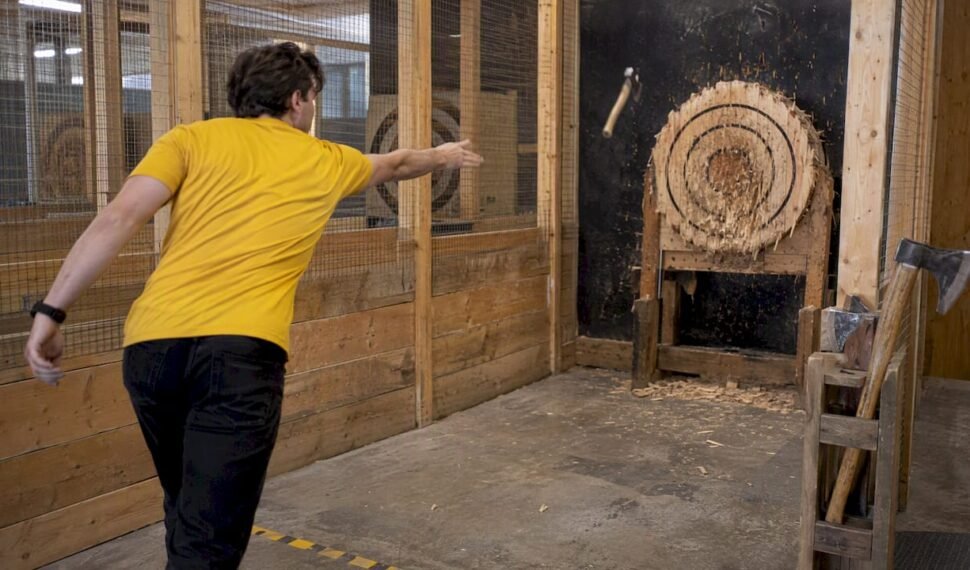
The main throwing axe types are the hatchet, the tomahawk, the big or felling axe, the double-bit axe, and the francisca, each built for a different throw and a different era. If you are starting out, grab a venue-approved standard hatchet: it is the easiest to rotate consistently, and most recreational venues already stock models that meet WATL or IATF rules.
TL;DR:
- Most beginner throwers should start with a venue-approved standard hatchet, which is easier to control and meets the safety standards of regulated leagues.
- WATL and IATF rules differ significantly in weight, handle length, and blade size, so verify current specifications before purchasing equipment for competition.
- Historical axes like the francisca are built for short, flat throws and generally do not meet modern safety or regulation standards for sport throwing.
- Venue staff regularly inspect equipment, enforce safety rules, and provide coaching, making supervised sessions safer and more consistent than backyard throws.
- Proper maintenance involves keeping the edge moderately sharp, inspecting the head for cracks, and storing axes in dry environments to prevent rust.
Table of Contents
- What are the main throwing axe types and their parts?
- How do WATL and IATF specifications compare?
- How do you choose the right throwing axe?
- What safety and venue rules apply to throwing axes?
- How do you maintain and store a throwing axe?
- What is the history behind axes like the francisca?
- What does a venue operator actually recommend?
- Sport gear or historical replica: which should you choose?
- Book a supervised axe-throwing session instead of guessing on gear
- Where to verify specs and historical details
- Sources
- FAQ
What are the main throwing axe types and their parts?
Each throwing axe type trades weight, length, and head shape for a different kind of flight, so recognizing them on sight tells you a lot about how they will behave in the air.
The hatchet is the standard sport axe you see at most venues: short handle, single blade, and a weight built for repeatable one-and-a-quarter rotations over a short lane. The tomahawk is its lighter cousin, with a straighter handle and a more streamlined head, a shape that specialty tool guides say favors throwing speed over chopping power. Hatchets are generally heavier relative to the handle and sturdier for actual woodwork, but a well-balanced hatchet throws just as well in sport settings.
The big axe (sometimes called a felling axe) is a different animal entirely. It is longer and heavier, thrown from a longer lane with fewer attempts per round under WATL’s big-axe and duals rules, and it rewards a slower, more deliberate swing rather than a quick wrist snap.
Double bit axes, with a blade on both sides of the head, are rare in regulated sport throwing because the second edge adds unpredictable rotation and extra risk on release. You will mostly see them as display pieces or historical replicas rather than lane equipment.
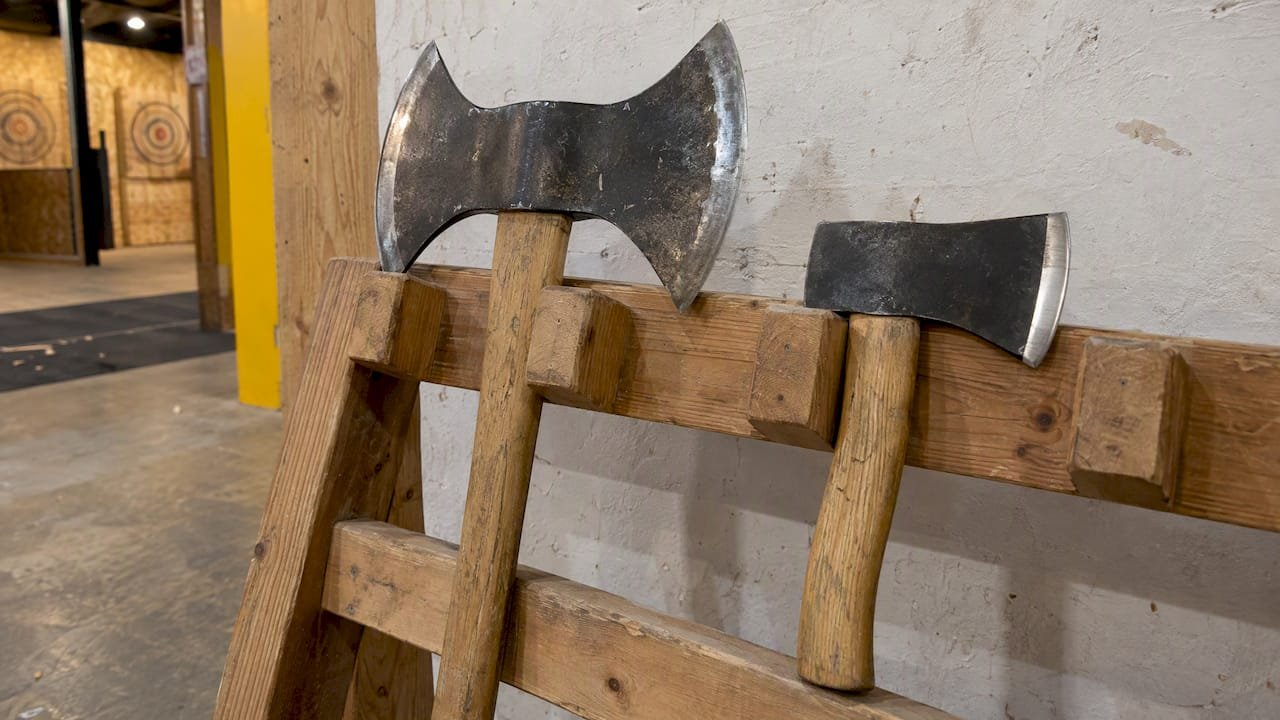
The francisca (or franziska) is the oldest design on this list. Archaeological and replica evidence described on Wikipedia shows a short haft around 16 to 18 inches with a cutting edge near 3.9 inches, a shape built for a flat, fast throw rather than the arcing rotation modern sport axes use.
Understanding the anatomy helps explain why these differences matter:
- Head: the metal mass that determines how the axe rotates in flight.
- Bit: the cutting edge; its length affects how deeply it sticks.
- Poll: the back of the head opposite the bit, which some models round or weight differently.
- Eye: the opening where the haft is fitted, critical for a secure, wobble-free connection.
- Haft (handle): its length and taper set the rotation speed and where your grip naturally falls.
How do WATL and IATF specifications compare?
Sport throwing is governed by rules, not guesswork, and the two major federations do not always agree on the numbers.
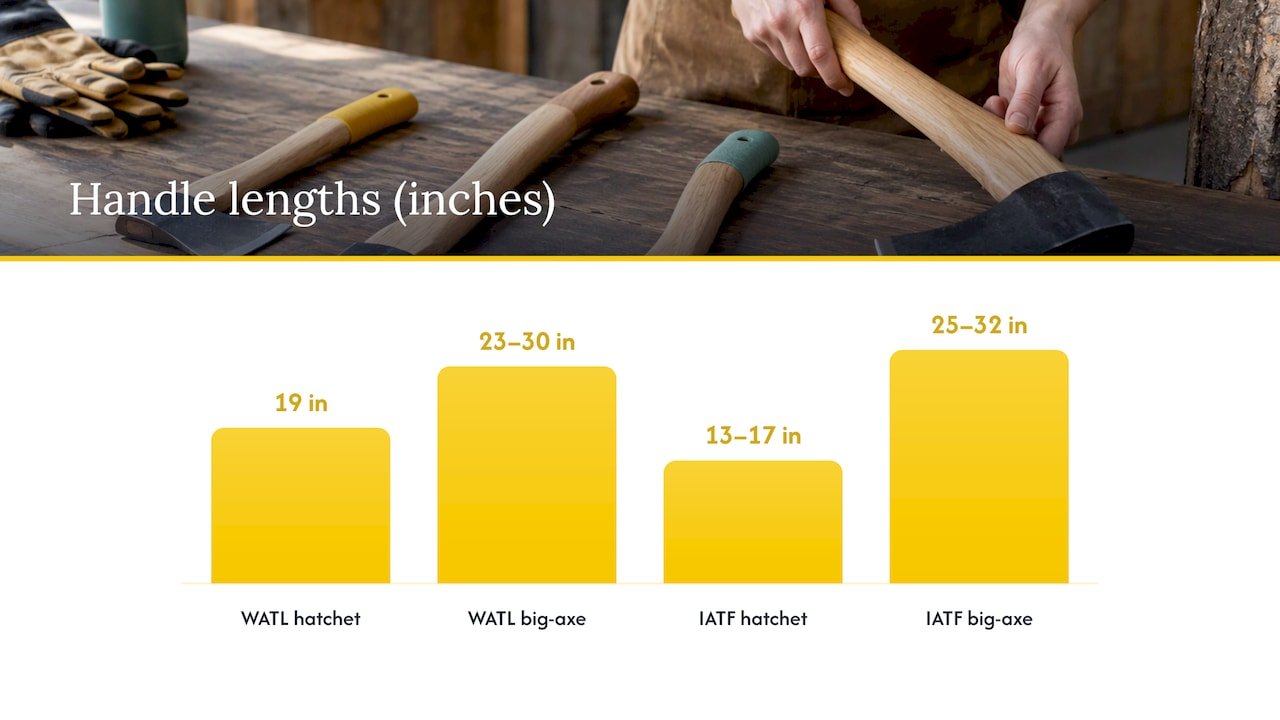
WATL caps the standard hatchet at 3 pounds, 19 inches in overall length, and a 4-inch bit, while its big-axe discipline runs 3 to 4.25 pounds with a 23 to 30-inch handle and a 15-foot fault line with seven throws per game. IATF sets its hatchet class at 1.5 to 2.5 pounds, a 13 to 17-inch handle, and a 3 to 4-inch blade, with a heavier big-axe class at 2.75 to 3.75 pounds and a 25 to 32-inch handle.
One rule change matters more than the rest right now: IATF revised its minimum head length to 4.75 inches (121 millimeters) in 2023, a tweak made specifically so common unmodified consumer models would still pass inspection.
The gap between federations creates real friction at checkout and at check-in:
- An axe bought for casual backyard throwing can fail a sanctioned-event inspection under a different ruleset.
- Extra spikes, a reshaped poll, or a slightly oversized blade are the most common reasons an axe gets rejected.
- Weight limits differ enough between WATL and IATF that a legal hatchet in one league can be too heavy in the other.
Before buying anything for competitive play, check the current spec sheet for whichever federation your venue follows rather than trusting a product label alone.
How do you choose the right throwing axe?
Picking a first axe is less about brand and more about matching dimensions to your hand, your throw, and the rules you will actually be throwing under.
- Start with a venue-approved standard hatchet. It is shorter, lighter, and more forgiving than a big axe or tomahawk, so your rotation stays consistent while you learn.
- Test the balance in hand before you throw it: a well-balanced hatchet should feel like the weight sits just ahead of your grip, not wobbling toward the head or the handle.
- Throw it once before buying anything. Most venues let you test house hatchets, and how the axe rotates on a practice throw tells you more than any spec sheet.
- Check the handle material. Wood hafts flex slightly and absorb shock better, but they can crack over time; composite handles last longer but feel stiffer on impact.
- Verify the weight, length, and single-bit rule against whichever federation spec your venue follows, since a double-bit or oversized head can get turned away at the door.
- Save replicas for display or reenactment, not the lane. A historical-style francisca or double-bit axe rarely meets modern safety specs for live throwing.
Pro Tip: If a hatchet feels head-heavy when you hold it level at arm’s length, it will usually rotate faster than you expect, so aim slightly lower on your first few throws.
What safety and venue rules apply to throwing axes?
Most venues restrict equipment for a simple reason: consistency keeps everyone safer, and house axes are inspected regularly in a way a personal axe rarely is.
- Typical venue rules limit throwers to single-bit axes only, ban extra spikes or modified polls, and cap blade length and overall weight.
- Before any session, check for a loose head, a cracked haft, or a damaged edge, and wear closed-toe shoes since lanes can get slick with repeated throws.
- Stay behind the throwing line until it is your turn and never retrieve an axe while someone else is mid-throw.
Supervised venue practice beats unsupervised backyard throwing because staff inspect equipment, enforce lane distances, and can correct a dangerous grip or stance before it becomes a habit.
How do you maintain and store a throwing axe?
A throwing axe needs less sharpening than most people assume, and over-sharpening is actually a common mistake.
- Keep the edge moderately sharp rather than razor sharp: a gentler edge sticks reliably without the added risk of a blade that bounces back dangerously on a bad throw.
- Inspect the haft regularly for cracks and check that the head sits tight in the eye; a loose head should be re-set or the axe retired rather than thrown again.
- Wipe the head dry after each session and store the axe somewhere dry to prevent rust, ideally with a light coat of oil on the metal if it will sit unused for a while.
Pro Tip: A slightly dull, well-balanced hatchet will outperform a razor-sharp one with a wobbly head every time.
What is the history behind axes like the francisca?
The francisca was a Frankish throwing weapon used in the Early Middle Ages, and its shape tells you exactly what job it was built for.
- Surviving examples and replicas show an average haft of 16 to 18 inches, a cutting edge near 3.9 inches, and an average weight around 1.3 pounds, according to archaeological and replica evidence.
- It was thrown to disrupt enemy shield walls at ranges up to roughly 12 meters, a short, flat trajectory rather than the looping rotation modern sport hatchets use.
- The Gränsfors Bruk Axe Museum documents these dimensions alongside other historical families, including tomahawks and battle axes, and notes that the francisca’s mass distribution produced a predictable, repeatable rotation at close range.
Combat and hunting axes were built around battlefield distance and target type, which is why their proportions look so different from a modern hatchet tuned for a 15 to 20-foot indoor lane.
What does a venue operator actually recommend?
Axe-throwing sessions at some venues use house-maintained equipment specifically so throwers do not have to guess whether their own axe meets the rules. Venue staff often handle inspection, lane assignment, and basic technique coaching, which removes most of the equipment decisions covered above.
Before booking or bringing your own axe anywhere, it helps to ask a few questions: what specification does the venue follow, is personal equipment allowed, and what happens if an axe fails inspection on arrival. Details on how bookings and equipment policies work are outlined on the archery booking page. For most first-timers, booking a supervised session is the simpler and safer starting point compared to buying gear before you know what you like throwing.
Sport gear or historical replica: which should you choose?
If your goal is competition, buy federation-compliant gear and verify it against the current WATL or IATF spec before you spend money, because rules change and marketing labels do not always keep up. If your goal is a display piece, a reenactment prop, or simply owning a piece of history, a francisca or double-bit replica makes more sense than a sport hatchet ever will. And if your goal is just a fun afternoon with friends or coworkers, a booked session with house equipment solves the entire selection problem for you.
— Archers
Book a supervised axe-throwing session instead of guessing on gear
Some venues supply venue-approved axes, safety briefings, and lane supervision, so you can focus on your throw instead of your equipment choices.

That setup works well for a first date with the sport, a birthday group, or a team outing where nobody wants to show up with the wrong axe. Packages range from drop-in sessions to full group events, including the Collab Package for team-building groups and the Game On Birthday Party package for family celebrations.
- Standard axe-throwing sessions use house equipment that already meets venue specifications.
- Group and party packages sometimes combine axe throwing with other activities like combat archery and dodgeball.
- Staff handle inspection and technique coaching so first-timers are not left to figure out grip and rotation alone.
Check current event packages to find a slot for a solo session, a birthday party, or a team event.
Where to verify specs and historical details
For exact measurements and current rules, check WATL’s axe throwing rules, IATF’s axe specifications, and the Gränsfors Bruk Axe Museum collection for historical reference. For a sense of how public axe-throwing attractions package the experience, see this Fremont Street axe-throwing listing.
Sources
- WATL – Axe throwing rules
- IATF – Axe specifications
- Gränsfors Bruk — Axe Museum
- Francisca — Wikipedia
FAQ
What are the different types of throwing axes?
The main types are the hatchet, tomahawk, big or felling axe, double bit axe, and the historical francisca. Each differs in weight, handle length, and head shape, which changes how it rotates and sticks.
What type of axe is best for throwing?
For most beginners, a standard venue-approved hatchet is the easiest to throw consistently because its shorter length and moderate weight make rotation predictable. WATL guidance points new throwers toward standard hatchets before moving to big-axe or specialty disciplines.
What are the different axe types?
Beyond throwing-specific designs, axes generally split into felling axes for cutting trees, splitting axes for firewood, hatchets for light chopping and sport throwing, and tomahawks historically used for both utility and combat. Throwing sport narrows that list down to hatchets, big axes, and occasional double-bit or historical replicas.
What are the top 5 axes?
There is no single ranked list, since the “best” axe depends on whether you want sport compliance, chopping durability, or historical accuracy. For sport throwing, the five worth knowing are the standard hatchet, the big axe, the tomahawk, the double bit axe, and the francisca, each suited to a different use or event type.
Why do WATL and IATF have different axe specifications?
The two federations set independent rules for weight, handle length, and blade size, so a hatchet legal under one spec may not pass inspection under the other. IATF’s 2023 update adjusted its minimum head length to 4.75 inches specifically to keep common unmodified hatchets compliant.


