
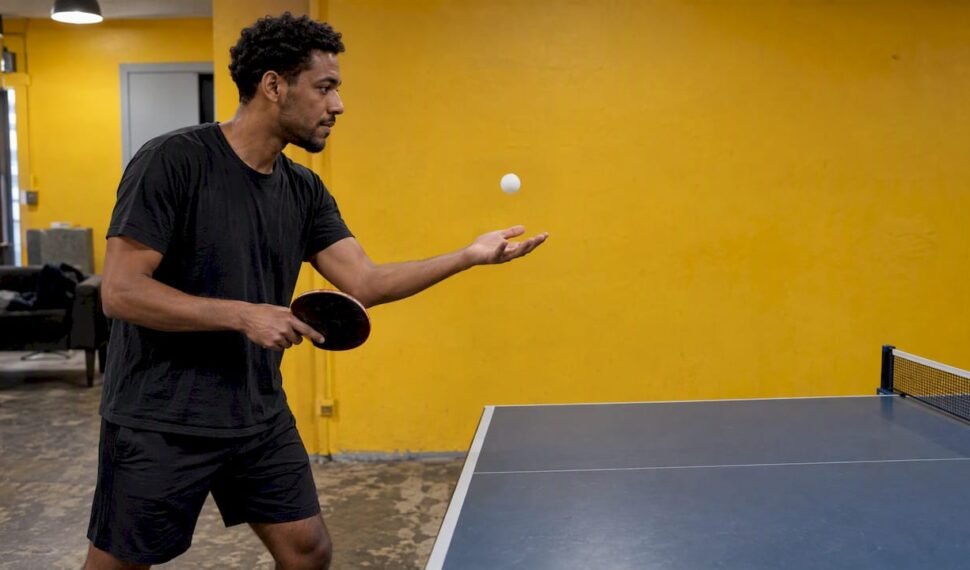
A legal ping pong serve starts with the ball resting on your flat, open palm. You toss it nearly straight up at least 16 cm (about 6 inches) and strike it as it falls. The ball must be behind the end line and above table level when you hit it. It then has to bounce once on your side and once on your opponent’s side. Everything else in the serving rules is detail around those few steps, and this guide walks through each one, plus doubles, service changes, grips and the faults that cost points in friendly games.
TL;DR
- Start with the ball resting on a flat, stationary, open palm. Toss it nearly vertically, at least 16 cm, with no spin.
- Hit the ball on the way down, behind the end line and above the table surface, with the ball visible to your opponent the whole time.
- Singles: the ball bounces on your side first, then anywhere on the receiver’s side. Doubles: right half to right half, diagonally.
- Service changes every two points, and every point once the score reaches 10-10. A game is normally played to 11, win by two.
- Grip (shakehand or penhold) changes how you generate spin, not what makes a serve legal.
Table of Contents
- The legal serve, step by step
- A quick checklist you can run in your head
- Singles and doubles: where the serve has to land
- Who serves first, and when does service change?
- The faults that cost most players points
- Does your grip change the serve?
- Serve types worth learning first
- Perspective: how we teach serving to groups
- Practice routine for a legal, consistent serve
- Play ping pong with us
- FAQ
- Sources
The legal serve, step by step
The official source is the Laws of Table Tennis, reproduced in the 2024 ITTF Statutes. Here is what they ask of you, in the order you do it.
1. Start with an open, flat palm
Service begins with the ball resting freely on the stationary, open palm of your free hand (the hand not holding the paddle). The ball is not pinched between fingers, not held in a cupped hand and not rolled off your fingertips. Your palm should be still before you toss. A moving palm that lifts the ball as it rises is a common reason for a disputed serve.
2. Toss it up, near vertically, with no spin
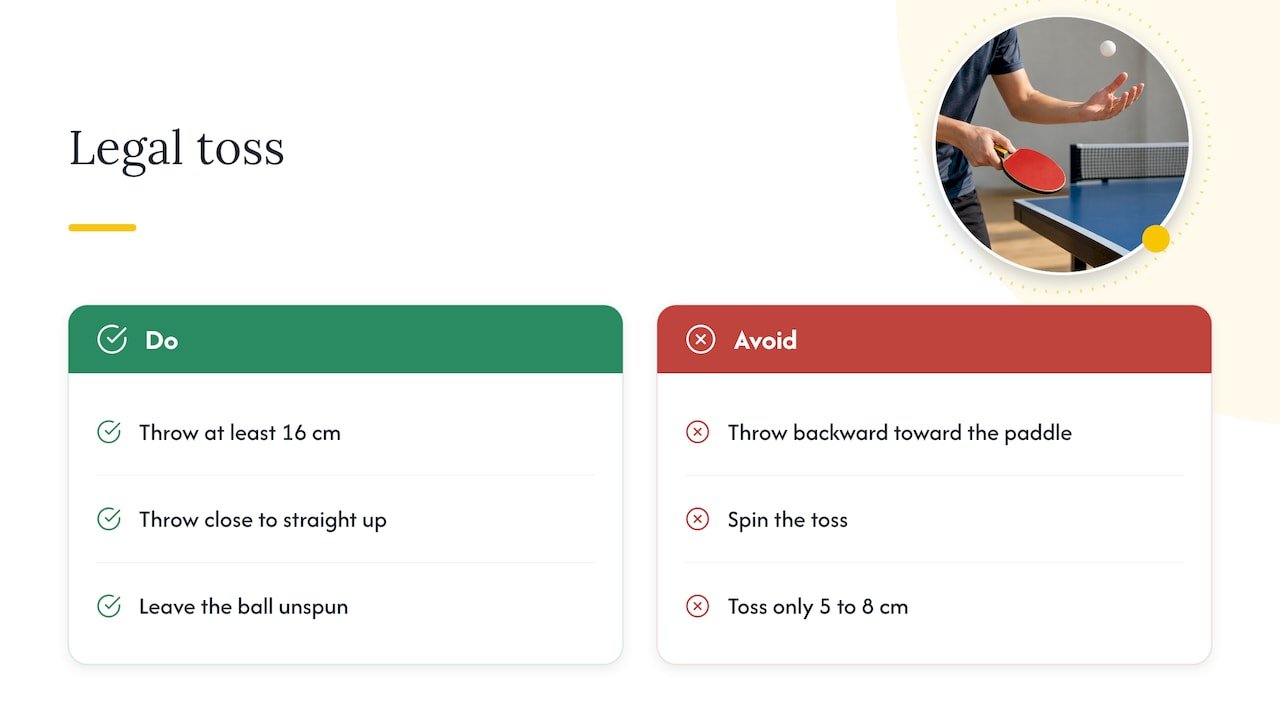
You project the ball upward so that it rises at least 16 cm after leaving your palm. It should go close to straight up, and it should not be spun. The Manitoba Table Tennis Association’s Level 1 umpire seminar spells out what that means in practice: throwing the ball backward toward the paddle is not near-vertical, and spinning the toss is prohibited.
Sixteen centimeters is roughly the height of a standard pen held upright, so a toss that barely leaves the hand fails. Many casual players toss 5 to 8 cm and hit it almost immediately. That is the single most common illegal serve at home tables and office tables.
3. Let it fall, and hit it on the way down
The ball must fall without touching anything on the way down. Your hair, sleeve, paddle or free hand are all things to keep clear of it. You strike the ball as it descends, never on the way up. If you tap it while it is still rising, the serve is illegal even if the toss was high enough.
4. Stay behind the end line and above the table
The Manitoba seminar states that the ball must be above table-surface level and behind the end line (or its imaginary extension) when you strike it. It must stay there from the moment of projection until contact. In practice:
- Stand behind the table’s end, not beside it.
- Keep the ball above the playing surface. Serving from under the table is out.
- Do not drift forward so that the ball is over the table when you hit it.
The ITTF text adds that the ball has to stay visible, so you can not hide it behind your body, arm or head during the action. After you launch the ball, your free arm and hand must also clear the space between the ball and the net.
5. Bounce it once on each side
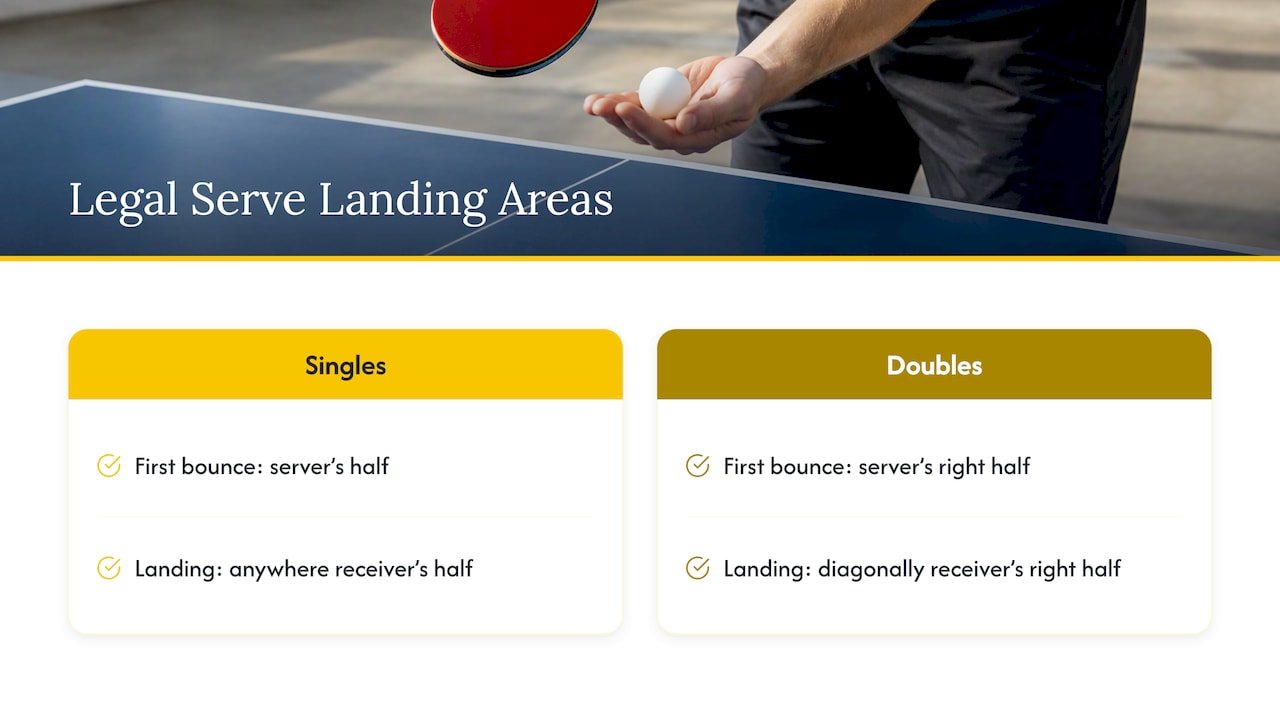
The serve must touch your court first and then the receiver’s court. That means one bounce on your half, the ball crossing the net, and one bounce on theirs. In singles, Table Tennis England’s rules guide explains that the serve may land anywhere on the receiver’s court after bouncing first on your side.
A quick checklist you can run in your head
| Step | Legal | Illegal |
|---|---|---|
| Starting position | Ball on a flat, still, open palm | Ball pinched, palm moving, cupped hand |
| Toss | Near vertical, at least 16 cm, no spin | Sideways or backward throw, spun toss, short toss |
| Contact | On the way down, behind the end line, above table level | While rising, over the table, below the surface |
| Visibility | Ball visible throughout | Hidden by arm, body or head |
| Bounce | Your side, then opponent’s side | Ball touches only one side, or opponent’s side first |
Singles and doubles: where the serve has to land
In singles, the serve can land anywhere on the receiver’s half after it bounces on yours. Doubles is stricter. According to Table Tennis England, the serve must bounce in the server’s right half-court and then land diagonally in the receiver’s right half-court. That means every doubles serve travels corner to corner, and a serve that lands in the wrong half is a fault.
Serving order in doubles follows a fixed rotation. The previous receiver becomes the server after a change of service, and the partner of the original server then receives. If you want the full rotation with worked examples, our guide to table tennis doubles rules covers it. Team sports in general run on rotation logic like this, and even a basketball event in Paris is organized around who plays when and with whom.
Who serves first, and when does service change?
Before the first point, the players decide the opening order by lot, usually a coin toss or hiding the ball in one hand. Under the rules summarized by the Canadian Independent International Schools Athletic Association, the winner of the lot chooses one option (serving, receiving or the end of the table), and the other side gets the remaining choice.
From there:
- Every two points, service passes to the other player or pair.
- At 10-10, service alternates after every single point.
- The game continues until one side leads by two points.
The Kitchener-Waterloo International Table Tennis Club’s rules summary confirms the same pattern: a game is normally won at 11 points with a two-point lead, with service changing every two points, or every point once the score reaches 10-10.
This two-point rhythm surprises people who know tennis or badminton, where the server keeps serving while winning. In table tennis, two serves each is the standard, regardless of who is ahead.
A worked example
Say you serve first. You serve points 1 and 2, your opponent serves points 3 and 4, and you serve points 5 and 6. At 5-5 it is your opponent’s turn to serve, because 10 points have been played (five rotations of two). If the game reaches 10-10, you alternate: you serve, then they serve, then you, until someone is two points clear.
The faults that cost most players points
Most serve faults come from habit rather than cheating. Watch for these in your own game.
- The short toss. A toss of a few centimeters is not enough. Aim well above 16 cm so you are never borderline.
- The hidden ball. Players who lean over the table or tuck the ball against the chest hide it from the receiver. Keep the ball in plain sight.
- The forward serve. Contact inside the end line, with the ball over the table, is illegal.
- The spun toss. Flicking the ball with your fingers to add spin before contact breaks the no-spin requirement.
- The rising hit. Waiting for the ball to fall costs half a second, and that half second is the rule.
- The thrown-back toss. Tossing toward your paddle is not near-vertical, as the Manitoba seminar points out.
In a friendly game, agree on the standard before you start. Many groups play “no hidden serves, ball above the table’s level, one bounce each side” and ignore the finer points. At a league, a tournament or an office competition, the full rules apply, so it pays to learn them once.
Does your grip change the serve?
Readers often ask about grips alongside serving rules, and the answer is simple: the rules do not care how you hold the paddle, only what the ball does. But grip changes what is easy to do.
Shakehand
The Instructor’s Guide to Table Tennis identifies shakehand as the dominant beginner grip and recommends it for students unless they already strongly prefer another. You hold the handle as if shaking hands, extend the index finger along the bottom of the blade, place the thumb on the other side and wrap the remaining fingers around the handle. It gives you both forehand and backhand surfaces with little adjustment, which is helpful for varied serves.
Penhold
Penhold, as the name suggests, holds the paddle somewhat like a pen, with the thumb and index finger pinching the blade near the handle. Players who use it often have a quick, flexible wrist for short, spinning serves on the forehand side. The tradeoff is that the backhand side is harder to learn. If you came to the game through a penhold-using family or club, there is no reason to switch just to serve.
Which should you choose?
For a first-time player, shakehand is the simpler start. Whichever grip you use, keep it loose. Squeezing hard moves control away from your wrist and can cost accuracy, a point the club beginner guides keep repeating. Grip style never affects whether a serve is legal. Your toss, contact point and bounce do.
Serve types worth learning first
Once your basic serve is legal every time, add variety one step at a time.
- The simple no-spin serve. Toss, strike the top-back of the ball with a flat paddle and aim for a bounce near your end line. This is your reliable starter.
- The backspin serve. Brush under the ball with an open paddle face. A short bounce on the opponent’s side makes it hard to attack.
- The sidespin serve. Brush across the side of the ball with a horizontal paddle motion to curve it.
- The long, fast serve. Aim to bounce deep on the opponent’s side, near their end line, for a surprise change of pace.
A good practice rule: mix short and long serves, and place them to the corners, not the middle. Do not use a serve you cannot make legally ten times in a row.
Perspective: how we teach serving to groups
We run a lot of ping pong sessions, from friendly games to birthday parties and team events, and the pattern repeats. Most groups do not argue about forehand technique. They argue about the serve. One person tosses 3 cm, another hides the ball under a sleeve, and the game stalls.
Our advice is to settle three things before the first rally: the toss height, which means “clearly above your palm, not a nudge”; contact behind the end line; and one bounce on each side. Then play to 11 and rotate the serve every two points. That takes two minutes and removes nearly every argument.
For mixed groups, we ask beginners to start with the simple no-spin serve and let the regulars show off spin later. The fun of the game comes from rallies, not from the serve itself. If you want a structured way to improve, our four-week ping pong skills plan fits 15 to 30 minutes a day, and our beginner rules guide covers the rest of a friendly match.
— Archers
Practice routine for a legal, consistent serve
Ten minutes before a match is enough for most players. Try this order.
- Five tosses with no paddle. Lay the ball on your open palm, toss at least 16 cm and catch it. The ball should go almost straight up and land back on your hand.
- Ten serves to a target. Place a small towel or cup on the table and aim for your opponent’s corner.
- Ten serves with a friend watching. Ask them to call anything that looks short, hidden or forward.
- Five short and five long. Alternate between serves that bounce twice near the net and serves that go deep.
If you want to play with others, a regular game night or league format keeps the habit going. For hosts, our tournament format guide lays out how to run 16 players in 2.5 to 3.5 hours, which is a good way to check that everyone shares the same serve rules.
Play ping pong with us
If you would rather practice on a good table than argue over a basement one, you can book a session at our Ontario venue. A single ping pong session is $30. For groups, our event packages start at $299 for Pong & Party On, and the Ultimate Paddle Party starts at $799. For parties and team events, we can help set up the rules and format so everyone plays the same game. If you prefer a quieter setup, you can also look at private pong room booking.
FAQ
How do you serve in ping pong?
Place the ball on your flat, open palm behind the end line, toss it nearly straight up at least 16 cm, and hit it as it falls. The ball needs to bounce on your side first, then on your opponent’s side. Keep it visible throughout.
What is the 16 cm rule in table tennis?
It is the minimum height of the toss in the official Laws of Table Tennis. The ball must rise at least 16 cm from your open palm, near vertically and without spin, before you hit it on the way down.
Do you have to serve diagonally in ping pong?
Only in doubles. In singles, the ball can land anywhere on the receiver’s side after bouncing on yours. In doubles, it must travel from your right half-court to the receiver’s right half-court.
When does the serve change in ping pong?
Service changes after every two points. Once the score reaches 10-10, it changes after every point until one player or pair leads by two. A game is normally played to 11 points.
Is penhold or shakehand better for serving?
Neither is legally better. Shakehand is the usual recommendation for beginners because it gives you both sides of the paddle easily. Penhold can feel quick and flexible for forehand-side serves.
Sources
- ITTF Statutes 2024: The Laws of Table Tennis
- Manitoba Table Tennis Association: Seminar for Umpires, Level 1
- Table Tennis England: Rules and how to play
- Canadian Independent International Schools Athletic Association: Table Tennis rules
- Kitchener-Waterloo International Table Tennis Club: Rules
- Instructor’s Guide to Table Tennis


