

You can run a full axe throwing session tonight with nothing more than a target board, a couple of hatchets, and one of the ten games below. Cricket, Cornhole, Around the World, HORSE (also called BAD AXE), Landmines, Humans vs Zombies, Baseball, Knockout, Bullseye Relay, and Killers cover everything from quiet two-player rounds to full-lane party chaos. Two organizations, the World Axe Throwing League and the International Axe Throwing Federation, set the scoring standards most venues borrow from, even when the game on the lane looks nothing like a sanctioned match.
- Cricket
- Cornhole
- Around the World
- HORSE / BAD AXE
- Landmines
- Humans vs Zombies
- Baseball
- Knockout
- Bullseye Relay
- Killers
Key Takeaways
Choosing the right axe throwing games and following basic fault-line and supervision rules turns a rowdy group activity into a safe, repeatable event people want to book again.
| Point | Details |
|---|---|
| Match games to group size | Cricket and HORSE suit pairs, while Knockout and Bullseye Relay handle eight or more players smoothly. |
| Know the scoring split | WATL uses ascending rings with a clutch shot near 6 points at bullseye, while IATF runs a 5/3/1 structure. |
| Enforce the fault line | Both feet stay behind the roughly 12-foot line until the axe lands, on every single throw. |
| Simplify for casual play | Venues commonly cut ring counts and relax clutch rules so beginners score and rotate faster. |
| Book a supervised venue | Archers Battlefield runs staffed axe throwing sessions with safety briefings built into party and team packages. |
Table of Contents
- The Best Axe Throwing Games and How to Play Them
- WATL vs. IATF: How League Scoring Actually Compares
- Safety and Etiquette Every Lane Should Enforce
- Running Axe Throwing at a Party or Team Event
- What Most Guides Get Wrong About Choosing a Game
- Book a Supervised Axe Throwing Session
- Sources
The Best Axe Throwing Games and How to Play Them
Each game below lists who play, what you need, and how a round ends. Pick two or three per session. Trying to cram all ten into one visit usually means nobody actually masters any of them.
1. Cricket
Cricket borrows its structure from the dartboard version. Players or teams of two must hit target numbers in a set sequence, usually the 6, 9, 15, and bullseye zones, before their opponent does. A hit “closes” that number; hitting a number already closed by both sides scores nothing. First side to close every number, or the side with the most closed numbers when time runs out, wins.
Teams of two to four work best, since it keeps the sequence moving and nobody stands around for five minutes waiting for a turn. Many venues run a simplified version with only three target numbers instead of four, which trims a 20-minute round down to about 12.
Pro Tip: Call out which number you’re aiming for before you throw. It keeps the scorer honest and adds a little trash talk to the lane.
2. Cornhole (axe-throwing style)
This version borrows scoring-by-difference from the bag game. Instead of racing to a set sequence, players tally raw points each round and subtract the lower score from the higher one. Only the net difference carries forward. Play to 21, or set a shorter target like 15 for faster groups.
The pacing advantage is real: since only the round’s winner banks points, there’s less bookkeeping and momentum swings feel bigger, which keeps casual throwers engaged even when they’re behind.
3. Around the World
Players must hit target zones in ascending order, typically working from the outer ring inward toward the bullseye. Miss a zone and you stay on it until you land the hit, while your opponent keeps advancing. First to reach and stick the bullseye wins.
For teams, rotate throwers by zone rather than by turn, so each person owns one or two rings. That keeps weaker throwers from feeling like they’re single handedly costing the group a round.
4. HORSE / BAD AXE
The letter-accumulation format that basketball players will recognize instantly. The first thrower calls a shot (a specific zone, a trick throw, a bounce off a Landmine target if the board has one) and lands it. The next thrower must replicate it exactly or take a letter. Spell HORSE, or BAD AXE for a longer game, and you’re out.
Overtime usually means sudden death: last two throwers alternate calling increasingly difficult shots until one misses. It’s the one game on this list that rewards creativity over consistency, and it’s a strong choice when your group has a wide range of skill levels, since a confident beginner can call an easy shot and stay alive just as long as an expert.
5. Landmines
Venues mark two or three specific numbers on the board as “landmines” before the round starts. Hit a landmine and your entire score for that throw gets zeroed out, or in more aggressive versions, your whole running total resets. It’s a simple twist that adds real tension to a game that would otherwise be pure accuracy scoring.
Landmines works particularly well for parties because it’s easy to explain in one sentence and instantly changes how people throw, since suddenly the safe zones matter as much as the bullseye.
6. Humans vs Zombies
A team game with a horror-movie hook. One team scores positive points as “humans” defending target zones; the other scores by “infecting” zones, flipping them to negative value for the humans. Whichever team controls (or infects) the most zones by the end of the round wins.
This format shines with six or more players split into two squads, since it turns axe throwing into a genuine team sport rather than a string of solo turns.
7. Baseball
Each thrower gets an “inning” of throws, and target zones convert to baseball outcomes: outer ring might be a single, middle rings doubles or triples, bullseye a home run, and a miss counts as an out. Three outs ends the inning. Play nine innings for a full game, or three for a quick round.
The scoring conversion takes a minute to explain but sticks fast, and it gives non-athletic throwers who “get” baseball an easy mental framework for reading the board.
8. Knockout
Line up three or more players in a rotation. Miss a throw two rounds in a row (or fail to beat the previous thrower’s score, depending on the house rule) and you’re eliminated. Last player standing wins. Ties at elimination usually go to a single sudden-death throw.
This is the single best format for large groups, since it lets eight or ten people rotate through one lane without anyone sitting out for long stretches.
9. Bullseye Relay
Split into teams and run a relay: each thrower gets one throw, then passes to the next teammate. First team to land a set number of collective bullseyes, or the team with the most bullseyes when the clock runs out, wins. A stopwatch or phone timer keeps things moving.
Relay format is the fastest way to burn through a big group in a short block of time, and it converts naturally into a tournament bracket if you’re running a corporate event with multiple lanes.
10. Killers
A head-to-head elimination variant closer to a duel than a group game. Two throwers face off, alternating throws, and the first to land a designated “kill shot” (often the bullseye or a specific marked zone) wins the match and stays on to face the next challenger. Losers rotate out.
Killers needs closer staff supervision than the other nine games, since the head-to-head pressure tends to push throwers toward faster, less careful throws. Any venue running this format should have a staff member watching the lane specifically, not just generally supervising the room.
WATL vs. IATF: How League Scoring Actually Compares
The two governing bodies score axe throwing differently enough that it’s worth knowing which one your local league follows before you show up expecting a bullseye to be worth a fixed number.
Under WATL’s official rules, a standard hatchet match runs 10 throws, with point rings that increase toward the center and a bullseye typically worth 6. WATL also uses a clutch/killshot mechanic, small target zones worth 7 or 8 points that a thrower can only attempt on specific throws, usually the last one of a round, which adds strategic risk to an otherwise straightforward final throw.
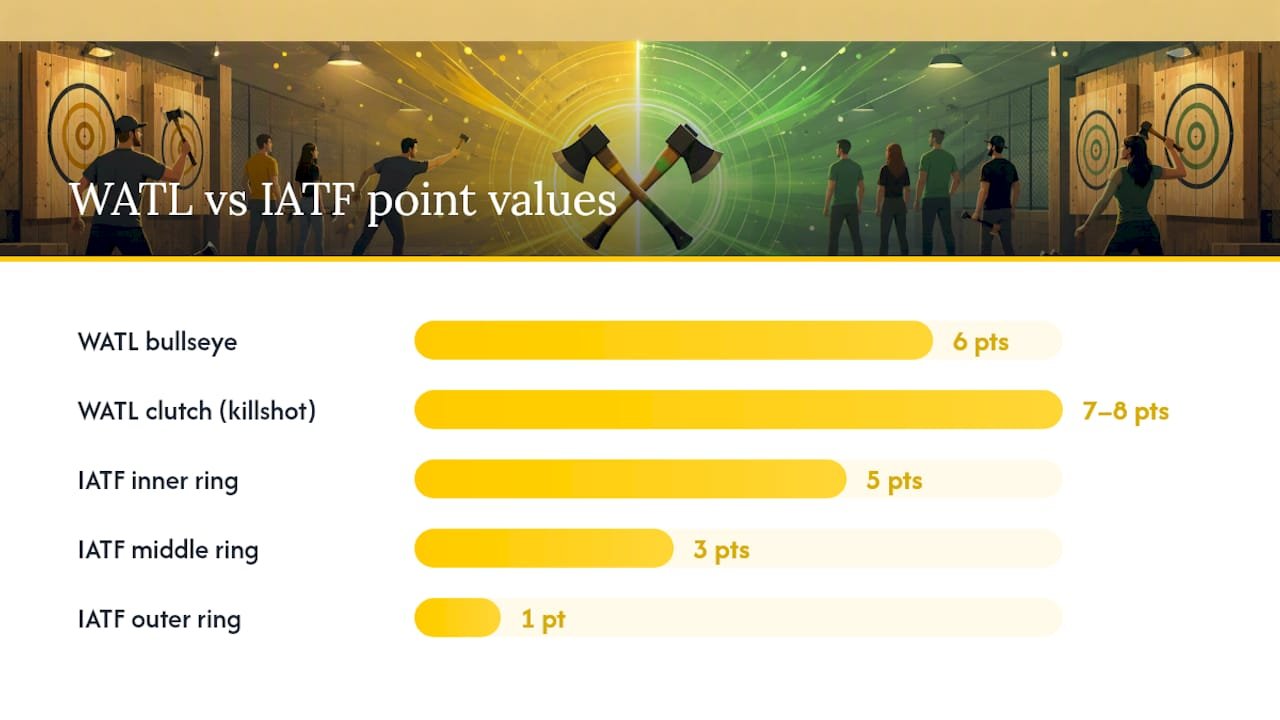
The IATF uses a different points structure entirely, closer to a 5/3/1 breakdown across its rings, along with its own target specs and tournament procedures that don’t map directly onto WATL’s system. Both leagues agree on one thing: an axe that sticks and then falls out counts as a drop, worth zero points, so a solid stick that doesn’t hold isn’t a technicality, it’s a miss.
Match structure tends to follow a similar shape across both leagues:
- A set number of throws per player per round (commonly five per side per round in match play).
- Best-of-format matches, where a thrower needs to win a set number of rounds rather than just accumulate the highest single-round total.
- A tiebreaker throw, usually sudden-death bullseye or clutch attempts, when regulation rounds end level.
Recreational venues rarely run either league’s full rulebook for walk-in groups. The common practice is to simplify scoring, cutting the number of rings, dropping or relaxing the clutch requirement, and rounding point values to make mental math easier after a few drinks. That’s not a lesser version of the sport; it’s a deliberate trade of competitive precision for faster, friendlier rotation.
Safety and Etiquette Every Lane Should Enforce
Every game on this list depends on the same handful of safety habits. Skip them and you’re not running axe throwing, you’re running a liability.
The industry standard fault line sits roughly 12 feet from the target, and the rule is simple: both feet stay behind that line from windup through release until the axe has landed. No leaning, no stepping through to “help” the throw.
Before anyone throws competitively, run a short warm-up round so people can adjust their grip and stance. If an axe drops mid-throw or a stick is disputed, that throw doesn’t count, retake it rather than argue over a borderline call. Closed-toe shoes are non-negotiable, and the lane floor should be dry and clear of anything a thrower could slip on mid-swing.
A quick checklist worth reading aloud before the first throw:
- Both feet behind the fault line until the axe lands, every throw.
- One thrower per lane at a time. No retrieving axes while anyone else is winding up.
- Report any crack, chip, or loose handle to staff immediately. Don’t throw a damaged axe.
- Know where the nearest staff member is if something goes wrong.
Running Axe Throwing at a Party or Team Event
Plan for roughly four to six guests per lane so nobody waits more than a few minutes between throws. A 90-minute booking typically breaks down into a 10-minute safety briefing, three 15-to-20-minute play blocks rotating between games, and short breathers in between to reset scorecards and swap lanes. Venues that stagger groups this way can comfortably run 24 to 36 guests across six lanes in that same window.
Before booking anywhere, ask directly about supervision ratio, insurance coverage, accessibility, and cancellation policy. A venue that hesitates on any of those four questions is telling you something.
Archers Battlefield runs supervised axe throwing alongside team-building packages, adult birthday events, and combat-style group activities, with staff briefings and safety supervision built into every session rather than bolted on as an afterthought.
Pro Tip: If you’re organizing for a corporate group, ask the venue whether they’ll run a bracket-style tournament across multiple games. It turns a one-hour booking into a story people tell at the next team meeting.
What Most Guides Get Wrong About Choosing a Game
Most lists rank axe throwing games by novelty, Landmines over Cricket because it sounds more exciting on paper. That’s backward. The games that actually work for a group are the ones that match your headcount and your patience for explaining rules twice. A five-person office outing doesn’t need Bullseye Relay’s timer pressure; it needs Knockout, because nobody sits out and nobody needs a rulebook.
The other blind spot: people treat WATL and IATF scoring as something only competitive throwers need to understand. In practice, knowing the difference helps you spot when a venue has quietly simplified its rules for good reason, faster rotation, easier scoring for beginners, not because they’re cutting corners on the experience.
If there’s one thing worth prioritizing above game selection, it’s supervision quality. A great game run by a distracted staff member is worse than a mediocre game run tight. Ask about ratios before you ask about the bullseye value.
— Archers
Book a Supervised Axe Throwing Session
Reading the rules is one thing. Standing at the fault line with a hatchet in your hand, in a lane run by someone who actually watches every throw, is another. Archers Battlefield gives you that hosted option without the DIY hassle of building your own scoreboard, sourcing your own gear, or hoping a friend remembers how clutch scoring works.

Sessions come staffed with safety briefings built into every booking, whether you’re bringing a family group for a birthday, a full office for team building, or a handful of friends looking to run through Cricket, Knockout, and Killers back to back. Lanes rotate on a set schedule so nobody stands around waiting, and the games above are exactly what you’ll be playing once you’re briefed and behind the line.
Check available dates and reserve your lanes through the axe throwing booking page to lock in a time slot before your preferred weekend fills up.
Sources
- Official Rules – World Axe Throwing League
- IATF gameplay rules
- Axe Throwing Rules and Scoring: Complete WATL and IATF Guide (2026) | AxeThrowingPlaces
- How to score axe throwing? – Houston Axe Mag


