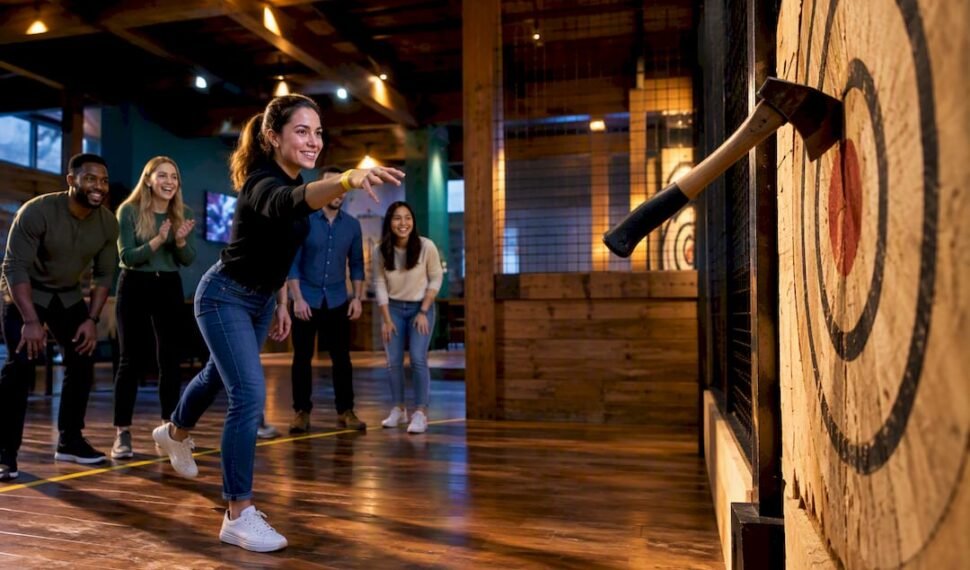
Axe throwing works as corporate team building for most Ontario groups, provided everyone can safely handle a light throwing motion and the team is open to a bit of friendly competition. It suits sizes from a small department to a full company outing, split into rotations. Some venues run corporate packages and handle the planning end. If that fits, move to the checklist below; if you’re weighing options for a mixed or low-mobility group, jump to the alternatives section.
TL;DR:
- Most groups should plan for multiple rotations with moderate group sizes to ensure safety and engagement during axe throwing events.
- Booking should be done two to three weeks in advance, especially during peak months like December and June, with clear communication about inclusivity and accessibility.
- Proper safety protocols require trained staff, documented first-aid plans, equipment maintenance, and pre-approved participant medical restrictions.
- Alternative activities such as Nerf battles or arcade games should be offered for participants who prefer lower-impact options or cannot throw.
- Keeping debriefs short and incentivizing participation with small prizes enhances post-event bonding and communication.
Table of Contents
- Why Does Axe Throwing Improve Team Bonding?
- How Do You Plan an Axe Throwing Event for Your Team?
- What Happens During a Session at Archers Battlefield?
- What Does a Sample Team Building Agenda Look Like?
- What Should You Confirm Before Booking in Ontario?
- What Safety Steps Should Employers Confirm?
- What Are Good Alternatives to Axe Throwing?
- A Few Things We’ve Learned From Running These Events
- Ready to Book Your Team’s Axe Throwing Event?
- Sources
- FAQ
Why Does Axe Throwing Improve Team Bonding?
The case for axe throwing isn’t just anecdotal. Gallup’s research on employee engagement finds that shared off-site activities build trust and collaboration in ways that desk-bound meetings rarely do, largely because people see coworkers succeed, fail, and laugh at themselves outside their usual roles. A junior analyst who lands three bullseyes in a row earns a different kind of respect than a spreadsheet ever buys.
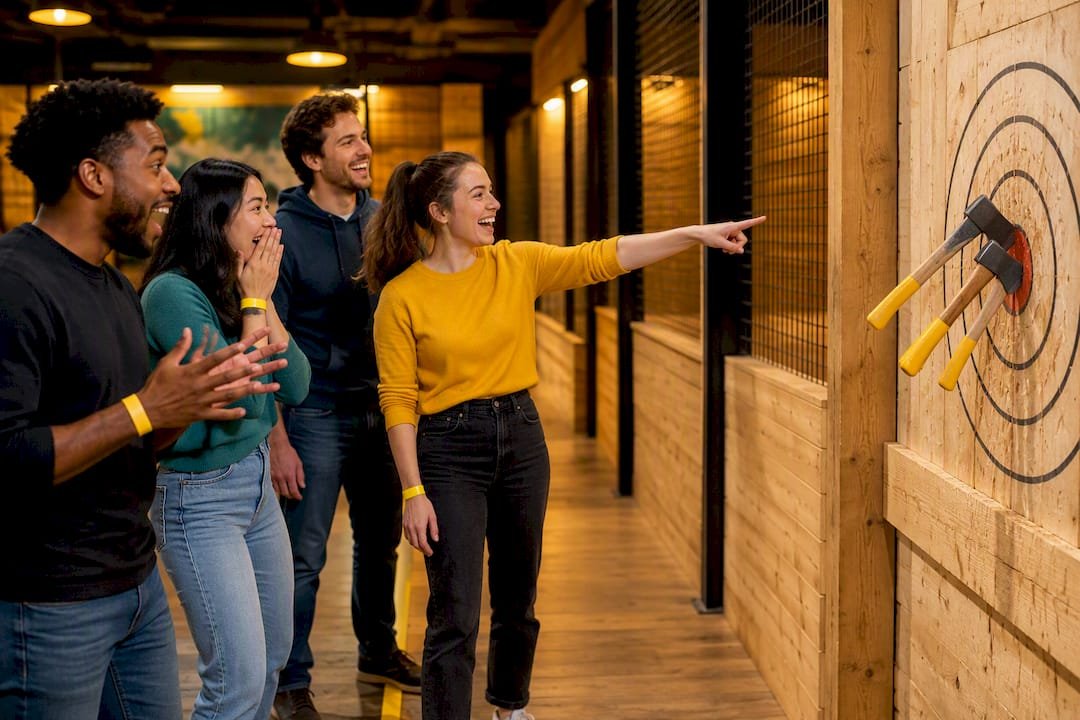
Part of the reason this works is structural. Axe throwing is hands-on and mildly competitive, but nobody’s job performance is on the line, so people relax faster than they would in a brainstorming session. That lowered guard is exactly when real conversation happens between throws.
What organizers can reasonably promise stakeholders:
- Faster rapport between departments that rarely interact day to day
- A shared story employees reference for months (the office does not forget who won)
- A low-stakes setting where quieter team members often step up unexpectedly
Quick stat: Bryant University’s research on short team-building formats notes that even brief, structured moments, five minutes or less, strengthen communication and trust when repeated consistently. An axe-throwing afternoon gives you dozens of those five-minute moments strung together.
How Do You Plan an Axe Throwing Event for Your Team?
Start with the numbers, then work outward. Here’s the order that keeps planning simple:
- Lock the group size. Most lanes run best with a moderate number of throwers per rotation; larger teams split into groups that rotate through lanes while others watch, cheer, or try a second activity.
- Set the budget conversation early. Ask what the quoted fee actually includes: facilitator time, lane time, all safety gear, and whether food is bundled or separate.
- Book with lead time. Ontario corporate groups should reserve well in advance, especially during busy holiday seasons like December and June when parties and year-end outings crowd the calendar.
- Flag accessibility and medical needs. Confirm with the venue how they accommodate participants with mobility limitations, shoulder or wrist injuries, or pregnancy, well before the event date.
- Set dress expectations. Closed-toe shoes, no loose sleeves, hair tied back. Send this in the calendar invite, not as a surprise at the door.
Pro Tip: Ask the venue directly how they split a 40-person group across lanes. If they can’t answer that in one sentence, they haven’t run a corporate group your size before.
What Happens During a Session at Archers Battlefield?
Every session follows a rhythm designed to keep first-timers comfortable and confident. Groups check in, get sorted into lanes, and sit through a safety briefing before anyone picks up an axe. A facilitator demonstrates proper stance and throw mechanics, then coaches each lane through warm-up throws before scoring rounds begin.
Staff roles are split deliberately:
- A facilitator runs the coaching, demonstrates technique, and keeps rounds moving
- A safety lead watches lane discipline and gear condition throughout the session
- An on-site coordinator manages timing, scoring, and transitions between activities
Archers Battlefield builds its team-building packages around this structure, with staff supporting everything from check-in to the final scoreboard. [Team qualification details and safety certification documentation available on request.] The wrap-up typically includes final scores, a quick group photo, and a natural pause point for a debrief if your agenda calls for one.
What Does a Sample Team Building Agenda Look Like?
A session of about one and a half to two hours works well for a single-department outing:
- Warm-up (15 minutes): Safety briefing plus a light icebreaker while lanes fill.
- Team rounds (60 minutes): Rotating lane play with running scores.
- Finale (15 minutes): Bracket-style knockout or a team relay for the competitive close.
- Debrief (10 minutes): A short facilitated conversation tying the activity back to how the team collaborated.
For a full afternoon with food, stretch that structure across three hours, adding a catered lunch between rounds and a longer group discussion at the end. Larger or mixed-energy groups often run axe throwing alongside Nerf battles, ping pong, or arcade games in rotation, which keeps everyone active even when a lane is full. Asana’s team-building research points out that combining activities by simplicity and fit works better than forcing one format on an entire group, especially when goals differ between departments hunting for competition and ones just looking for a relaxed social afternoon.
What Should You Confirm Before Booking in Ontario?
A few logistics questions save headaches later:
- Lead time: Book two to three weeks ahead; summer and the November to December stretch fill up fastest.
- Deposits: Expect a deposit to hold your date, with cancellation terms that tighten closer to the event.
- Food and drink: Ask whether outside catering is allowed and whether alcohol is permitted on-site, since policies vary by venue and time slot.
- Arrival logistics: Confirm parking availability and transit access for staff commuting from different parts of the Greater Toronto Area.
Reserve directly through Archers Battlefield’s booking page once your headcount and date are set.
What Safety Steps Should Employers Confirm?
This isn’t legal advice, but it is a reasonable checklist. Before booking, confirm the venue has trained facilitators on every lane, a documented first-aid plan, and regular equipment maintenance on the axes and target boards. Ask directly about insurance coverage for corporate bookings rather than assuming it’s standard.
On your end as the organizer:
- Request the venue’s waiver template ahead of time so HR can review it
- Collect any relevant medical restrictions from participants before the event, not at the door
- Plan a lower-impact alternative activity for anyone who opts out of throwing
Pro Tip: Send the waiver link in the same email as the calendar invite. Waivers signed the morning of the event slow down check-in for the entire group.
What Are Good Alternatives to Axe Throwing?
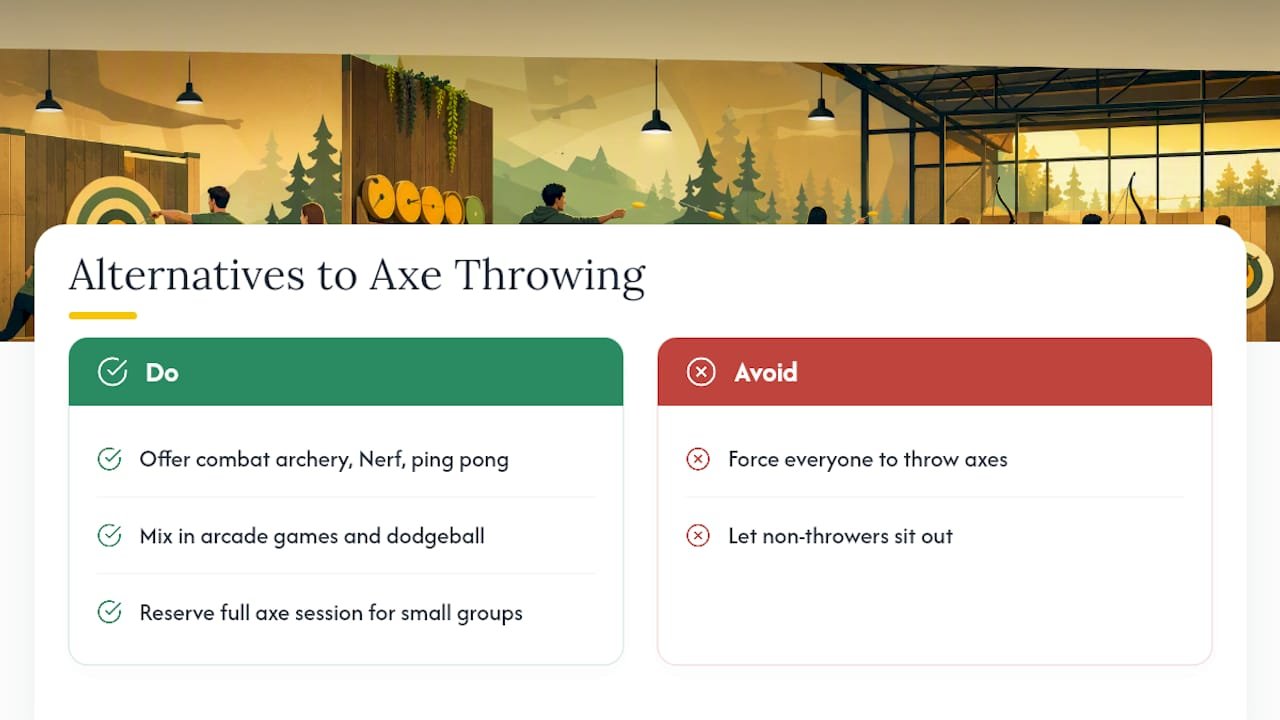
Not every attendee wants to throw a blade at a target, and that’s fine. Some venues offer activities such as combat archery, Nerf battles, ping pong, arcade games, and dodgeball, all easy to slot in as a lower-impact option or a full rotation partner. BetterUp’s research on team-building design recommends building in adaptable, low-pressure choices exactly for this reason. Reserve a full session for axe throwing when the group is small and competitive; mix in alternatives for larger or more varied teams so nobody sits out.
A Few Things We’ve Learned From Running These Events
Small moves change how an event lands. Keep debriefs brief, three or four minutes, not a lecture. Small prizes, even something as minor as a gift card, motivate more than trophies. Mixing people from different departments into the same lane, rather than letting cliques self-sort, produces the best conversations we see. And scoring that rewards consistency over raw power keeps competitive types in check without dulling the fun.
— Archers
Ready to Book Your Team’s Axe Throwing Event?
Archers Battlefield builds customizable team-building packages around your headcount and goals, with event-planning support handling the logistics HR usually dreads. The Collab Package starts from $699, the Ultimate Paddle Package from $799, and the Momentum Package from $2,395, all listed on the event packages page.
Next steps are simple: review the package options, request a quote for your headcount, confirm safety documentation with the venue, and lock your date through Book Now. If you’re still gathering icebreaker ideas for the agenda, this party games roundup is worth a scan before you finalize your run sheet.
Sources
- 30 Five-Minute Team-Building Activities | Bryant University
- 45 Team building games to bring teams together at work | Asana
- Team-building exercises | BetterUp
FAQ
How Many People Can Do Axe Throwing Together?
Lanes typically run best with a moderate number of throwers per rotation, and larger corporate groups simply split into multiple rotating groups. Ask the venue how they structure rotations for your exact headcount before booking.
What Should Employees Wear to Axe Throwing?
Closed-toe shoes and fitted clothing without loose sleeves are standard requirements. Send this detail in the calendar invite so nobody shows up unprepared.
How Much Does a Corporate Axe Throwing Event Cost?
Pricing depends on the package and group size. Archers Battlefield’s team-building packages start from $699 for the Collab Package, with current pricing for all options listed on the event packages page.
Is Axe Throwing Safe for Beginners?
Yes, with a proper safety briefing and facilitator coaching before any scored throws begin. Confirm the venue trains every participant on stance and technique and maintains its equipment regularly.
Can We Combine Axe Throwing With Other Activities?
Yes, pairing axe throwing with Nerf battles, ping pong, or arcade games in rotation keeps mixed-energy groups engaged. This approach works especially well for larger teams or groups with varying interest in competitive activities.


