

In doubles, three rules separate it from singles: the serve must go diagonally, from the server’s right half-court to the receiver’s right half-court, partners must strike the ball in strict alternation, and service rotates among all four players in a fixed cycle. Games run to 11 points, and you need a two-point lead to close one out. These rules come straight from the International Table Tennis Federation, the governing body behind the Laws of Table Tennis, and they apply whether you’re at a club tournament or a Friday night session at Archersbattlefield.
Here’s the shorthand version to memorize before you walk up to the table:
- Serve diagonally: right half-court to right half-court, every time.
- Alternate hits: server, then receiver, then server’s partner, then receiver’s partner.
- Rotate service: all four players take turns serving in a set order, two points at a time.
- Score to 11: win by two, switch ends between games.
TL;DR:
- Players must serve diagonally from the right half-court to the opponent’s right half-court, with the serve landing within the diagonal box and crossing the net accurately.
- The hitting order in doubles is fixed: server, receiver, server’s partner, receiver’s partner, and violating this order results in an immediate loss of point.
- Service rotates among all four players every two points, with a complete cycle covering eight points, and at deuce, service alternates every single point without changing the sequence.
- Scoring follows standard rules: games go to 11 points, and a two-point lead is necessary to win, with teams switching ends after each game and at 5 points in the final game.
- Common faults include illegal serve toss, partner interference, and out-of-turn hits, while lets occur when the serve clips the net and lands in the correct diagonal area.
Table of Contents
- Table Tennis Doubles Rules for Serving: Diagonal Placement and the Center Line
- Order of Play: Why Alternating Hits Is Non-Negotiable
- Service Rotation in Doubles: Tracking the Four-Player Cycle
- Scoring and Match Length in Doubles
- Faults, Lets, and the Infractions That Trip Up Doubles Teams
- Doubles Strategy: Positioning, Footwork, and Rotation Cues That Actually Work
- How Archersbattlefield Runs Doubles Sessions
- What Happens When Service Order Goes Wrong
- Doubles-Specific Faults: Blocking the Serve and Partner Interference
- When a Serve Clip Counts as a Let, Not a Fault
- Doubles Etiquette: Communication Without Breaking the Rules
- Our Take: What Actually Matters in Doubles
- Key Takeaways
- Sources
Table Tennis Doubles Rules for Serving: Diagonal Placement and the Center Line
The mechanics of a legal serve don’t change just because you’ve got a partner. The ball has to rest on an open palm, get tossed near vertically at least 16 centimeters, and stay visible to both the receiver and the umpire the entire time, per ITTF service law. Hide the toss behind your body or shortchange the height, and it’s a fault regardless of whether you’re playing singles or doubles.
What doubles adds is the diagonal requirement. The serve must land in the server’s right half-court, cross the net, and land in the receiver’s right half-court. Picture two players, A1 and A2, versus B1 and B2. If A1 is serving, the ball has to leave A1’s right side of the table and land on B1’s right side, the diagonal path only, never straight across.
The center line matters more here than in singles because it’s what defines “right half.” That line is 3 millimeters wide, and legally it counts as part of the right half-court on both sides of the net, according to the ITTF Statutes. So if your serve clips that line and stays in bounds, it’s a legal serve, not a fault.
A few things to lock in before you serve:
- Stand so your body doesn’t block the receiver’s view of the toss.
- Aim for the far right corner of the diagonal box, giving yourself margin instead of clipping the line by accident.
- Watch your partner’s position, standing too close to the table can obstruct the receiver’s sightline and draw a let or a fault call.
Pro Tip: Practice serving to a target zone about a paddle’s width inside the diagonal corner. It builds enough margin that borderline calls almost never go against you.
Order of Play: Why Alternating Hits Is Non-Negotiable
The hitting sequence in doubles follows a fixed loop: server hits, receiver hits back, then the server’s partner takes the next shot, followed by the receiver’s partner, and the cycle repeats for the entire rally. This isn’t a suggestion, it’s written into ITTF Law 2.08.3, and violating it costs you the point immediately.
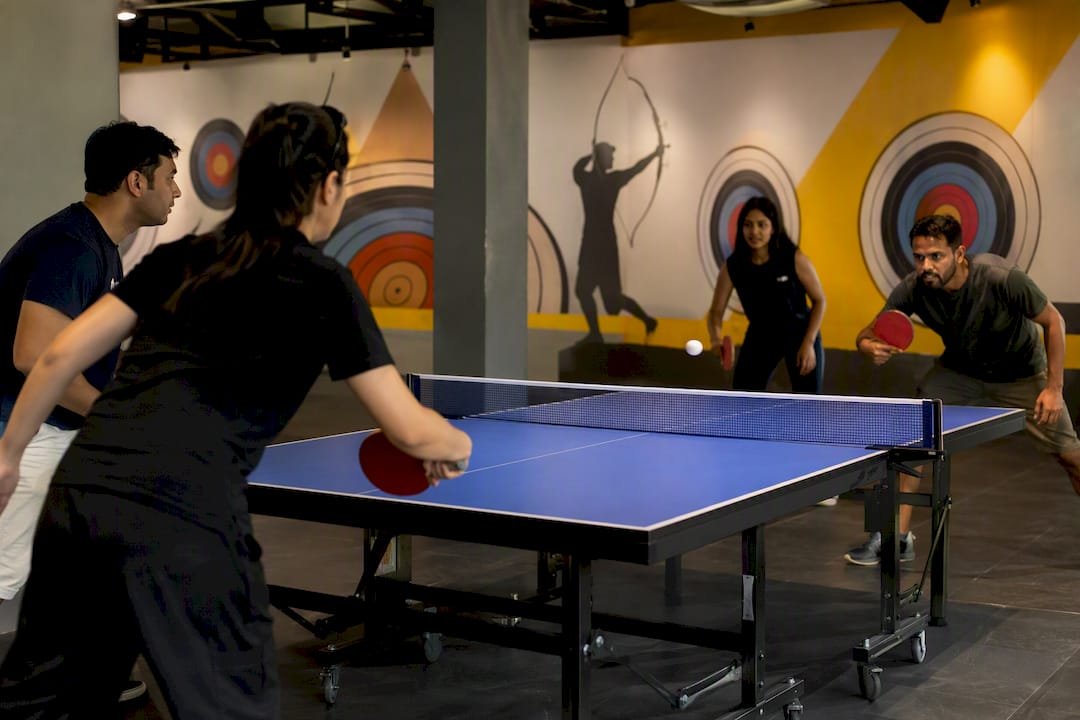
Recreational players trip on this constantly, usually because instinct says “hit the ball that’s coming toward you,” not “wait your turn.” If your partner is closer to an easy shot, you still can’t poach it. The moment someone hits out of sequence, the rally is dead and the point goes to the opposing team.
Why does this rule exist at all? It forces genuine teamwork instead of letting one strong player dominate the table, and it’s the reason doubles strategy revolves so heavily around court positioning and clearing out after your shot.
A few practical notes on how this plays out:
- Umpires catch order violations immediately in most matches; there’s no ambiguity once it happens.
- In casual games without a referee, both teams need to self-police, so calling it out early avoids arguments later.
- There’s a specific carve-out for wheelchair pairs: once at least one player in the pair uses a wheelchair, either partner may return the ball after the first two strokes, without forced alternation between them, as outlined in the official Laws of Table Tennis.
Service Rotation in Doubles: Tracking the Four-Player Cycle
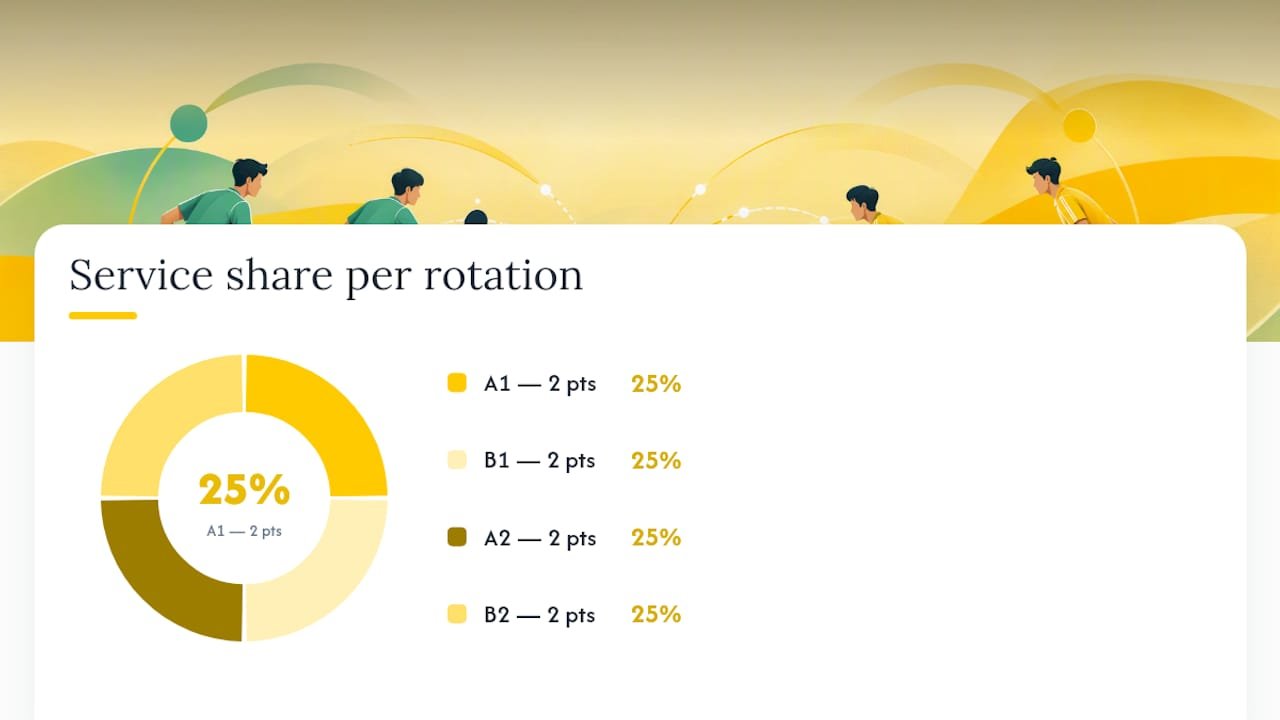
Service in doubles moves through all four players in a fixed order, and each player serves two consecutive points before the ball passes to the next server. One complete rotation covers eight points total, cycling through every player exactly once, based on ITTF Law 2.13.6.
Here’s how to map it. Say Team A has players A1 and A2, and Team B has B1 and B2. A common rotation runs like this:
- A1 serves to B1 for two points.
- B1 serves to A2 for two points.
- A2 serves to B2 for two points.
- B2 serves to A1 for two points, completing the cycle.
That’s eight points, four servers, no repeats until the loop starts over.
At 10-10 (deuce), the two-point block disappears. Service alternates every single point instead, but the rotation order itself doesn’t change, whoever’s turn was next in the cycle still serves, just for one point instead of two. This detail trips up more recreational players than any other doubles rule, because they assume deuce resets the whole order. It doesn’t. It just shortens the serving turns.
Receiving order carries over from game to game too. Whichever pair received first in game one typically flips the pattern in game two, keeping rotation fair across a match.
Scoring and Match Length in Doubles
Scoring in doubles matches singles scoring exactly: games go to 11 points, and you need a two-point cushion to win at deuce, per the official ITTF-based Laws. A score of 11-9 ends the game; 11-10 does not.
Match formats vary by setting:
- Best-of-5 games: standard for most club and recreational play, first to win 3 games takes the match.
- Best-of-7 games: common in higher-level tournament play, first to 4 wins.
- Teams switch ends of the table after every complete game.
- In the deciding game of a match, teams also switch ends once either side reaches 5 points, keeping conditions fair if one end has better lighting or background.
For casual games without an umpire, appoint one person to track score and rotation out loud after every point. It sounds excessive until you’re three rotations deep and nobody remembers whose serve it is.
Faults, Lets, and the Infractions That Trip Up Doubles Teams
A let means the point gets replayed with no score change, most commonly when a serve clips the net but still lands correctly in the diagonal box. It’s not a fault, it’s a do-over.
Actual faults end the point outright. The most common ones in doubles play:
- Hidden serve: the tossing arm, torso, or head blocks the receiver’s view of the ball during the toss or contact.
- Insufficient toss: the ball rises less than 16 centimeters before being struck.
- Wrong diagonal: the serve lands in the receiver’s left half-court instead of the right.
- Touching the table: any part of your free hand touching the playing surface during a rally.
- Out-of-turn hitting: someone strikes the ball outside the required alternation order, awarding the point to the opposing team instantly.
If an order violation isn’t caught until several points later, the umpire stops play, corrects the server and receiver to the proper sequence at the current score, and the match continues, but every point already scored stays on the board, according to Topspin11’s breakdown of doubles rules. Nothing gets erased. That single detail resolves most disputes in recreational matches faster than any rulebook citation.
Doubles Strategy: Positioning, Footwork, and Rotation Cues That Actually Work
Doubles rewards teamwork over raw power, mostly because forced alternation means you can’t just camp in the best spot at the table. After you hit, clear out immediately so your partner has a clean path to the ball, this single habit prevents more collisions than any footwork drill.
A few positioning basics that hold up across skill levels:
- The server should stand slightly off-center after serving, opening a lane for the partner’s next shot.
- The non-serving partner should stay a half-step back and to the side, ready to rotate into position rather than standing directly behind the server.
- Use a simple verbal or hand signal before the serve if you and your partner favor different return angles, cutting down on tangled feet.
For tracking whose turn it is to serve, use this cue: the previous receiver becomes the next server. It’s a shortcut that keeps casual games moving without a referee checking every rotation.
Pro Tip: The single most common beginner mistake is staying planted after your shot instead of stepping back and clearing the lane. Fix that one habit and your rotation gets dramatically smoother.
How Archersbattlefield Runs Doubles Sessions
Archersbattlefield hosts recreational pong sessions where these exact rules get applied in real matches, not just explained on paper. Groups booking a private pong room get a dedicated space to practice rotation and diagonal serving without worrying about other players crowding the table.
Staff on-site help facilitate doubles formats for parties, corporate outings, and casual meetups, walking newer players through the rotation cycle before the first serve. Booking pages and customer feedback on the site reflect groups who’ve used these sessions for birthday parties, team-building events, and pickup games alike.
A few ways to book:
- Reserve a standard session through pong booking.
- Book a themed or private event through X Pong booking.
- Combine doubles play with other activities through event packages for adult birthdays and group celebrations.
What Happens When Service Order Goes Wrong
Service order violations get treated differently depending on when they’re caught. If the umpire or opposing team notices immediately, that’s an automatic fault, the serve doesn’t count, and if it happened mid-rally, the point goes to the team that got shortchanged by the wrong sequence.
The trickier scenario is a violation nobody catches for several points. Say Team A serves out of the correct rotation order for three straight points before anyone notices. Under Topspin11’s explanation of the doubles laws, play stops the moment the error surfaces. The umpire (or the players themselves in a casual match) corrects the server and receiver to their proper positions based on the current score, then play resumes normally. Every point scored during the error stands. Nothing gets replayed or subtracted.
This matters because a lot of recreational players assume a caught error means starting the game over or forfeiting points. It doesn’t work that way. The rule exists specifically to avoid turning a simple mixup into a drawn-out argument about what the score “should” be.
The practical lesson: assign someone to track rotation out loud, especially in matches without a dedicated umpire. A quick “A2 serves next” announcement after every server change costs nothing and prevents the entire multi-point correction scenario from happening in the first place. Teams that skip this step are the ones most likely to end up in a heated rules debate three games into a casual tournament.
Doubles-Specific Faults: Blocking the Serve and Partner Interference
Beyond the standard singles faults, doubles introduces a category of infractions tied directly to having a partner sharing your side of the table. The most common one: a partner’s body, paddle, or shadow blocking the receiver’s clear view of the serve.

Because the server’s partner typically stands just off to the side during the serve, it’s easy for that player to drift into the receiver’s sightline without realizing it. If the receiver can’t see the ball leave the server’s hand and get struck, that’s a fault against the serving team, even though the server themselves did nothing wrong mechanically.
Paddle interference works similarly. If a non-striking partner’s paddle enters the space above the table during a live rally, whether swinging in anticipation or simply positioned poorly, and it touches the ball or obstructs the opponent’s shot, that’s a fault too. The rule exists because doubles puts four people and four paddles in a tight space, and accidental contact happens more often than most new players expect.
The fix is almost entirely about positioning discipline. Server’s partners should stand a full step back and to the side, never leaning into the serving lane. Receiving partners should hold their paddle low and out of the net’s airspace until it’s actually their turn to hit. It’s a small habit, but it’s the difference between smooth rallies and constant fault calls in a casual doubles match.
When a Serve Clip Counts as a Let, Not a Fault
The most common let scenario in any match, singles or doubles, happens when a serve clips the top of the net but still lands within the correct diagonal box on the receiver’s side. That’s a let. The point gets replayed with no score change, and the same player serves again.
Doubles doesn’t change this core definition, but it does add a layer of complexity because of the diagonal requirement. If a serve clips the net and lands in the receiver’s right half-court, it’s a legal let and gets replayed. If that same net-clipped serve lands in the wrong half, the left side instead of the right, it’s not a let anymore. It’s a fault, because the diagonal placement rule still applies regardless of what the ball touched on its way over.
Another doubles-specific let scenario involves obstruction. If the receiver’s partner is standing in a spot where the served ball would have legally landed but gets deflected or blocked before it can complete its path, and that partner didn’t touch the ball intentionally, umpires may call a let rather than award a fault, depending on the circumstances. This is judgment-call territory more than a hard rule, which is exactly why positioning discipline among partners matters so much during service.
The practical takeaway: a let in doubles isn’t just about net contact. It’s about net contact combined with legal diagonal landing, two conditions that both have to be true.
Doubles Etiquette: Communication Without Breaking the Rules
Doubles rewards teams that communicate well, but there’s a fine line between helpful signals and behavior that crosses into coaching or obstruction during live play. Most club-level etiquette norms aren’t written into the ITTF law book directly, they’ve developed as unspoken standards among players who’ve learned what keeps matches fair and fast-moving.
Quick verbal calls like “mine” or “yours” before a shot are standard and expected, especially when a ball lands near the center line and either partner could reasonably take it. What’s frowned upon is extended conversation about strategy mid-rally or coaching-style instructions shouted across the table while the ball is live.
Between points, brief tactical check-ins are normal and even encouraged. Good doubles teams use the few seconds between rallies to confirm rotation order, flag whether the next serve needs extra spin, or simply reset focus after a lost point. This is also the moment to resolve any confusion about whose turn it is to serve, rather than debating it mid-rally.
One habit separates smooth doubles teams from chaotic ones: acknowledging your partner’s shot with a quick nod or word, win or lose, rather than reacting visibly to their errors. Matches move faster and stay friendlier when both players treat every point as shared, not something to silently blame a partner for.
Our Take: What Actually Matters in Doubles
Most explainers treat doubles rules as a list of restrictions bolted onto singles. That framing misses the point entirely. The alternation requirement isn’t a limitation, it’s the mechanic that makes doubles a genuinely different sport, one where positioning and anticipation matter more than raw shot power.
Where conventional advice falls short is treating rotation as something to memorize once and forget. It isn’t. The players who track rotation instinctively, without stopping to calculate whose serve it is, are the ones who keep rallies fast and avoid the awkward pauses that kill momentum in recreational matches.
If you take one thing from this explainer, prioritize the clearing-the-table habit over anything else. Nail that, and the diagonal serve and rotation rules become almost automatic because you’re never scrambling for position. Rules knowledge matters, but footwork discipline is what actually wins points, and it’s the part most guides skip entirely.
— Archers
Key Takeaways
Doubles hinges on three enforced mechanics, diagonal serving, strict shot alternation, and four-player rotation, layered onto standard scoring to 11 points with a two-point win margin.
| Point | Details |
|---|---|
| Diagonal serve rule | Serve must travel from server’s right half-court to receiver’s right half-court every time. |
| Strict alternation | Hitting order runs server, receiver, server’s partner, receiver’s partner, with no exceptions except wheelchair pairs. |
| Four-player rotation | Each server serves two points before rotation passes to the next player, covering eight points per full cycle. |
| Deuce changes serve, not order | At 10-10, service alternates every point, but the underlying rotation sequence stays the same. |
| Errors don’t erase points | Umpires correct out-of-order service mid-match, but every point scored before discovery stands. |
Ready to put these rules into practice? Book a pong session at Archersbattlefield and run through diagonal serves and rotation cycles with real opponents instead of just reading about them.
Sources
- International Table Tennis Federation (ITTF)
- Laws of Table Tennis 2026–27 (Table Tennis England / Official Laws PDF)
- Topspin11 — Table Tennis Doubles Rules: Serving, Rotation, and Strategy


