
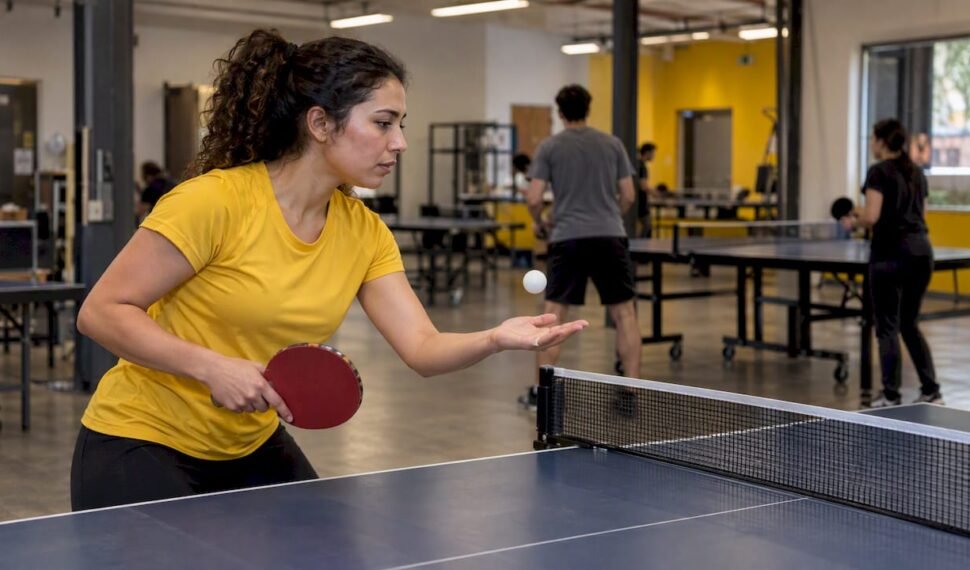
A game of ping pong is won by the first player to reach 11 points with a lead of at least two, and the rule beginners trip up on most is the serve: the ball must be tossed nearly vertically at a regulation height from an open palm and stay visible to your opponent the whole time. Get the toss and the scoring straight, and you can start playing with confidence.
TL;DR:
- At a 10 to 10 tie, serve changes after every point rather than every two, and this rotation applies in both singles and doubles.
- A faulty serve gives the receiver the point because there is no second attempt, while a net serve that lands correctly is replayed.
- Rally returns must follow a bounce on your side; volleys, double hits, or touching the table with your free hand lose the point.
- In doubles, the serve must land diagonally in the receiver’s right service area, and partners must alternate every shot rather than hit twice in succession.
- Casual play rarely requires equipment checks, but clubs and tournaments enforce table specifications and different colored paddle rubbers, usually red and black.
Table of Contents
- Fundamental rules: scoring, match formats, and point awards
- Serving rules in detail: how to make a legal serve
- Returning, rallies, and common fouls to avoid
- Singles vs doubles: what changes when you play with partners
- Equipment and table specs every beginner should check
- Quick-start checklist: what to remember during your first game
- Running a friendly match or small tournament
- Focus on consistency, not power
- Play your first match at Archers Battlefield
- FAQ
- Sources
Fundamental rules: scoring, match formats, and point awards
Standard play continues until the winning point, and you need to win by two points. If the score is tied near the end, play continues until one side pulls ahead by two points, sometimes called deuce. Casual matches are usually a single game to 11, while club play and tournaments favor best-of-3 or best-of-5 formats, according to the Olympics’ official rules guide.
Points aren’t only won by smashing winners past your opponent. Plenty of points come from mistakes, which is part of what makes the sport approachable for new players.
- A serving fault (bad toss, hidden ball, wrong contact point) gives the point to the receiver.
- Missing the ball entirely or hitting it into the net gives the point to the other side.
- Hitting the ball before it bounces on your side, or letting it bounce twice, costs you the point.
- Touching the table with your free hand during a rally gives the point away.
At 10-10, the only change is serve alternation: instead of switching every two points, players switch the serve after every single point until someone wins by two, a detail covered in the RecSports MSU rules page.
Serving rules in detail: how to make a legal serve
The serve is the one moment in ping pong where the rulebook gets specific, and for good reason: a clean serve keeps the rally fair and prevents either player from hiding the ball’s spin or direction.
- Rest the ball on an open, flat, stationary palm, fingers together, no spin added before the toss.
- Toss the ball nearly straight up, at least 16 cm (roughly 6 inches) above your palm, according to TableTennisCoach’s serve breakdown.
- Strike the ball on its way down, from behind the end line and above the table surface.
- Keep the ball visible to your opponent throughout the toss and strike, never hiding it behind your body or paddle.
- Let the ball bounce once on your own side before it crosses the net.
If your serve clips the net but still lands correctly on the opponent’s side, that’s a let: the point is replayed, and lets can happen repeatedly with no penalty, per the same RecSports MSU guide. There’s no second-serve cushion like in tennis. A fault on your only attempt hands the point straight to your opponent, so it pays to groove one reliable toss rather than risk a flashy one.
Pro Tip: Practice your toss height against a wall or doorframe before your first match. Once 16 cm feels automatic, you’ll stop thinking about it mid-game.
Returning, rallies, and common fouls to avoid
Once the serve is in play, the return rules are simpler. The ball must bounce once on your side before you hit it back. Hitting it on the fly, known as a volley, is illegal and costs you the point, a rule confirmed in wikiHow’s table tennis walkthrough.
Beyond that, a handful of fouls account for most lost points among beginners:
- Touching the table with your free hand during the point.
- Hitting the ball twice in succession with your paddle.
- Letting your body, clothing, or paddle touch the table or net while the ball is live.
- Striking the ball before it bounces on your own side.
Edge balls, where the ball clips the corner edge of the playing surface, count as good and stay in play. A return that clips the net but still clears it and lands on the table is also live: keep playing until the ball is clearly out or hits the floor.
Singles vs doubles: what changes when you play with partners
Doubles adds one key twist: the serve must travel diagonally, landing in the receiver’s right-side service area, rather than anywhere on the table like in singles. The wikiHow guide spells out this diagonal requirement clearly.
Serve rotation stays similar to singles (switching every two points, every point after 10-10), but doubles adds a hitting order: partners must alternate strokes, so you can’t hit two shots in a row even if the ball comes back to your side of the table.
- Confirm serving and receiving order before the first point to avoid mid-game confusion.
- Stand slightly to the side, not directly behind your partner, so you can move into position without collisions.
- Call out “mine” or “yours” early in casual games until the rotation becomes second nature.
For a full breakdown of partner rotation and positioning, our doubles rules guide walks through common mix-ups.
Equipment and table specs every beginner should check
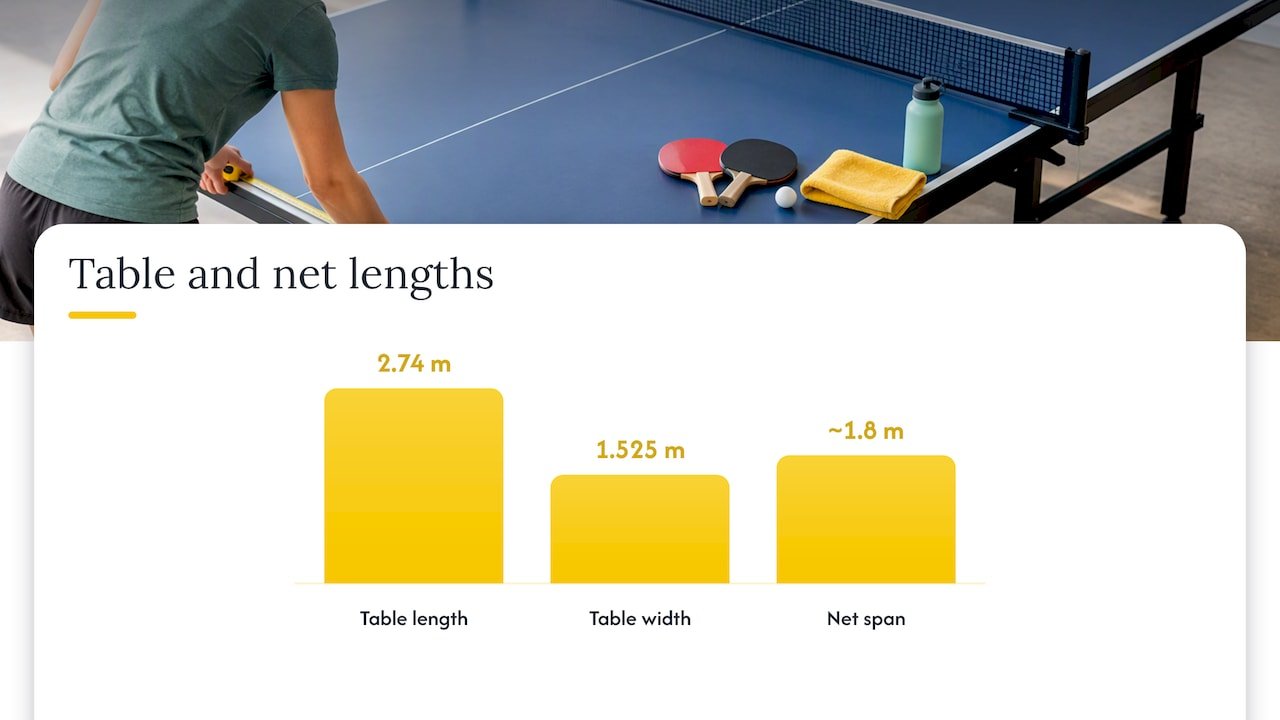
A regulation table measures 2.74 by 1.525 meters (9 by 5 feet) and sits 76 cm (30 inches) above the floor, with a net stretching about 1.8 meters across and standing 15.25 cm high, according to Britannica’s equipment overview.
The ball itself is 40 mm in diameter and weighs about 2.7 grams, made in white, yellow, or orange depending on table color, a detail also confirmed by Britannica. Paddles used in sanctioned competition need different-colored rubber on each side, usually red and black, so opponents can read spin.
- Casual play rarely requires measuring your table or weighing your ball.
- Club nights and tournaments are stricter about paddle color rules and surface specs.
- A wooden blade with rubber facing is standard for recreational and competitive paddles alike.
Quick-start checklist: what to remember during your first game
Before the first point, settle who serves (a quick coin flip or a palm-guess works fine) and agree on the two-point serve rotation.
- Confirm the serve order and how scoring will be tracked.
- Run through the serve checklist: open palm, toss at least 16 cm, strike behind the end line, ball visible the whole time.
- Hit a couple of practice serves before keeping score.
- Call lets out loud and replay them without argument.
- Play a short rally-to-5 warm-up focused on keeping the ball on the table, not power.
Pro Tip: Slow, controlled rallies teach you more in ten minutes than trying to smash every shot. Save the power once your placement is consistent.
For a structured way to build these habits, our four-week skills plan lays out short daily drills.
Running a friendly match or small tournament
A round-robin into single elimination works well for casual groups. Splitting 8 to 16 players into groups of four, playing fast round-robin games within each group, then advancing top finishers into a knockout bracket, keeps a small event moving in roughly 2.5 to 3.5 hours.
- Assign tables in advance so rotations don’t stall between rounds.
- Keep paddles and balls at each table rather than shared across the room.
- Track scores on a simple sheet or whiteboard visible to all players.
- Remind players to call their own faults and lets honestly, especially in friendly settings.
Our tournament format guide breaks down timing and bracket templates for groups this size, and our private pong room booking page covers reserving space for your own event.
Focus on consistency, not power
Beginners win more points by avoiding errors than by hitting winners. Keep the ball on the table, serve legally every time, and let your opponent make the mistakes. A well-run venue backs that up with clear rules and friendly supervision so nobody’s guessing at the fine print mid-rally.
— Archers
Play your first match at Archers Battlefield
We set up ping pong sessions and party packages where the tables, paddles, and supervision are already sorted, so you can focus on learning the serve instead of hunting for gear. A single Ping Pong session is available, and if you’re planning something bigger, our event packages include options built around small-group play and casual tournament formats. Current prices are on the pricing page.

- Equipment and tables are set up and ready when you arrive.
- Staff on-site can explain serve and scoring rules to new players.
- Packages scale from a quick session to a full private event.
If you’re planning a themed night around the match, groups looking for an immersive twist sometimes pair activities with kits like Murder in Prague’s party experiences for the non-ping-pong portion of the evening. For booking a table or a private room with us, check availability and packages to lock in a time.
FAQ
What are the basic ping pong rules?
Games are played to 11 points and must be won by two, with serve rotating every two points until 10-10, when it switches every point, according to the Olympics’ rules guide. The ball must bounce once on each side during serve and once on the return side during rallies, with no volleys allowed.
What are the 10 basic rules of table tennis?
There’s no single official “10 rules” list, but the core points cover legal serving (open palm, 16 cm toss, visible ball), one-bounce returns, no volleys, no double hits, no table touches with the free hand, scoring to 11 by two, deuce alternation, let replays, and diagonal serving in doubles. The RecSports MSU rules page and Britannica’s equipment and play overview cover these in detail.
What are the fouls in table tennis?
Common fouls include an illegal serve, hitting the ball before it bounces on your side, hitting it twice in a row, touching the table with your free hand, and letting your body or clothing touch the table or net during a live point. Any of these hands the point to your opponent immediately.
What is an illegal serve in ping pong?
An illegal serve happens when the toss is lower than 16 cm, the ball is hidden from the receiver’s view, the server’s palm isn’t open and stationary before the toss, or the ball is struck in front of the end line, as detailed by TableTennisCoach. Since there’s no second serve, any of these faults gives the point straight to the receiver.
Sources
- How to do a legal table tennis serve — TableTennisCoach
- Table tennis rules: Everything you need to know — Olympics
- Table tennis – Equipment, rules, play — Britannica
- Table tennis rules — RecSports MSU


