
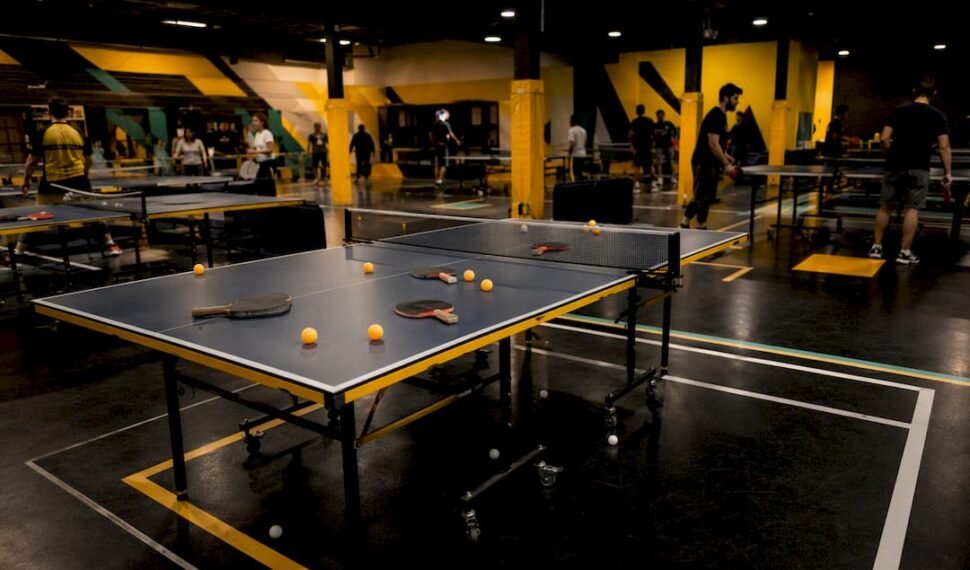
The best ping pong tournament format balances your available time against how many guaranteed matches players want. Choose single-elimination when you’re short on time or table space, round-robin when fairness and match count matter more than speed, and double-elimination or Swiss when you want a middle ground. Standard scoring is games to 11, win by two, played best-of-3 or best-of-5 games.
TL;DR:
- For small groups of fewer than 16 players, single-elimination is the fastest format, but it offers less match time and fairness for early losers.
- Round-robin groups are best for 4 to 8 players when fairness and multiple matches per person are priorities, but they become impractical with more players or tables.
- Using seeding based on prior results or quick skill checks improves fairness and prevents top players from eliminating each other in early rounds.
- Setting clear scoring rules, match time caps, and dispute procedures before play starts helps ensure smooth tournament flow and reduces arguments.
- Hiring a hosted tournament service simplifies setup, scheduling, and officiating, especially for larger events or when organizers want to focus on social aspects.
Table of Contents
- What Are the Main Ping Pong Tournament Formats?
- How Do You Choose a Tournament Format?
- What Scoring Rules Should You Set Before Play Begins?
- How Many Matches and Tables Will You Actually Need?
- How Do You Build a Fair Bracket or Schedule?
- How Should You Break Ties and Decide Progression?
- What Should Your Day-Of Setup Checklist Include?
- How Should You Seed and Rank Players?
- Should You Run Team Formats or Individual Matches?
- What Conduct Rules and Dispute Procedures Do You Need?
- How Should You Structure Awards and Prizes?
- A Host’s View on Running a Tournament in Person
- Book a Hosted Pong Tournament and Skip the Setup Work
- Sources
What Are the Main Ping Pong Tournament Formats?
Every table tennis tournament structure boils down to a handful of core designs, and picking the wrong one is the single most common reason organizers run out of time or hear complaints about fairness.
Single-elimination is exactly what it sounds like: lose once, you’re out. It’s the fastest format by a wide margin, which is why pickup tournaments and lunch-break brackets lean on it constantly. The tradeoff is brutal for players who lose early. Someone can show up, play one match, and go home in five minutes.
Double-elimination softens that blow. Players drop into a losers’ bracket after one loss and only exit after two. It roughly doubles the total number of matches compared to single-elimination ping pong, which means more play time for everyone but a longer event and a more complicated bracket to manage.
Round-robin ping pong has every player face every other player in their group. It’s the fairness champion, since results reflect a full body of work rather than one bad game. The cost is math: groups grow the match count fast, so round-robin only stays practical at smaller group sizes.
Swiss (progressive knock-out) pairs players against opponents with similar records each round instead of a fixed bracket. It scales better than round-robin for larger fields while still giving everyone multiple matches, but it takes more administrative attention to pair each round correctly.
- Single-elimination: fastest, least fair to early losers, minimal admin
- Double-elimination: more matches, one buffer against a bad game, moderate admin
- Round-robin: most matches per person, best for groups of 4 to 8, gets slow past that
- Swiss: scales to larger fields, keeps matches meaningful, requires round-by-round pairing work
Group-plus-knockout hybrids (round-robin pools feeding a single-elimination playoff) split the difference nicely for medium-sized fields, and they’re worth considering before you commit to a pure format.
How Do You Choose a Tournament Format?
Start with four numbers: how many people are playing, how many tables you’ve got, how many total hours you have, and the minimum number of matches you want each player to get. Those four answers point you toward a format almost automatically.
- Count your players and tables. Fewer than 4 tables for more than 16 players means round-robin for everyone is off the table (literally).
- Set your time ceiling. A 2 hour window with 20 players almost always forces single-elimination or a fast Swiss system.
- Decide your minimum-matches promise. If you’re advertising “everyone plays at least 3 matches,” round-robin groups or Swiss deliver that. Single-elimination cannot.
- Match the format to the vibe. A competitive office ladder tolerates single-elimination’s harshness. A birthday party or team-building night usually shouldn’t.
An office lunch tournament with 8 people and 45 minutes calls for single-elimination on one table. A 2-hour club night with 16 players and 3 tables works well as round-robin groups of 4, feeding a short knockout. A full-day event with 30+ players has the runway for Swiss rounds or a group stage into double-elimination.
Pro Tip: If you’re not sure how much time you actually have, run the match-count math (covered in the next section) before you announce a format. Committing publicly to round-robin and then discovering it needs six hours is a bad afternoon.
What Scoring Rules Should You Set Before Play Begins?
Lock in your scoring standard before the first serve, not after the first argument. The near-universal norm, matching Olympic table tennis rules, is games to 11 points, win by two. Casual and club events commonly play matches as best-of-3 or best-of-5 games, with best-of-3 favored when time is tight and best-of-5 reserved for finals or slower events.
A few operational details prevent most disputes before they start:
- Use a legal, ITTF-approved ball diameter and confirm paddles meet basic sanctioned covering rules if anyone’s bringing custom equipment.
- Set a hard time cap per match (10 to 15 minutes is common) for high-volume events, with the leading player winning if time expires mid-game.
- Decide in advance how a no-show is handled. A 5-minute grace period followed by a forfeit is standard and should be posted, not improvised.
- For shortened matches due to schedule slippage, drop to best-of-1 rather than skip players entirely. Everyone still gets on the table.
Posting these rules where players can see them before the tournament starts, not mid-argument, is one of the simplest things that separates a smooth event from a chaotic one.
How Many Matches and Tables Will You Actually Need?
This is where organizing a ping pong tournament stops being guesswork. Round-robin math runs on one formula: n·(n−1)/2, where n is the number of players in a group. That formula scales fast, which is exactly why round-robin pools stay small.
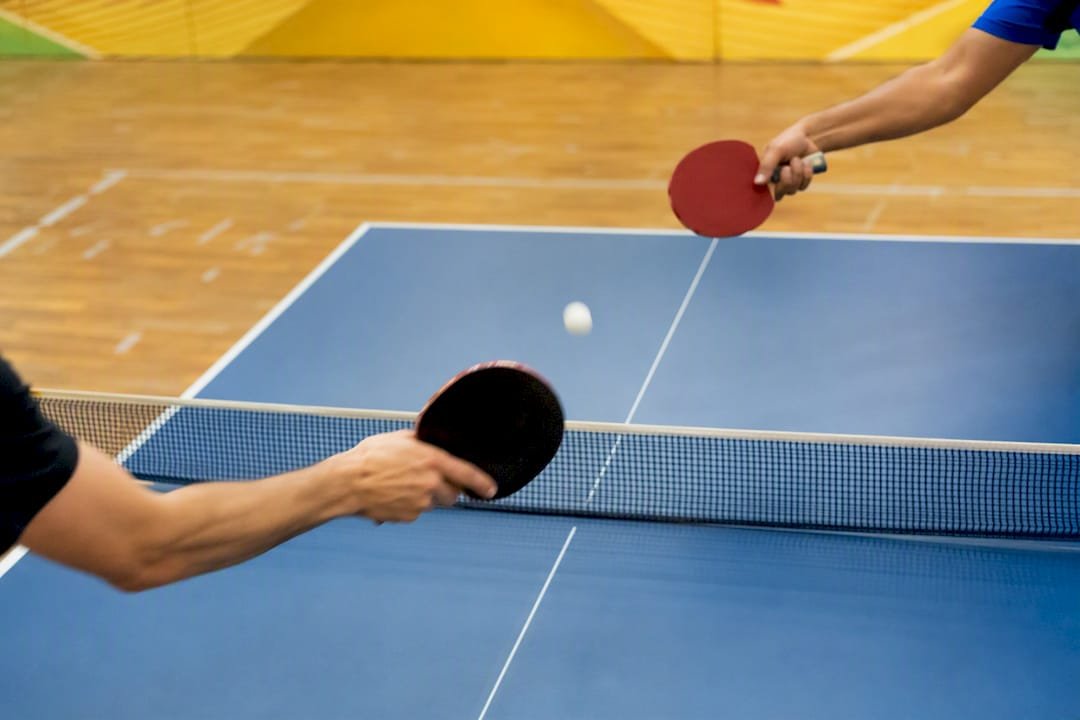
Those time ranges assume one table running matches back to back with no downtime, which is rarely realistic. Add more tables and matches run in parallel, cutting total elapsed time roughly in proportion to table count. For space, plan on roughly 3 meters by 3 meters of clear floor per table so players can move and retrieve balls safely without colliding with the next table over.
If your field has an odd number of players, give the sitting-out player a “phantom” bye each round and rotate who sits, so no one player loses more playing time than anyone else.
How Do You Build a Fair Bracket or Schedule?
Round-robin schedules aren’t built by hand-waving pairings together. The standard scheduling algorithm is the circle method, which rotates players around a fixed pivot each round so no two players face each other twice and byes get distributed evenly across an odd-numbered field.
Doing this manually for 6 or more players gets tedious fast, which is why most organizers now lean on a round robin generator or a dedicated bracket-generator tool rather than sketching a table on a whiteboard. Automated schedule generators earn their keep once you cross roughly 8 players or run more than 2 tables simultaneously.
What good generator output looks like:
- Balanced rounds with no player sitting out twice before everyone has sat out once
- Zero double-bookings, meaning no player is scheduled on two tables in the same round
- A printable or shareable bracket and standings sheet you can post at the venue
- Round assignments optimized across however many tables you actually have available
Tools built for this, like ping pong schedule generators designed for table tennis specifically, will also handle the table-optimization math for you, which saves real time on setup day.
How Should You Break Ties and Decide Progression?
A round-robin group without a pre-agreed tiebreak procedure will eventually produce a three-way tie, and the moment that happens without a rule already posted is when tournaments start losing goodwill. Set the sequence in advance:
- Head-to-head result between the tied players decides first, when applicable.
- Game difference (games won minus games lost) breaks it if head-to-head doesn’t apply or involves more than two players.
- Points difference across all group matches is the next tiebreaker.
- A short playoff match (single game to 11) settles anything the numbers can’t.
Three-way ties usually resolve fastest with a mini round-robin among just the tied players rather than trying to untangle head-to-head records across all three. For detailed tiebreaker playbooks covering edge cases like four-way ties, a written procedure beats improvising every time.
Keep a paper or digital score sheet signed by both players after every match, and post updated standings visibly after each round. Disputes over “what the score actually was” mostly disappear once results are public and timestamped.
What Should Your Day-Of Setup Checklist Include?
Beyond tables and balls, bring spare paddles (players forget theirs constantly), a printed scoresheet stack, a whiteboard or visible bracket display, printed rules, and a basic first aid kit.
Two templates that work reliably:
- Template A, 16 players: Four groups of four, round-robin within groups (6 matches per group, 24 total), top two from each group advance to a single-elimination playoff. Expect roughly 2.5 to 3.5 hours on 2 tables.
- Template B, 8-player single-elimination: Seven total matches across three rounds. On one table with best-of-3 matches, budget 60 to 90 minutes start to finish, ideal for a lunch-hour office event.
Pro Tip: Print two copies of the bracket. One stays with the organizer, one goes on the wall. Players checking their own progress cuts down “when do I play next” interruptions dramatically.
How Should You Seed and Rank Players?
Seeding decides who avoids whom in early rounds, and getting it wrong is how your two strongest players end up eliminating each other in round one instead of meeting in the final. If you have any prior data, whether it’s club ladder rankings, previous tournament results, or informal skill ratings, use it to seed the top 4 to 8 players apart from each other in the bracket.
For groups with no history together, a quick pre-tournament skills check works better than guessing. A short warm-up rally or a 5-minute mini-game per player, scored loosely, gives you enough signal to split obviously strong and weak players into different groups or bracket halves. It doesn’t need to be scientific. It just needs to prevent your best player from facing your second-best player in the opening round of a single-elimination ping pong bracket.
Self-reported skill levels work reasonably well too, especially for casual and workplace events where players are honest about being beginners. Ask entrants to rate themselves on a simple scale (beginner, intermediate, advanced) at sign-up, then distribute those self-ratings evenly across groups rather than clustering all the “advanced” players into one pool.
For ranked or recurring leagues, a simple win-percentage or point-differential system carried over from previous events gives you real seeding data instead of guesswork. Whatever method you choose, publish the seeding logic alongside the bracket. Players tolerate losing to a tougher opponent far better when they can see the reasoning wasn’t arbitrary.
Should You Run Team Formats or Individual Matches?
Team tournament formats change the math and the energy of an event considerably. In a team format, each “match” between two teams is actually a series of individual games, commonly singles matches plus a doubles match, with the team format scoring based on total games or matches won rather than a single result.
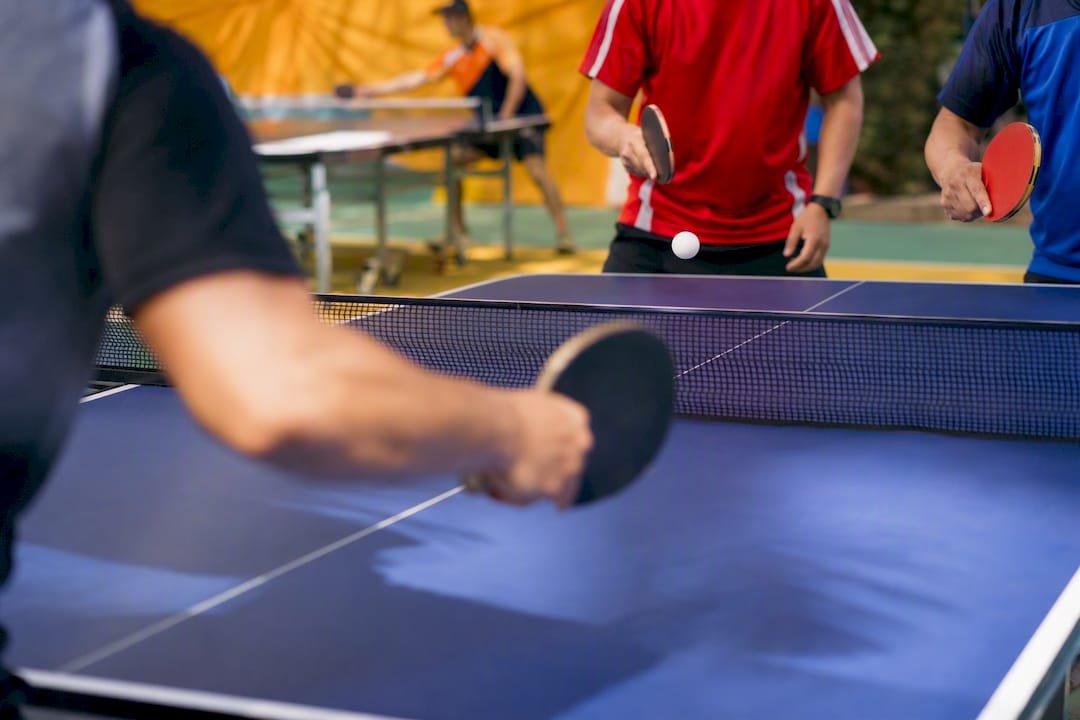
A common structure for a 4-person team match: two singles matches, a doubles match, and a reverse singles match, with the team securing the most wins taking the overall tie. This structure works well for corporate team-building ping pong tournaments and club events, since it lets weaker players contribute to a team result without carrying the full weight of an individual elimination bracket on their shoulders.
Team formats also solve an inclusivity problem individual brackets don’t. A beginner paired with a stronger teammate in doubles stays engaged and competitive even if they’d get steamrolled in singles. That matters more than organizers often expect for workplace events where half the room hasn’t picked up a paddle since middle school.
The tradeoff is time. A team match with three or four individual games inside it takes roughly three to four times longer than a single individual match, so team formats generally fit best with smaller fields (4 to 8 teams) or longer event windows. If your window is tight, individual round-robin or single-elimination will move faster, but team formats build camaraderie that individual brackets simply don’t generate on their own.
What Conduct Rules and Dispute Procedures Do You Need?
Every table tennis event guideline worth following starts with the same principle: rules posted before the first serve prevent almost every argument that happens after it. At minimum, cover legal serves (no hiding the ball at contact), the let rule for net-touch serves, and what counts as an obstruction.
Disputes over close line calls or edge balls are inevitable in table tennis. Without a referee, the standard practice is that the player who has the better view of the call makes it, and any disagreement defaults to a replay of the point rather than an argument. For a table tennis tournament structure without dedicated officials, appointing one neutral floor monitor per 4 to 6 tables to make judgment calls on genuinely disputed points saves enormous friction.
Conduct expectations should be simple and stated up front: no coaching mid-point from the sidelines, no touching the table during play, and any behavior disrupting an adjacent match gets a warning before a forfeit. Posting this alongside your bracket, the same way you’d post scoring rules, means nobody can claim they didn’t know.
How Should You Structure Awards and Prizes?
Prize distribution should scale with your bracket size and match your event’s stakes. For a single-elimination or double-elimination bracket, the natural stopping points are champion, runner-up, and (for larger fields) a bronze-medal match or shared third place between both semifinal losers.
For round-robin or Swiss formats without a final, awarding based on final standings (top 3 by wins, or by the tiebreak sequence covered earlier) works cleanly since there’s no single decisive match to anchor the podium around.
Casual and corporate events often add secondary awards beyond the top spots: most improved player, best sportsmanship, or a random participation draw for anyone who didn’t place. These cost little to implement and noticeably increase how many people leave the event feeling like it was worth their afternoon. Physical prizes (paddles, gift cards, a trophy that travels to next month’s event) tend to land better for lower-stakes events than cash, which can shift the tone toward something more serious than a casual tournament usually calls for.
A Host’s View on Running a Tournament in Person
Running dozens of these events teaches you that the format matters less than how organized it looks. A printed bracket on the wall and an announced round schedule reads as professional even for a casual office night. Hosted packages with private rooms and event staff running the boards free the organizer to actually play, and small add-ons (extended time, a facilitator, a scoring app) tend to boost engagement more than the format choice itself.
— Archers
Book a Hosted Pong Tournament and Skip the Setup Work
Building a bracket, hauling tables, and hoping nobody argues about a let-serve is doable on your own, but it eats hours you’d rather spend actually playing. Archersbattlefield runs the logistics for you: private pong rooms with tables already spaced and set, staff who can referee close calls, and printed brackets handled before your guests arrive.

If you’re weighing DIY versus hosted, the decision usually comes down to group size and how much you want to manage during the event itself. A small office lunch bracket is easy enough to run yourself. A birthday party, corporate outing, or club night with 16 or more players benefits enormously from having someone else track scores, manage the bracket, and reset tables between rounds while you focus on your guests. Archersbattlefield’s event packages scale from small friend groups to full corporate team-building days, with pong as a standalone booking or paired with combat archery and other activities for a longer event.
Check availability and get your tournament on the calendar through the pong booking page.
Sources
- Round Robin Generator – PlayRez
- Table Tennis round robin generator — AthletePath
- Round-Robin Scheduler – PingPongInfo


