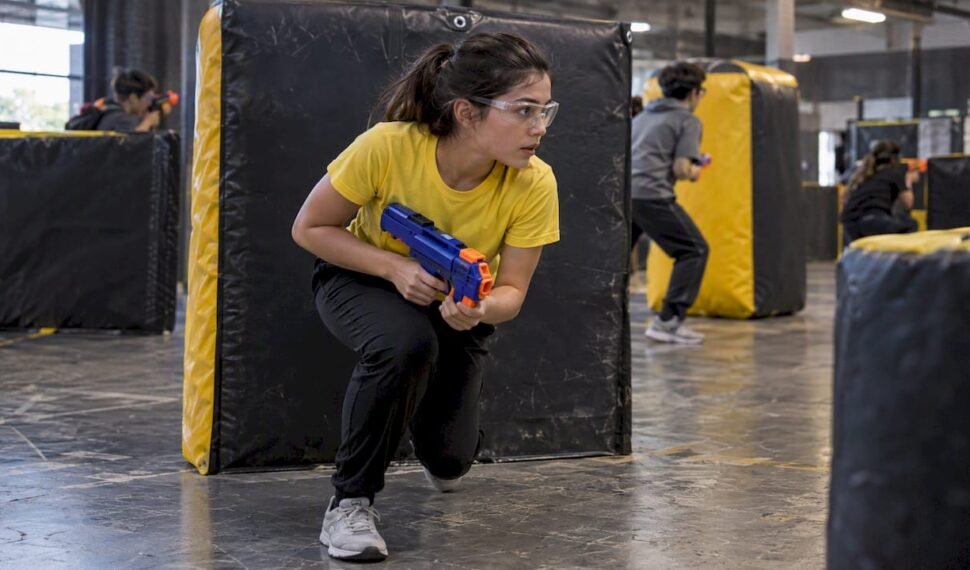
The best Nerf battle outfit is simple: impact-rated eye protection, light clothes that let you move, closed-toe shoes with grip, and a few pockets for darts. Everything else, from tactical vests to team colors, is a bonus. Below we cover the gear that matters, the gear that is just fun, and how to dress a whole group for a party or a team event.
TL;DR
- Eye protection is the one non-negotiable item. Foam darts can still cause serious eye injuries, so wear proper protective eyewear, not a fashion pair of glasses.
- Dress for movement: breathable layers, stretchy bottoms, closed-toe shoes with real grip.
- A vest or belt with pockets is useful for carrying darts. Armor, masks and costumes are optional, and anything that blocks your view or hearing is a bad trade.
- Ask your venue what it provides and what it bans before you buy anything.
- For groups, pick one team color per side so players can tell friend from foe at a glance.
Table of Contents
- Start with your eyes
- What to wear: the clothing basics
- Tactical gear: what earns its place
- Dressing for combat archery
- Costume ideas that still work in a battle
- What to wear for different groups
- Our perspective
- Before you buy anything: ask your venue
- Book a Nerf battle with us
- FAQ
- Sources
Start with your eyes
If you buy one thing, buy this. The Canadian Ophthalmological Society lists Nerf alongside airsoft, BB and paintball guns as nonpowder projectile weapons that can cause permanent vision loss. Its 2019 position statement notes that no Canadian regulation requires eyewear for private Nerf play, yet it strongly recommends that everyone within range of a projectile wear CSA-approved eye protection at all times.
The American Academy of Ophthalmology makes the same point: foam is not the same as harmless, and injuries such as bleeding inside the eye (hyphema) have been documented. Manufacturers agree. Hasbro’s own instructions say never to aim at the eyes or face and recommend protective eyewear for players and anyone within range.
What to look for in eyewear
- An impact rating. Hobbyists look for a Z87+ marking on the temple of the frame, as explained in this blaster safety guide. Everyday prescription glasses are rarely built for a direct dart strike.
- Wrap-around coverage. Darts come from the side and from below as often as from the front.
- A snug fit. Glasses that slide down your nose when you duck behind cover will end up in your pocket. Look for an adjustable strap or soft temple tips.
- Fit over your own glasses. If you wear prescription lenses, ask for over-the-glasses goggles rather than relying on your frames.
For kids, buy youth sizes. Adult goggles on a small face leave gaps exactly where you do not want them.
What to wear: the clothing basics
You will sprint, crouch, twist and reach for ammo for an hour or more. Dress for that, not for a photo.
Tops
A moisture-wicking T-shirt or light long-sleeve shirt works best. Cotton is fine for a short party, but it holds sweat. A thin long sleeve also takes the sting out of close-range hits on the forearms. In a Canadian winter, think layers: you will arrive in a parka and be hot ten minutes into the first round, so wear something you are happy to play in once the coat comes off.
Bottoms
Athletic pants, joggers or stretchy shorts. Avoid stiff jeans, which restrict a deep lunge, and avoid anything long enough to step on. Cargo pants are popular for a reason: the pockets hold spare darts.
Shoes
Closed-toe sneakers with a grippy sole. Floors in indoor venues can be smooth, and darts underfoot act like marbles. Skip sandals, slides and heeled boots.
Accessories
- A hair tie or headband, so hair does not cover your eyes.
- A light cap is fine, but a brim can block your sightline when you look up.
- Thin gloves only if they do not cost you trigger feel.
- A small water bottle left at the sideline.
Tactical gear: what earns its place
Search results for this topic are crowded with vests, belts, holsters and masks. Some of it is genuinely useful, and some is costume.
| Item | Useful? | Why |
|---|---|---|
| Dart pouch or vest with pockets | Yes | Keeps spare darts and magazines within reach so you spend less time crawling for ammo |
| Belt with a holster | Yes | Frees your hands when you swap to a sidearm or climb over cover |
| Mesh tactical vest | Yes, if breathable | Mesh and adjustable straps give a universal fit without overheating |
| Shoulder armor and padded plates | Optional | Looks great, adds bulk and heat, blocks nothing that matters |
| Full face mask | Only if it is built for impact | A fabric mask is a costume piece, not eye protection |
| Scarf, cape or long cloak | Skip | Snags on cover and furniture |
Retail kits vary widely. According to one major retail listing, single vest sets start at roughly US$20, while 10-player party kits can run above CA$90. A kit that covers a whole birthday party is usually cheaper per head than buying one at a time, but check that straps adjust for the youngest and the tallest players.
Vest tips
- Fill the pockets before the game and keep weight low and even. A lopsided vest slows you down.
- Make sure nothing dangles. Loose straps get caught on bunkers.
- Wear it over a light shirt, not directly on skin, if it has rough edges.
Dressing for combat archery
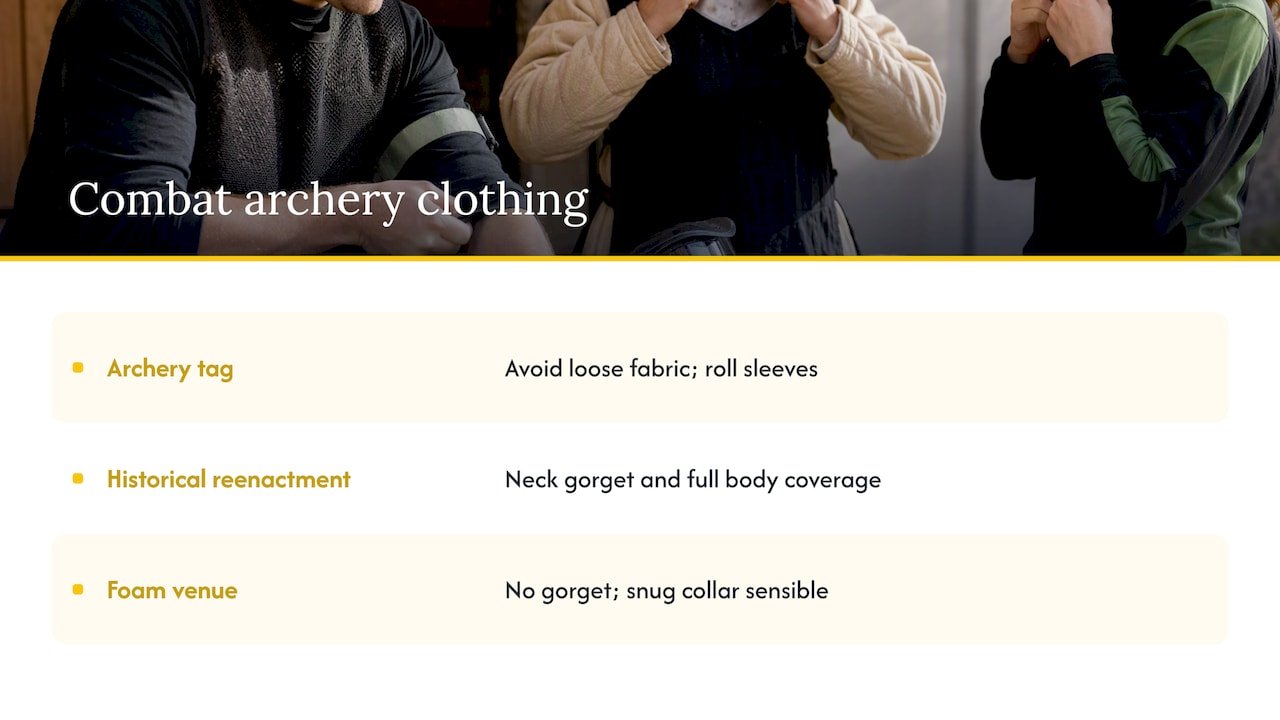
If your group is mixing Nerf with other combat-style games, the rules change a little. For archery tag, mobility is the main constraint. Players who write about larp archery clothing warn against loose fabric near the bowstring and anything that constricts the shoulders, and recommend rolling up sleeves for a clean release. Snug vests beat flowing cloaks.
Combat archery fighters in historical re-enactment also treat the neck as a weak point. Authorisation rules for combat archery require a neck gorget and full body coverage by clothing. Foam-tipped archery tag at a venue is a different, gentler setup, so you will not need a gorget there. But a snug collar or a light neck gaiter is a sensible habit, and the same principle holds: cover skin, keep sleeves out of the way. Our own combat archery rules page covers the pregame points we read aloud before each session.
Costume ideas that still work in a battle
Part of the fun is looking the part. The trick is to keep the costume on the outside of a functional base layer.
- Team colors. Orange versus blue shirts is the classic: instant identification, no fuss, cheap to buy in bulk.
- Military-inspired. Olive or camo pants with a dart vest. Easy to build from clothes you already own.
- Sci-fi or superhero. Pick a character whose look is a fitted tunic rather than a cape. If you want a worked example of a costume that avoids bulky foam pieces, this family costume guide for DIYers shows how to build a recognizable look from fabric rather than rigid props.
- Matching group tees. Great for corporate events and birthday groups, and they double as party favors.
- Retro sports. Headbands, wristbands, and tracksuits. Very comfortable, very quick to run in.
One rule for costume days: no scary masks and nothing that hides the face from staff. Some events with costume rounds ban them for exactly that reason, and a mask also raises the question of whether eye protection is sitting correctly underneath.
What to wear for different groups
Kids’ birthday parties
Comfortable clothes they can get sweaty in, sneakers, and youth-sized eye protection. Parents should skip anything with drawstrings at the neck or long hanging items. If you want to theme the party, a matching team shirt per side is the simplest upgrade. Our Nerf party ideas page walks through how to run the day.
Adult groups and date nights
Think gym clothes, not going-out clothes. Fitted athletic wear, sneakers and a hair tie. If you are coming straight from work, bring a change of shoes.
Corporate team building
Ask attendees to wear what they would wear to a casual Friday, plus sneakers. Sending a short dress code in the invitation avoids delays at check-in; we put one together in our corporate event dress code guide. Company T-shirts in two colors are an easy way to split teams.
Sports teams
Jerseys and practice gear are perfect. Make sure the two sides are in clearly different colors, and ask players with glasses to bring a case.
Our perspective
We run group games every week, and the same pattern shows up: the groups that have the best time are not the ones with the most gear, they are the ones who arrive comfortable. Players who show up in stiff jeans, flip-flops or a heavy costume spend the first round adjusting rather than playing.
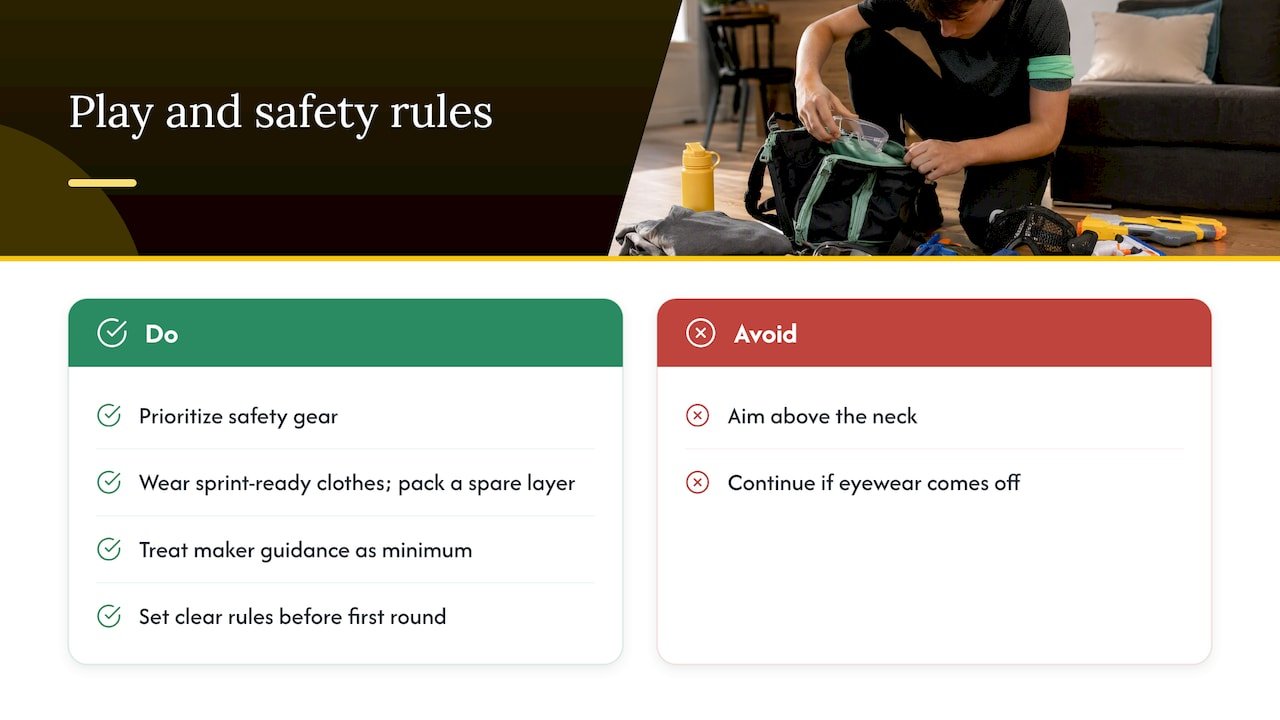
Our view is simple. Safety gear comes first, clothing second, costume third. Eye protection is not an upgrade, and we would rather a guest laugh at their goggles than miss a week of work over an eye injury. After that, wear things you can sprint in, bring a spare layer, and keep it light.
We also think organizers should set clear rules before the first round and treat a manufacturer’s guidance as the minimum, not the target. That includes below-the-neck aiming for casual rounds and a hard stop when anyone’s eyewear comes off. If you are comparing foam blasters to harder-hitting options, our piece on Nerf versus airsoft explains why supervision changes the risk.
— Archers
Before you buy anything: ask your venue
Venues differ, so a five-minute call saves money. Ask:
- Is eye protection supplied, or should we bring our own?
- Are there rules on footwear, masks, hats or costume pieces?
- Can we bring our own blasters and vests, or is equipment provided?
- Is there a minimum age, or a rule about adult supervision for younger players?
- Where do we store coats and bags?
If you are booking with us, details on our Nerf battle experience are on that page, and our team can answer outfit questions when you reach out.
Book a Nerf battle with us
We offer individual Nerf battle sessions at $35, and party packages for kids and adults. Kids’ parties start with Game On Birthday Party from $399 and Epic Birthday Party from $499. For corporate groups and sports teams, the team packages begin at $399 for Game On Team Battle. Ready to pick a date? Use our booking page.
FAQ
Do I really need eye protection for a Nerf battle?
Yes. Canadian eye doctors say foam-dart play can cause permanent vision loss, and the Canadian Ophthalmological Society recommends CSA-approved eye protection for everyone within range. No law requires it for private play, but that is a legal floor, not a safety standard. Wear it every round.
Can I wear my regular glasses?
Not as your only protection. Everyday frames are rarely designed for a direct dart strike, and players look for Z87+ markings on protective glasses. If you wear prescription lenses, choose goggles that fit over them.
What shoes are best?
Closed-toe sneakers with a grippy sole. You will be running, stopping suddenly and stepping on loose darts, so avoid sandals, slides and heels.
What should kids wear to a Nerf birthday party?
Light, comfortable clothes they can sweat in, sneakers, and youth-sized eye protection. A matching team shirt is a nice touch. Keep costumes simple and avoid capes, scarves and anything that covers the face.
Is a tactical vest worth buying?
If you play often, yes: it keeps darts at hand and frees your hands. Choose mesh for breathability and adjustable straps for fit. For a one-off party, a simple pouch or cargo pockets does the same job.
Sources
- Position Statement on the Use of Nonpowder Projectile Weapons (Canadian Ophthalmological Society)
- Are toy guns dangerous to your eyes? (American Academy of Ophthalmology)
- Nerf Fortnite SMG-Zesty official instructions (Hasbro)
- Blaster Safety (Out of Darts)
- Nerf Elite Ultimate Battle Vest listing (Amazon)
- Larp archery guide, part 2: clothing
- Combat Archery Authorisation
- Star Wars costume ideas for families and DIYers


