Team building most reliably improves communication, collaboration, trust, morale, and the team processes that can support better performance. A meta-analysis of team training found moderate positive effects, and Gallup reports that global engagement fell to 21%, so the need is real. Durable results depend on design and follow-up, which is how we shape events at Archers Battlefield.
TL;DR:
- Match the intervention to the diagnosed problem: use role clarification for blurred ownership, problem solving for coordination gaps, and interpersonal work for trust or morale.
- Debriefs that are conducted well can improve team effectiveness by about 25%, while process gains often appear within weeks and performance changes take longer.
- Record a baseline, check immediate reactions, then repeat the same survey and two or three work metrics later; satisfaction alone can flatter weak programs.
- Keep membership stable, secure visible leader support, and involve the team in event design; results vary with team size, training content, and operating conditions.
Table of Contents
- What outcomes can you expect from team building?
- 1. How does team building actually create change?
- 2. What does the evidence say, and how strong is it?
- 3. How do you measure team-building effectiveness?
- 4. How should you design a team-building event?
- 5. What is our view on realistic expectations?
- 6. Ready to put these outcomes to work with your team?
- FAQ
- Sources
What outcomes can you expect from team building?
Each outcome responds to different kinds of activities, so it helps to map what you want to what you run.
- Communication: Information moves faster and misunderstandings drop when an activity forces people to explain, listen, and confirm. Interventions that target communication processes directly tend to show the clearest gains.
- Collaboration and processes: Handoffs, role awareness, and coordination improve when a team works through a shared problem and then spells out who owns what.
- Trust and psychological safety: Trust is what lets people admit a mistake, ask a question, or challenge a plan. It is an affective outcome, meaning it concerns how people feel about each other, and it shifts when people see colleagues act reliably under mild pressure.
- Morale and engagement: Shared experiences build belonging, and belonging feeds motivation. Gallup’s workplace research points to team building and performance coaching as ways managers can rebuild emotional connection, and its State of the Global Workplace report stresses manager engagement as a key lever.
- Performance: Gains here are usually indirect. Better trust, clearer roles, and smoother coordination come first, and results follow. A meta-analysis of intrateam trust found trust positively related to team performance, with the strength of that link varying by task interdependence and how differentiated team members’ authority and skills are.
The practical lesson: a team with role confusion needs a different exercise than a team with a conflict problem. Picking the outcome first keeps the day from becoming generic fun.
Performance also depends on conditions outside the event. Stable membership and a targeted focus help, while a team that reshuffles every month will struggle to hold onto anything it learned. Expect the earliest wins in how people talk and coordinate, and treat performance as a lagging result of those improvements.
1. How does team building actually create change?
Researchers describe four common components of team building: goal setting, interpersonal relations, role clarification, and problem solving. A comprehensive investigation of team building identified all four and reported positive moderate effects, strongest on affective and process outcomes. Here is how each component typically maps to results:
- Goal setting aligns effort and gives the team a shared definition of success, which supports coordination and performance.
- Interpersonal relations build familiarity and social cohesion, which feed trust, morale, and engagement.
- Role clarification reduces overlap and gaps, which improves handoffs and process quality.
- Problem solving gives the team practice working through ambiguity together, which strengthens communication and shared understanding.
Behind these components sit a few mechanisms: shared mental models (the team pictures the work the same way), social cohesion, familiarity, psychological safety, and structured reflection. That last one matters most after the activity ends. Reflection is where an experience turns into a changed habit.
The same meta-analysis found that effectiveness varies with team size, how stable membership is, and training content. Leadership behavior and the operating environment matter too, since a manager who ignores the event the next day undoes much of its value.
Pro Tip: Use an external or neutral facilitator. People drop their guard more easily when the person running the session has no stake in who speaks up, which lowers defensive barriers.
2. What does the evidence say, and how strong is it?
The strongest support comes from meta-analyses and reviews, and the picture is encouraging but not unlimited.
The team training meta-analysis found moderate, positive relationships between team training and cognitive, affective, process, and performance outcomes, with training content, membership stability, and team size moderating the results.
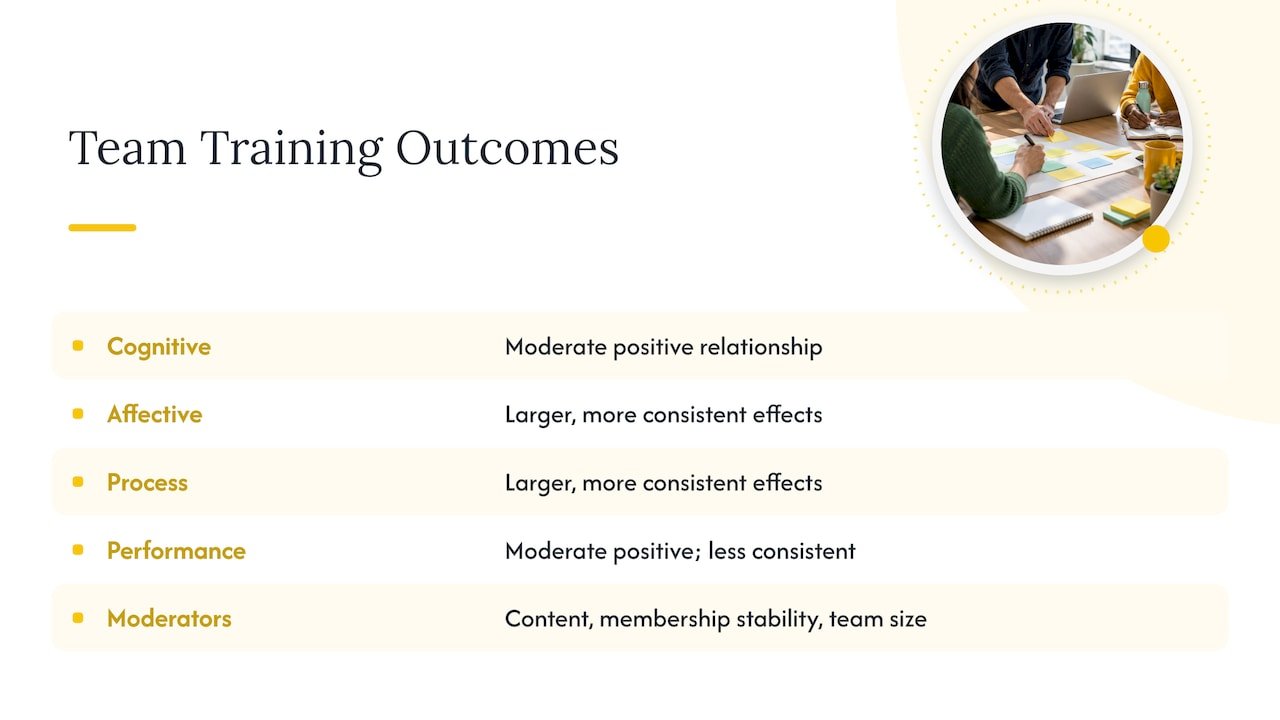
That means a team-building program is not a magic switch, and it works better for some teams than others. Affective and process outcomes show larger, more consistent effects than hard performance numbers.
Debriefs deserve special attention. Research on team debriefs indicates that well-conducted ones can improve team effectiveness by about 25% across a variety of organizations and settings, and that they strengthen learning and team processes. If you only add one thing to an event, add a debrief.
The CIPD evidence summary on high-performing teams adds guidance on when interventions succeed: when they are corrective, aimed at group-level dynamics, supported by leadership, and often facilitated externally or jointly with an internal neutral.
Team-building initiatives succeed most often when they are targeted at a real group-level problem, backed visibly by leadership, and facilitated by someone outside the team’s reporting line. (Paraphrasing the CIPD evidence summary)
Evidence is more mixed on psychological safety. A systematic review of psychological safety interventions found varied results, limited by a lack of objective outcome measures. The studies that did show improvement often involved end-user co-design, visible leader support, and multifaceted approaches. The takeaway is to involve your team in designing the event and to measure with something firmer than a mood check.
3. How do you measure team-building effectiveness?
Measure before you play, right after, and again once the glow has faded. Relying on perceptions alone is the most common mistake, because people tend to rate any pleasant day highly.
Use a mix of subjective and objective signals:
- Perception surveys: Short pre and post items such as “I can raise a concern without worrying about how it will be received” or “I know who owns each part of our current project.”
- Behavioral and process indicators: How long meetings run, how many handoff errors or repeated questions occur, and how quickly decisions get made.
- Task KPIs: Throughput, error rates, or customer satisfaction, where they connect to the work the team does.
Timing shapes what you will see. Immediate satisfaction shows up the same day, but durable process change takes weeks, and performance signals lag further behind. Judging an event in the afternoon survey alone will flatter weak programs and miss slow ones.
A simple measurement routine:
- Capture a baseline with your survey and two or three process metrics before the event.
- Run a short check immediately afterward to catch reactions and early commitments.
- Revisit the same survey and metrics later, and compare against the baseline.
- Share the results with the team and adjust the next intervention accordingly.
Keeping the same questions across all three points is what makes the comparison honest.
4. How should you design a team-building event?
Start with the problem, not the activity. The integrative review of team development interventions recommends treating team building as a targeted action embedded in a repeated development rhythm, with clear follow-up and accountability. In practice that means corrective framing: choose the event to fix role confusion, a coordination gap, or friction, rather than running one generic outing for everyone.
Facilitation and leadership shape the result. CIPD guidance notes that participants feel more comfortable in activities removed from the work environment, and that external facilitation plus management support improves the odds of honest communication. Leaders should show visible, non-evaluative support and plan their own follow-up. Practitioner guidance on team development interventions adds that fostering psychological safety is essential, and that leaders should balance advocacy with inquiry so they do not stifle open discussion.
Integration keeps the gains. Pair the event with training, debriefs, and routine team rituals. For activity inspiration, our guide to indoor team building games shows formats that map to communication and collaboration, and creative workshop examples can spark ideas for facilitators. If you are planning a multi-session offsite, a walkthrough of retreat planning tools can help with logistics, and our list of small team offsite ideas suits shorter formats.
A planning checklist:
- Define the objective in one sentence, such as “cut handoff errors between sales and operations.”
- Choose the component or components tied to that outcome.
- Plan the debrief and the action steps that will come out of it.
- Assign owners for each action, including a leader for follow-up.
- Measure against your baseline, then repeat and refine.
Pro Tip: Favor short, frequent interventions with a structured debrief over a single all-day event that has no follow-up. A focused session with a clear reflection step can be more useful than a full day of fun that nobody revisits.
5. What is our view on realistic expectations?
Team building is a useful tool, but it works best as one part of an ongoing development rhythm rather than a one-time fix. It pairs well with manager coaching, team training, and regular debriefing rituals, and it asks for patience: process improvements can appear within weeks, while performance changes take longer and depend on follow-through.
Our advice is to begin with a quick diagnostic. Ask your team where communication breaks, where roles blur, and where trust is thin, then target the single most impactful component first. Small, well-aimed steps compound, and they are easier to measure than an ambitious program that tries to fix everything at once.
— Archers
6. Ready to put these outcomes to work with your team?
We offer active formats that get people communicating and solving problems together. Our Collab Package starts at $699, and we tailor sessions to your group size and goals. Tell us about your group and goals, and we will help plan an event. Visit our team building page to see packages and request your date.
FAQ
What are some quick and effective team building activities?
Short problem-solving challenges, role-clarification exercises, and brief group games followed by a debrief work well. The debrief matters most, since well-conducted debriefs can improve team effectiveness by about 25%. Even a brief activity with structured reflection can help a team consider how it coordinates.
What are the five C’s of team building?
There is no single official list, and versions vary. A common version covers communication, collaboration, commitment, cohesion, and confidence. These line up with the research components of goal setting, interpersonal relations, role clarification, and problem solving.
Why is teamwork important?
Teamwork turns individual effort into coordinated results. It supports clearer communication, smoother handoffs, and trust, and a meta-analysis of trust found trust positively related to team performance. It also affects engagement, which is a growing concern given Gallup’s reported global decline.
How do you evaluate the effectiveness of a team?
Combine perception surveys on trust and communication with process indicators such as meeting effectiveness and handoff errors, plus task-specific KPIs where relevant. Compare results against a baseline, then check again later. Using both subjective and objective measures gives a more reliable picture.
Sources
- High-performing teams: An evidence review: Practice summary and recommendations
- Does team training improve team performance? A meta-analysis


