

A party cleanup plan is the venue’s written scope that says what staff will reset and what the host must remove. It is normally tied to the time you booked, which means running long can trigger extra fees rather than free cleanup grace. Some venues document these expectations directly in their event packages, so hosts know their obligations before the party starts.
TL;DR:
- Most venue cleanup responsibilities are clearly outlined in the booking, with staff handling equipment resets and trash, while hosts remove personal items and decorations.
- Cleanup time is typically included in the booked hours, so overrunning can lead to extra charges, making it essential to wind down activities early.
- Assigning a designated cleanup leader before the event and confirming vendor disposal duties in writing reduces misunderstandings and last-minute disputes.
- Conducting a final walkthrough with photos and a written sign-off helps document the condition of the space and avoid post-event disagreements.
- Incorporating clear, written cleanup clauses into contracts, including waste separation and approval for extra charges, ensures both parties understand their obligations in advance.
Table of Contents
- Scope of venue cleanup versus guest responsibilities
- Timing: booked time, cleanup windows, and extra charges
- Host checklist: what the booking lead should do before leaving
- Vendor and caterer responsibilities (what organizers should confirm in advance)
- Documenting condition and resolving disputes: walkthroughs, photos, and authorizations
- Sample plain-language cleanup terms organizers should confirm with any venue
- Eco-friendly and recycling considerations during cleanup
- Tips for efficient trash sorting and disposal
- Recommended tools and supplies for party cleanup
- Delegation strategies: assigning cleanup tasks to guests or helpers
- Publisher perspective: Archers Battlefield’s approach to cleanup in party packages
- How Archers Battlefield can simplify cleanup
- Useful sources and internal pages to confirm cleanup terms
- FAQ
Scope of venue cleanup versus guest responsibilities
Most disputes over cleanup come down to one problem: nobody wrote down who does what. Clear, plain-language boundaries prevent that friction, and the split usually follows a predictable pattern.
Venue staff typically handle the reset work tied to their own equipment and space. Guests, or more precisely the host on their behalf, handle anything they brought in.
- Staff side: resetting venue equipment, wiping down high-touch surfaces, and emptying venue-owned trash bins.
- Guest side: removing brought-in décor and personal items, placing rubbish in designated receptacles, and clearing anything that does not belong to the venue.
When you get a booking confirmation, look for phrases that name these boundaries directly, such as “staff will reset activity equipment” or “host is responsible for removal of decorations and personal items.” Vague language like “cleanup included” without a definition of what that covers is worth a follow-up question before you sign anything.
Timing: booked time, cleanup windows, and extra charges
Cleanup time is usually part of the time slot you paid for, not an extra buffer tacked on afterward. If your event runs past its scheduled end while people are still packing up gift bags, that overrun often counts against you.
- Confirm the exact end time for your booking and treat it as the moment everything, including cleanup, needs to be done.
- Ask what happens if you run over, since overtime staff pay, cleaning surcharges, or deductions from a damage deposit are common consequences.
- Build in a buffer by winding down activities 20 to 30 minutes before the contracted end time so packing up does not eat into time you do not have.
Pro Tip: Assign one person as the departure lead whose only job for the last half hour is getting people moving toward the door, not enjoying the party.
Host checklist: what the booking lead should do before leaving
The booking lead, whoever signed the contract or made the reservation, is the person a venue holds accountable for guests and vendors alike. That makes a short pre-departure checklist worth having ready before the event even starts.
- Assign a cleanup and departure lead and brief that person on the venue’s specific policy ahead of time.
- Remove personal décor and gifts so nothing gets left behind or mistaken for venue property.
- Consolidate trash in designated receptacles rather than leaving bags scattered across tables and floors.
- Remove non-venue supplies if your agreement requires it, including anything brought in by outside vendors.
- Confirm vendor pickup times and keep a contact number handy in case a vendor runs late.
- Request or complete a final sign-off with venue staff before you leave.
Non-obvious items are the ones that cause the most disagreements later. Whether staff remove leftover food and decorations, how “excessive mess” is defined, and how extra charges get authorized are worth confirming in writing before the event, not after. Written scope protects both the venue and the host because it turns a subjective judgment call into something both sides agreed to in advance.
Vendor and caterer responsibilities (what organizers should confirm in advance)
Caterers and outside vendors are generally expected to remove their own food, equipment, and hazardous waste, such as cooking oils. Venues typically do not absorb that responsibility, which means a gap can open up if nobody assigns it clearly.
Before the event, ask each vendor:
- Who removes leftover food and where it goes if guests do not take it home.
- Who is responsible for oils, fats, or other materials that carry separate disposal rules.
- What time the vendor plans to finish loading out their equipment.
Once you have answers, add vendor removal duties to your booking confirmation in writing. That single step closes most of the gaps that show up when a caterer assumes the venue will handle something the venue never agreed to.
Documenting condition and resolving disputes: walkthroughs, photos, and authorizations
A final walkthrough with venue staff, covering trash, any damage, and leftover vendor materials, is one of the simplest ways to avoid disagreements after the fact. It gives both sides a shared reference point instead of competing memories.
- Do a final walkthrough before you leave and note anything unusual out loud with staff present.
- Take time-stamped before-and-after photos and keep them attached to your booking record.
- Get extra charges authorized in writing by the person who made the original booking, not verbally agreed to by a random guest.
Pro Tip: Snap your “before” photos the moment setup is done, not when guests start arriving, so the comparison actually reflects the party’s impact.
Sample plain-language cleanup terms organizers should confirm with any venue
Ambiguous wording is where most cleanup disputes start. Bringing your own plain-language clauses to a booking conversation, or asking the venue to confirm equivalents, removes most of the guesswork.
- Staff scope clause: “Venue staff will reset activity equipment and empty venue-owned trash bins within the booked time.”
- Guest removal clause: “Host is responsible for removing all brought-in décor, gifts, and personal items before departure.”
- Vendor waste clause: “Caterers and outside vendors are responsible for removing their own food, equipment, and cooking waste.”
- Walkthrough clause: “A final walkthrough with venue staff will occur before the host departs, covering trash, damage, and vendor materials.”
- Authorization clause: “Any additional charges for overtime or excessive cleanup require written authorization from the designated booking contact.”
Treat cleanup scope as a negotiation item during booking. Exchanging a short, explicit clause prevents most misunderstandings before they start.
Place these clauses in your booking confirmation, email chain, or a contract addendum, whichever the venue uses to finalize details. Wording will need to be adapted to each venue’s own policies, but keeping a written copy on file is what actually matters if a question comes up later.
Eco-friendly and recycling considerations during cleanup
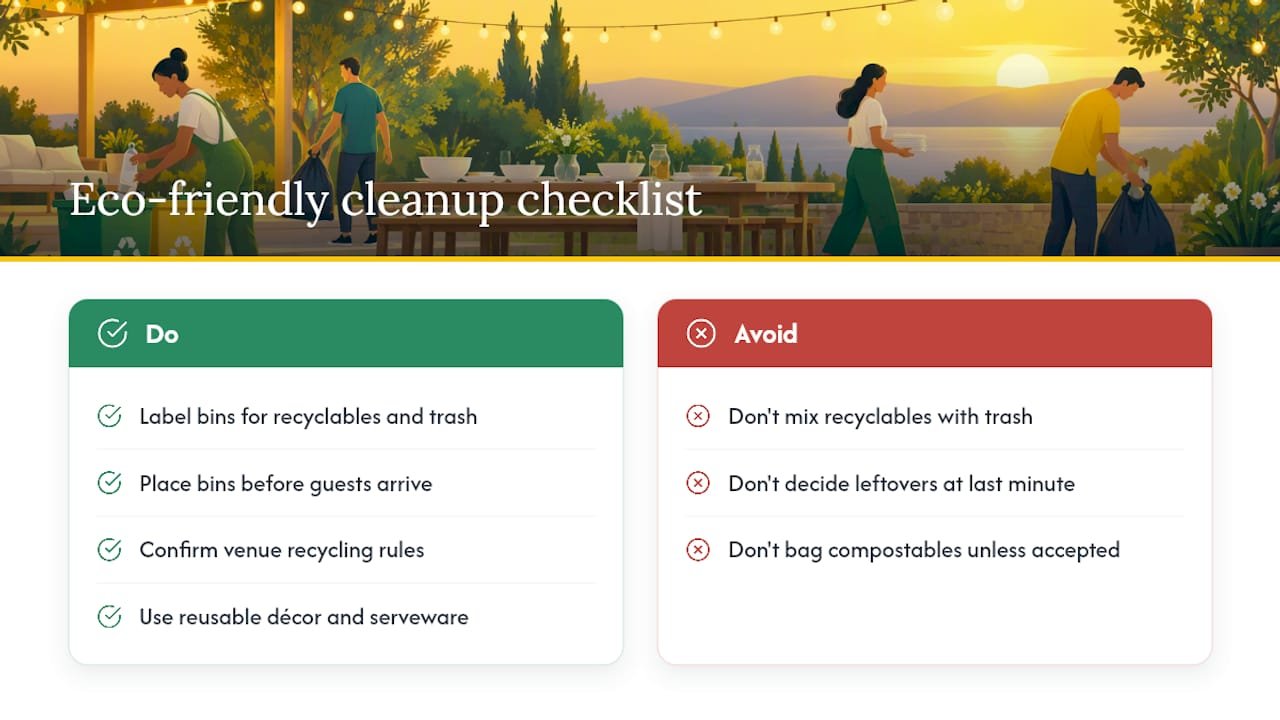
Sorting waste properly during a party cleanup does more than reduce landfill volume. It also tends to speed up the process itself, since recyclables, food waste, and general trash headed to separate bins do not need to be re-sorted later by venue staff or a cleaning crew.
Set up clearly marked bins for recyclables like cans, bottles, and cardboard separately from general trash before guests arrive, not as an afterthought during breakdown. If the venue provides its own recycling stream, ask which materials it accepts so you are not bagging items that end up in general waste anyway.
Reusable décor and serving ware cut down on what needs sorting in the first place. Cloth tablecloths, refillable pitchers, and reusable centerpieces mean less single-use material moving through the cleanup process at all. When disposable items are unavoidable, compostable plates and cutlery are worth considering if the venue or municipal service accepts them, though not every disposal system does.
Leftover food deserves its own decision point rather than automatic disposal. Offering guests takeaway containers for extra food reduces both waste and the volume you need to bag and carry out. Whatever the answer, deciding on it before the party starts keeps cleanup faster and avoids the last-minute scramble of figuring out what goes where while guests are already heading for the door.
Tips for efficient trash sorting and disposal
Sorting as you go beats sorting at the end. A party that generates trash steadily over two or three hours is much easier to manage if bags get tied off and replaced periodically instead of left to overflow until breakdown time.
Label bins clearly, even with something as simple as handwritten signs taped to the front, so guests and helpers do not have to guess which bag is for what. Placing bins near food and drink stations, where most waste actually gets generated, cuts down on trash left on tables and floors in the first place.
Break disposal into stages rather than one big push at the end:
- During the event, do a quick sweep every 30 to 45 minutes to catch stray cups and plates before they pile up.
- As the party winds down, consolidate all bags into one holding area near the exit or designated receptacle.
- Before departure, do a final walk-through of every room or activity area to catch anything left behind.
Heavier or wet trash, like food scraps or drink spills, should go into sturdier bags than paper napkins and wrapping paper. Doubling bags for anything with liquid prevents the kind of mid-carry tear that turns a five-minute task into a bigger cleanup than it needed to be.
Recommended tools and supplies for party cleanup
A short supply kit prepared ahead of time saves a lot of scrambling once the party is actually winding down. Heavy-duty trash bags are the obvious start, since standard kitchen bags tend to tear under the weight of bottles, cans, and food waste.
Beyond bags, a practical kit includes:
- Disposable gloves for anyone handling food waste or spills during breakdown.
- A few rolls of paper towels or reusable cloths for wiping down surfaces before a final walkthrough.
- An all-purpose cleaning spray for quick spot cleaning of spills on tables or floors, where permitted by the venue.
- A small broom and dustpan for confetti, cake crumbs, or other debris that does not belong in a regular trash bag.
- Ziplock bags or small containers for handling odds and ends like leftover party favors or small decorations.
Bringing your own basic supplies rather than assuming a venue will provide them is generally the safer approach, since not every venue stocks cleaning materials for guest use. A rolling cart or wagon, if you have one, also makes hauling bagged trash and leftover supplies out to a car far faster than multiple trips by hand.
Delegation strategies: assigning cleanup tasks to guests or helpers
Trying to clean up solo while also saying goodbye to guests is one of the more common ways hosts run over their booked time. Splitting tasks among a few reliable people ahead of time solves that problem before it starts.
Assign specific, narrow tasks rather than a vague request for “help cleaning up.” A friend who knows their job is bagging trash from tables works faster than a group of people unsure what to grab. Useful roles to hand out in advance include a trash and recycling runner, a décor and gift collector, a table and surface wiper, and someone dedicated to checking lost and found items before the room clears out.

Give each helper their assignment before the party starts, not when it is already ending, so nobody is improvising while guests are filtering out the door. It also helps to ask one or two close friends or family members to stay 15 to 20 minutes past the main crowd specifically for this purpose, since most other guests will not linger to help once the party itself winds down.
For kids’ parties, older siblings or a co-host parent often make the most reliable helpers, since younger guests are rarely in a position to pitch in meaningfully. For corporate events, assigning a colleague as departure lead keeps the task off the shoulders of whoever organized the event and was likely busy coordinating everything else all day.
Publisher perspective: Archers Battlefield’s approach to cleanup in party packages
Cleanup disputes usually come down to unspoken assumptions rather than bad faith on either side. The fix is not stricter rules, it is clearer ones, stated before the deposit changes hands.
Archers Battlefield builds its event packages around that idea, defining staff tasks and organizer duties as part of the event package terms rather than leaving cleanup as an afterthought. Organizers booking any hosted party are better served asking about cleanup specifics at the time of booking rather than assuming a standard applies everywhere.
— Archers
How Archers Battlefield can simplify cleanup
Booking a venue that spells out cleanup responsibilities upfront means fewer surprises at the end of the night. Some venues document these responsibilities directly in their party packages, so organizers know before the event which tasks fall to staff and which fall to the host.

Event planning support can be part of a booking, which means questions about departure timing, vendor coordination, or trash placement can get answered before the party rather than during it. A few starting points worth checking depending on your event type:
- Reviewing kids birthday party packages if you are planning a child’s celebration.
- Checking team-building packages for corporate or group events.
If your event has a special cleanup arrangement in mind, such as an unusual amount of décor or an outside caterer with specific removal needs, mention it directly when you book now so it can be confirmed ahead of time rather than negotiated on the day.
Useful sources and internal pages to confirm cleanup terms
A few pages are worth bookmarking before you finalize any hosted party booking. The private events page lays out how plain-language agreement terms typically get structured for activity parties and hosted entertainment.
- Event packages for a full view of party and team-building options.
- Book now to check availability and confirm terms directly.
- For general background on how cleanup tasks map against a fixed event schedule, this event timing and operations guide offers a useful outside perspective for planners.
FAQ
What is typically included in a venue’s cleanup plan?
A venue’s cleanup plan usually covers staff resetting activity equipment, wiping high-touch surfaces, and emptying venue-owned trash bins. Hosts are typically responsible for removing their own décor, gifts, and personal items before leaving.
Does cleanup time count against my booked hours?
Yes, cleanup is commonly treated as part of the time slot you booked rather than a separate grace period afterward. Running past your contracted end time can trigger overtime pay, cleaning surcharges, or deductions from a damage deposit.
Who is responsible for removing leftover food after a party?
Caterers and outside vendors are generally expected to remove their own food, equipment, and waste like cooking oils, since venues typically do not absorb that task. Confirming this in writing with your caterer before the event avoids a last-minute gap.
What should a final walkthrough with the venue cover?
A final walkthrough should cover trash removal, any damage to the space, and whether vendor materials have been cleared out. Time-stamped before-and-after photos, kept with the booking record, are a simple way to support that walkthrough if a dispute comes up later.
How does Archers Battlefield handle cleanup responsibilities?
Archers Battlefield defines staff tasks and organizer duties directly within its event packages, so cleanup expectations are set before the party begins. Organizers can confirm the exact terms for their event type when they book.


