
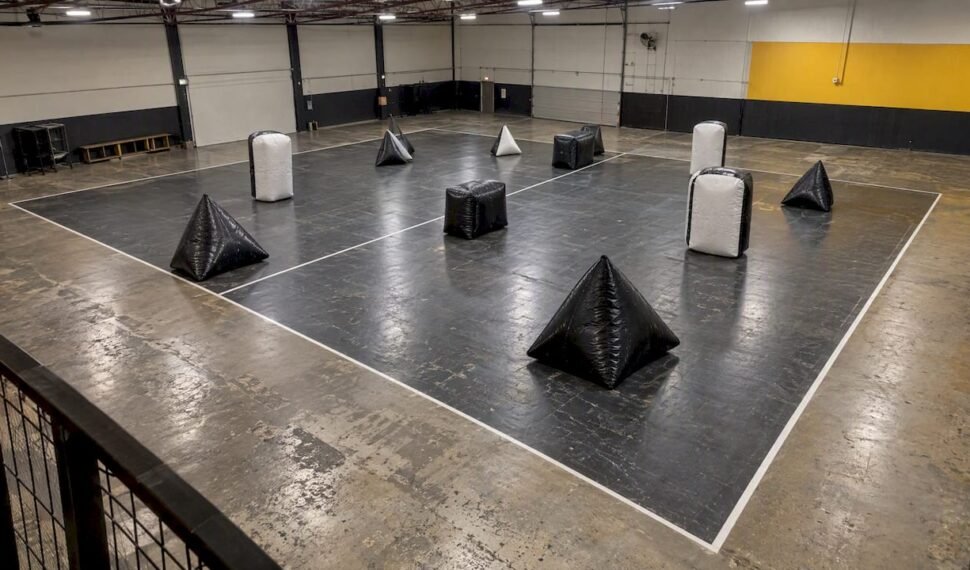
A standard combat archery field, also called an archery tag field, is about 62 feet long and 30 feet wide: two 22-foot action zones with an 18-foot neutral zone between them. That is a small footprint, roughly 1,860 square feet of playing surface. Games themselves are short, usually a few minutes each, so a booked session is a string of rounds rather than one long match. Below we explain where those numbers come from, how a real indoor venue uses its space, and how to plan group size and timing.
TL;DR
- The brand guideline layout for archery tag is 62 feet long: two 22 x 30 ft action zones and one 18 x 30 ft neutral zone (Archery Tag field setup).
- There is no single legal standard. Venues adjust the field to the room, the group size and the age of the players.
- Individual rounds typically run a few minutes, and a session is made up of many rounds plus a briefing and gear-up.
- Plan for the buffer around the field, not only the field itself, because safety distance is what actually eats floor space.
- At Archers Battlefield, single combat archery sessions start at $35 per person, and group packages start at $399.
Table of Contents
- The standard field: 62 feet by 30 feet
- Is there one official size?
- What an indoor venue looks like in practice
- Safety space: the buffer matters more than the field
- How many players fit on a field?
- How long does a game last?
- Planning around the field: kids, teams and parties
- Our perspective
- Book combat archery with Archers Battlefield
- Checklist: questions to ask any venue about its field
- FAQ
- Sources
The standard field: 62 feet by 30 feet
The most widely used reference layout comes from the Archery Tag brand. Its field setup guideline describes a field 62 feet long. It is split into three parts:
| Zone | Length | Width | Area |
|---|---|---|---|
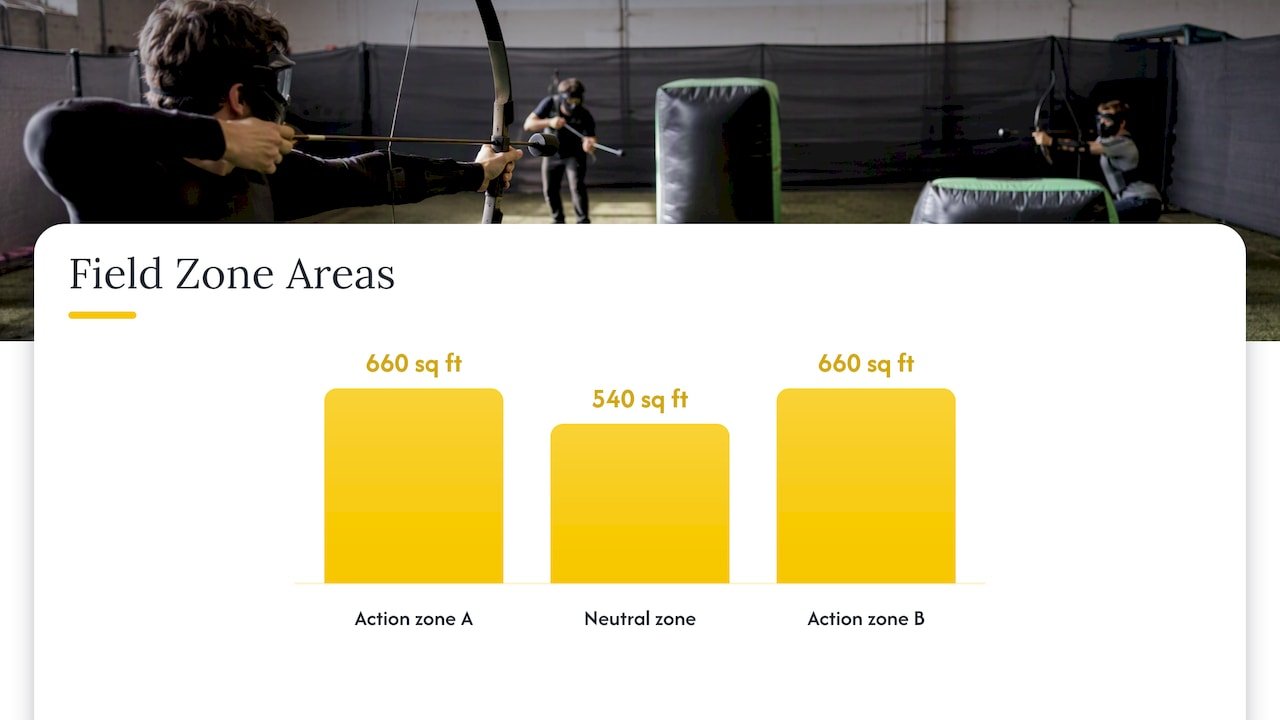
| Action zone (team A) | 22 ft | 30 ft | 660 sq ft |
| Neutral zone | 18 ft | 30 ft | 540 sq ft |
| Action zone (team B) | 22 ft | 30 ft | 660 sq ft |
| Whole field | 62 ft | 30 ft | 1,860 sq ft |
The area figures are our own arithmetic from the published dimensions. In metric terms the field is a little under 19 metres long and about 9 metres wide.
The layout makes sense once you see how the game plays. Each team starts in its own action zone, usually behind inflatable bunkers. The neutral zone is the gap players cross to reach the middle line, collect equipment or push toward the other side. Because arrows are foam-tipped and the shooting distances are short, the game is built around quick movement and cover rather than long-range accuracy.
Why the field is so small
Combat archery is a tag game, not a target sport. Standard archery ranges are built around fixed shooting distances that are far longer than this. Archery GB’s facility guidance, for example, notes that indoor competition archery uses an 18 metre shooting distance, nearly the whole length of a combat archery field on its own. A tag field compresses the action so that every player is within range of every opponent, which keeps rounds fast and keeps beginners involved.
Is there one official size?
No. The 62 by 30 foot figure is a brand guideline, not a law or a national rule. Operators who run combat archery adapt the field to the building, the equipment they own and who is playing. A few common adjustments:
- Shorter fields for younger players. Kids shoot at shorter effective distances and tire quickly, so a shorter neutral zone keeps the game moving.
- Wider fields for larger groups. More players per side means more bodies in the same space. Widening the field gives each player room to move and lowers the chance of crowding behind one bunker.
- Different layouts per game mode. Capture-the-flag style rounds, elimination rounds and target-based rounds all place bunkers differently. We cover those in our guide to archery tag game modes venues use.
- Room-driven limits. Ceiling height, columns, lighting and exits all shape where a field can go indoors.
So when a venue says its field is a certain size, the useful question is how that size compares with the layout above and how many players it is built for.
What an indoor venue looks like in practice
A field marked on the floor is only part of the picture. A local visit report on Archers Battlefield in Pickering, Ontario describes it as an 8,500-square-foot indoor arena. That is more than four times the 1,860 square feet of one standard field. The extra room is not wasted: it holds waiting areas, equipment racks, safety briefing space and the buffer around the playing area.
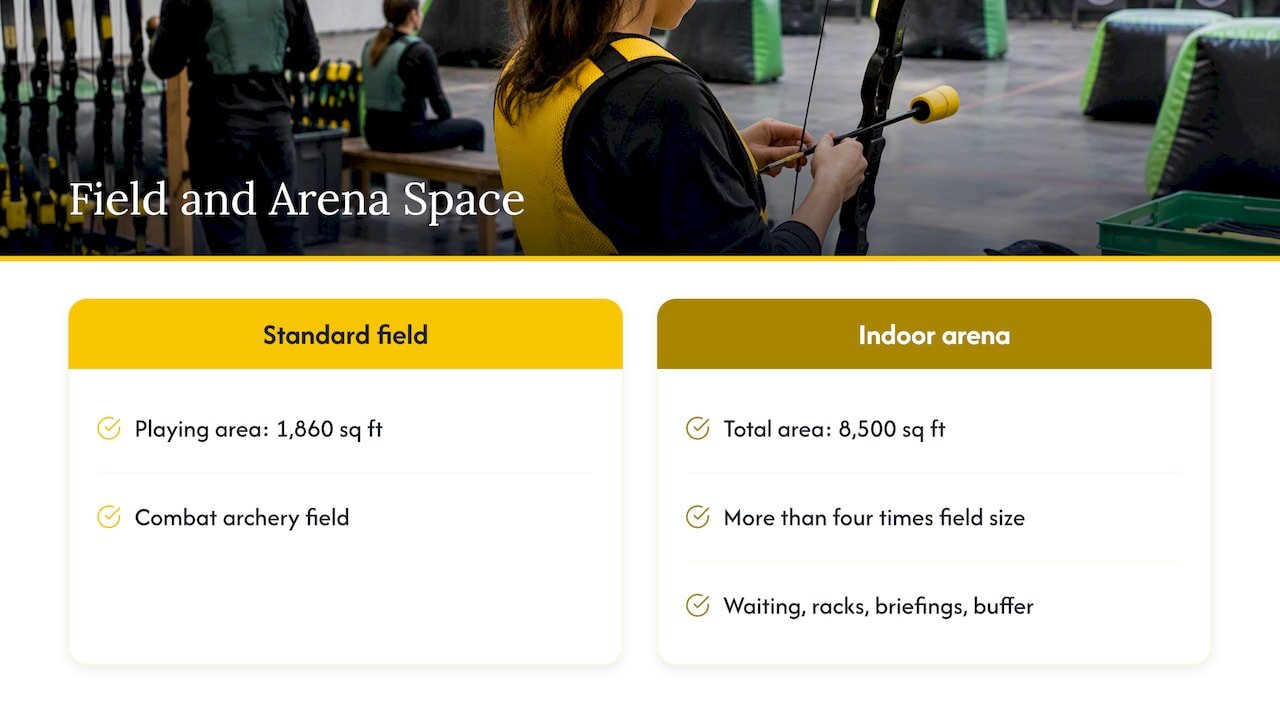
If you are comparing venues, treat total room size and playing field size as two different numbers. A big hall does not mean a big field, and a modest field in a well-organized room can play better than a huge one with no structure.
It also helps to think about how different this is from a fixed, lane-based range. A shooting range in a city like Krakow, such as the shooting range in Kraków experience, is laid out in lanes with shooters facing one direction. A combat archery field is the opposite: two teams face each other across open floor, moving constantly, so the layout is built around cover and sight lines rather than lanes.
Safety space: the buffer matters more than the field
The field is the easy part. Safety distance is what determines how much room you really need.
A useful comparison is a duel format used in historical combat archery. The Archer’s Holmgang game uses two 8-metre circles and a 1-metre-square central area, and the guidance recommends that spectators stay at least 30 metres away. That is a different activity with different equipment, so do not read it as a rule for foam-tipped archery tag. It does show how seriously combat archery sports treat the zone around the action.
For a recreational venue, the sensible takeaways are practical:
- Keep spectators outside the field, behind a barrier or netting. Parents and coworkers watching should never stand where arrows can land.
- Mark where players may and may not go. Clear boundary lines and bunkers help players know their zone.
- Control arrow collection. Arrows are gathered between rounds on a signal from the referee, never during play.
- Require face protection. Masks are part of the setup. See our guide to combat archery masks for what they cover and how to choose one.
- Read the rules aloud before each session. Our combat archery rules page lists seven pregame points we cover.
How many players fit on a field?
The published layouts do not give a single headcount, so here is a practical way to think about it using the 1,860 square foot reference field.
With teams of five, each side has 660 square feet of action zone, or 132 square feet per player. With teams of ten, that drops to 66 square feet per player, which is tight but workable for fast elimination rounds with bunkers. Beyond that, most organizers either widen the field or split the group into rotating teams so that some players wait while others play.
Rotation is the more common solution at group events. It keeps the game safe and it keeps every player involved, because a round is short and the waiting team is only a couple of rounds from playing.
| Group size | Typical approach |
|---|---|
| 6 to 10 players | One field, all play at once, 3 to 5 per side |
| 10 to 20 players | One field, rotating teams, or two smaller games |
| 20+ players | Rotation across several activities, such as combat archery, dodgeball and ping pong |
These are planning suggestions based on the area math above, not published limits. Ask any venue what its maximum is for the field it uses.
How long does a game last?
Rounds are short because the game is intense. Published rules and venue pages show a range:
- A university intramural rule sheet sets a 5-minute time limit for elimination and points games, with shorter limits for best-of-five match formats.
- Many venues run longer rounds, especially when kids play, so that everyone gets a turn at the target.
The pattern is clear: a round lasts minutes, not an hour. What makes a booking last an hour or two is the number of rounds, the changeovers between them and the time spent explaining the rules.
What a session includes
The total time you book usually covers more than playing. Expect these pieces:
- Arrival and check-in. Waivers, sorting teams, and getting everyone into the room.
- Safety briefing. Rules, boundaries, what to do if a game is called, and how to wear the mask.
- Gear-up and practice shots. Bows, arrows and masks are handed out, and beginners get a few practice shots.
- Rounds of play. Several short games with arrow collection and team swaps between them.
- Wrap-up. Gear is returned, and in a party setting this is where food, cake or a debrief happens.
If you are booking for a birthday or a team event, ask whether the stated time is playing time or the whole slot. Check the details for your package on the relevant booking page, because we do not want to promise a duration here that varies by package and group.
Planning around the field: kids, teams and parties
For kids’ birthday parties, the field size matters less than the structure. A shorter, well-run set of rounds, then cake, beats a long game that tires everyone out. Our combat archery birthday packages are built for that rhythm, and families can compare options on the kids birthday party packages page.
For corporate groups and sports teams, rotation is the key. Short rounds suit team building because everyone gets multiple turns, switching sides keeps it friendly, and competition scores are easy to track. See our team building page for what is included.
For mixed groups, a single field cannot give everyone the same experience for two hours. That is why we pair combat archery with other activities. A group might play archery tag, then move to dodgeball, ping pong or Nerf battles while another team takes the field.
Our perspective
We run combat archery in an indoor venue with other activities close by, and the thing we see most often is that organizers worry about field size when they should worry about flow.
A standard field is small on purpose. What makes a session feel generous is clear rules, a quick briefing, fast changeovers and a mix of activities, so no one is standing around for long. That is how we plan groups, whether it is eight kids or a full office.
We also think the room around the field deserves as much planning as the field itself. Spectator space, a place to put coats and a spot to gather for cake or a team debrief all decide whether the day goes smoothly. Our packages are designed around that, with planning support so you do not have to work out the layout yourself.
Archers
Book combat archery with Archers Battlefield
If you would rather skip the layout math, we handle the field, the equipment, the briefing and the rotation. Single combat archery sessions are $35 per person, and Nerf battles are also $35. For parties, the Game On Birthday Party starts at $399 and the Epic Birthday Party at $499. Team packages for sports groups start at $399 with the Game On Team Battle.

See all event packages or start with the Archers Battlefield home page to choose an activity and send an event inquiry.
Checklist: questions to ask any venue about its field
Before you book anywhere, these questions give you a clearer picture than the field’s dimensions alone:
- How big is the playing field, and how many players is it designed for?
- Is the space inflatable-bunker based or open floor?
- Where do spectators and waiting players stand?
- Is face protection included for all ages?
- How long is each round, and how many rounds fit in the slot?
- Does the booked time include briefing, gear-up and changeovers?
- Can the group rotate to other activities so the wait is short?
FAQ
What size is an archery tag field?
The brand guideline is 62 feet long and 30 feet wide, made up of two 22-foot action zones and an 18-foot neutral zone. Venues often adjust this to fit the room and the group, so treat it as a reference point rather than a fixed rule.
How much space do I need indoors for combat archery?
You need the field plus a safety buffer and room for waiting players and equipment. A single field is about 1,860 square feet, but a venue needs noticeably more floor area than that to run it safely with a group.
How long does one game of archery tag last?
Individual rounds usually run from a couple of minutes to around five minutes in published rule sheets, and some venues run longer ones for younger players. A session is many rounds back to back, plus a safety briefing and gear-up.
Does the session time include the briefing and setup?
It depends on the venue and the package. Ask whether the time you book is playing time or the full slot. For our packages, check the details on the booking page for your group.
Sources
- Field Setup, Archery Tag
- Archery Facilities: Guidance and Specifications, Archery GB
- Archer’s Holmgang, Archery in Lochac
- Ready, Aim, Fun: Inside Durham’s First and Only Combat Archery Arena, Tolobi
- Archery Tag rules, University of Wyoming intramural sports
- Shooting Range Cracow


