

Choose an arcade-style venue when you want turnkey, active, supervised group fun, and choose a console party when you need a low-visible-cost, small, familiar gathering and can handle the setup yourself. The right pick depends on budget, group size, and how much activity you want built into the event. Archers Battlefield packages lean into the venue side, while the Canadian 24-Hour Movement Guidelines help explain why activity level matters so much in that decision.
TL;DR:
- Groups of eight or more, mixed ages, or high energy needs favor a venue; four close friends with a trusted adult can manage at home.
- Home parties look cheaper, but hosts cover snacks, setup, supervision, cleanup, and equipment backups; venues bundle staffing and cleanup, while guests still face travel.
- Guidelines cap recreational screen time at two hours daily for children ages 5 to 17 and call for 60 minutes of activity; add active breaks.
- For console parties, choose cooperative or motion based games, join the children, and schedule a 10 to 15 minute active break halfway through.
Table of Contents
- Arcade venue vs console party: pros and cons side by side
- A quick checklist to pick the right format
- What a venue or a home party actually costs once you add it up
- What screen-time guidance means for your event format
- How Archers Battlefield fits the venue side of this decision
- Ready to book a venue event instead of hosting?
- Why I’d rather pay a bit more and stress a lot less
- FAQ
- Sources
Arcade venue vs console party: pros and cons side by side
An arcade venue trades a higher sticker price for less planning, built-in activity, and staff who manage the logistics. A console party trades convenience for a lower upfront cost and the comfort of a familiar living room, but it shifts nearly all the setup, supervision, and cleanup onto the host.
Arcade venue strengths:
- Staff handle setup, game rotation, and cleanup, so the host can actually enjoy the event.
- Guests move between games, which keeps energy up and reduces the awkward lulls that happen when everyone sits still.
- Group dynamics tend to be stronger because people play side by side rather than waiting for a turn on one screen.
Arcade venue weaknesses:
- Higher upfront cost and a fixed time window.
- Travel is required, which matters for guests without easy transportation.
Console party strengths:
- Lower apparent cost since you are using equipment you likely already own.
- Familiar, private setting with no travel for the host.
Console party weaknesses:
- One or two screens mean long waits for turns in larger groups.
- Supervision, snacks, cleanup, and troubleshooting all fall on the host.
Co-located cooperative play, where people are physically together and working toward a shared goal, tends to produce stronger social bonds than solitary or passive screen time, according to research on player cooperation. That matters for birthday parties and team-building events, where the goal is connection, not just entertainment.
The Canadian 24-Hour Movement Guidelines recommend limited recreational screen time daily for children ages 5 to 17, along with a minimum amount of moderate-to-vigorous physical activity. A long console party can use up a child’s entire daily screen allowance in one sitting, which is worth weighing against an arcade setting that mixes movement into the fun.
A quick checklist to pick the right format
Run through these inputs before you book or plan anything, in roughly this order of importance.
- Guest count: eight or more guests, or a wide age range, usually points to a venue with multiple activity stations.
- Energy expectations: if the group wants to run around and burn energy, a venue with built-in movement beats a couch and a screen.
- Budget shape: if you need a predictable, all-in price with no surprise costs, a packaged venue event is easier to plan around.
- Space and supervision: a small, close-knit group with one or two trusted adults and a quiet space at home can make a console party work well.
- Time available to plan: if you have more money than spare hours, pay for the convenience.
Pro Tip: If you’re unsure, ask how many “active minutes” the event will realistically include. If the honest answer is under 30, lean toward a venue.
Three quick scenarios: a mixed-age kids’ birthday with 10 guests fits a venue because rotation keeps everyone engaged regardless of age. A small teen hangout with four close friends and one parent nearby can work fine as a console night since the group already knows how to entertain itself. A small family party with grandparents and young kids together often does better at a venue, since staffed activities bridge the energy gap between generations better than a single screen can.
What a venue or a home party actually costs once you add it up
The sticker price rarely tells the whole story on either side. At home, the real costs include your own planning time, cleanup afterward, snacks and drinks for the group, equipment rentals if you don’t own enough controllers, and a backup plan if the console or Wi-Fi fails mid-party. Hidden effort and time investment often make at-home events cost more in practice than their raw price suggests, according to commentary on movement guidelines.
A venue price usually bundles more of this in from the start:
- Staffing to run games and manage rotation so no one is left waiting.
- Cleanup handled on-site, with no mess to deal with afterward.
- Equipment and liability coverage built into the booking, instead of something you have to arrange yourself.
- Travel time for guests, which is the main added cost on the venue side.
Before you book or host, confirm the setup and teardown windows, any food or outside drink rules, parking and accessibility for guests with mobility needs, and a backup plan for bad weather or a tech failure.
What screen-time guidance means for your event format
The Canadian Paediatric Society recommends favoring screen activities that are active, educational, or social, and encourages parents to join in rather than drop kids off in front of a screen. That guidance applies directly to console parties: a two-hour session of passive, solo-style gameplay is a different experience than one built around cooperative, social game modes with an adult involved.
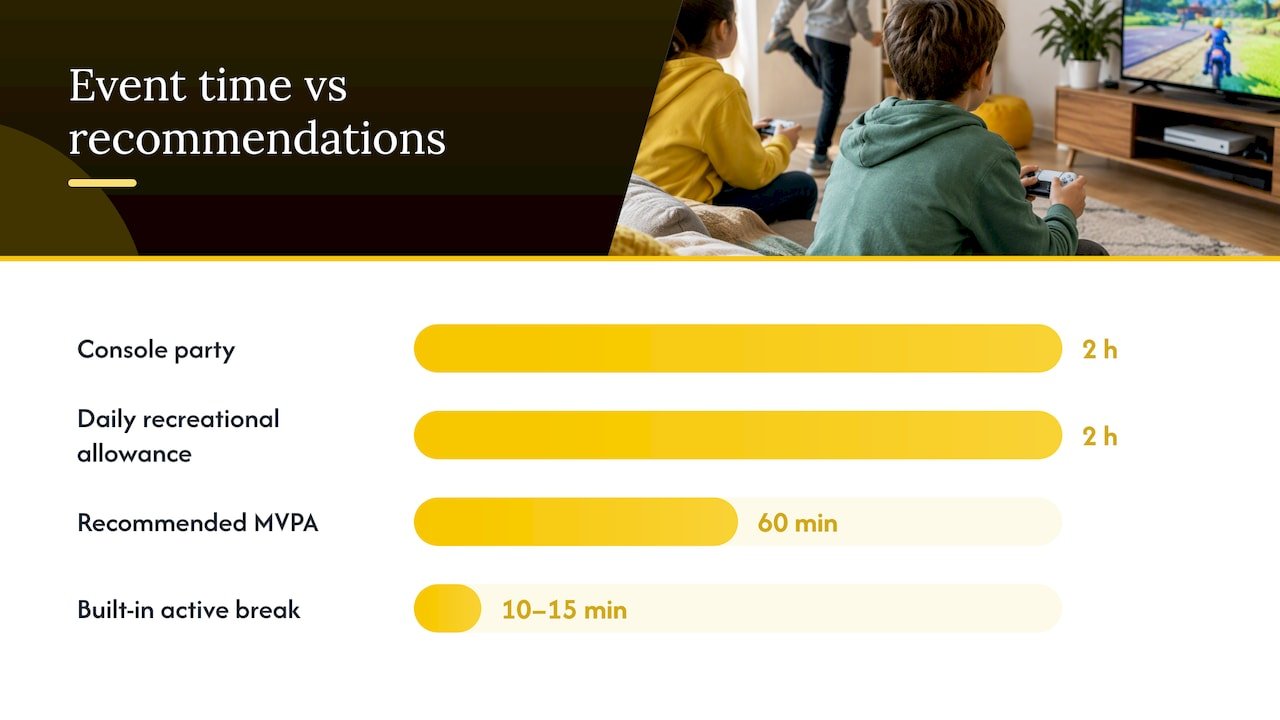
A console party of typical length can account for the entire daily recreational screen allowance recommended for children ages 5 to 17, per the movement guidelines, which also call for at least 60 minutes of moderate-to-vigorous activity that day.
If you do go the console route, a few adjustments help close the gap:
- Build in a 10 to 15 minute active break halfway through, even something as simple as a quick game outside.
- Choose cooperative or motion-based game modes over solitary, screen-only ones.
- Stay in the room and play alongside the kids instead of leaving them unsupervised.
- Set a soft time limit going in so the party doesn’t quietly run long.
How Archers Battlefield fits the venue side of this decision
For organizers who land on the venue side, Archers Battlefield packages mix arcade games in with combat archery, Nerf battles, dodgeball, and other active formats, so guests rotate through stations instead of watching one screen. Staff run the event and handle setup and cleanup, covering supervision and logistics concerns. Packages are designed for groups of various ages, which can suit a wide age range scenario from the checklist above. Details on what’s included and how booking works are on the arcade party games page, and the full package list, including options for larger or mixed-activity groups, is on the event packages page.
Ready to book a venue event instead of hosting?
If the checklist above points you toward a venue, the next step is simple: compare package inclusions and lock in a date before your preferred slot fills up.

- Browse the full lineup, including Pong & Party On from $299 and Action & Chill Bash from $599, on the event packages page.
- Planning a kids’ birthday specifically? The kids’ birthday packages start at $399 for Game On and include age-appropriate activity rotation.
- Organizing a corporate or sports team event? Team-building packages start at $699 for the Collab Package.
For families who want a low-key, screen-free option between bigger events, Screen Free Family Time has a practical starter plan worth a look.
Why I’d rather pay a bit more and stress a lot less
A console party saves money on paper, but the planning, cleanup, and supervision add up fast. Paying a little more for a venue buys back your weekend and gets kids moving instead of sitting. Pick based on how much of your own time you’re willing to spend, not just the number on the invoice.
— Archers
FAQ
Is an arcade party more expensive than a console party at home?
An arcade venue usually has a higher visible price, but a console party carries hidden costs in host time, cleanup, snacks, and equipment backups. Once you account for those, the gap between the two options is often smaller than it first appears.
How much screen time is appropriate for a kids’ party?
The Canadian 24-Hour Movement Guidelines recommend no more than 2 hours of recreational screen time per day for children ages 5 to 17. A long console party can use up that entire daily allowance in one sitting, so pairing it with active breaks helps keep the event in line with the guidance.
What age group works best for an arcade-style venue versus a console party?
Mixed-age groups and larger gatherings tend to do better at a venue, since staffed rotation keeps everyone engaged regardless of age. Small, close-knit groups of similar age with a trusted adult present can do well with a console party instead.
Does Archers Battlefield offer packages that include arcade games?
Yes, arcade games are included as part of mixed-activity event and party packages at Archers Battlefield, alongside combat archery, Nerf battles, and other activities. Full package details and pricing are listed on the event packages page.
Are console parties bad for kids’ social skills?
Not inherently, but research on cooperative play suggests co-located, cooperative gaming builds stronger social bonds than solitary or passive screen time, according to research on player cooperation. Choosing cooperative game modes and staying involved as a parent helps console parties deliver more of that social benefit.
Sources
- Canada
- Digital media: Promoting healthy screen use in school-aged children and adolescents | Canadian Paediatric Society
- From Solo to Social: Exploring the dynamics of player cooperation (Eindhoven University of Technology)


