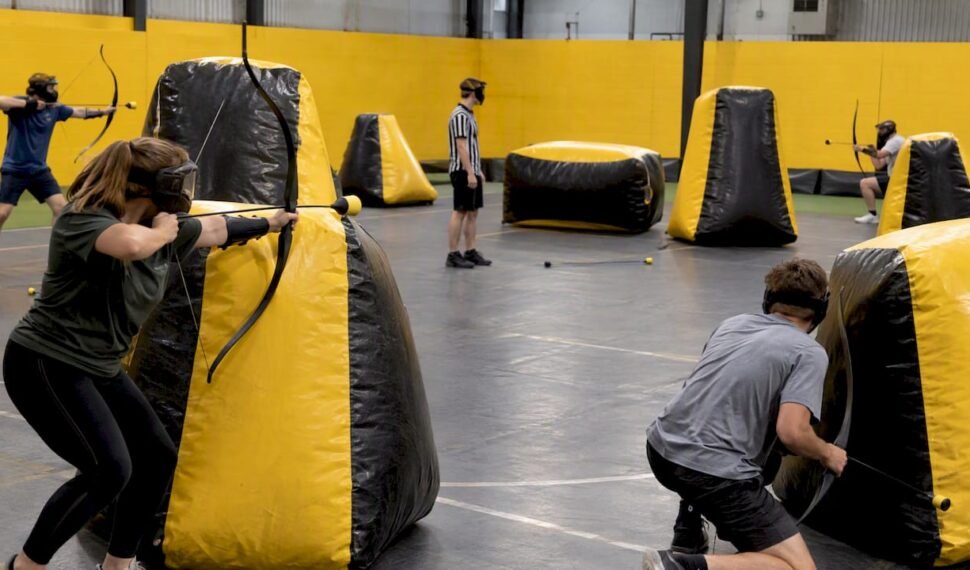
Archery tag is safe when four things are in place: everyone in the playing area wears a properly fitted face mask, the equipment is inspected before the game, the field is padded and clearly marked, and a referee enforces the rules from the first arrow to the last. Remove any one of them and the risk climbs. This guide walks through each, plus age and supervision, so you can judge any combat archery session, ours or anyone else’s, before you book.
TL;DR
- Face masks are the core rule: everyone in the active playing area, including referees and sideline observers, wears a properly fitted mask at all times.
- Gear gets inspected before play: worn or rounded foam tips come out of use, bow limbs must be secure, and frayed strings get waxed.
- Hard surfaces such as walls, posts and pillars should be padded, and the field boundaries and neutral zones must be clear.
- Younger children need closer supervision and a game style adapted to them; a referee should be on the field for the whole session.
- Ask your venue about its mask policy, referees and insurance before you pay a deposit.
Table of Contents
- What archery tag is and why its safety model differs from target archery
- The mask rule: non-negotiable
- Equipment checks before every game
- Rules players follow during the game
- Setting up a safe playing area
- Age, suitability and supervision
- What organizers and referees do when something goes wrong
- Our perspective on archery tag safety
- Questions to ask before you book any combat archery session
- Book a supervised session with us
- FAQ
- Sources
What archery tag is and why its safety model differs from target archery
Archery tag, also called combat archery, is a team game. Players shoot foam-tipped arrows at opponents to eliminate them or score points, usually in dodgeball-style rounds behind inflatable bunkers. The manufacturer of the original equipment describes the arrows as non-lethal, and that is the key difference from target archery.
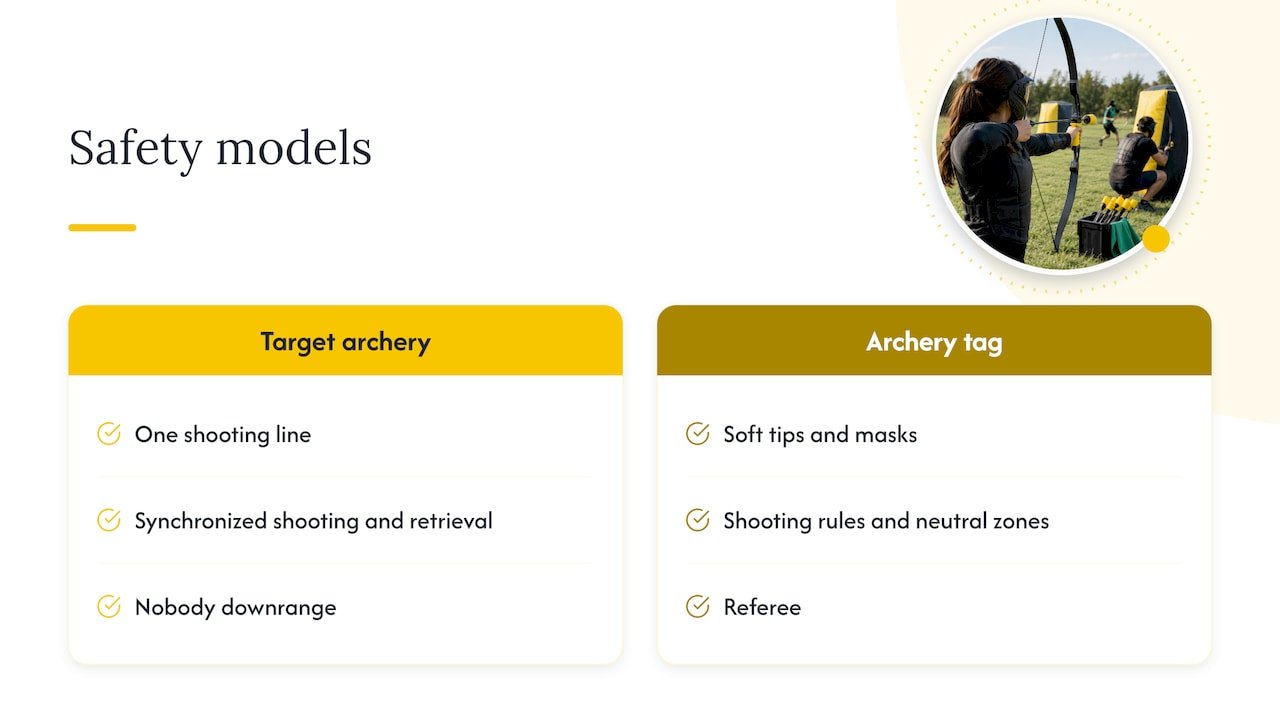
On a target range, safety comes from direction and discipline: one shooting line, everyone shoots and retrieves together, and nobody is ever downrange. In archery tag, people are the targets by design, so the safety comes from the equipment and the structure of the game instead. Soft tips, masks, shooting rules, neutral zones and a referee replace the range line.
The two worlds still share one idea. Archery Canada’s rule book puts responsibility on every participant, not just officials, to watch their shooting group and report unsafe behaviour. That works just as well in a combat archery arena: if you see something unsafe, say so right away.
The mask rule: non-negotiable
The main risk in archery tag is a foam-tipped arrow reaching the face, and above all the eyes. That is why the one rule every serious operator enforces is the mask. The equipment maker’s safety page states that all participants, including sideline observers and referees, must wear properly fitted face masks at all times while within the active playing area.
Three practical points follow from it.
- Fit matters as much as wearing one. A mask that slides down or leaves gaps is not doing its job. Adjust the straps before the first round, and again if a mask loosens.
- Eyewear is not a substitute. Sunglasses, ski goggles or sports glasses are not a stand-in for the mask supplied for the game. Glasses wearers should tell the staff before play so the mask is fitted over their glasses properly.
- The mask comes off only in a designated safe area. If someone needs a break, they leave the field first, then remove the mask. Pulling it up to wipe sweat or talk mid-round is how accidents happen.
We cover what masks do and do not protect, and how to choose one, in our guide to combat archery masks.
Equipment checks before every game
Safe gear is checked gear. The manufacturer’s guidance says to inspect equipment before gameplay and to replace worn foam tips, or take the arrow out of use if the tips are worn or significantly rounded. It also calls for making sure bow limbs are secure and waxing frayed or fuzzy strings right away.
Here is a simple pre-game checklist anyone can run, whether you are the venue or a parent watching from the side:
| Item | What to look for | What to do |
|---|---|---|
| Foam tips | Worn, compressed, cracked or rounded down | Pull the arrow from play |
| Bow limbs | Loose, cracked or wobbling | Fix or retire the bow |
| Strings | Frayed or fuzzy | Wax or replace before use |
| Masks | Cracks, loose straps, poor fit | Replace or readjust |
| Field edges | Hard surfaces without padding | Pad or block off |
If a venue cannot tell you how and when it inspects its arrows, that tells you something. A good operator will answer in a sentence.
Rules players follow during the game
The equipment maker lists several gameplay safety rules. Players should remove all jewelry and piercings, never use equipment to deflect incoming arrows, and never intentionally shoot at anyone outside the designated field or in a safe zone. Each one has a clear reason.
- Remove jewelry and piercings. Rings, earrings and necklaces can catch on gear, or get pushed into skin by a hit.
- Do not block arrows with your bow. Using the bow as a shield can damage it and send arrows off in unpredictable directions.
- Never shoot into the neutral zone or outside the field. Referees, staff, spectators and players retrieving arrows are all there. They are off limits.
- Report unsafe play to the referee. During play, the referee should hear about anything unsafe so it can be corrected immediately.
Other sensible house rules vary from venue to venue: a minimum shooting distance, flat shots rather than arcing arrows into areas you cannot see, and no running with a nocked arrow. Ask what your venue’s version is. Our own seven pregame rules to read aloud is a good model for the briefing every group should hear.
For everyday clothing, closed-toe shoes are the sensible default because the game involves quick movement and ducking. Long sleeves and long pants add comfort for sensitive younger players. For groups arriving from the office, the same logic applies, and our corporate event dress code guide shows what works.
Setting up a safe playing area
Most of a venue’s safety work happens before the first player walks in. The manufacturer says that hard surfaces such as walls, doors, fences, posts and pillars should be padded, that unauthorized barriers without padding should not be used, and that players must not shoot at anyone in the neutral zone or outside field boundaries.
When you tour a space or look at photos, check these points:
- Clear boundaries. Players should always know where the field ends, where the neutral zone is and where to stand when they are eliminated.
- Padded obstacles. Bunkers should be soft or inflatable. Pillars, posts and walls near the action should be padded.
- Separated spectators. Parents and observers either stay outside the active area or wear masks like everyone else.
- Clean floor. Loose arrows, water bottles and bags on the floor are trip hazards. A good operator collects arrows between rounds on a signal, not in the middle of live play.
- Enough room for the group. An overcrowded field means closer shots and more collisions. Group size should match the space.
If the venue is a rented hall or a town facility, check who is responsible for what. Some municipalities set specific insurance conditions for high-risk sports: Oakville, for example, requires permit holders renting Town facilities for sports such as archery to carry commercial general liability insurance of at least $5,000,000 per occurrence. If you are organizing a game at a municipal or school space in Ontario, ask the facility what it requires before you plan anything.
Age, suitability and supervision
There is no single Canadian rule that sets a minimum age for archery tag, so the answer comes from the operator’s policy, your own judgment and the child’s maturity. Those ranking pages on the topic suggest roughly age 8 as a typical starting point, but treat that as a rule of thumb, not a regulation. What matters more is whether a child can listen to a safety briefing, keep a mask on, and follow a stop call.
Official guidance for organized youth archery in Canada is stricter than a typical party. Nova Scotia’s physical education safety guidelines say that archery is not appropriate for grades Primary to 3 and that teachers instructing it need Basic Archery Instructor certification. That guideline covers real bows and school instruction in Nova Scotia, not foam-tipped games, but it shows the level of caution Canadian education bodies apply to archery with young children. The Department of National Defence applies a similar idea to the Junior Canadian Rangers: every activity needs a risk management plan, training for participants and supervision levels adapted to the activity.
Translate that into what you can ask for at a party or school trip:
- A trained referee on the field for the whole session, not someone who briefs the group and leaves.
- A game adapted to the players. A birthday for nine-year-olds should not run like a stag party. Slower rounds, shorter sessions and simpler modes suit younger kids, and we describe how venues adapt them in our guide to archery tag game modes.
- Adult supervisors who know the rules too. If you are the host, listen to the briefing yourself.
- A stop signal everyone knows. One whistle or call that freezes the game instantly.
- Individual attention for nervous kids. Let them watch a round first, wearing a mask, before they play.
For school groups and youth leaders, check your own board’s or organization’s policy on off-site activities before you book, and keep the paperwork the venue provides.
What organizers and referees do when something goes wrong
Most incidents are minor: a trip, a collision, a hit on an unprotected hand. The response should still be fixed in advance.
- Stop play at once. A referee’s call should freeze the field. Archery Canada’s rulebook gives its own safety officers the power to pause all shooting during an emergency; the same principle should apply in any game that uses arrows.
- Move the player out of the field before checking them, and keep the rest of the group in a safe area.
- Take equipment out of use. If a broken bow or damaged arrow caused the problem, tag it and set it aside.
- Report it. The manufacturer’s guidance asks players to report unsafe activity to the referee, and that includes equipment problems.
- Call emergency services for anything serious, especially an eye injury or a head injury. Do not wait to see if it settles.
An Archery Canada safety rule in plain terms: everyone has a role. That includes the players, the host and the staff.
Our perspective on archery tag safety
We run combat archery alongside Nerf battles, dodgeball, bazooka ball, axe throwing and ping pong, so we watch how different groups behave around risk every week. What we notice is that the safest sessions are rarely the ones with the most rules. They are the ones where the briefing is short, specific and repeated, the referee stays on the field, and the gear is checked every time rather than when someone remembers.
We also think safety should shape the game, not shrink it. A group of eight-year-olds, a corporate team and a league night all want different energy, so the format, the pace and the briefing change with them. Equipment checks and a clear stop call do not spoil the fun. They are what let people relax and play hard.
If you remember one thing, make it this: ask any venue how it handles masks, how it inspects arrows and who is on the field during play. The answers should come easily.
— Archers
Questions to ask before you book any combat archery session
Use this list when you phone or email a venue. It takes five minutes and filters out most poorly run operations.
- Is a mask mandatory for everyone in the active area, including spectators and referees?
- Who supplies the masks, and do they fit over glasses?
- How often are arrows, bows and strings inspected, and who does it?
- Is a referee on the field throughout, and what is the group-to-referee ratio?
- Are walls, posts and pillars padded, and are boundaries and neutral zones marked?
- What age range does the session suit, and how is the game adapted for younger players?
- What is the procedure for an injury?
- Is the venue insured, and does it carry waivers for guests?
A venue that answers confidently is a venue that has thought it through. If you are comparing archery tag with other group games, our write-ups on Nerf battles versus paintball and Nerf versus airsoft explain how supervision changes the risk in each.
Book a supervised session with us
We built our events around group sizes and ages, with planning support so you are not organizing the safety side alone. Combat archery is listed at $35 per person on our site, and our Game On Birthday Party starts from $399, with the Epic Birthday Party from $499. For teams, the Game On Team Battle starts from $399.

Look through our kids’ birthday party packages, our sports team events or our team building options, and tell us your group size and ages so we can suggest the right format. If you want to start with the basics, our combat archery birthday guide shows what an organizer needs. You can also see everything we offer at Archers Battlefield.
FAQ
Does archery tag hurt?
A hit from a foam-tipped arrow is meant to be a light sting at most, not an injury, because the tips are soft and designed to be non-lethal. Discomfort depends on distance, the player’s sensitivity and what they are wearing. Long sleeves and pants soften it for younger or sensitive players. Worn or rounded tips should be replaced, since damaged gear is the one thing that changes the feel of a hit.
Do I have to wear a mask the whole time?
Yes, inside the active playing area. The equipment maker’s rule covers everyone there, including referees and sideline observers. Masks come off only once you have left the field to a designated safe area. Taking it off mid-round to adjust it or catch your breath is the habit that most often leads to eye injuries.
What is the right age for archery tag?
There is no single Canadian legal minimum for foam-tipped games, so venues set their own policies. Many suggest around age 8 as a starting point, provided the child can follow instructions and keep the mask on. Younger children need a gentler format and closer supervision, and some will simply prefer a different game.
Can I wear glasses while playing?
Tell the staff before you start. Sunglasses or sports goggles do not replace the mask, so the mask must be worn over your glasses and fit properly. If it cannot be fitted securely, sit that round out and ask the venue about options.
Is archery tag safer than target archery?
They are safe in different ways. Target archery relies on one shooting line and strict discipline around real arrows. Archery tag uses soft tips, masks, padded fields and a referee, because players are the targets. Both depend on following the rules, and in both, everyone is responsible for reporting unsafe behaviour.
Sources
- Safety, Archery Tag, Extreme Archery Equipment
- Archery Tag, Extreme Archery Equipment
- Archery Canada Rule Book 2024: Field and 3D Archery
- Physical Education Safety Guidelines Grades Primary to 12, Nova Scotia
- 10011 JCR Program Safety, Canada.ca
- Insurance Requirements Procedure, Town of Oakville


