
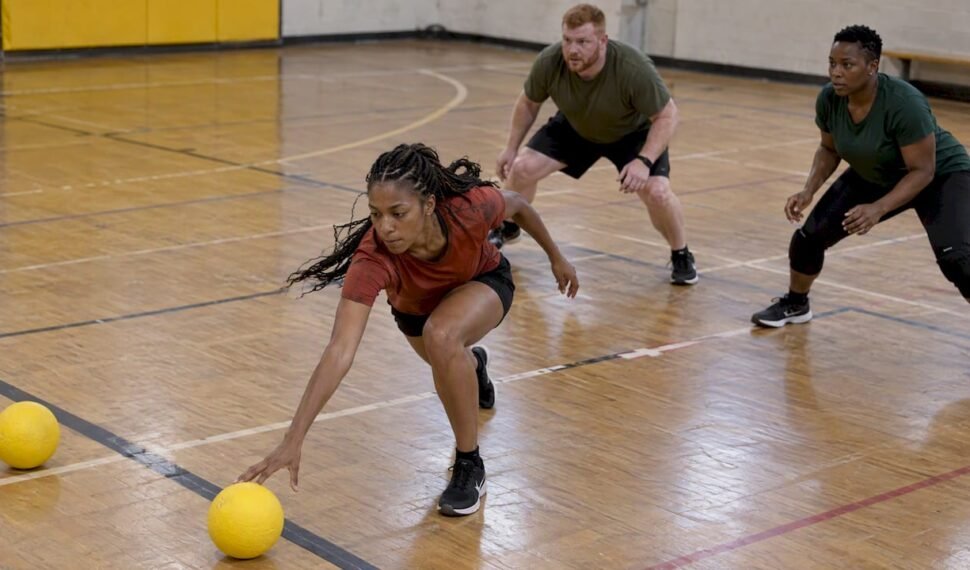
The teams that win at dodgeball are rarely the ones with the hardest throwers. They count balls, throw together, aim at one target, and keep their best players alive. Learn those habits and you can beat a team that throws harder than you do.
This guide covers the strategy that decides games: ball control, group throws, throwing technique, dodging and catching, tournament rules, and how to run a practice. If you want to play with your group instead, our dodgeball sessions are $30 per person.
TL;DR
- Count balls first. When the other team holds more of them, stay defensive. When you hold more, attack.
- Throw as a group at one player. Several balls arriving at once are far harder to track than one.
- Aim at a specific spot on a specific player and throw at about 80% of your maximum. Accuracy beats raw speed.
- Learn the rules of your event. Eliminations, neutral zone lines and head-shot rules change from league to league.
- With kids and beginners, build skills first and keep contact below the waist.
Table of Contents
- Start with ball control
- Throw together: the group throw
- Throwing technique: accuracy before speed
- Defense: dodging, catching and staying alive
- Know the rules before the tournament
- Strategy for kids, schools and beginners
- A practice plan for your team
- Our perspective: what we see on the court
- Play it with your group
- FAQ
- Sources
Start with ball control
Every strong dodgeball team plays the ball count, not just the opponent. The New Orleans Dodgeball Association suggests counting your opponent’s balls before counting your own, which keeps your eyes forward. If the opponent has control, you generally do not want to throw into their ready hands.
What this looks like in a game:
- You have more balls: attack in organized waves and keep pressure on.
- Balls are even: hold, fake, and wait for a mistake. A rushed throw gives the ball away.
- They have more balls: defend, protect your teammates, and do not feed them a free catch.
The same source describes keeping “two-ball control” as a defensive lever. Holding balls for a moment limits what the other team can do, and it means you throw when you choose to. Casual players often throw everything at once, then stand empty-handed while the other team takes over.
The opening rush
Most games begin with balls on the center line and a sprint. Not everyone should run. Send your fastest players for balls, and have the rest hang back to defend and take the balls they bring back. A team that sends all six forward gets hit together.
Throw together: the group throw
The single most effective offensive idea in the sport is also simple. British Dodgeball’s tactics guide describes coordinated group throws, where several players target one opponent at the same moment. The opponent has to deal with several balls at once, and the guide notes that the human brain struggles to track that many projectiles.
To run a group throw:
- Pick one target. Call out a name or number. Commonly it is the player with the most balls, or the one who has been dodging well.
- Call a signal. A count of “three, two, one” or a single word works. Pick it before the game.
- Fake first. The same guide says faking a throw can draw out big dodges, which makes the real throw easier to land. It can also make the opponent throw early and lose a ball.
- Release together. Balls should arrive within the same second.
- Lock on. Players who are not throwing can fake and then lock on to opposing ball holders opposite them, as the Level 2 tactics material describes.
A floor general helps. One player, usually near the middle, calls targets and timing so nobody has to think while moving.
Take out the strongest player first
Top-result guides agree on this: work to eliminate the strongest opposing player early. They are the one most likely to catch your throws and start the other team’s rally. Group throws are the tool for doing it.
Throwing technique: accuracy before speed
Raw speed is what beginners practice. Precision is what wins. Coach Darko Sarovic writes that throwing near 100% effort often hurts precision, and that throwing around 80% of your maximum can keep shots tighter. A throw you can place also carries less risk of becoming an easy catch.
Mechanics that help
- Line up side-on to the target. British Dodgeball’s throwing card suggests a side-on stance, a crow hop or a few running steps, and your weight finishing on the front foot.
- Aim at a spot. The same card says to pick a specific target rather than the whole body, such as a knee or hip.
- Use your whole body. A biomechanics study found throwing velocity is influenced by the legs and core rotation, and that a run-up raises the speed of the body’s center of mass. For accuracy, it advises releasing with the arm fully extended and the elbow above shoulder height rather than pushing the ball like a shot put.
- Use your non-throwing arm. It helps balance and direction.
Throws that fool opponents
| Throw | What it does | When to use it |
|---|---|---|
| Fake, then throw | Draws the dodge, creates a gap | Against a good dodger |
| Look-away | Hides your target | When the opponent reads your eyes |
| Low throw at the legs | Hard to catch, easy to hit | Against strong catchers |
| Cross-court throw | Pulls defenders out of position | When the opposing line is bunched |
| Group throw | Overloads tracking | Any time you have several balls |
Note the rule for your environment before you aim anywhere. Many school and youth settings require all contact below the waist, and head shots are not allowed. Low throws fit those rules and are good strategy anyway.
Defense: dodging, catching and staying alive
Defense in dodgeball is mostly about decisions, not reflexes.
- Stay small and light. Stay on the balls of your feet, knees bent, hands up, and keep moving side to side.
- Watch the ball, not the thrower. A thrower’s eyes lie. The ball does not.
- Dodge away from the group. Against a group throw, do not try to avoid all balls. Pick the closest one and move away from the others, or use a teammate’s position to block lines.
- Catch only when it is safe. A catch can be worth a lot, since under official standards a caught throw eliminates the thrower. A fumbled catch costs you. If you are not set, dodge.
- Protect your teammates. Holding a ball lets a player cover a teammate by blocking or knocking down a throw.
- Slow the pace when behind. Hold balls, take time, and wait for the other team to get impatient.
The pop-culture “5 Ds” (dodge, duck, dip, dive, dodge) come from the movie Dodgeball. British Dodgeball notes they are not part of any official rules. Fun to shout, not a strategy.
Know the rules before the tournament
Strategy depends on the rules, so check them early. The World Dodgeball Federation standards describe a match of two 15-minute halves, with an indeterminate number of sets. A set is won when every opposing player is eliminated, and the team that wins the most sets takes the match. Players are eliminated when they are hit, when their thrown ball is caught, or when they cross the opposition’s neutral zone line.
Teams are six players on the court, with up to six substitutes, according to World Dodgeball’s guide.
Local leagues and recreational events often change these. Before a tournament, ask:
- How many balls are in play, and how many players per team?
- How long is each game, and how are ties settled?
- Are head shots allowed, or is contact limited to below the shoulders or waist?
- Can you hold a ball, and for how long?
- What happens when a player crosses the center line?
- Is there a limit on substitutions?
Then build your plan around the answers. A short game rewards aggressive group throws early. A long game rewards ball control and patience.
Setting up a tournament
If you are organizing one, decide these five things first: format (round robin into a knockout is the easiest to explain), game length, ball type, court size, and who referees. Write the rules on one page and send it to captains before game day. Our guide to dodgeball game modes and rule templates gives organizers ready-made formats to choose from.
Strategy for kids, schools and beginners
For young players, the best tactic is a good learning sequence. Ontario educators work from Ophea’s dodgeball safety guidelines, which require ball contact below the waist and prohibit head shots. They suggest modifications like requiring a bounce before the throw or using the non-dominant hand to cut velocity. The guidance also favors skill-based progression over elimination-heavy play, so students show basic throwing and dodging before full competitive games.
That translates into a simple youth plan:
- Warm up with movement. Side shuffles, stops, and starts.
- Teach throwing at targets. Hit a cone or a mat before a person.
- Teach dodging without throwing. Players practice moving away from rolled balls.
- Play small-sided games. Three against three gives everyone touches.
- Move to full games. Only once the first four go smoothly.
For a youth-group evening, our 90-minute dodgeball run sheet lays out the timing.
A practice plan for your team
Want to improve before your next game? Try this 60-minute session.
- 10 minutes: warm-up and throwing mechanics with a partner. Focus on side-on stance and a full arm extension.
- 10 minutes: target throwing at 80% effort. Count hits out of ten.
- 15 minutes: group throw drill. Three throwers, one target, with a count signal.
- 15 minutes: defensive drill. Two players throw at one dodger, who practices picking the closest ball.
- 10 minutes: scrimmage where the only goal is to win the ball count.
Record one number for each session: hits per ten throws. It tells you more than who threw hardest.
Our perspective: what we see on the court
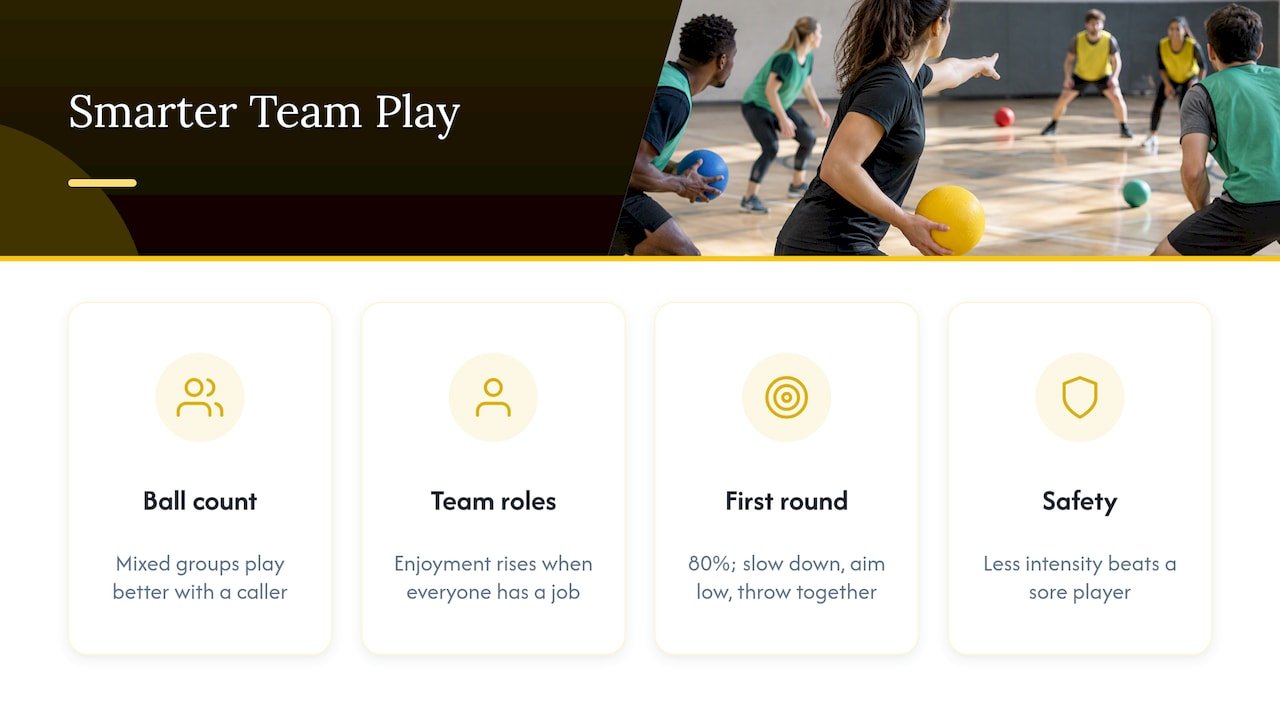
We host dodgeball for birthday groups, school and youth groups, sports teams and corporate teams, so we see the same pattern every time. A group of mixed ability usually plays better once someone calls the ball count out loud. The enjoyment goes up when everyone has a job: a thrower, a defender, a caller.
Our advice for first-time groups is to play the first round at 80%. Slow down, aim low, and throw together. People laugh more, nobody gets hurt, and the strategies in this guide start to show up on their own. Safety comes first in everything we run, and we would rather a game be a little less intense than a player leave sore.
— Archers
Play it with your group
If you would like to test these strategies, you can book dodgeball at our venue for $30 per person. For groups, our kids birthday packages start from $399 for Game On Birthday Party, and our sports team events start from $399 for Game On Team Battle. Planning something for the office? See our corporate dodgeball booking guide or the team building packages, which start from $699 for the Collab Package.
FAQ
How do you win at dodgeball?
Control the ball count, throw as a group at one target, and eliminate the strongest opposing player first. Aim for accuracy at about 80% effort rather than maximum speed. Dodge away from the group and only catch when you are set.
What is the best way to throw a dodgeball?
Stand side-on to your target, take a crow hop or a few steps, and release with your arm extended and elbow above the shoulder. Aim at a specific spot such as a knee. Put your weight on your front foot as you finish.
What are the 5 Ds of dodgeball?
Dodge, duck, dip, dive and dodge come from the movie Dodgeball. They are a joke, not an official rule or technique. Real strategy is ball control, group throws and accurate throwing.
What are the basic rules of dodgeball?
Two teams of six try to eliminate each other. Under World Dodgeball Federation standards, a player is out if hit, if their throw is caught, or if they cross the neutral zone line. Local leagues and schools may change details such as head shots, so always check the event rules.
Sources
- World Dodgeball Federation rules and regulations
- World Dodgeball: how to play
- Ophea dodgeball safety guidelines
- Biomechanics of ball graspability and run-up (J-STAGE)
- British Dodgeball tactics
- British Dodgeball throwing technique card
- New Orleans Dodgeball Association game strategy
- Darko Sarovic on dodgeball throwing skill


