
Book a full-service corporate dodgeball package from a provider that supplies referees, equipment, and event facilitation. That single decision removes most of the risk and guesswork from running corporate dodgeball, whether you’re planning a one-off office bash or a recurring league.
A properly staffed package typically includes:
- Trained referees and an on-site facilitator to run the schedule
- Foam equipment, court setup, and teardown
- Scoring, bracket management, and prizes or trophies
The fastest next step is to check dates and group size against a dodgeball booking page and get specifics on package tiers before you send a save-the-date to your team.
Key Takeaways
Booking a full-service corporate dodgeball package with dedicated referees, equipment, and facilitation cuts planning risk far more than assembling the event piece by piece.
| Point | Details |
|---|---|
| Match format to goal | Choose a one-off event for celebrations, a league for recurring bonding, a tournament for a single decisive day. |
| Confirm package inclusions | Get referees, equipment, scoring, and prizes itemized in writing before comparing quotes. |
| Book with lead time | Plan three to four weeks out for small groups, six to eight weeks for larger tournaments with merchandise. |
| Lock in safety terms | Require waivers, insurance proof, and a first-aid plan from any provider before signing. |
| Archers Battlefield fits full-service needs | Its dodgeball package bundles referees, equipment, and facilitation into corporate team-building bookings. |
Table of Contents
- Tournament, League, or One-Off: Choosing Your Corporate Dodgeball Format
- What’s Included in a Full-Service Corporate Dodgeball Package
- Booking Timeline, Pricing Models, and Venue Requirements
- Dodgeball Rules and Safety Standards for Corporate Play
- Ready-to-Use Agendas for Corporate Dodgeball Events
- How Archers Battlefield Runs Corporate Dodgeball Events
- Rescheduling and Cancellation Terms to Confirm Before You Sign
- Insurance, Waivers, and Liability: What Organizers Need to Confirm
- What Actually Trips Up First-Time Dodgeball Organizers
- Book Your Corporate Dodgeball Event With Archers Battlefield
- Resources for Planning Your Corporate Dodgeball Event
- Frequently Asked Questions About Corporate Dodgeball
- Sources
Tournament, League, or One-Off: Choosing Your Corporate Dodgeball Format
Corporate dodgeball comes in three shapes, and picking the wrong one is the most common planning mistake. A tournament is a single-day, bracket-style event, often round-robin play followed by playoffs, built for a big group that wants a clear winner by the end of the afternoon. A league runs across several weeks with recurring match nights, which fits companies treating dodgeball as an ongoing wellness or morale program rather than a one-time event. A one-off corporate event is the simplest version: no standings, no season, just a booked block of time for a specific occasion.
Match format matters here. The Dodge Wars: Corporate Throwdown tournament, for example, runs on 10-minute matches with round-robin and playoff rounds, a structure most corporate providers borrow directly.
Match up the format to your actual goal:
- Charity fundraiser or all-hands celebration: one-off event, single date, no ongoing commitment
- Recurring team bonding or wellness initiative: league, multi-week season
- Company-wide bragging rights day: tournament, bracket format, prizes at the end
Roster rules tend to follow a standard pattern: multiple players per side on the court at once, with substitutes rotating in, and co-ed matches often requiring a minimum number of women on court at all times.
What’s Included in a Full-Service Corporate Dodgeball Package
A quote that just says “dodgeball event, $X” tells you almost nothing. Ask for a breakdown. Full-service packages generally include the following, and comparing quotes item by item is the only way to catch hidden gaps before you sign — learn more about the benefits of flexible event packages.
- Officiating and facilitation. Trained referees who call the game and a facilitator who manages the overall schedule, not just the matches.
- Equipment. Foam balls rated for indoor group play, court markers, and any barriers or netting the venue needs.
- Setup and teardown. Someone other than your team should be moving equipment before and after.
- Scoring and brackets. A system for tracking wins, especially in tournament format, so results don’t turn into an argument.
- Prizes or trophies. Even a modest trophy or gift card pool changes the energy of the closing ceremony.
Beyond the core package, most providers offer add-ons: branded team shirts, event photography or video, catering coordination, and formal awards ceremonies. Providers commonly recommend booking these add-ons well ahead of the event date since photography and shirt orders often carry their own lead times.
Pro Tip: Ask every provider the same direct question: “What happens if a referee doesn’t show up?” A vague answer is a red flag. A specific backup plan tells you they’ve run this before.
Booking Timeline, Pricing Models, and Venue Requirements
Corporate dodgeball logistics come down to four things: timing, price shape, space, and the right questions to a provider before you sign anything.
For timeline, book small internal events (under 30 people) about three to four weeks out. Larger multi-department tournaments or anything involving branded merchandise need six to eight weeks minimum.
Pricing usually falls into one of three shapes:
- Flat team fee covering a set block of time regardless of headcount within a range
- Per-person pricing that scales with attendance, common for larger open-invite events
- Tiered packages, where a base price adds referees, equipment upgrades, or catering as add-ons
Entry-fee tournaments, like the Dodge Wars corporate model, give you a real-world example of how team-based fee structures work in practice.
Venue needs are straightforward but easy to overlook: a gym or court with adequate ceiling height, clear floor space for at least two courts if you have more than 20 players, parking for staff cars, and room for spectators who aren’t playing that round.
Before booking, ask providers directly about staffing ratios, liability insurance coverage, cancellation terms, and how they accommodate players who need modified rules.
Dodgeball Rules and Safety Standards for Corporate Play
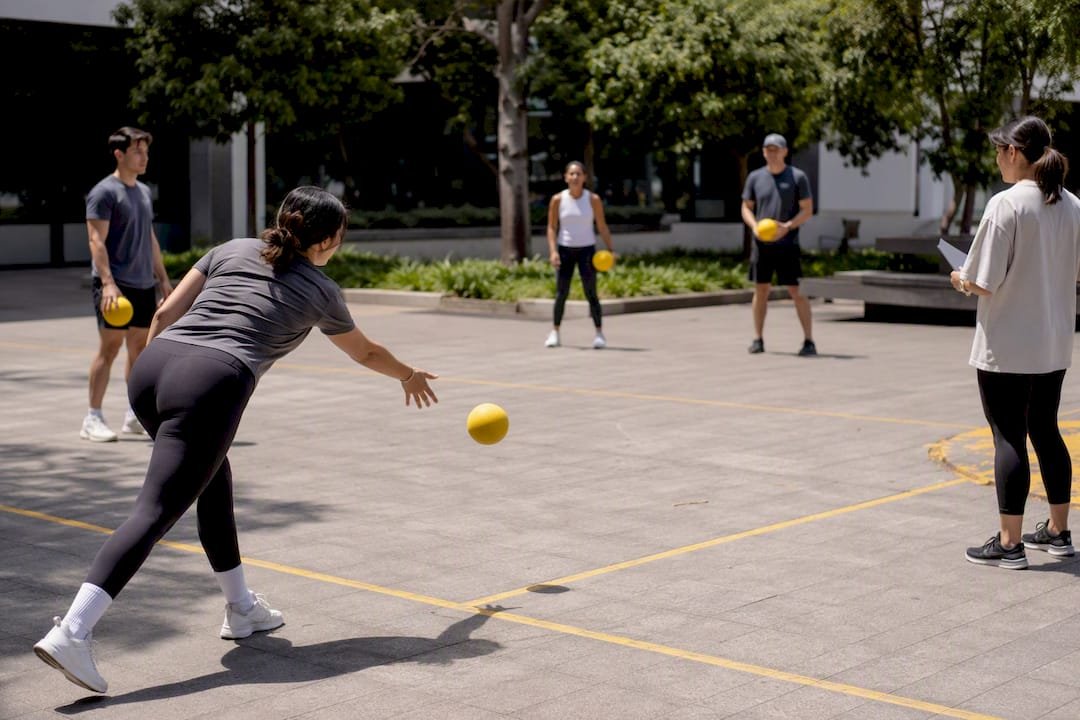
Corporate dodgeball keeps the basics simple: a player is out when hit by a live ball below the shoulders or when a thrown ball they catch reaches the ground first, and matches typically run in short timed rounds with substitutions between games rather than mid-play.
Safety comes down to a short checklist you should confirm with any provider before booking:
- Soft, low-density foam balls, never the hard rubber gym-class kind
- Certified or trained referees present at every match, not just a staff member with a whistle
- Signed waivers collected from every participant before play starts
- A basic first-aid plan and someone on-site who can execute it
Dodgeball Ontario publishes regional rulesets that most professional providers model their own guidelines after, which is worth checking if your legal or HR team wants a reference point.
Inclusive variants matter more than most organizers expect. Low-impact throwing lines, rotating “out” players back in after a set time, and optional non-contact roles like ball retrievers or scorekeepers let people with different mobility levels or comfort with contact sports still take part fully.
Ready-to-Use Agendas for Corporate Dodgeball Events
A copy-paste agenda saves hours of internal back-and-forth. Adjust timings to your group size, but these three templates cover most corporate needs.
- Half-day (3 hours): 30 minutes check-in and team assignment, 30 minutes rules briefing and warmup, 90 minutes round-robin play, 30 minutes finals and awards.
- Full-day (6 hours): Morning mirrors the half-day format, then a one-hour lunch and social break, followed by a second team-building activity or lounge time, closing with finals and a wrap-up ceremony.
- Mini-tournament (90 minutes): Best for lunch-hour events. Skip the extended warmup, run three short round-robin games per team, and go straight to a single-elimination final.
Staff at least one referee per active court and build in regular water breaks during play. Skipping breaks is the fastest way to burn out your least athletic employees quickly.
How Archers Battlefield Runs Corporate Dodgeball Events
Archers Battlefield structures its dodgeball packages around the same checklist above: referees, foam equipment, facilitation, and scoring built into every corporate booking rather than sold as extras.
- Trained facilitators manage scheduling so your HR team isn’t running the clock mid-event
- Safety protocols and waivers are standard practice, not an upsell
- Packages scale from small office groups to multi-team corporate team-building days
Pro Tip: Ask about pairing dodgeball with a second activity, like archery tag, if your group has a wide range of energy levels. Splitting the day keeps low-contact players engaged too.
Rescheduling and Cancellation Terms to Confirm Before You Sign
Weather cancels outdoor plans. A key stakeholder gets pulled into a client emergency the morning of your event. Half your invite list catches a cold in the same week. None of these are hypothetical, and every organizer runs into at least one of them eventually.
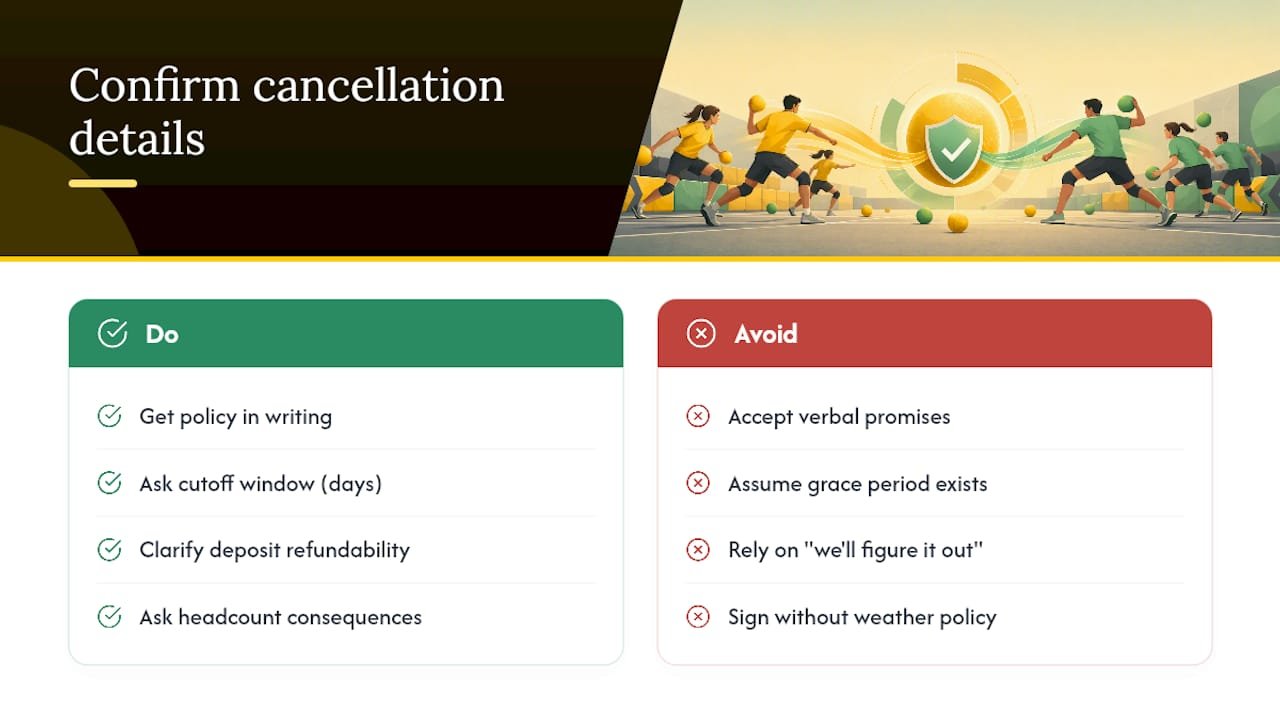
Before you sign a contract, get the provider’s cancellation and rescheduling policy in writing, not verbally over a phone call. The details that actually matter are the cutoff window (how many days before the event you can cancel or move the date without penalty), whether a deposit is refundable or only transferable to a new date, and whether the policy changes for weather-related cancellations versus a simple change of plans on your end.
Most professional venues build in a grace period, commonly somewhere in the range of 48 to 72 hours before the event, after which a deposit or partial fee becomes non-refundable. That’s standard practice, not a red flag, but it needs to be spelled out clearly rather than left as a verbal assumption.
Ask specifically what happens if attendance drops below a minimum headcount close to the date. Some providers will still run the event at a reduced rate; others require you to hit the original number or forfeit part of your deposit. Get this in writing, because “we’ll figure it out” is not a policy.
If your event involves outdoor space or a rain-dependent format, confirm the backup plan explicitly: is there an indoor alternative, a hard reschedule, or a credit toward a future date? A provider who can answer this without hesitation has done it before.
Insurance, Waivers, and Liability: What Organizers Need to Confirm
Dodgeball is a contact sport, even played with foam balls, and that means liability isn’t optional paperwork. It’s a real consideration your legal or HR team should review before the invite goes out.
Every participant should sign a waiver before stepping onto the court, covering the general risks of physical activity and confirming they’ve disclosed any relevant medical conditions. This applies to every player, not just new hires or younger employees, and it should happen the same day as check-in, not weeks in advance where it can be forgotten.
Confirm the provider carries their own liability insurance covering the venue, the equipment, and the referees running the game. This is separate from your company’s general liability policy, and a reputable provider should be able to produce proof of coverage on request without treating it as an unusual ask.
If your event is happening off your own company property, which is almost always the case with dodgeball, check whether your organization’s existing event insurance extends to off-site activities or whether you need a short-term rider. Some corporate insurance policies exclude contact sports entirely, so this is worth a five-minute call to your broker rather than an assumption.
Health considerations extend past the waiver form. Ask employees in the invite to flag any physical limitations privately to HR, not the whole group, and make sure the low-impact play options described earlier in this guide are visible and available, not just theoretically offered. A player who feels pressured to play through a knee issue because no one mentioned an alternative role is a liability problem you created, not one the provider caused.
What Actually Trips Up First-Time Dodgeball Organizers
Low attendance is the most common failure, usually caused by an invite that reads like a mandatory meeting instead of a fun outing. Set expectations clearly: state the time commitment, the physical intensity, and that low-impact roles exist.
Poor scheduling is the second one. Cramming dodgeball into a 45-minute lunch slot with no buffer for late arrivals guarantees a rushed, frustrating event. Build in the extra 15 minutes.
Forgetting accessibility needs early is the third, and the easiest to fix: ask about it in the same email where you ask about dietary restrictions. Reach out to a provider like Archers Battlefield early in your planning process, before the date is locked, so accommodations aren’t an afterthought.
Book Your Corporate Dodgeball Event With Archers Battlefield
Archers Battlefield gives corporate organizers something a rented gym and a bag of foam balls can’t: a fully staffed event with referees, equipment, and facilitation handled from setup to final score, so your team shows up and plays instead of managing logistics. That’s the difference between running an event and simply hosting one.

If your group wants more than one activity in a single visit, dodgeball pairs easily with combat archery or Nerf battles for teams with mixed energy levels and comfort with contact play. Packages scale from a small department outing to a full-company tournament day, with the same referees and safety protocols at every size.
Check available dates and group pricing on the team-building booking page and get a package breakdown before you commit to a date.
Resources for Planning Your Corporate Dodgeball Event
Check Dodgeball Ontario for regional rulesets and event listings, and review the Dodge Wars tournament format for a real example of match structure and entry fees. For direct booking, visit the Dodge Ball page or explore full event packages at Archers Battlefield.
Frequently Asked Questions About Corporate Dodgeball
How many people do you need for a corporate dodgeball event?
Most providers can run a match with as few as 12 to 14 players (two full teams), though events scale up easily to 50 or more using multiple courts and rotating brackets.
How long does a typical corporate dodgeball event last?
A standalone event usually runs two to three hours including check-in, rules briefing, and a short awards segment. Full-day formats add a social or second activity block.
Do employees need any dodgeball experience to join?
No. Corporate dodgeball events are built for mixed-skill groups, and low-impact rule variants let less athletic or physically limited employees participate without sitting out.
What’s the difference between a dodgeball league and a one-off event?
A league runs across multiple weeks with standings and recurring matches, suited to ongoing team-building. A one-off event is a single booked session with no season commitment.
What should be in a corporate dodgeball waiver?
A standard waiver covers general physical activity risk, requires disclosure of relevant medical conditions, and should be signed by every participant on the day of the event, not weeks ahead.


