
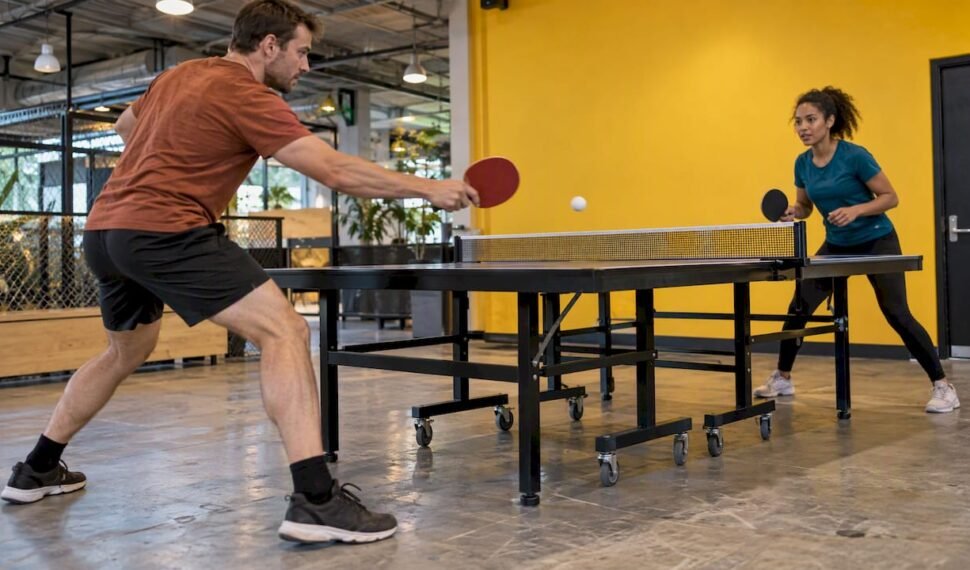
Ping pong is better exercise than most people expect. Casual rallies already count as moderate activity, competitive play can reach vigorous levels, and the game trains balance, reaction time and concentration along the way. It is also one of the few workouts people keep doing because it is fun.
Below we go through what the evidence supports, where the claims get overstated, and how to turn a friendly game into something that counts toward your weekly activity. We run a ping pong room at Archers Battlefield, so we also share what we see when real groups, from kids to coworkers, pick up paddles.
TL;DR
- Casual play sits around moderate intensity (about 4.0 METs), while competitive play or footwork drills can reach 8.5 to 10.5 METs, so it can be cardio.
- A 2026 meta-analysis of 14 randomized trials found table tennis improved balance and cognitive function.
- Older adults who trained for six months showed gains in lean mass and bone density in one trial.
- It is low-barrier and social, which helps people stick with it. Kids, adults and mixed-age groups can all play at their own level.
- Your results depend on how you play: longer rallies, more movement and regular sessions matter most.
Table of Contents
- Is ping pong good exercise?
- Cardio and heart health
- Does it count toward Canadian activity guidelines?
- Balance, coordination and reaction time
- Brain benefits: why ping pong is not like a treadmill
- Bones, muscle and healthy ageing
- Mood, stress and the social side
- Why it works for kids and mixed-age groups
- How to get more out of every game
- Perspective: what we see at the table
- Play ping pong with us
- Limits of the evidence
- FAQ
- Sources
Is ping pong good exercise?
Yes, with a caveat: it depends on how you play. Researchers measure effort in METs, where one MET is your resting energy use. A mini-review published in 2026 puts casual table tennis at about 4.0 METs, which is moderate. Serious competitive play or training with intensive footwork reaches 8.5 to 10.5 METs, firmly in vigorous territory.
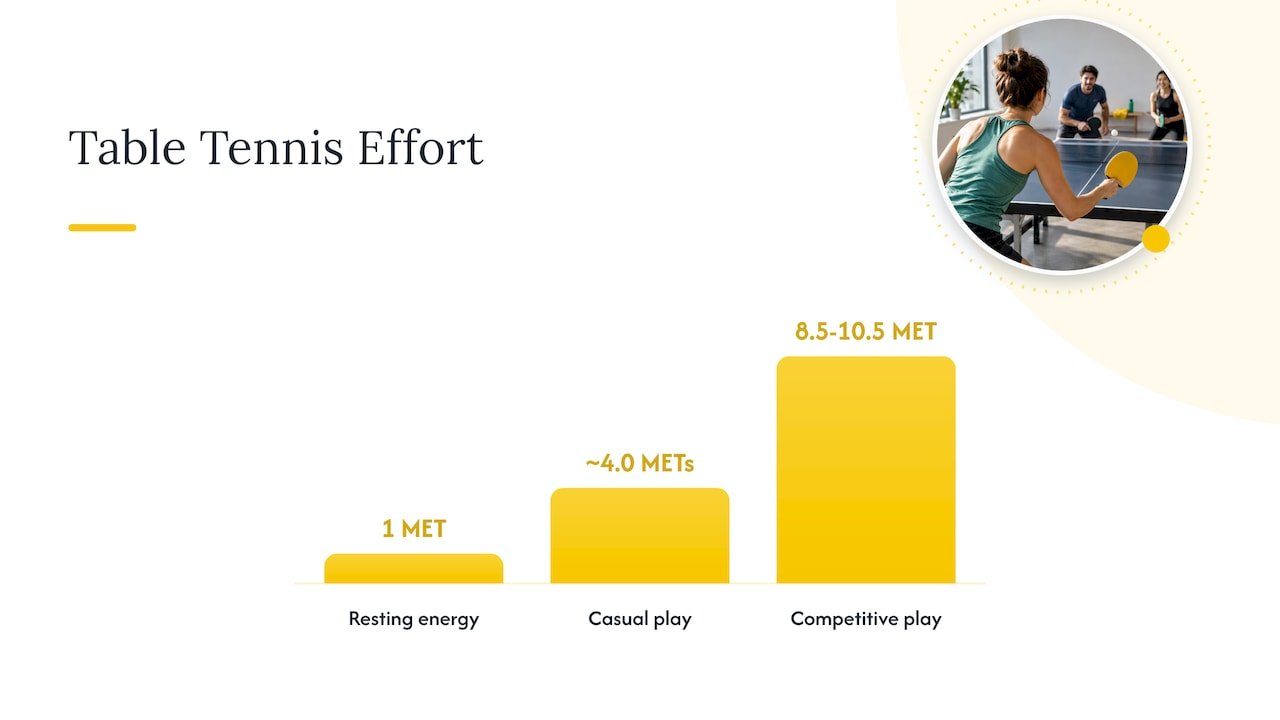
That gap matters. Standing at the table and tapping the ball back and forth is a pleasant warm-up. Moving your feet, hitting from different positions and playing long points is a real workout. The British Heart Foundation also describes table tennis as offering moderate-intensity activity that is easy to start, since all you need is a bat, a ball and someone to play with.
A physiological review of the sport notes that table tennis has a long history but that its demands are less studied than those of many other sports. So treat any single calorie number you see online with caution. Your body weight, your level and the pace of the rallies change the result a lot.
Cardio and heart health
Table tennis is an intermittent activity: short bursts of movement followed by brief pauses between points. That pattern raises your heart rate without the grinding feel of a long run, which is part of why people play for an hour and barely notice.
For people with heart conditions, the evidence is encouraging but specific. A study of low-risk cardiac patients with a mean age of 67.6 found that a 10-minute bout of play averaged about 3.2 METs, a workload similar to standard exercise training for many cardiac patients. If you have a heart condition, ask your cardiologist or rehabilitation team whether it suits you and at what intensity before you start.
For everyone else, the practical point is simple. You can raise the cardio load by:
- keeping the ball in play longer instead of ending points with hard smashes,
- standing a step further back from the table,
- playing doubles with alternating shots, which forces constant movement,
- adding short footwork drills between games.
Does it count toward Canadian activity guidelines?
For adults 18 and older, the Canadian 24-Hour Movement Guidelines recommend at least 150 minutes of moderate-to-vigorous physical activity per week. Three one-hour sessions of lively play would cover that on their own, and shorter sessions add up too.
For children and youth, the guidance in the IMPACT Trial module is 60 minutes a day of moderate-to-vigorous activity, including vigorous activity at least three times a week. Ping pong will not fill that whole hour, but a game or two fits well into a day that also includes running and active play. The same guidance suggests casual play counts toward moderate goals, while footwork drills and competitive rallies can contribute to vigorous ones.
Balance, coordination and reaction time
The strongest recent evidence is about balance. A 2026 meta-analysis pooled 14 randomized controlled trials with 1,565 participants and found significant improvements in both balance and cognitive function compared with control groups. The balance effect was moderate to large (a standardized mean difference of about 0.78). The cognitive effects were larger in some analyses, but those figures come from varied studies and populations, so read them as a strong signal rather than a promise for any one person.
Why would a tabletop game train balance? You are constantly shifting your weight, reaching sideways and recovering your stance. Hand-eye coordination and reaction time get a workout because the ball is small and fast. Those skills carry over to everyday life: catching a falling object, stepping off a curb, reacting to a slip.
Brain benefits: why ping pong is not like a treadmill
Researchers describe table tennis as an open-skill sport. You cannot repeat the same motion, because each shot depends on what your opponent just did. The same meta-analysis discusses this unpredictability as a likely reason for its cognitive benefits compared with more repetitive exercise such as treadmill running.
That fits what the MDPI review on brain health emphasizes: table tennis puts demands on reaction time, hand-eye coordination and executive function, which makes it a useful tool for maintaining brain health, especially with age. Executive function is the mental toolkit for planning, switching attention and making quick decisions.
There is also promising work in Parkinson’s disease. A 2025 review in Cureus looked at table tennis for motor function and cognitive performance, and describes it as a multidimensional intervention that combines thinking, precise movement and social contact. If you or a family member lives with Parkinson’s, talk with your neurologist or physiotherapist about adding it to a program. Do not treat it as a replacement for medical care.
What can we say for ordinary players? Reasonably, that regular play challenges attention and quick decision-making in a way a steady walk does not. Be wary of articles promising a specific boost to memory or work performance after a few games. The research above points to better balance and cognitive outcomes over regular practice, not an instant effect.
Bones, muscle and healthy ageing
In older adults, the picture is promising. A randomized trial in older men found that consistent table tennis practice reduced total and regional fat mass while increasing lean mass and bone mineral density, with gains in the femur and spine after six months of regular training.
This is one trial in one group, so we would not generalize it to everyone. Still, it makes sense: the game involves small jumps, lunges and quick changes of direction, all of which load the legs and hips. Because the table is a physical barrier and the ball is light, injury risk from contact is low compared with many sports. Players with knee, hip or back problems should still check with a physician or physiotherapist and keep movement controlled.
Mood, stress and the social side
You cannot play ping pong alone for long. You need a partner, you trade shots, you laugh at missed serves. That social element is a major reason why the sport sticks. Clinical reviewers quoted in the Parkinson’s literature argue that the mix of thinking, movement and company can lead to better long-term adherence than repetitive exercise programs. The best workout is the one you will keep doing.
In our experience running group events, ping pong is often where a mixed group relaxes. People who are nervous about a more physical game find a table less intimidating, and the rules take a minute to explain. Our guide to ping pong rules for beginners covers the basics for a first friendly match.
Why it works for kids and mixed-age groups
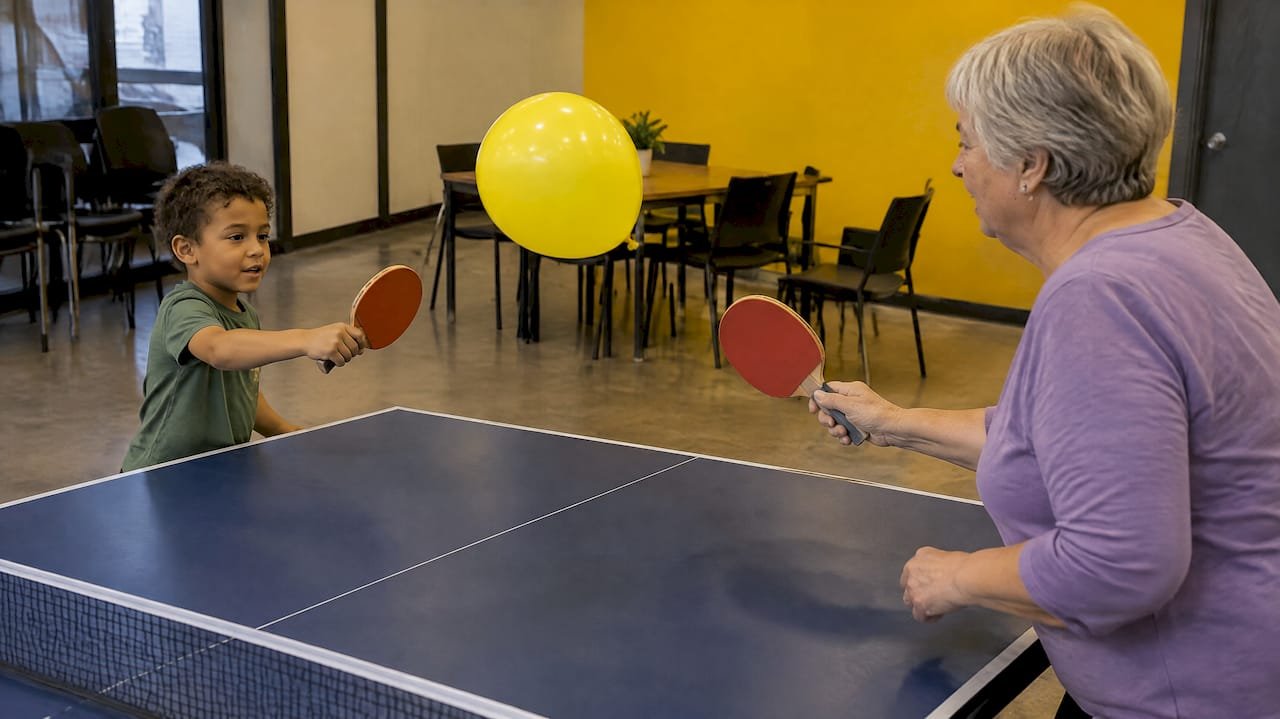
An educational review in Sports describes table tennis as an inclusive tool for physical education. The entry barrier is low, it adapts to different skill levels (for example with balloon or tabletop versions for younger or less experienced players), and it supports both social-emotional development and basic motor skills.
The same logic applies at a birthday party or family gathering. A grandparent and a seven-year-old can share a table if you adjust the rules: bigger targets, more bounces allowed, or cooperative rallies where the goal is to keep the ball going. Simple warm-up games such as ball in the bucket hire style challenges are another way to get a mixed-age group loosened up and comfortable with aim and timing before paddles come out. For more ideas, see our mixed age party games playbook.
How to get more out of every game
If you want the benefits above rather than just a pleasant hour, a few habits help.
- Play regularly. Two or three sessions a week beat one long monthly marathon. The trials above ran for months, not days.
- Keep moving. Stay light on your feet, return to a ready position after every shot and avoid planting yourself at the table.
- Vary your opponent. A new partner forces new decisions, which is where the open-skill benefit comes from.
- Add a drill block. Ten minutes of forehand and backhand repetition, then play points. Our four-week ping pong skills plan lays out 15 to 30 minutes a day.
- Warm up. Shoulder circles, hip swings and a few easy rallies before you go hard.
- Stop if something hurts. Sharp pain, dizziness or chest discomfort means stop and see a doctor.
Perspective: what we see at the table
We run a venue where ping pong sits alongside combat archery, Nerf battles, dodgeball, axe throwing and arcade games, so we see how people actually behave. Ping pong is the activity that most reliably gets a whole group involved. Nobody needs special gear or experience, and nobody sits out for long.
We also see the other side of the research. The people who get the most from it are not the ones who treat it as a gentle pastime for ten minutes. They are the ones who start a tournament, keep score, rotate partners and end up slightly out of breath. That is why we like formats that keep everyone moving. If you are hosting, our tournament format guide shows how to run a 16-player bracket in a few hours without leaving anyone waiting.
One more thing: fun is not a side effect here, it is the mechanism. People come back to what they enjoy. A glow-in-the-dark game, a doubles round with friends or a mini league with coworkers will do more for your fitness than a plan you abandon in week two.
— Archers
Play ping pong with us
If you would like to try it, we offer ping pong sessions at $30, and you can look at our Pong room or book a private pong room for your group. For parties, the Pong & Party On package starts from $299, and the Ultimate Paddle Party starts from $799, both on our event packages page. Teams can look at the Ultimate Paddle Package, from $799, on our team building page.
Planning a glow game? Our glow ping pong equipment guide explains what you need.
Limits of the evidence
A few honest caveats before you rush to buy a paddle.
- Intensity varies. The 4.0 MET figure for casual play and the 8.5 to 10.5 METs range for competitive play are very different workloads. Which one you get depends on you.
- Many studies are small or specific. Results in older men, cardiac patients or people with Parkinson’s disease may not apply to a healthy 25-year-old.
- It is not a complete program. Ping pong does not replace strength training or longer aerobic sessions if you have those goals. It can complement them.
- Health conditions need professional input. Heart disease, balance disorders, joint replacements and neurological conditions call for advice from your own physician or physiotherapist.
FAQ
Is ping pong good for your health?
Yes. Evidence shows benefits for balance, cognitive function, and in some groups bone density and body composition. It is also a moderate-intensity activity at casual pace, and the social side helps people keep playing. Check with a doctor first if you have a heart, joint or balance condition.
Does ping pong count as cardio?
It can. Casual play is around 4.0 METs, which is moderate, and competitive play or footwork-heavy training reaches 8.5 to 10.5 METs. Longer rallies, more movement and shorter rests turn a social game into a proper cardio session.
How long should I play to see benefits?
The Canadian guideline for adults is at least 150 minutes of moderate-to-vigorous activity a week, and ping pong sessions can count toward that. The trials behind the bone and balance findings used regular training over months, so consistency matters more than any single long session.
Is ping pong safe for older adults and kids?
It is generally low-impact and easy to adapt, which is why researchers describe it as inclusive for different ages and skill levels. Use shorter rallies and larger targets for beginners, and have older adults with balance or heart concerns talk to their physician first.
Sources
- Table Tennis as a Sustainable Health Intervention: A Meta-Analysis of Its Effects on Balance and Cognitive Functions
- Dietary and nutritional supplementation strategies for table tennis athletes (Frontiers in Nutrition, 2026)
- Why you should take up table tennis (British Heart Foundation)
- The physiological demands of table tennis: a review
- Table tennis in low-risk cardiac patients (PubMed)
- Adherence to physical activity and sedentary guidelines among adults (Statistics Canada)
- Module 2, IMPACT Trial (Nipissing University)
- Table tennis and brain health (MDPI)
- The Effects of Table Tennis on Motor Function and Cognitive Performance in Parkinson’s Disease (Cureus)
- Table tennis in physical education (Sports, MDPI)
- Table tennis and body composition, bone density in older men (ScienceDirect)


