
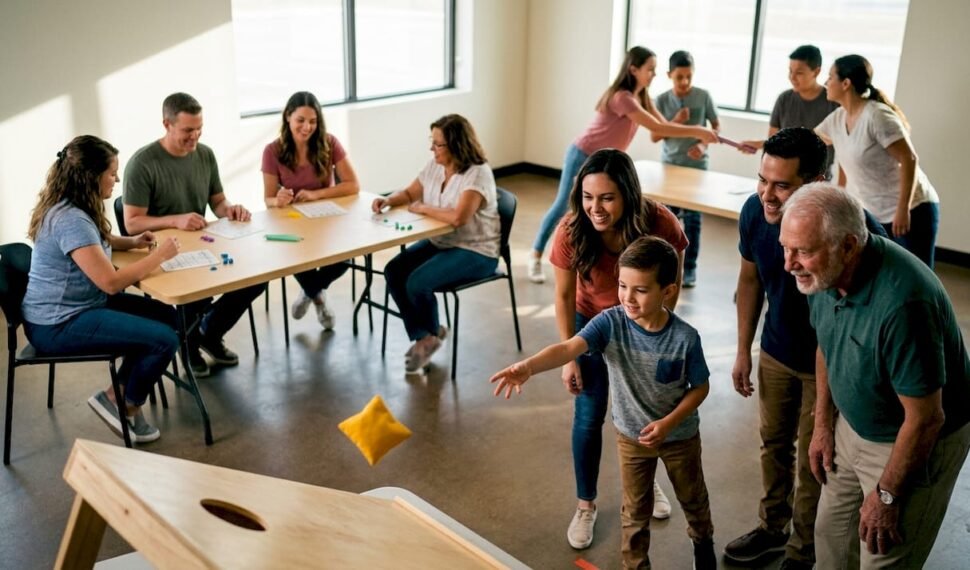
The games that work for a mixed-age party are the ones with almost no rules, no reading pressure, and no reward for being fast: think social guessing games, cooperative matching, and low-stakes physical tasks over trivia or timed word games. Sort your options into active, seated, tabletop, and digital-assisted categories, and pick one or two from each so nobody sits out for long. If you’d rather skip the planning entirely, a booked venue or party package can run the whole rotation for you.
TL;DR:
- Games that eliminate reading, speed, or trivia advantages, like Herd Mentality or charades, work best for a mixed-age audience.
- Adapting games with simple prompt reading, team pairing, and tiered scoring ensures fair play across different ages and abilities.
- Keeping game sessions to 15-20 minutes per round allows for multiple activities without downtime, and a designated moderator helps coordinate smoothly.
- Using soft equipment, clear walkways, and accessible options creates a safe, inclusive environment for all participants.
- Booking a venue with staff and pre-planned activities can ease organization and accommodate larger, more diverse groups.
Table of Contents
- Mixed Age Party Games You Can Pick in Under Five Minutes
- How to Adapt Any Game So Every Age Has a Fair Shot
- Setting Up the Room So Games Run Without Dead Air
- Keeping Mixed-Age Play Safe, Welcoming, and Actually Inclusive
- Copy-Paste Game Plans for Any Mixed-Age Guest List
- What Actually Happens When You Run These Parties
- Book a Venue That Runs the Whole Rotation for You
- Sources
- FAQ
Mixed Age Party Games You Can Pick in Under Five Minutes
Not every party needs a spreadsheet of options. Here’s a shortlist organized by what actually matters when you’re staring at a room full of 6-year-olds, teenagers, and grandparents: energy level, prep time, and how forgiving the rules are.
- Herd Mentality (or similar herd-style guessing games): Everyone writes a one-word answer to a prompt and scores points for matching the group’s most common answer. No trivia, no reading speed advantage. Herd Mentality supports 4 to 20 players) and typically lasts under 30 minutes, which makes it one of the most dependable openers for a mixed-age crowd.
- Monikers, family edition: Three escalating rounds (describe it, one word only, then act it out) mean even a shy grandparent or a 7-year-old gets a fair shot. The family edition rewrites the card prompts specifically to strip out mature references, so nobody has to censor on the fly.
- Charades, no-frills version: Zero cost, zero setup, and it scales from four people to forty. Best for filling a gap between scheduled games.
- Ring toss or bean bag toss: Low-impact, seated-friendly if you shorten the distance, and it rewards accuracy over speed, so a 10-year-old and a 70-year-old are on roughly even footing.
- Sock toss or balloon volleyball: Soft equipment means nobody gets hurt, and slow-motion versions work fine for older adults with limited mobility.
- Bingo variants (with actions or trivia mixed with easy prompts): Fully seated, easy to follow, and you can weight the categories so it’s not all pop culture trivia that skews young.
- Print-and-play or browser-assisted bluffing games like Let’s Fib: Players use their own phones as controllers while the group plays in one room, and the game includes a print-and-play PDF as a backup if the WiFi drops or someone’s phone dies.
- Simple relay races with a twist (spoon-and-egg, balloon-between-knees): Keep distances short and let teams choose who runs which leg, so a grandparent can hand off to a grandkid without embarrassment.
- Two truths and a lie: Zero prep, works seated, and often becomes the most memorable part of the night because people learn something real about each other.
- Categorized indoor games grouped by energy level: If you want a running list to pull from instead of building one yourself, categorized game resources can save you the sorting.
Each of these earns its spot because it removes at least one age-based advantage, whether that’s reading speed, physical stamina, or pop culture knowledge.
How to Adapt Any Game So Every Age Has a Fair Shot
Almost any game can flex to fit a mixed-age crowd if you tweak three or four things before you start. The goal isn’t to make the game easier. It’s to remove the specific advantage that favors one age group over another.
- Read prompts aloud instead of handing out cards. This single change levels the field for younger kids who read slowly and older adults who forgot their glasses.
- Swap text-heavy cards for pictorial or symbol-based versions when you can. Charades and Herd Mentality-style games already lean this way, which is part of why they hold up so well across ages.
- Pair a younger player with an older one on the same team. Mixed teams turn a potential mismatch into a built-in mentorship moment, and it usually cuts down on complaints about fairness.
- Add handicaps openly, not secretly. Extra time for a reading task, a shorter throwing distance for younger kids, or an assisted scorekeeper for someone who struggles with math all work fine when everyone knows the rule going in.
- Switch competitive scoring to tiered scoring when the age gap is wide. Score kids under 10 against other kids under 10, and adults against adults, then combine for a team total. Nobody has to lose to someone twice their age or half their size.
- Have a cooperative fallback ready. If a game starts creating real frustration, pivot to a team target (everyone works together to hit a shared point goal) instead of head-to-head competition.
Pro Tip: Write the handicap rule on an index card and hand it to the player before the round starts, out loud, in front of the group. Doing it quietly feels like pity. Doing it as a stated rule feels like strategy.
Setting Up the Room So Games Run Without Dead Air
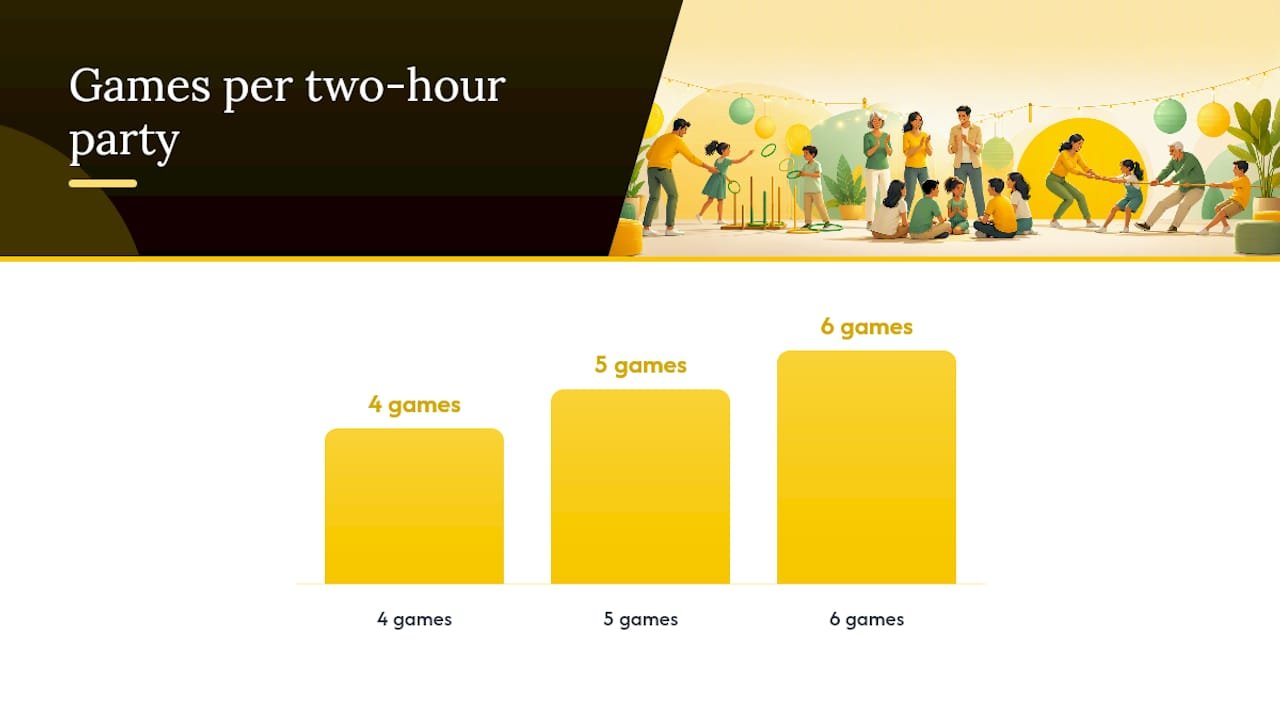
Most successful rounds run 15 to 20 minutes, including setup and explanation, and a two-hour party comfortably fits four to six games with breathing room for food and mingling. Plan your schedule around that math instead of guessing.
Zone the space so people aren’t crossing paths mid-game. A seated corner for bingo or two truths and a lie, an open floor area for relays or toss games, and a table for Monikers or charades cards keeps traffic moving instead of bottlenecking around one activity.
Build a simple supply kit before guests arrive:
- Index cards and markers for writing prompts on the fly
- Masking tape for marking throw lines or team zones
- Balloons and a few soft tossables as backup equipment
- A basic kitchen timer or phone timer for rounds
- Printed prompt cards as backup for any digital-assisted game
Assign one person as the MC for the whole event, even if it’s just for transitions. A single clear voice calling “next game in two minutes” prevents the awkward lull where half the room doesn’t know what’s happening. If you’re borrowing tables, chairs, or staging for a bigger gathering, event furniture rental guidance covers the logistics of laying out a multi-zone space properly.
Keeping Mixed-Age Play Safe, Welcoming, and Actually Inclusive
Physical safety and social safety both matter here, and they get overlooked for different reasons. Nobody forgets to clear a walkway before a relay race, but plenty of hosts forget that a competitive trivia round can quietly exclude the one grandparent who doesn’t know current pop culture.
Physical checklist:
- Clear walkways and remove trip hazards before any active round starts
- Use soft, lightweight equipment for anything involving throwing or tagging
- Keep at least one adult supervising active games, even casual ones
- Shorten distances or add seating options for anyone with mobility limits
Social and accessibility checklist:
- Build in a genuine opt-out option that doesn’t require an explanation
- Avoid prompts that single out one person’s knowledge gap or physical ability
- Offer a quiet, low-pressure role (scorekeeper, timer, photographer) for anyone who wants to participate without performing
- Use large-print cards or a microphone for anyone with vision or hearing limits
- Add a language-accessible option if your group includes non-native speakers, since multilingual game resources exist specifically for this
Games with minimal reading and no trivia advantage consistently score better for inclusivity in family-focused reviews, largely because the entire group can participate at the same skill level regardless of age. If your party includes physical activities and you’re hosting somewhere other than a dedicated venue, it’s worth a quick check on your homeowner’s policy or event liability coverage, since standard party insurance in Ontario doesn’t automatically cover every activity type.
Copy-Paste Game Plans for Any Mixed-Age Guest List
These are ready to run with almost no planning. Each one lists what you need, how long it takes, and two adaptation tips, one for the youngest guests and one for older adults.
Herd Mentality (social-guessing)
What you need: the boxed game or a DIY version with paper and pens. Prep: under 5 minutes. Play time: typically under 30 minutes for a full round. Best for 4 to 20 players, ages 10 and up per the publisher’s recommendation, though younger kids can play paired with an adult scribe. For young kids: let them whisper their answer to a partner who writes it down. For older adults: read every prompt aloud twice before writing time starts.
Monikers, family edition (charades-style)
What you need: the family edition card deck. Prep: 5 minutes to sort cards and explain the three rounds. Play time: roughly 30 minutes. Best for 6 to 16 players in teams of two or more, and Big Potato’s product details confirm this style of game is built specifically for easy family scaling. For young kids: skip round three’s stricter rules and let them act freely. For older adults: allow sitting during the acting round instead of standing.
Seated bingo with mixed prompts
What you need: printed bingo cards with a blend of easy and harder prompts, plus a caller. Prep: 10 minutes to print and shuffle prompts. Play time: 15 to 20 minutes per round. Best for any group size, since everyone plays from a seat. For young kids: use picture-based cards instead of text. For older adults: use large-print cards and a microphone if the room is big.
Low-impact active: sock toss or bean bag toss
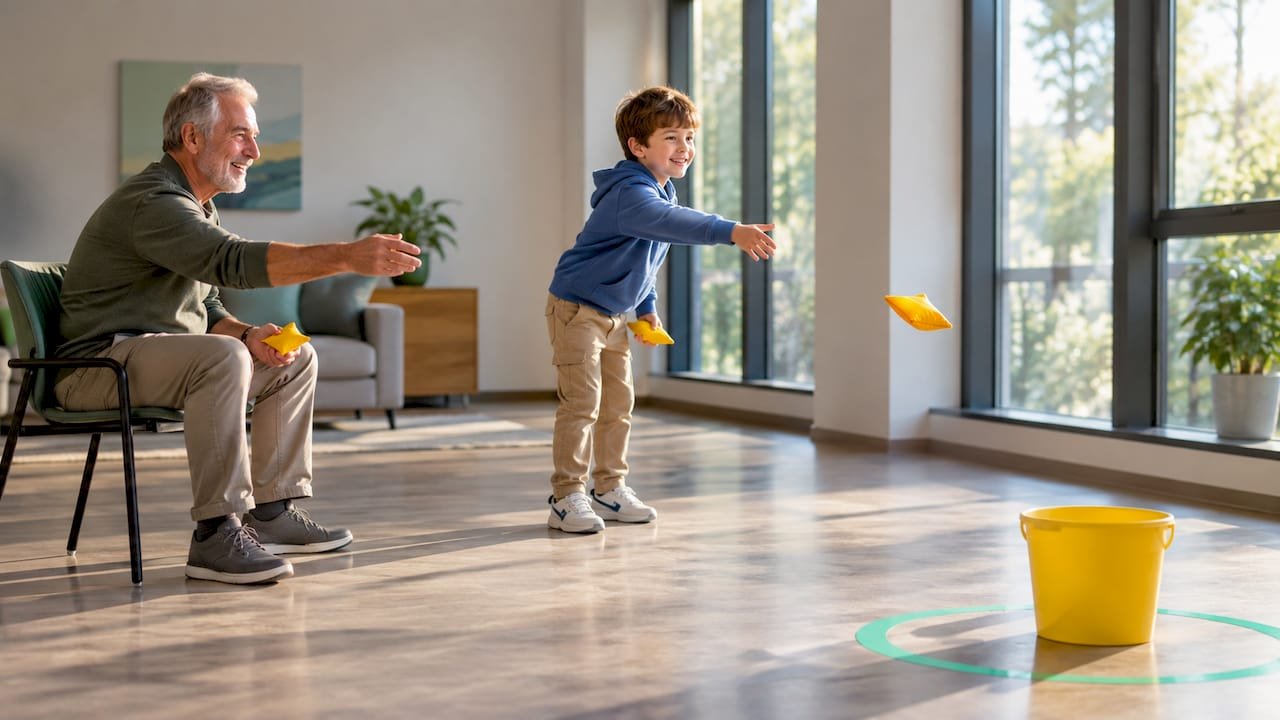
What you need: a target (bucket, hoop, taped zone) and soft tossables. Prep: 5 minutes to set up the target zone. Play time: 15 minutes for a full rotation. Best for 4 to 10 players at a time. For young kids: move the target closer and let them use both hands. For older adults: offer a seated throwing option instead of requiring a standing position.
Relay-team hybrid: spoon-and-egg handoff
What you need: plastic spoons, plastic eggs or balls, a marked course. Prep: 10 minutes. Play time: 15 to 20 minutes including team setup. Best for 6 to 20 players split into mixed-age teams of three or four. For young kids: shorten their leg of the relay. For older adults: allow walking instead of running, and count it the same.
Print-and-play or browser-assisted: Let’s Fib
What you need: phones for each player and either the browser version or the printable version as backup. Prep: 5 minutes to get everyone connected or to print cards. Play time: 20 to 30 minutes. Best for 4 to 10 players in one room. For young kids: pair them with an adult to help read prompts. For older adults: have the printed version ready in case anyone struggles with phone navigation.
Games like Herd Mentality and the relay hybrid need almost nothing beyond household items, which makes them ideal for a living room. Anything involving running, throwing at real distance, or larger groups over 15 people tends to run smoother at a dedicated venue with staff managing rotation and cleanup between rounds.
What Actually Happens When You Run These Parties
Pacing beats variety. A room full of great games still falls flat if you cram them back to back with no breathing room between rounds. Mixed teams solve more problems than clever rules ever will. Put a grandparent and a kid on the same relay team and watch the whole dynamic soften. And always have a backup game ready. The one time a projector failed or a deck of cards went missing, a two-minute round of two truths and a lie saved the entire afternoon.
Never skip: a clear opt-out option, a supervising adult for active rounds, and a low-tech backup for anything digital.
— Archers
Book a Venue That Runs the Whole Rotation for You
A fixed-price alternative is to book a venue offering one location, staff running the rotation, and activities built for a range of ages to balance the group. When your guest list spans toddlers to grandparents, weather is unpredictable, or you just don’t want to be the one setting up ring toss while also managing a cake, a booked venue solves the supervision and scale problems that DIY setups struggle with.

Archers Battlefield’s event packages cover combat archery, dodgeball, ping pong, and arcade games in one indoor space, so a teenager who wants competition and a grandparent who wants to sit and watch both have something to do. Families booking a kid’s birthday can start with the Game On Birthday Party from $399, while groups planning a bigger multigenerational gathering can look at the Momentum package from $2,395 for a full-scale event. Check dates and get a quote through the event packages page to lock in a time slot before your date fills up.
Sources
FAQ
What are some fun activities for a mixed-age group?
Social-guessing games like Herd Mentality, charades-style games like Monikers, and low-impact toss games work best because they don’t reward reading speed or trivia knowledge. Seated bingo variants and simple relay races round out a solid rotation for groups spanning kids through grandparents.
What are some fun games for different age groups?
Pick games with pictorial or verbal prompts instead of text-heavy cards, and use mixed-age teams so nobody competes solely against their own age bracket. Categories to draw from include active, seated, tabletop, and digital-assisted games, each offering a different energy level for different guests.
What are some hilarious adult party games?
Two truths and a lie and bluffing games like Let’s Fib tend to get the biggest laughs from adult groups because they reveal genuinely surprising things about the players. Charades and Monikers also work well for adult-only rounds if you swap in the standard edition instead of the family version, and a few adult party game ideas can help you tailor prompts for an evening crowd.
What are some fun, easy party games?
Charades, two truths and a lie, and any bingo variant require almost no setup and no purchased materials, making them the easiest options for a last-minute gathering. If you want zero planning at all, booking a package through Archers Battlefield covers the activities and setup for you.


