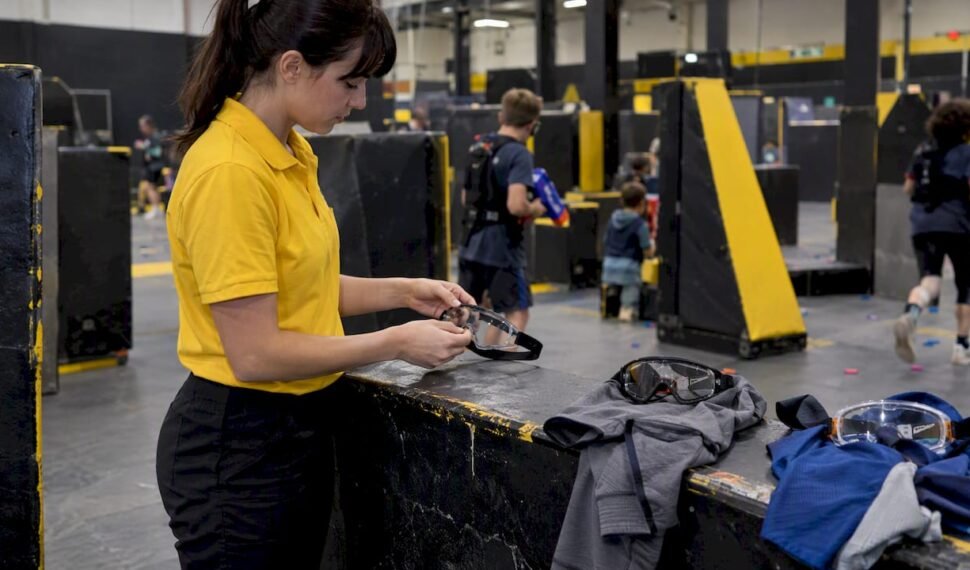
Nerf suits families, mixed-age groups, and casual get-togethers, while airsoft fits adult hobbyists who want tactical realism and don’t mind a steeper gear investment. The deciding factor is almost always safety tolerance and the protective gear each format demands. Supervised venues remove most of the guesswork, which is why we recommend booking one for larger groups or first-timers rather than running either activity on your own, especially when considering indoor activities matched to kids’ ages in Dallas.
TL;DR:
- Foam darts can reach 45 meters per second and carry 1.92 Newton meters of energy, so everyone within range needs eyewear rated for impact.
- Standard Nerf suits children ages 8 and up, but Pro Gelfire is rated 14 and older and requires eyewear and closer adult oversight.
- Airsoft adds costs beyond the gun: automatic electric models need batteries, magazines, and BBs that players replenish by the thousands each session.
- For newcomers or groups larger than a handful, choose a staffed venue with rentals, mandatory goggles, and referees enforcing distances and rules.
Table of Contents
- Head-to-Head: Play Style, Realism, and Game Mechanics
- Equipment, Costs, and Upkeep
- Safety, Injury Risk, and Protective Standards
- Age, Accessibility, and Who Each Option Suits
- Where to Play: Venues, Rentals, and Organized Fields
- How to Choose: A Decision Framework and Checklist
- Venue Perspective: What Supervised Nerf Events Look Like
- When We Recommend Nerf vs Airsoft
- Book a Supervised Nerf Party or Team Battle
- FAQ
- Sources
Head-to-Head: Play Style, Realism, and Game Mechanics
Nerf and airsoft solve for different experiences, and that shows up the moment the first shot fires. Nerf is built for quick fun: foam darts or gel rounds, simple rules, and reloads fast enough that nobody sits out for long. Most Nerf games reward speed and reflexes over tactics, which is exactly why birthday parties and office events gravitate toward it.
Airsoft asks for more patience and buy-in. Players commit to role discipline, honest hit-calling, and safety briefings before a single round is fired. Engagement distances tend to run longer than Nerf, accuracy matters more, and teams organize around actual military-style roles like point, support, and flanker. The realism is the draw for adult hobbyists, but it also raises the stakes on following rules correctly.
A few format examples make the contrast concrete:
- Nerf: capture the flag, elimination rounds, or team deathmatch in a gym-sized arena with foam darts and quick respawns.
- Nerf Pro Gelfire: hopper-fed gel-round skirmishes that play faster and hit harder than standard foam dart games.
- Airsoft: scenario-based milsim games, close-quarters battle (CQB) drills in enclosed structures, or long-range field skirmishes with defined objectives.
Engagement distances in casual Nerf play often run under 20 feet, while airsoft fields commonly enforce minimum distances well beyond that for higher-powered guns. That spacing requirement is one of the clearest signals of how differently the two activities are policed on-site.
Equipment, Costs, and Upkeep
Gear is where the two hobbies diverge most sharply. A basic Nerf blaster and a pack of foam darts cost very little, and that low barrier is part of the appeal for family play. Hobbyist-grade Nerf, especially the Pro Gelfire line, moves closer to airsoft territory: higher-capacity hoppers, faster cycling, and hydrated gel rounds that require dedicated eyewear and careful handling, as Hasbro’s instructions for the Gelfire Uproar blaster make clear.
Airsoft starts at a higher price point across the board. Entry-level spring or gas pistols are affordable, but automatic electric guns (AEGs), the most common choice for organized play, cost significantly more once you add batteries, magazines, and a reliable supply of BBs.
- Consumables: Nerf darts and gel rounds are reusable or cheap to replace; airsoft BBs are consumed by the thousands per session and need steady restocking.
- Power sources: Nerf blasters run on batteries or spring action; AEGs need rechargeable battery packs, and gas-powered guns need propellant refills.
- Maintenance: airsoft internals (gearboxes, hop-up units) need occasional cleaning and part replacement; Nerf blasters are largely maintenance-free.
Rental gear at a dedicated venue sidesteps most of this. Instead of buying blasters, eyewear, and ammunition outright, you pay per session and let the venue absorb the cleaning, storage, and replacement costs.
Safety, Injury Risk, and Protective Standards
Both activities can injure eyes, and the data on foam projectiles is more concerning than many people assume. A case series reviewing pediatric patients found that foam projectile toys were the single most common cause and involved in a large share of cases, with some resulting in open-globe injuries, retinal damage, and permanent vision loss, according to a peer-reviewed study in PMC. That finding cuts against the assumption that foam is automatically the “safe” choice next to airsoft.
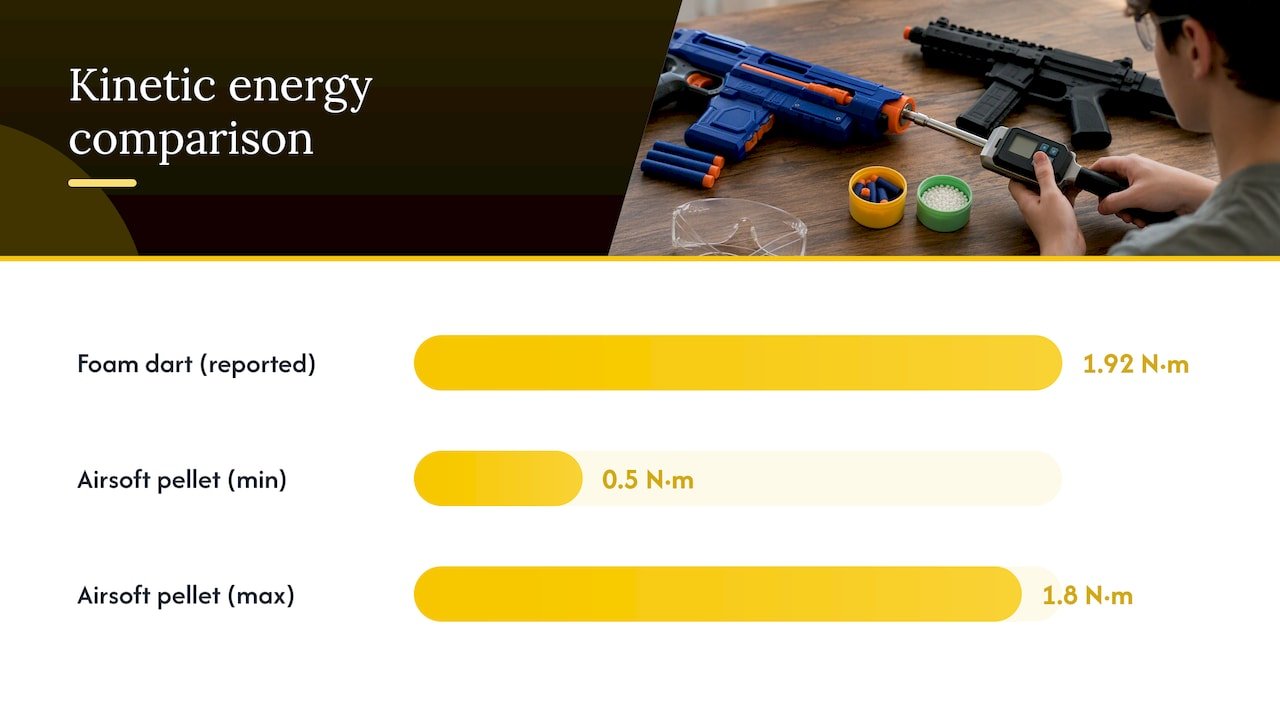
Velocity comparisons help explain why. The Canadian Ophthalmological Society’s position statement notes that foam darts can travel up to 45 meters per second with kinetic energy around 1.92 Newton-meters, while airsoft pellets travel faster, 75 to 110 meters per second, but carry less kinetic energy per hit, roughly 0.5 to 1.8 Newton-meters. In practice, this means a foam dart to the eye can deliver more force than many people expect, and a fast-moving airsoft BB carries real risk too, just through a different mechanism.
The same position statement is direct: protective eyewear is vital for every participant and bystander within range, and organizations running these activities should enforce that rule rather than leave it optional. For choosing eyewear, the CSA Z94.3 standard sets selection guidance for eye and face protectors against flying objects, covering coverage area, impact rating, and proper fit, which is a more reliable benchmark than picking any pair of sunglasses off a shelf.
Pro Tip: Look for eyewear marked as meeting an impact standard like CSA Z94.3, not just “safety glasses” on the label, since marketing language alone doesn’t guarantee impact resistance.
Practical rules that reduce risk on either side of this comparison:
- Mandatory, well-fitted goggles rated for impact resistance, for players and anyone standing within range.
- Minimum engagement distances enforced by referees or staff, not left to players’ judgment.
- Supervised play for any session involving younger participants or high-performance gear.
- Age and power restrictions on Pro Gelfire and similar high-velocity Nerf lines, which Hasbro’s own instructions rate for ages 14 and up.
Age, Accessibility, and Who Each Option Suits
Age labeling tells you a lot about intended use, but it’s worth reading past the box. Standard Nerf blasters are typically marketed for ages 8 and up, which fits their low recoil and gentler darts. High-performance Nerf Pro Gelfire lines carry a 14+ rating because of their higher velocity and automatic fire, putting them closer to airsoft in risk profile than to a basic foam blaster.
Airsoft generally assumes an older, more disciplined player base. Honest hit-calling, consistent rule-following, and comfort wearing full protective gear for an extended session matter more here than in casual Nerf play, which is part of why most organized fields set a minimum age well above Nerf’s.
- Nerf (standard): fits ages 8 and up, minimal supervision needed for casual backyard play.
- Nerf Pro Gelfire: rated 14+, requires eyewear and closer adult oversight.
- Airsoft: best suited to teens and adults who can follow safety briefings and engagement rules without reminders.
Accessibility also varies. Nerf’s light blasters and short games make it workable for a wider range of physical abilities and shorter attention spans, while airsoft’s gear weight, longer match duration, and outdoor terrain can be more demanding. Rental availability at venues helps on both counts, since nobody needs to own gear that fits their build before trying the activity.
Where to Play: Venues, Rentals, and Organized Fields
Backyard Nerf is easy to set up but has no one enforcing eyewear or engagement distances beyond whatever the host remembers to mention. That’s fine for a quick game among trusted friends, but it puts all the safety oversight on one person who’s also trying to run the party.
Commercial venues change that equation. A dedicated indoor or outdoor space typically includes rental blasters or guns, referees watching for rule violations, and cleaned or sanitized gear between sessions, which removes most of the guesswork around whether safety gear is actually being used correctly.
Before booking anywhere, it’s worth asking:
- What gear and eyewear are included, and is it cleaned between groups?
- What age limits and staff-to-player ratios apply to the session?
- What’s the cancellation or waiver policy if someone in your group can’t attend?
How to Choose: A Decision Framework and Checklist
Matching the activity to your group doesn’t take long once you know what to check first.
- Start with ages. A mixed-age group, especially with kids under 14, points toward standard Nerf; an all-adult group open to more intensity can consider airsoft.
- Rate your realism preference. If tactical role-play and longer engagement ranges sound appealing, airsoft delivers that; if you want fast, low-prep fun, Nerf wins.
- Check venue access. A field or venue with referees and rental gear lowers the risk for either activity compared to organizing it yourself.
- Set a budget. Factor in rental fees versus buying blasters, guns, eyewear, and consumables outright.
- Gauge safety tolerance. Groups uneasy with higher-velocity gear or longer sessions should lean toward supervised Nerf over airsoft.
When booking a venue, ask directly what gear is provided, whether eyewear is enforced for every player, what the staff-to-player ratio looks like, and how equipment gets cleaned between groups.
Pro Tip: For a mixed-age birthday or office event, book Nerf at a staffed venue instead of running it yourself. Save airsoft for an adult-only outing at a dedicated field with an established safety culture.
Venue Perspective: What Supervised Nerf Events Look Like
A typical supervised Nerf session includes rental blasters, required eyewear for every participant, staff acting as referees, and game modes built around the group’s size and age range. That structure solves the two biggest risks of DIY play: unclear rules and inconsistent eyewear use.
Logistics stay simple from the booking side too. Groups reserve a block of time, staff handle setup and cleaning between sessions, and most attendees only need to show up ready to play, since blasters and protective gear are provided on-site.
When We Recommend Nerf vs Airsoft
We lean toward Nerf for family gatherings, mixed-age groups, and any event where low prep and fast fun matter more than realism. Airsoft earns its place with adult hobbyists who want tactical depth and are playing at fields with an established safety culture already in place.
The common thread across both is eyewear and supervision. For birthday parties, office outings, or any group larger than a handful of friends, booking a supervised venue removes the guesswork that causes most avoidable injuries.
— Archers
Book a Supervised Nerf Party or Team Battle
We run staffed Nerf Battle sessions built around exactly the safety gaps covered above: every player gets protective eyewear, referees enforce the rules in real time, and custom game modes fit whatever group size shows up. For families planning a celebration, our kids birthday party packages include Game On, Epic, and Momentum tiers starting from $399, each built around supervised Nerf play.
Corporate groups and sports teams get the same setup through our team-building packages, with options like the Collab Package starting from $699. A standalone Nerf Battle session is available for groups that want to drop in; current pricing details are on the website.
What’s included on any of these:
- Rental blasters and ammunition, no gear to buy or clean yourself.
- Required safety eyewear for every participant.
- On-site referees enforcing engagement rules and hit-calling.
- Custom game formats matched to your group’s age range and size.
Ready to book? Check availability and package details on our event packages page.
This article is general information, not a substitute for advice from a qualified doctor. Consult a qualified healthcare professional about your own circumstances before acting on anything here.
FAQ
Is airsoft growing or dying?
Industry reporting points to steady growth in airsoft participation and product demand, reflecting an expanding hobbyist and commercial-venue market rather than a decline, according to market data from Emergen Research. Organized fields and simulation-style events appear to be a meaningful part of that growth.
Is Nerf dying out?
There’s no evidence Nerf is fading. The brand continues expanding into higher-performance lines like Pro Gelfire, which points to an active, evolving product category rather than a shrinking one, as reflected in Hasbro’s current product instructions.
Can a Nerf gun shoot a real bullet?
No. Nerf blasters are designed exclusively around foam darts or hydrated gel rounds and aren’t built to chamber or fire live ammunition. The mechanisms and barrels are shaped specifically for their lightweight foam or gel projectiles.
Which is safer, BB or airsoft?
Both carry real eye injury risk, and comparing velocity and kinetic energy matters more than the label on the gun. The Canadian Ophthalmological Society notes airsoft pellets travel faster than foam darts but with less kinetic energy per hit, so protective eyewear rated to a standard like CSA Z94.3 matters more than which projectile type you choose.
Sources
- Position Statement on the Use of Nonpowder Projectile Weapons, Including Airsoft, BB, Nerf, Paintball, and Pellet Guns — Canadian Ophthalmological Society
- Incidence of Eye Trauma in Children Associated With Foam Bullets or Foam Darts From Nonpowder Guns — PMC
- Nerf Pro Gelfire Uproar Blaster — Rules & Instructions (Hasbro)


