

The essential classic arcade games include well-known titles like Pac-Man, Space Invaders, Donkey Kong, Ms. Pac-Man, and others, each one a design or genre milestone that still shapes how arcade games get made. These titles anchor every serious catalogue, from MobyGames to the International Arcade Museum’s collector rankings, and several still show up on the floor at venues like Archers Battlefield today.
TL;DR:
- The most influential classic arcade games are widely recognized for their genre innovations and high gameplay engagement, with titles like Pac-Man, Space Invaders, and Donkey Kong leading the list.
- The top 50 includes genre-specific titles such as Berzerk, Zaxxon, and Mappy, which extended gameplay mechanics and design during the golden age of arcade gaming.
- Finding authentic versions today involves licensed digital compilations, official re-releases, arcade museums, or restored cabinets at venues like Archers Battlefield.
- Arcade lists balance popularity and technical influence; omissions of region-specific or genre-specific titles are inevitable given the scope.
- Playing these games now is accessible via modern platforms, dedicated arcades, museums, or venues that host functioning cabinets, with legal acquisition recommended through licensed sources.
Table of Contents
- 1. A Curated Top 20 of Classic Arcade Games
- 2. Going Deeper: Top 50 Highlights and Full Catalogue Options
- 3. How Era and Genre Shape Which Classics You’ll Enjoy
- 4. Where to Play or Find These Classic Games Today
- 5. Where Archers Battlefield Fits Into the Arcade Picture
- 6. Why Every Classic Arcade List Involves Trade-offs
- 7. Bring the Arcade Experience to Your Next Event
- FAQ
- Sources
1. A Curated Top 20 of Classic Arcade Games
A good classic arcade list balances two things: how much a game shaped the genre around it, and how much people actually played it. The twenty games below cover maze chase, fixed and scrolling shooters, platforming, racing, and puzzle action, spanning the late 1970s through the mid 1980s. Each entry names the release year, genre, and the reason it earned a permanent spot in arcade history.
- Pac-Man (1980, maze chase): Designed by Toru Iwatani for Namco, it broke from shooter conventions and brought arcade gaming to a wider, less combat-focused audience.
- Space Invaders (1978, fixed shooter): Taito’s release is widely credited with launching the golden age of arcade video games, as detailed in the overview of that era.
- Donkey Kong (1981, platform): Nintendo’s title introduced Mario (then called Jumpman) and established jumping over obstacles as a core arcade mechanic.
- Ms. Pac-Man (1982, maze chase): A sequel that added faster ghosts and new mazes, and one of the titles that consistently ranks high in collector surveys from the International Arcade Museum.
- Galaga (1981, fixed shooter): Namco’s follow-up to Galaxian added enemy formations and a capture mechanic that rewarded risk-taking over simple survival.
- Asteroids (1979, vector shooter): Atari’s black-and-white vector graphics and physics-based movement gave players a sense of momentum that few shooters of the time matched.
- Defender (1981, scrolling shooter): Williams Electronics built a side-scrolling world with a radar map, a feature that later became standard in action games.
- Centipede (1981, fixed shooter): Atari’s trackball-controlled shooter and its mushroom-filled playfield gave it a distinct rhythm, and it remains a frequent entry in Top 100 collector lists.
- Frogger (1981, action): Konami’s traffic-and-river crossing game swapped shooting for timing and patience, widening who felt comfortable at the controls.
- Dig Dug (1982, action maze): Namco’s underground digger let players inflate or crush enemies, a puzzle-combat hybrid that stood apart from pure shooters.
- Pole Position (1982, racing): Namco’s pseudo-3D racer set the template for arcade driving games with its qualifying lap and track-based scoring.
- Q*bert (1982, puzzle platform): Gottlieb’s isometric cube-hopping game demanded spatial reasoning rather than reflexes alone.
- Tempest (1981, vector shooter): Atari’s tube-shaped playfield and rotary controller created a shooter that felt closer to a reflex test than a battlefield.
- Galaxian (1979, fixed shooter): Namco’s answer to Space Invaders introduced color graphics and individualized enemy movement patterns, a direct predecessor to Galaga.
- Joust (1982, action): Williams Electronics paired ostrich-riding knights with flight controls, one of the few arcade games built around cooperative and competitive play at once.
- Missile Command (1980, fixed shooter): Atari’s trackball defense game turned city-saving into a tense, escalating puzzle rather than a straightforward shootout.
- Burger Time (1982, action platform): Data East’s kitchen-themed platformer used assembly-line humor to stand out from the era’s combat themes.
- Robotron: 2084 (1982, dual-stick shooter): Williams Electronics’ twin-joystick control scheme influenced decades of later shooters, including modern twin-stick titles.
- Battlezone (1980, vector shooter): Atari’s first-person tank combat and periscope-style cabinet pushed arcade hardware toward immersive viewpoints.
- Gauntlet (1985, action RPG): Atari Games let up to four players fight through dungeons together, a structure that previewed cooperative multiplayer design for years afterward.
Genre spread matters here. Maze chase games like Pac-Man and Dig Dug rewarded pattern memory, fixed shooters like Galaga and Centipede rewarded precision, and early platformers like Donkey Kong and Qbert rewarded spatial judgment. Racing and puzzle hybrids, including Pole Position and Qbert, show that the golden age was never just about shooting.
2. Going Deeper: Top 50 Highlights and Full Catalogue Options
A Top 20 covers the games almost everyone recognizes, but arcade history runs much deeper. A Top 50 adds titles that mattered to specific genres or regions even if they never reached the same mainstream recognition. A handful of notable additions worth knowing:
- Berzerk (1980): An early example of voice synthesis in arcade hardware, paired with maze-based robot combat.
- Pengo (1982): A puzzle-action title where ice blocks became both weapons and shields.
- Elevator Action (1983): A spy-themed platformer that mixed stealth with shooting mechanics.
- Zaxxon (1982): One of the first arcade games to use isometric, pseudo-3D perspective in a shooter.
- Rally-X (1980): A maze-driving hybrid that added fuel management to the chase formula.
- Mappy (1983): A platform-maze game starring a police mouse, known for its trampoline mechanics.
- Time Pilot (1982): A time-traveling shooter that moved players through different historical eras of combat.
- Mr. Do! (1982): A digging-and-dodging game often compared to Dig Dug but with its own cherry-collecting twist.
Beyond fifty, the field opens into the hundreds, and that is where a Top 100 list or a full catalogue earns its place. A Top 100, like the one maintained by the International Arcade Museum, works well when a reader wants a historically weighted ranking built from collector and enthusiast input rather than a quick scan. It is the right tool for settling debates about relative importance among titles that never broke into mainstream memory.
For raw discovery, a searchable catalogue serves a different purpose entirely. MobyGames indexes thousands of arcade releases spanning decades, filterable by year, genre, and score, which makes it the better choice when a reader is hunting for a specific obscure title, a sequel, or a regional variant rather than browsing a ranked list. Use the Top 100 to settle “how important was this game,” and use a full catalogue to answer “does this game exist and what else is like it.”
3. How Era and Genre Shape Which Classics You’ll Enjoy
Grouping classic arcade games by era and genre matters because two games released the same year can feel nothing alike, and two games built a decade apart can feel like cousins. The golden age of arcade video games, generally dated from the late 1970s through the early 1980s, is the period most people mean when they say “classic arcade.” It runs from Space Invaders in 1978 through landmark titles like Galaxian in 1979, Asteroids in 1979, Pac-Man in 1980, and Frogger in 1981, as outlined in the history of that period.
Representative titles from the golden age include:
- Space Invaders (1978): The game most historians point to as the starting gun for the era.
- Asteroids (1979): Vector graphics and physics-based movement that felt distinct from sprite-based shooters.
- Pac-Man (1980): A non-violent maze chase that broadened who played arcade games.
- Defender (1981): A side-scrolling shooter that introduced map awareness to action games.
- Donkey Kong (1981): The platformer that introduced jumping as a core verb in arcade design.
After the golden age, the mid-to-late 1980s and into the 1990s brought beat-em-ups, fighting games, and more elaborate scrolling shooters, a natural evolution rather than a break from what came before.
Genre groupings help even more when a reader already knows what kind of experience they want:
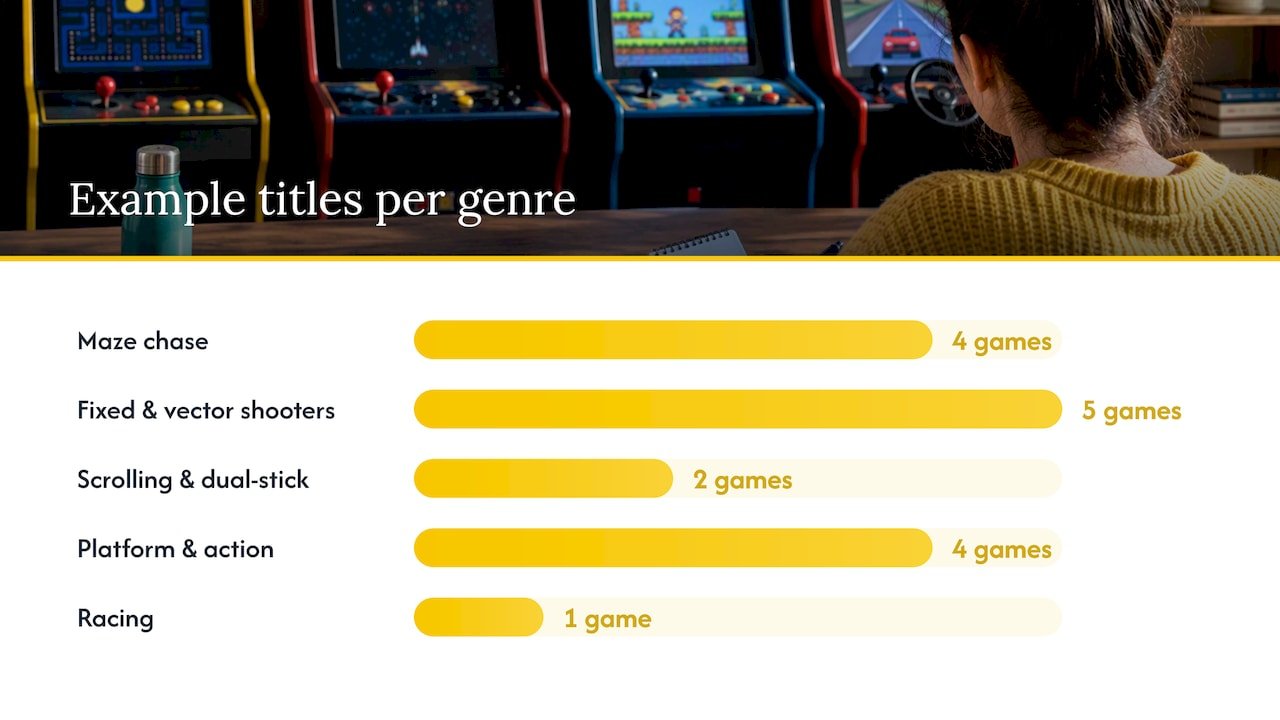
- Maze chase: Pac-Man, Ms. Pac-Man, Dig Dug, Mappy. Pattern recognition and timing matter more than reflexes.
- Fixed and vector shooters: Space Invaders, Galaga, Centipede, Tempest, Asteroids. Precision aim and escalating difficulty define the challenge.
- Scrolling and dual-stick shooters: Defender, Robotron: 2084. Spatial awareness across a moving or expanding field separates skilled players from casual ones.
- Platform and action: Donkey Kong, Q*bert, Burger Time, Joust. Jumping, climbing, and obstacle timing replace direct combat.
- Racing: Pole Position. Lap times and track memorization substitute for score chasing.
Knowing these groupings changes expectations before a single credit gets inserted. A player who loved Centipede’s trackball precision will likely enjoy Tempest more than Frogger, even though all three count as golden age classics. Genre, not just release year, predicts what a player will actually want to replay.
4. Where to Play or Find These Classic Games Today
Finding a working version of a 45-year-old arcade game takes more effort than opening an app, but the options are broader than most people expect. Four main routes exist: licensed digital compilations, official re-releases on modern consoles or PC, arcade museums with restored cabinets, and original physical cabinets still in circulation at bars, retro arcades, or venues.
- Check for licensed compilations first. Companies like Atari, Namco, and Williams have released official anthology packs on modern platforms that bundle many golden age titles with accurate emulation.
- Search MobyGames for release history. Enter the title, then check its platform list to see every official port, from the original cabinet to modern remasters.
- Cross-reference with the International Arcade Museum. Its Top 100 list often links to cabinet specifications, original manufacturers, and collector notes that confirm a release is genuine rather than a bootleg.
- Visit a dedicated arcade or museum. Many retro arcades keep restored cabinets running on original or replica hardware, which is the closest experience to how these games played in 1981.
A quick legal note: downloading ROM files for games you do not own, even old ones, generally falls outside the law in most markets unless the publisher has released them for free, so stick to licensed compilations or verified official sources.
Pro Tip: Before paying for a “retro collection,” search the title on MobyGames and confirm the publisher listed matches the original developer; a mismatch usually signals an unlicensed clone rather than an official port.
5. Where Archers Battlefield Fits Into the Arcade Picture
Archers Battlefield is not a museum or a software catalogue, but it does give players a practical, local way to put hands on arcade machines as part of a broader group outing. The venue’s offerings include combat archery, Nerf battles, bazooka ball, dodgeball, ping pong, axe throwing, and arcade games, organized into packages for families, corporate groups, sports teams, and individuals.
- Arcade games sit alongside activities like ping pong and dodgeball as part of the venue’s regular activity lineup.
- Game listings and pricing details appear on the price list page, including documented options like Pong.
- Readers curious about how the venue organizes its full activity roster can browse the categorized games hub or filter by style on the genre listing page.
- Event packages for birthdays, team building, and sports groups are built around combinations of these activities rather than arcade play alone.
None of this replaces a dedicated retro arcade or a museum collection built specifically around golden age cabinets. What Archers Battlefield offers instead is a way to fold a round of arcade play into a larger group event, whether that event is a birthday party, a corporate outing, or a team celebration, without needing to plan a separate trip to a specialty arcade.
6. Why Every Classic Arcade List Involves Trade-offs

Every curated list like this one makes judgment calls that a pure sales chart never would. Pac-Man’s cultural reach outweighs its mechanical complexity, while Tempest’s influence on shooter design outweighs its relative obscurity outside collector circles. Cabinet sales numbers favor whatever was cheapest and most widely distributed, while design-breakthrough rankings favor whatever other developers copied for the next decade. Neither approach alone tells the full story, which is why a balanced list leans on both popularity signals and documented design influence rather than picking one metric and ignoring the rest.
Some omissions will bother longtime players. Several notable genres and regional favorites never crossed over widely enough to earn a confident spot. If a title you consider essential is missing, that is less an oversight than a reflection of how any list this size has to draw a line somewhere.
— Archers
7. Bring the Arcade Experience to Your Next Event
Reading about classic arcade games is one thing. Standing in front of a cabinet with friends, a birthday group, or a coworker you are trying to beat at Pac-Man is another. Archers Battlefield folds arcade games into a lineup that also includes combat archery, Nerf battles, bazooka ball, dodgeball, axe throwing, and ping pong, so a visit turns into a full afternoon rather than a single activity.
- The Pong & Party On package starts at $299 and blends arcade-style play with other group activities.
- Families planning a birthday can look at the Game On Birthday Party, starting at $399, which bundles arcade access with other activities.
- Companies and sports groups can check the team-building packages, including the Collab Package starting at $699, for arcade-inclusive group events.
Pricing and package details for all activities, including arcade games, are listed on the booking page, where you can check availability and lock in a date for your group.
FAQ
What are the top 20 classic arcade games?
The top 20 generally include Pac-Man, Space Invaders, Donkey Kong, Ms. Pac-Man, Galaga, Asteroids, Defender, Centipede, Frogger, Dig Dug, Pole Position, Q*bert, Tempest, Galaxian, Joust, Missile Command, Burger Time, Robotron: 2084, Battlezone, and Gauntlet. This list spans maze chase, shooter, platform, racing, and action genres from the late 1970s through the mid 1980s, as detailed in the curated Top 20 above.
What are the top 100 classic arcade games?
A Top 100 list, such as the one maintained by the International Arcade Museum, ranks coin-operated games using collector and historian input rather than a simple popularity count. It is the better reference when you want a historically weighted view that goes well beyond the most famous titles.
What are some classic arcade games?
Beyond the most famous names, classics worth knowing include Berzerk, Pengo, Elevator Action, Zaxxon, Rally-X, Mappy, Time Pilot, and Mr. Do!. These titles extended golden age genres into new mechanics, from isometric shooting to platform-based puzzle design.
What are the top 50 arcade games?
A Top 50 extends the essential Top 20 with notable genre contributions like Berzerk’s voice synthesis, Zaxxon’s isometric perspective, and Mappy’s trampoline-based platforming. It is a useful middle ground between a quick-reference Top 20 and the much larger Top 100 collector rankings.
Where can I actually play these classic arcade games today?
Licensed digital compilations and official re-releases on modern consoles and PC offer the most accessible legal route, and checking a title’s platform history on MobyGames confirms whether a given version is official. Dedicated retro arcades, museums, and venues that keep arcade cabinets, including Archers Battlefield, offer hands-on play without needing to own hardware.


