A Nerf battle party works best at 60 to 90 minutes of total time for school-age kids, with about 45 to 60 minutes of actual play. Teens, adults and corporate groups can go to 2 hours. The right number depends on three things: the age of the youngest player, how many people are playing, and where the food break goes.
The length of the battle itself is shorter than most hosts expect. A single round lasts only a few minutes, so a “90-minute Nerf party” is really a sequence of rounds, resets, water breaks and cake. Plan the clock first and everything else, from the number of games to the number of adults, falls into place.
TL;DR
- Plan on rounds of roughly 10 to 15 minutes, including the short reset between games, so one hour holds about four rounds.
- Under 8 years old: aim for 60 to 90 minutes in total. Ages 9 and up, teens and adults: 90 minutes to 2 hours.
- Put food at the end of a 60-minute party, in the middle of a 90-minute one, and make it a proper sit-down at 2 hours.
- Corporate and sports groups can run a longer tournament-style format, since adults tire less quickly and want to see a result.
- Our Nerf Battle is listed at $35, and our group packages start at $399. See the package pages for the session length of each.
Table of Contents
- The short answer: how long by group
- What a Nerf battle round really looks like
- Choosing the length by age
- Where the food break goes
- Sample schedules you can copy
- What changes the total time
- Teams, leagues and corporate groups
- Our perspective
- Book the right length at Archers Battlefield
- FAQ
- Sources
The short answer: how long by group
| Group | Total time to book | Play time | Food break |
|---|---|---|---|
| Kids under 8, or fewer than 6 guests | 60 to 90 minutes | 40 to 50 minutes | At the end (60 min) or middle (90 min) |
| Ages 8 to 12, 6 to 12 guests | 90 minutes to 2 hours | 60 to 75 minutes | Middle, about 15 to 20 minutes |
| Teens | 2 hours | 75 to 90 minutes | Optional, 15 minutes |
| Adults, friends, date night | 60 to 90 minutes | Most of it | Before or after, not during |
| Corporate or sports team | 90 minutes to 2 hours | 75 to 100 minutes | Short break between bracket stages |
These are planning figures we use for building a schedule, not rules. A very energetic group of eight-year-olds can happily play the full 90 minutes, and a mixed group with a few shy younger siblings will want shorter bursts.
What a Nerf battle round really looks like
A round is one game with one objective: team elimination, capture the flag, protect the VIP, last one standing. Most rounds are over in 5 to 10 minutes because players are eliminated or the objective is reached. Then comes the part people forget: collecting darts, swapping sides, explaining the next game, and getting everyone back to their start positions.
A workable rule is to budget 10 to 15 minutes per round once you include that reset. That gives you simple maths:
- 60 minutes: about 4 rounds
- 90 minutes: about 5 rounds plus a food break
- 2 hours: 6 to 8 rounds, a sit-down break and a final “championship” game
If you plan the number of games first and the length second, you usually end up with a party that is either rushed or full of standing around. Choose the total time first.
Why shorter rounds beat longer ones
Most kids lose interest when a game drags on because they have been eliminated early. Short rounds with quick re-entry keep everyone involved. Variations that bring players back in (a respawn zone, medic tags, or two lives each) keep a 10-minute round from feeling like a 10-minute wait for half the room.
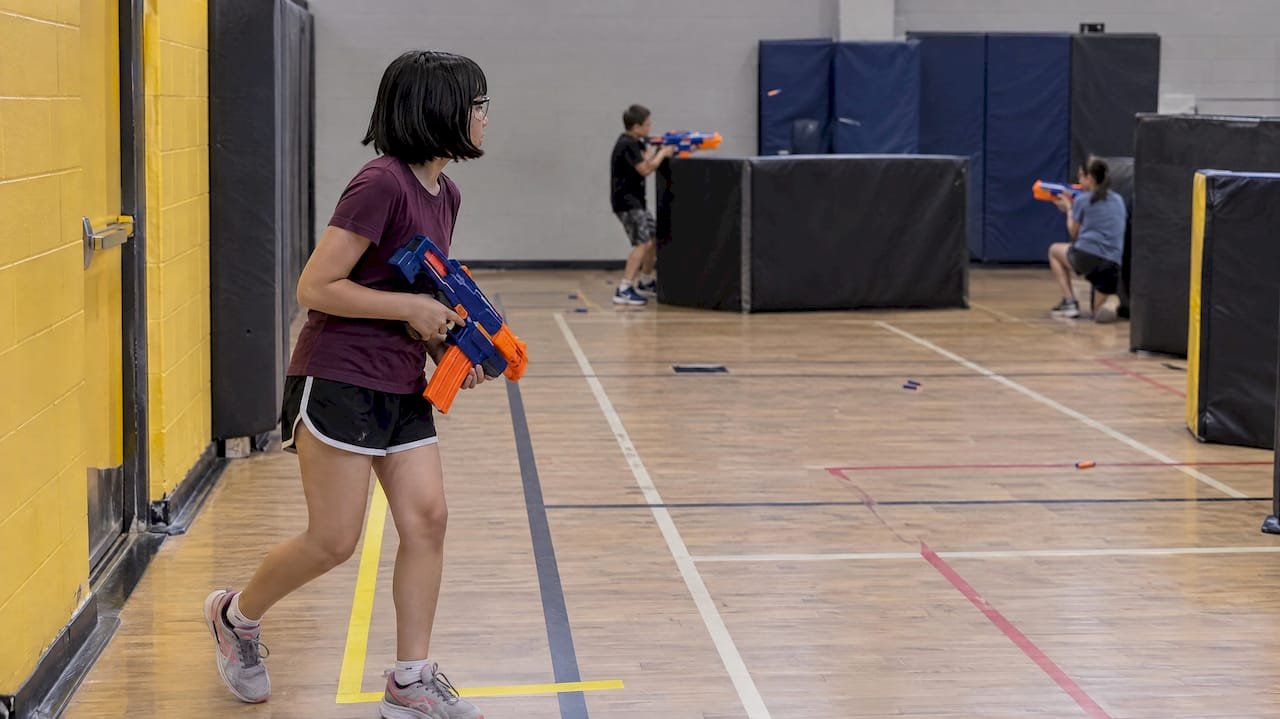
For the same reason, rotate game types. Alternate a fast elimination round with an objective game, so the energy rises and falls instead of staying at one level for an hour.
Choosing the length by age
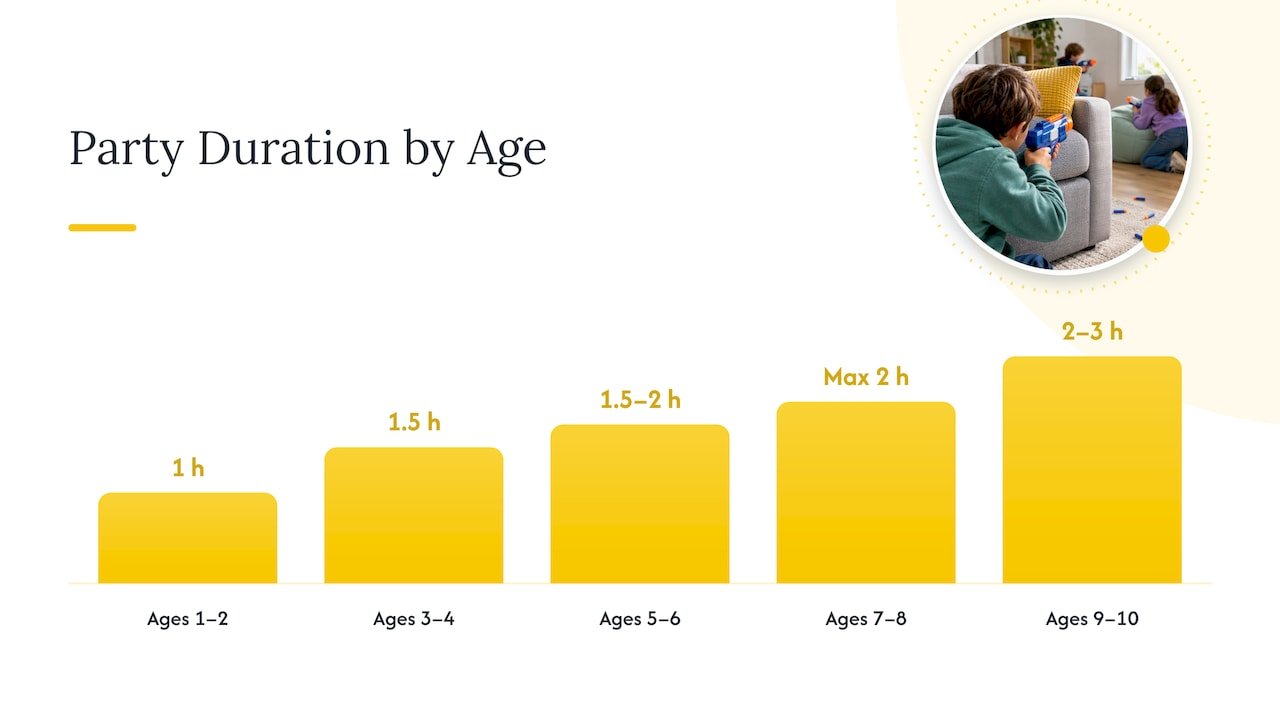
Party length guidance from parenting sources is consistent: the younger the child, the shorter the party. Canadian parenting site SavvyMom suggests 1 hour for ages 1 to 2, 1.5 hours for ages 3 to 4, 1.5 to 2 hours for ages 5 to 6, a 2-hour maximum for ages 7 to 8, and 2 to 3 hours for ages 9 to 10, with the recommended guest list growing from 4 to 6 children for the youngest to 10 to 12 for the oldest.
BabyCenter Canada makes the same point for preschoolers: a four-year-old’s party should last 90 minutes to two hours at most, scheduled around nap time, because young children get wound up and the longer a party goes, the more likely they are to lose their cool.
Those numbers cover a whole party, including arrival, gifts and cake. A Nerf battle is physically demanding, so we translate them this way:
Ages 5 to 7
Keep the total to 60 to 90 minutes. Younger players often lose steam well before the hour mark, so extra time tends to buy tired kids rather than more party. Use short rounds, simple objectives and plenty of water breaks. If you are unsure whether your child is old enough to join in, our guide to the Nerf party age range explains who can play and how to adapt the game.
Ages 8 to 10
This is the sweet spot for 90 minutes. Kids this age can follow rules, play five or six rounds and still have energy for cake. If the group is 10 or more, go to 2 hours and bring a second adult.
Ages 11 to 15
Teens want more strategy and a clear winner. Two hours works well, and a bracket or a points system across rounds makes the time feel purposeful.
Adults, date nights and friends
Adults often prefer 60 to 90 minutes. The activity is a workout, and the best part is usually the laughing and the rematches, not the length. Book a time slot you will fill with play, then eat afterward.
Where the food break goes
Food timing is the part hosts most often get wrong, and it changes with the party length:
- 60 minutes: food goes at the end. A break in the middle of a short party breaks momentum and eats the play time.
- 90 minutes: food goes in the middle, after round three or so. If you put it at the 80-minute mark, the group has nothing left to do afterwards.
- 2 hours: make it a real 15-minute sit-down, not a five-minute grab, so kids rest and rehydrate before the final rounds.
Whatever the length, plan cake or pizza for a fixed time and tell the group in advance. Kids who know a break is coming play harder in the stretch before it.
Sample schedules you can copy
60-minute party (under 8s, up to 6 kids)
- 0 to 5 minutes: safety briefing, eye protection, team split
- 5 to 40 minutes: three rounds of short games
- 40 to 50 minutes: final “everyone against the birthday child” round
- 50 to 60 minutes: cake and goodbyes
90-minute party (ages 8 to 10, 6 to 12 kids)
- 0 to 10 minutes: briefing and teams
- 10 to 40 minutes: three rounds
- 40 to 60 minutes: food and cake
- 60 to 85 minutes: two final rounds, including a finale
- 85 to 90 minutes: photos and exit
2-hour party (ages 9 and up, 10 or more players)
- 0 to 10 minutes: briefing and teams
- 10 to 55 minutes: four rounds
- 55 to 70 minutes: sit-down food break
- 70 to 110 minutes: three or four rounds, ending with a championship game
- 110 to 120 minutes: wrap-up
The numbers are rough on purpose. If a game is going well, let it breathe. If a round is dragging, end it and start the next.
What changes the total time
Group size. More players means longer briefings, longer resets and more darts to collect. A group of 16 needs more transition time than a group of 6, even if the rounds themselves are the same length.
Number of adults. One adult per four kids is a sensible ratio for running a safe game, and a second adult helps on the reset between rounds. Fewer supervisors means slower transitions.
Age mix. A party with a six-year-old sibling and a twelve-year-old cousin needs shorter, simpler rounds. Our mixed-age party games playbook has ready-made rounds for that situation.
Gear and clothing. Kids who arrive in the wrong shoes or with loose clothing slow everything down. Our Nerf battle outfit guide covers what to wear.
Waiting kids. Eliminated players need something to do. Quick activities for the sidelines, such as these balloon party games for birthdays, keep the energy up between rounds without extending the battle itself.
Teams, leagues and corporate groups
For team building, a 90-minute to 2-hour slot works best. The format is usually a mini tournament: several short rounds, a point tally, then a final. Adults tolerate more play time than children, but they also want clear structure so the afternoon does not turn into a free-for-all. If the goal is team bonding, leave a short break between stages for debriefs and refills. Our guide to Nerf team building in Ontario walks through the planning.
Sports teams tend to want shorter rounds and more of them, with a bracket and a trophy at the end. That keeps the competitive energy high and gives the coach an easy way to mix up squads.
Our perspective
We think the most common mistake in planning a Nerf party is booking for the wrong length rather than the wrong game. A host picks two hours because it sounds generous, and half the guests are flagging by the 70-minute mark. Or they choose an hour for a group of twelve ten-year-olds and spend most of it on briefings and darts.
The way around it is to start from the group, not the date: the age of the youngest guest, how many players, how many adults. Once those are set, the number of rounds and the place of the food are straightforward.
That is why we offer customizable packages for different group sizes and dedicated planning support. A party works better when someone has already thought about the clock, the teams and the safety briefing, so the host can watch the kids play instead of running the schedule. Safety is part of this, and a well-paced session keeps players focused and the game orderly.
If you tell us who is coming, we can help you pick the length and package that suit them.
Archers
Book the right length at Archers Battlefield
If you want the planning done for you, our Nerf Battle is listed at $35, and our group packages cover different sizes and ages. For birthdays, the kids’ birthday party packages include Game On Birthday Party from $399 and Epic Birthday Party from $499. For teams, Game On Team Battle starts at $399 and Epic Team Battle Event at $499 on our sports team event page. Check the package page for the session length and what is included, and tell us your group size and the youngest player’s age when you book.
If you are still comparing ideas, our Nerf party ideas page is a fast way to build a plan.
FAQ
How long does one Nerf battle round last?
Most rounds are over in 5 to 10 minutes, depending on the game type and group size. With the reset time between games, plan on 10 to 15 minutes per round for scheduling.
How long should a Nerf birthday party be?
For children under 8, 60 to 90 minutes in total is enough. For ages 8 to 10, 90 minutes is a good default, and groups of 10 or more older kids can go to 2 hours. Parenting guidance such as SavvyMom’s party-length guide also points to shorter parties for younger children.
Should food come before or after the Nerf battle?
It depends on the length. At 60 minutes, serve food at the end. At 90 minutes, serve it in the middle. At 2 hours, schedule a 15-minute sit-down break around the halfway mark.
Is two hours too long for a Nerf party?
Not for ages 9 and up, teens and adults, as long as there are breaks and a variety of games. For under-eights, two hours is usually more than the group needs, and 60 to 90 minutes works better.
How long should a Nerf session be for adults?
Sixty to ninety minutes suits most friend groups and date nights, and corporate teams often prefer 90 minutes to 2 hours with a tournament format and a break between stages.
Sources
- Birthday Party Planning 101: How Long Should the Party Last? (SavvyMom)
- Four-year-old’s birthday party: timing it right (BabyCenter Canada)
- 10 balloon party games for a successful birthday


