
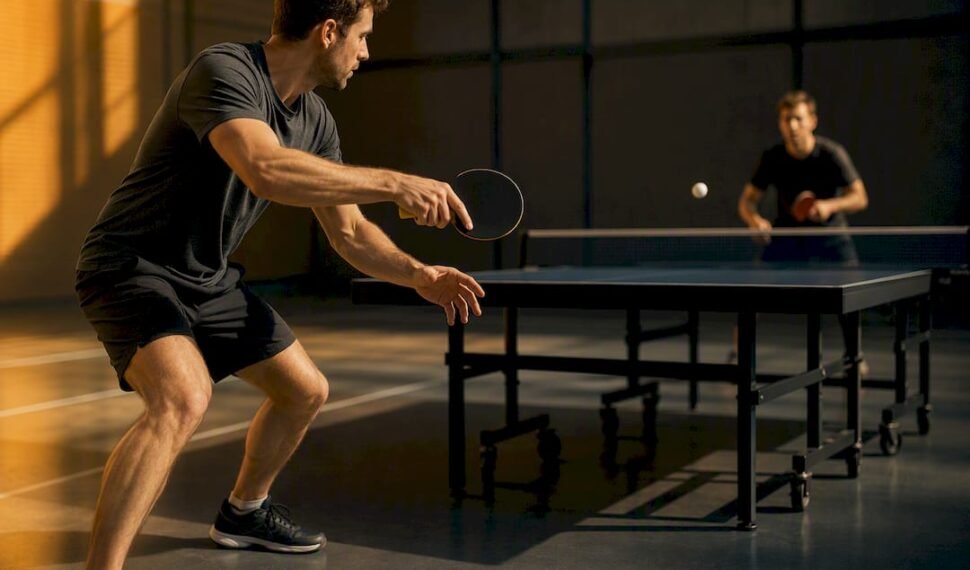
To improve fastest, fix three things in this order: grip, stance and footwork, then consistent forehand and backhand drives. Everything else, spin, serves, smashes, builds on that foundation. Practice 15 to 30 minutes daily, drilling drives and footwork before anything fancy. The 4-week training plan below turns that into a real schedule.
TL;DR:
- Proper grip pressure and a low, wide ready stance are essential for consistent contact and quick reactions during fast exchanges.
- Isolating and repeating core strokes like forehand and backhand drives with controlled tempo accelerates skill development more effectively than unstructured rallying.
- Varying serve pace, spin, and placement, combined with deliberate disguise, enhances unpredictability and makes returns more challenging for opponents.
- Weekly progression with targeted drills, including solo and partner practices, helps build muscle memory and adapt skills to real match scenarios.
- Coaching or structured group sessions provide critical feedback that solo drills cannot replace, especially for correcting subtle technical flaws.
Table of Contents
- Ping Pong Skills Start With Grip, Stance, and Footwork
- Core Strokes: Drives, Pushes, Blocks, and the Smash
- Serve Types and How to Read a Return
- Progressive Drills and a Training Plan That Actually Builds Skill
- Choosing a Paddle and Basic Practice Equipment
- Common Ping Pong Mistakes That Quietly Stall Progress
- When Coached Sessions Beat Solo Practice
- Spin Techniques: Topspin, Backspin, and Sidespin
- Advanced Shot Variations: Loop, Chop, Flick, and Lob
- Strategy: Shot Placement and Exploiting Weaknesses
- Mental Skills: Focus, Anticipation, and Game Mindset
- A Coach’s View on Pacing Your Practice
- Ready to Put These Skills Into Practice?
- Further Learning Hubs for Table Tennis Technique
- Sources
- FAQ
Ping Pong Skills Start With Grip, Stance, and Footwork
Every reliable shot in table tennis traces back to three things: how you hold the paddle, how you stand, and how you move your feet to get there. Skip these and you’ll spend months fighting your own technique instead of your opponent.
Shakehand vs. penhold grip. The shakehand grip, holding the paddle like you’re shaking someone’s hand, dominates recreational and competitive play worldwide because it gives you a natural backhand and forehand without flipping your wrist. Penhold, gripping the handle like a pen with your index finger curled behind the blade, rewards fast forehand-dominant players but makes backhand shots trickier for beginners. If you’re just starting out, shakehand is the easier path to consistent contact on both sides.
The most common grip mistake isn’t which style you choose, it’s grip pressure. Squeezing the handle tight kills wrist snap and turns every shot into a stiff push. Hold the paddle the way you’d hold a bird: firm enough it won’t fly away, loose enough it won’t get crushed.
Ready position. Between shots, you want knees bent, weight on the balls of your feet, and your paddle held around belt height in front of your body. This “low and wide” stance lowers your center of gravity so you can explode in any direction. Standing too upright is the single biggest reason beginners get caught out of position on fast exchanges. Foundational work on grip, stance, and footwork has to come before you build actual strokes, according to Racket Insiders’ beginner guide to table tennis, and that order matters more than most players realize.
Footwork patterns. Two movements cover 90% of what you need early on:
- Side-step: small, quick steps that shift your whole body left or right without crossing your feet, used for shots inside your normal reach.
- Crossover step: a longer stride where one foot crosses in front of the other, reserved for balls you have to chase wide.
Drill both without a ball first. Set two cones or water bottles about three feet apart and shuffle between them for 30 seconds, then rest 30 seconds, for five rounds. Once that feels automatic, add a partner feeding balls alternately to your forehand and backhand corners while you recover to center after each shot.
Pro Tip: Check your balance by having a partner gently push your shoulder mid rally. If you stumble instead of absorbing it, your stance is too narrow or your weight is too far back on your heels.
Core Strokes: Drives, Pushes, Blocks, and the Smash
Once your base is solid, four strokes carry almost every point you’ll ever play: the forehand drive, backhand drive, push, and block, with the smash as your finishing move.
Forehand drive. This is your primary attacking shot off a ball with topspin or no spin. The power comes from rotating your hips and shoulders, not swinging your arm. Contact the ball at the top of its bounce, slightly in front of your body, and finish with your paddle rising toward your opposite eye. A simple three-step progression:
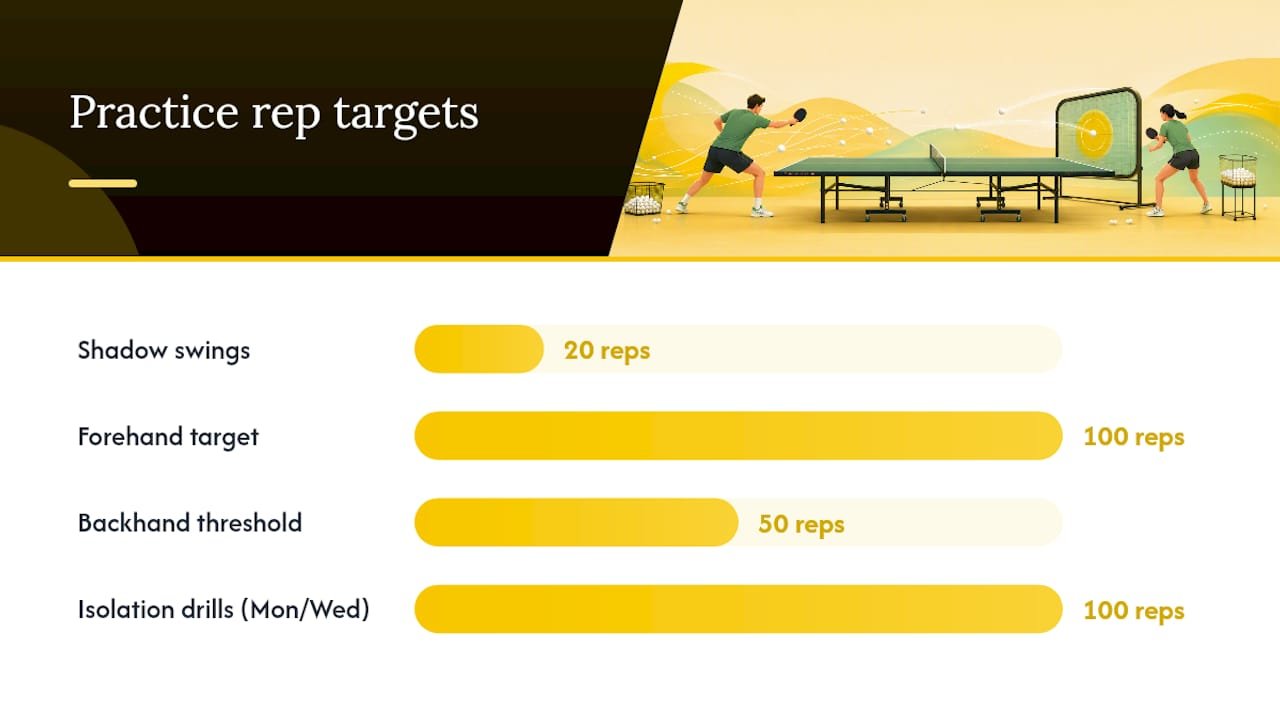
- Shadow-swing without a ball 20 times, focusing only on hip rotation.
- Have a partner feed easy forehands while you count consecutive clean returns, aiming for a run of 20.
- Build toward 100 controlled forehand drives in a row before adding pace or angle variation.
Backhand drive. The backhand relies on a small elbow pivot rather than the full hip turn you use on forehand. Keep your elbow roughly six inches from your body and let the forearm do the work. The footwork adjustment is subtle: a slight weight shift onto your left foot (for right-handers) as you make contact. Once you can do 50 backhand drives in a row, start alternating forehand and backhand with a partner to build the transition speed real rallies demand.
Push (backspin return). A push is a short, controlled stroke used against backspin serves or short backspin balls, keeping the ball low and safe rather than attacking. Angle your paddle face slightly open, brush under the ball, and keep the stroke compact, no big backswing. Use a push when the incoming ball has heavy backspin or when you’re not in position to attack; use a drive when the ball is flat or has topspin and sits up for you.
Block. Blocking redirects an opponent’s attacking shot using their own pace rather than generating power yourself. Keep the paddle angle nearly vertical, meet the ball early right off the bounce, and absorb rather than swing. Timing beats power here every time.
Smash. The smash finishes points off a high, slow ball, usually a weak lob or a loose return. Decision rule: only smash balls above net height with obvious arc; smashing low, fast balls is how beginners miss easy points. Aim for open court, not just maximum speed.
Pro Tip: Count your rally streaks out loud during drills. “One, two, three…” keeps you honest about whether you’re actually building consistency or just playing loosely.
Run this weekly sequence to layer the strokes together:
- Monday: forehand drive isolation, 100 reps.
- Wednesday: backhand drive isolation, 100 reps.
- Friday: alternating forehand/backhand drive rally, then push-to-drive combination drills.
- Weekend: light match play applying all four strokes under real point pressure.
Serve Types and How to Read a Return
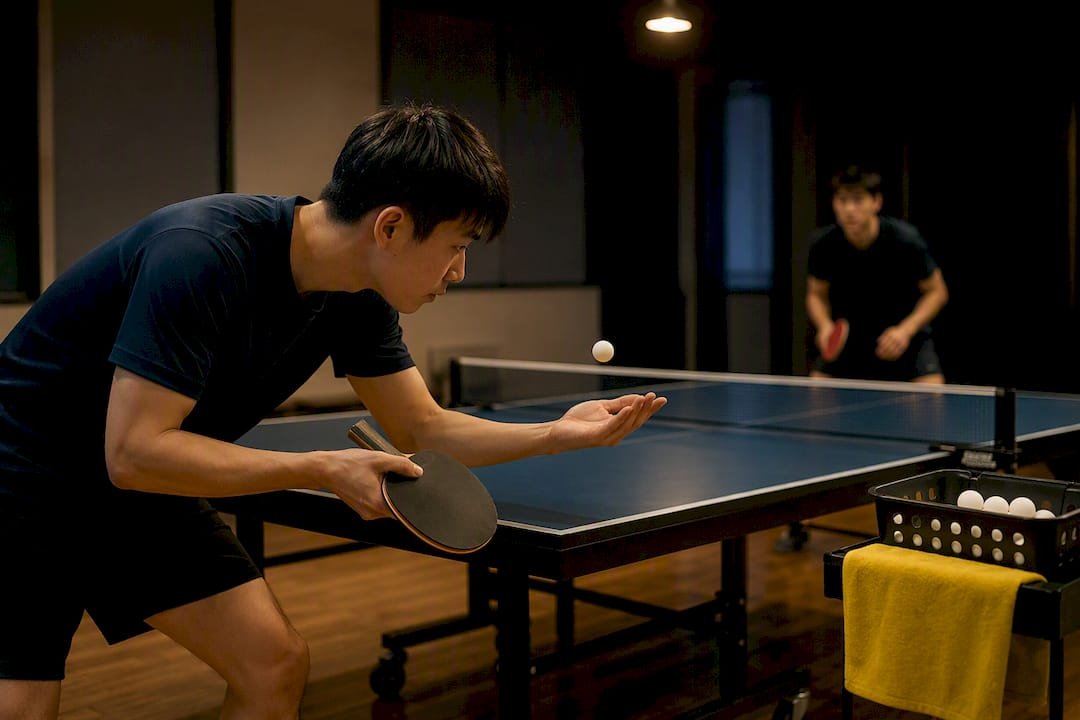
A legal serve requires you to toss the ball at least six inches straight up from an open palm and contact it behind the end of the table, no hidden serves, no throwing curveballs with your body blocking the view. Practicing sloppy, illegal serve motions early just builds habits you’ll have to unlearn later, so get the toss right from day one.
Split your serve practice roughly equally between fast, low serves and heavy backspin serves. That balance matters because mixing pace and spin on serves makes you far harder to read than a player who only serves one way. Within each type, vary placement, wide to the backhand, tight to the middle, short to the forehand, so opponents can’t anticipate location either.
Disguise is where beginners leave the most points on the table. Beginner progress speeds up noticeably once serve practice includes deliberate disguise and placement rather than just raw speed. Try this:
- Practice the identical backswing motion for both a fast serve and a heavy backspin serve, so your opponent can’t read your intent from your setup.
- Serve 20 in a row aiming for one specific quadrant of the table before switching targets.
- Have a partner randomly call out “fast” or “spin” a split second before you serve, forcing you to adjust mid motion.
Reading the return. Watch your opponent’s paddle angle and swing speed, not just the ball. A paddle face pointing down through contact usually signals topspin coming back at you, call for a drive. A paddle face open and brushing low usually means backspin, call for a push or a slightly lifted return. React to the bat first; the ball’s flight confirms what you already guessed.
Combine serve and third-ball attack by practicing this two-shot sequence 20 times per session: serve heavy backspin short, then attack whatever comes back with a forehand drive. That third-ball pattern, serve, return, attack, decides more amateur points than any single stroke in isolation.
Progressive Drills and a Training Plan That Actually Builds Skill
Warm up properly before every session. A dynamic warm-up covering your neck down to your ankles cuts injury risk and prepares your body for the sport’s quick, twisting movements. Five minutes of light cardio, arm circles, hip rotations, ankle bounces, then ten practice swings with your paddle before the first real ball.
A progressive, day-by-day structure that isolates one skill before combining it with others builds beginner competence faster than random, unfocused rallying. Here’s a four-week version:
- Week 1, isolation. Grip, stance, and single-stroke repetition only. Forehand drives, backhand drives, pushes, each in isolated blocks of 50 to 100 reps. No footwork combinations yet.
- Week 2, integration. Add footwork. Alternate forehand and backhand drives while moving between two spots on the table. Introduce push-to-drive transitions.
- Week 3, serve and return focus. Split sessions between serve practice (fast and spin, as covered above) and return reads. Add the third-ball attack drill.
- Week 4, match integration. Play full games, but consciously apply what you drilled: call your shot type in your head before you make it, then check afterward if it worked.
No partner available? Solo options still build real skill. Wall drills and playback-position rallying let you rack up repetition without a training partner, and a rebound board or robot serves the same purpose if you have access to one. Aim for 50 to 100 reps per solo session, same target as partner drills.
| Week | Focus | Rep target | Checkpoint |
|---|---|---|---|
| 1 | Grip, stance, isolated strokes | 100 per stroke | Clean form without watching your feet |
| 2 | Footwork integration | 50 rally exchanges | Recover to center after each shot |
| 3 | Serve variety and return reads | 20 serves per type | Correctly call spin most of the time |
| 4 | Match play | 3 full games | Apply at least one drilled pattern per game |
If you plateau, the fix usually isn’t more hours, it’s fresher constraints. Shrink the target zone, add a shot-count requirement before you’re allowed to attack, or switch practice partners so you’re not just memorizing one person’s rhythm.
Choosing a Paddle and Basic Practice Equipment
Paddles trade off three qualities: control, speed, and spin. A beginner paddle should lean toward control, meaning a softer sponge and a flatter rubber surface that forgives mistimed contact. Speed-oriented paddles reward players who already have consistent strokes; spin-heavy rubbers reward players who understand how to generate rotation, which usually isn’t a true beginner yet.
Look for these features on a starter paddle:
- A sponge thickness around 1.5 to 1.8 millimeters, thick enough for touch, thin enough to stay forgiving.
- A flared or straight handle, whichever fits your hand comfortably during a full grip.
- ITTF-approved rubber if you plan to play any organized matches later.
Rubber and sponge thickness matter because thicker sponge stores more energy, meaning more speed and spin potential, but also less margin for error on off-center hits. The natural upgrade path is control paddle first, then a slightly faster rubber once your 100-shot consistency targets are consistently met, then a spin-oriented setup once you’re deliberately generating topspin and backspin rather than just reacting to it.
Beyond the paddle itself, three accessories make practice dramatically more productive:
- A bucket of practice balls (40+ balls) so you’re not chasing one ball across the room between reps.
- A ball basket or hopper to speed up multiball feeding drills with a partner.
- A rebound board or wall space for solo repetition when no partner’s around.
Budget-wise, buy a decent all-around paddle first, the accessories matter more than a premium blade at the beginner stage. Upgrade the paddle once technique, not equipment, becomes your limiting factor.
Common Ping Pong Mistakes That Quietly Stall Progress
Most beginners plateau for the same handful of reasons, and every one of them is fixable in a single practice session once you know what to look for.
- Grip too tight. Shows up as stiff, chopping shots with no wrist snap. Fix: consciously loosen your hand between points, and check that you can wiggle your fingers slightly around the handle mid-rally.
- Standing too close to the table. Leaves no time to react to fast returns or generate power. Fix: back up until your extended arm just reaches the table edge, that’s roughly your correct base distance.
- Poor recovery after a shot. Leaving your paddle out front or drifting sideways instead of returning to ready position. Fix: add a “reset” cue, mentally say “back to center” after every single shot in practice.
- Arm-only swinging. Relying on the elbow and wrist instead of hip and trunk rotation robs your shots of power and consistency. Fix: shadow-swing in front of a mirror and watch your hips, not your arm.
- Watching the ball instead of the paddle. By the time the ball is airborne, it’s too late to read spin. Fix: train your eyes to snap to your opponent’s paddle face during their swing, not just the ball’s flight path.
Pro Tip: After every practice session, run this 30-second checklist: Did I recover to center after each shot? Was my grip loose? Did I watch the paddle, not just the ball? If any answer is no, that’s next session’s single focus, not three new things at once.
Deliberate, focused drilling beats unstructured rallying almost every time. Perfect, progressively harder practice produces better skill transfer than simply hitting the ball back and forth for an hour without a specific target in mind.
When Coached Sessions Beat Solo Practice
Solo drilling builds repetition, but it can’t replace live feedback. A coach or experienced partner spots grip drift, footwork lag, and timing errors in real time, catching flaws days or weeks before you’d notice them on your own. That’s the real value of a structured group session over another hour against a wall.
Structured venue sessions with rotating drills give players high-quality repetitions and informal feedback without needing to hire a private coach outright. A well-run group session typically includes:
- A guided warm-up covering the same dynamic stretching your solo routine should already have.
- Drill rotation, so you’re not stuck rallying with just one skill level the entire time.
- Supervised practice with basic safety guidance around paddle handling and table spacing in shared spaces.
If you’re building skill on your own during the week, consider pairing that with a monthly private pong room session or group booking. Solo drills handle the volume; coached or peer-rotated sessions catch the errors volume alone won’t fix. The combination, weekly solo reps plus a periodic structured session, tends to close skill gaps faster than either approach used alone.
Spin Techniques: Topspin, Backspin, and Sidespin
Spin is what separates a player who just hits the ball from one who controls it. Topspin makes the ball dip sharply after crossing the net, produced by brushing up and over the back of the ball with a closed paddle angle. It’s your main attacking spin, used on loops and aggressive drives, because it lets you hit with pace while the ball still drops into the table instead of flying long.
Backspin does the opposite: brushing down and under the ball makes it float, then die or even skid backward off the opponent’s paddle if they’re not ready for it. Backspin is your defensive and setup spin, used on pushes and chops, and it’s brutal against opponents who instinctively drive every ball without checking spin first.
Sidespin curves the ball’s flight path left or right and, more importantly, throws off an opponent’s angle of return. It shows up most on serves, where a sideways brushing motion sends the ball spinning in a way that makes straightforward returns sail wide or dive into the net.
Applying spin correctly comes down to reading it before you decide your shot. Heavy backspin coming at you needs an open paddle face and a lifting motion, or the ball dies into the net. Topspin needs a closed paddle and a shorter, more compact swing, or your return sails off the end of the table. Practice this by having a partner alternate topspin and backspin feeds while you call out which one before you swing.
Advanced Shot Variations: Loop, Chop, Flick, and Lob
Once your basic drives and pushes are consistent, these four shots extend your range against tougher opponents.
The loop is topspin taken to its extreme, a big, looping swing that brushes heavily up the back of the ball to generate massive rotation and arc. It’s the primary weapon in modern attacking table tennis, letting you hit hard while keeping the ball safely on the table.
The chop is a defensive backspin shot played well back from the table, absorbing an opponent’s attack and returning heavy backspin low over the net. Chopping well buys you time against aggressive loopers and forces errors from players who don’t respect the spin.
A flick is a quick wrist-driven shot used against short balls close to the net, generating topspin without a full swing since there’s no room for one. It’s the shot that turns a defensive short ball into an immediate attacking opportunity.
The lob sends the ball high and deep, usually as a last resort when you’re pulled off the table by a smash or loop. A well-placed lob with topspin can actually neutralize an opponent’s attack and force them to hit a difficult overhead shot instead of an easy finish.
Layer these in only after your core strokes are automatic. Trying to loop before your forehand drive is consistent just multiplies the ways you can miss.
Strategy: Shot Placement and Exploiting Weaknesses
Placement wins more points than raw power at almost every skill level below elite competition. The classic target is the opponent’s elbow zone, the awkward spot between forehand and backhand where players struggle to decide which stroke to use. Aim there consistently and you’ll draw weak returns even from players who can out-hit you in a straight rally.
Watch for patterns early in a match: does your opponent struggle more on wide forehand balls, or do they fall apart against short backspin serves? Most recreational players have a clearly weaker side, usually the backhand, and a shorter reach in one direction than the other. Feed that weakness relentlessly rather than mixing shots evenly out of habit.
Vary depth as much as direction. A short push followed by a deep, hard drive forces your opponent to move forward and backward, not just side to side, which tires footwork and breaks rhythm faster than lateral placement alone. Against a player who loves pace, slow the ball down with pushes and chops; against a player who thrives on spin exchanges, flatten your shots and rush their timing.
Mental Skills: Focus, Anticipation, and Game Mindset
Technique wins practice points; focus wins matches. Diaphragmatic, controlled breathing before your serve or return helps steady your nerves and keeps your shoulders loose instead of tense, which matters more than it sounds once the score gets close.
Anticipation is trainable, not innate. It comes from watching your opponent’s paddle angle and body position half a second before contact, the same skill you built reading spin in the serve section. The players who look “fast” are usually just reading cues a fraction of a second sooner than everyone else.
Between points, reset deliberately. Elite and recreational players alike benefit from a short physical routine, a bounce of the ball, a breath, a glance at your paddle, that signals to your brain the last point is over. Carrying frustration from a missed smash into your next serve is one of the fastest ways to lose two points instead of one.
A Coach’s View on Pacing Your Practice
Here’s the mistake I see constantly: players treat practice like a sprint instead of a habit.
Short, frequent sessions beat occasional marathon ones. A practice plan built around daily short technical work plus two longer weekly sessions that include real match play tends to convert raw technique into in-game decision-making far better than one exhausting three-hour session every other weekend. Your muscles and your brain both need the repetition spaced out, not crammed in.
Before each session, ask yourself three questions: What broke down last time, technique, footwork, or decision-making? What’s the one thing I’ll focus on today? And how will I know, specifically, if I improved? If you can’t answer that third question, you’re drilling without a target, and that’s how motivated players spend months standing still.
— Archers
Ready to Put These Skills Into Practice?
Reading about grip angles only gets you so far. At some point you need a table, a partner, and structured time that doesn’t dissolve into aimless rallying. That’s exactly the gap a session at Archersbattlefield fills: a private pong room booked on your schedule, with dedicated table time instead of waiting your turn at a public facility.

If you’re practicing solo during the week, a monthly private pong room session gives you focused table time to test the drills from this guide against a real opponent instead of a wall. Groups looking for a bigger event have options too: the Ultimate Paddle Party package, starting at $799, bundles pong with a full party setup for friends, families, or coworkers who want structured play without organizing it themselves. Smaller gatherings can start with the Pong & Party On package from $299. Either way, you get dedicated tables and a rotation format built for actual repetition, not just casual hitting. Check dates and book your session now to turn this week’s drills into real rally time.
Further Learning Hubs for Table Tennis Technique
Keep building beyond this guide with a few reliable references:
- Racket Insiders’ complete beginner guide covers grip, stance, and stroke fundamentals in more technical depth.
- Expert Table Tennis’s 12-step lesson structure breaks down a full progressive lesson plan for serves and rallying.
- MegaSpin’s basic technique library is useful for warm-up routines and injury prevention specifics.
- Ping Pong Reviewed’s beginner’s guide offers solo practice methods for players without a regular partner.
Sources
- How to Play Table Tennis (in 12 Simple Steps)
- Racketinsiders
- Basic Table Tennis Techniques – MegaSpin
FAQ
What Skills Do You Need to Play Ping Pong Well?
You need a comfortable grip (usually shakehand), a low, balanced ready stance, quick side-step and crossover footwork, and consistent forehand and backhand drives. Layer in serve variety, spin reading, and shot placement once those basics hold up under rally pressure.
What Are Some Good Techniques for Improving at Ping Pong?
Isolate one stroke at a time and build toward 100 controlled repetitions before adding speed or spin variation. Combine that with regular serve practice split between fast, low serves and heavy backspin, since mixing the two makes you far harder to read.
What Are the Basic Rules of Table Tennis?
Games are played to points with alternating serves every few points. Serves must toss the ball at least six inches from an open palm behind the end line, and the ball must bounce once on each side before returning it on a serve.
What Are the Core Skills Tested in Table Tennis?
The core skills are grip and paddle control, stance and footwork, stroke consistency (forehand and backhand drives, push, block, smash), serve variety, spin reading, shot placement, and mental focus under pressure. Most coaching plans, including structured sessions like those built around Archersbattlefield’s group pong bookings, work through these in roughly that order.
Do I Need a Coach to Improve, or Can I Practice Alone?
Solo practice with a wall or rebound board builds real repetition and is a legitimate way to rack up reps when no partner is available. Coached or group sessions add something solo drilling can’t: live feedback on grip, footwork, and timing errors you likely won’t catch on your own.


