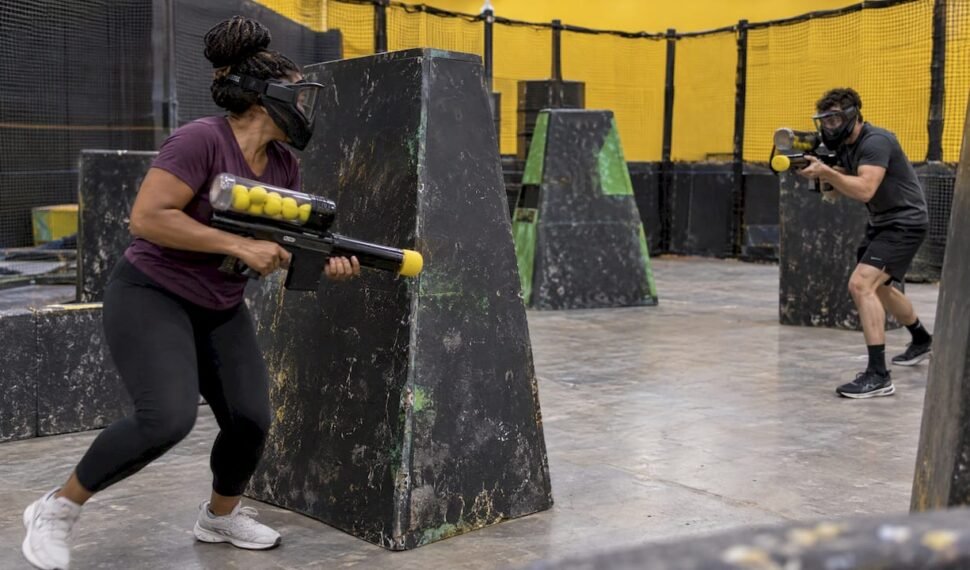
Bazooka Ball is a team combat game where players fire soft, 2-inch foam balls from modified paintball markers. It plays like paintball, with no paint, no mess and a much gentler impact. It is usually played in an arena with barriers or target stations, and it suits birthday parties, team events and group nights out.
If you have seen the name on a venue’s activity list and wondered what you would actually be doing, this guide covers the equipment, the rules of play, the safety gear, how it differs from paintball and Nerf, and how to plan a group around it.
TL;DR
- Bazooka Ball is a combat game using paintball-style markers with a special barrel that launches 2-inch foam balls instead of paint.
- Games are team-based: shoot targets, eliminate opponents, or defend your base inside an arena or at battle stations.
- The balls are light and dimpled, so hits feel soft, but proper eye protection is still the standard for everyone in the play area.
- It sits between Nerf battles and paintball: more power and range than a toy blaster, with no paint, welts or cleanup.
- Groups of kids, teens, adults and coworkers can all play, which is why it works for parties and team building.
Table of Contents
- What bazooka ball is, in plain terms
- How the game is played
- What equipment you use
- Does it hurt?
- Safety: what Canadian guidance says
- How bazooka ball compares with paintball and Nerf battles
- Who it suits
- Our perspective
- Planning a bazooka ball event
- Making it part of a bigger event
- Plan your group event with us
- Common mistakes to avoid
- FAQ
- Sources
What bazooka ball is, in plain terms
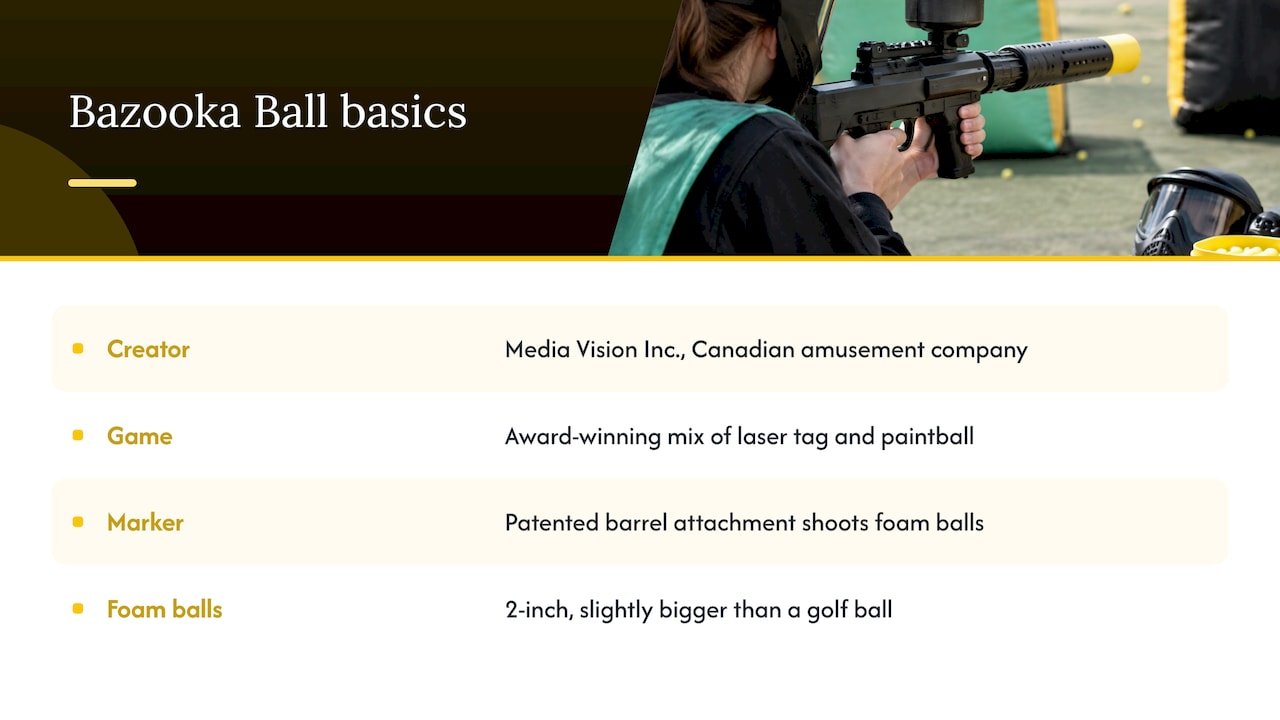
The game was created and is manufactured by Media Vision Inc., a Canadian amusement company. It describes Bazooka Ball as an award-winning combination of laser tag and paintball, using real paintball markers and 2-inch foam balls.
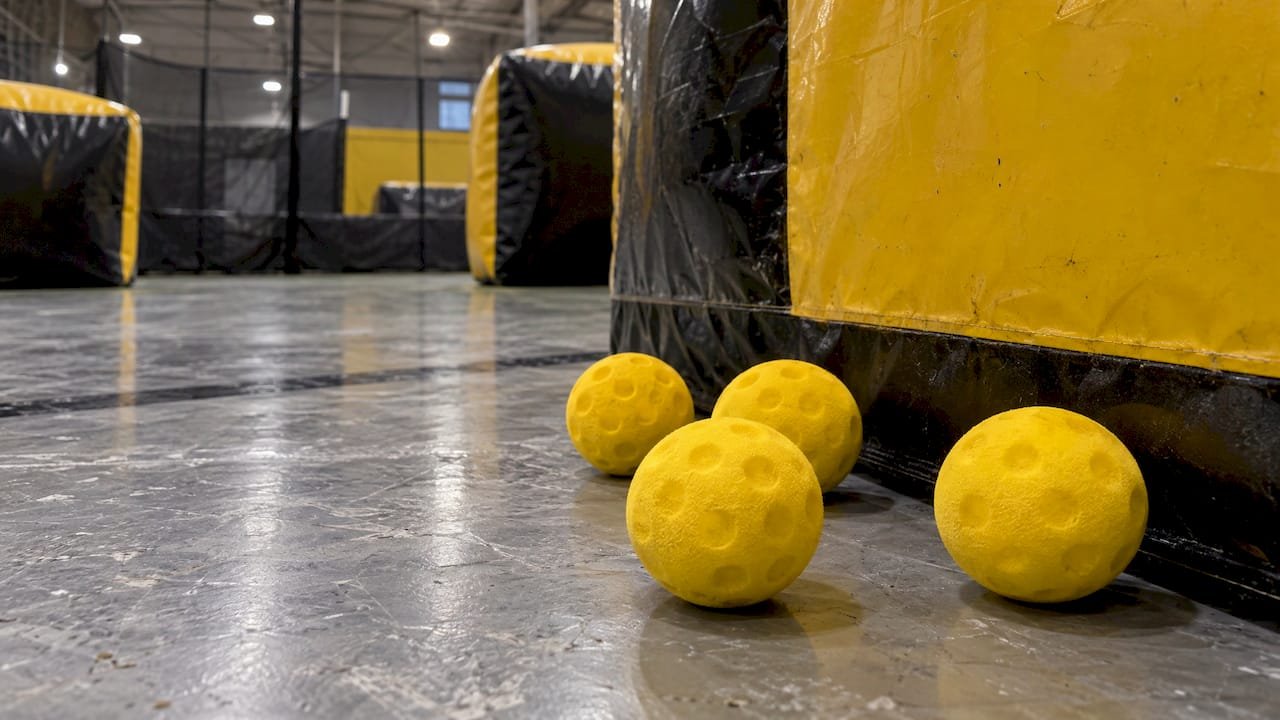
The name sounds bigger than the game. Nobody is firing anything resembling a rocket launcher. The “bazooka” is a marker with a patented barrel attachment that lets it shoot foam balls. Those balls are slightly bigger than a golf ball, light enough to bounce off you, and bright enough to see in flight.
That is also why people search the phrase and find a mix of results: the term shows up on venue pages, family fun centres, and manufacturer sites, all describing the same basic idea. A group, a marker each, foam ammo, and a goal.
How the game is played
Any format you could play in paintball can be played with foam balls, which gives venues plenty of room to design games. The most common setups are these:
Combat arena
Media Vision says the Combat Arena format starts at around 2,000 square feet and uses custom themed barriers. Players hide, move and flank much as they would in a paintball field, only indoors and with soft ammo. Think of it as a maze of cover with two teams working through it.
Battle station
The same source describes a smaller Battle Station layout, from around 600 square feet, with impact-scoring targets on the walls and pod stations for players. Scoring happens in real time on a customized scoreboard with sound effects. This format suits groups who want a more arcade-style, points-driven game.
Common game modes
- Team elimination: a player hit by a foam ball is out for the round. Last team with players standing wins.
- Capture the flag: grab the other team’s flag and bring it back to your base.
- Target defence: protect your team’s target while trying to hit the opposing one.
- Free-for-all: every player for themselves, good for short warm-up rounds.
Rounds are short, so there is no waiting around. Teams reset, swap sides, and go again. That rhythm is a big part of why it works so well for mixed-age groups: a bad round costs a few minutes, not an afternoon.
What equipment you use
Players typically get a marker, a supply of foam balls, a face mask and a vest or team identifier. Details vary by venue.
The markers
The barrel attachment is patented and, according to the ball specifications, fits standard Tippmann 98 markers and the Bazooka Ball Vertex Marker, with adaptors for several other marker brands. Markers are air-powered, so players do not need to cock or pump anything. You aim and squeeze the trigger.
The foam balls
The specifications published by the manufacturer are precise:
| Spec | Detail |
|---|---|
| Diameter | 2 inches |
| Weight | 11 grams |
| Speed | 43 feet per second (chronograph tested) |
| Energy | 0.94478 joules |
| Surface | Dimpled, like a golf ball |
The manufacturer says that energy level means the balls are classified as toys, so no licence is required in countries with strict gun laws. For perspective, the same page lists the speed in feet per second, which is far slower than the speeds typical of a paintball.
The dimples help the ball fly straight. Some operators also use specialty balls, such as water-filled “splat” balls or LED-lit balls for glow-style games, depending on what the venue has set up.
Does it hurt?
Hits from foam balls feel like a light tap or a firm poke, not the sting of a paintball. That is the main appeal: you can play hard, get hit many times, and walk out without welts. It is why venues recommend it for younger players and for adults who want the thrill of a paintball-style game without the bruises.
The gentle ball does not replace the safety basics, though. Eyes are the part of the body that deserves care in any game where projectiles fly, and the Canadian guidance is clear on that point.
Safety: what Canadian guidance says
The Canadian Ophthalmological Society’s position statement on nonpowder projectile weapons (July 2019) gives three simple rules that are easy to follow at any organized game:
- Everyone within firing range wears CSA-approved eye protection at all times.
- Children use these weapons only under adult supervision.
- Nobody aims at another person’s face or eyes.
The same document notes that nonpowder projectile weapons are not regulated by the Canadian government. It also notes that companies offering activities with them require every participant to wear protective eyewear, while people using them privately have no such requirement. In practice, that is the strongest reason to play at a venue where the gear, briefing and referee come with the booking, rather than improvising in a backyard.
Safe-play checklist for any group
- Wear the supplied mask or eye protection from the moment you enter the play area until you leave it.
- Listen to the safety briefing, even if you have played before.
- Keep markers pointed down or at the playing field when not in a round.
- Never remove protective gear mid-game to see better or to take a photo.
- Adults supervise younger children, and group leaders keep an eye on the energy level between rounds.
- Tie back long hair and wear closed-toe, flat shoes you can run in.
For related setups, our guides to archery tag safety and dodgeball safety rules walk through the same approach to gear, rules and space.
How bazooka ball compares with paintball and Nerf battles
| Bazooka Ball | Paintball | Nerf battle | |
|---|---|---|---|
| Ammo | 2-inch foam balls | Paint-filled capsules | Foam darts |
| Marker | Air-powered paintball-style marker with foam barrel | Paintball marker | Toy blaster |
| Impact | Soft | Can sting and leave welts | Very light |
| Mess | None | Paint on clothes and gear | None |
| Feel | Tactical, arena-style | Intense, outdoor | Playful, high-volume |
| Typical groups | Mixed ages, parties, team events | Older teens and adults | Kids, families, parties |
Bazooka Ball is closest to paintball in how the game flows: markers, cover, teams, objectives. It is closest to Nerf in comfort: no mess, no pain to speak of, and little to clean up. If you are weighing the options for a group, our comparison of Nerf and paintball for group games breaks down the trade-offs by age, space and goal.
Who it suits
Because the balls are soft and the games are simple to learn, foam-ball combat tends to be played by a wide age range. Operators often describe it as suitable for all ages, though the minimum age differs by venue, so confirm it when you book.
Typical groups include:
- Kids’ birthday parties: short rounds, quick wins, and plenty of laughs.
- Teen groups: a competitive game without the intensity or cost of paintball.
- Adult birthdays and date nights: a team game that gets people moving and talking.
- Corporate teams: objectives like capturing a flag or defending a base demand communication and role-sharing.
- Sports teams and school groups: a high-energy break from practice, with easy rotation for large numbers.
If you are planning for coworkers, our Ontario Nerf team building guide shows how to structure a session, and the same planning logic applies to foam-ball combat: short rounds, mixed teams, a debrief at the end.
Our perspective
We have watched what makes a group event land, and it is rarely the gear. It is how quickly everyone is playing and laughing. Foam-ball combat does that well: you can explain it in a minute, and a first-timer is part of the action in the first round.
That is why we think of games like Bazooka Ball as one piece of a bigger event, not the whole thing. Combat-style games get people moving and competing. Then a break for pizza, a round of ping pong, or a few arcade games keeps the energy from burning out. Mixed-age groups especially benefit from variety, because there is always something for the quiet guest and the competitive one.
Our emphasis is on safety, simple rules and clear briefings. Eye protection, supervision and a facilitator who sets expectations before the first round are the basics we plan every event around. When a game feels safe, people play harder and laugh more, and that is what a good party or team event looks like.
Archers
Planning a bazooka ball event
A few practical steps make the difference between a chaotic hour and a great one.
1. Decide what the group wants
A birthday party wants quick, silly rounds and lots of action. A corporate group wants objectives that reward teamwork. A sports team wants friendly competition that mixes up the usual lineups. Pick the mood first, then the games.
2. Count your players
The format and the space decide how many people can play at once. The manufacturer’s own layouts show how much room matters: a larger arena with barriers needs roughly 2,000 square feet and up, while a battle station layout works from around 600. Ask the venue how many players each session handles and how rounds rotate.
3. Confirm age rules and gear
Ask the venue about the minimum age, what protective gear is supplied, and how supervision works for young children. Under the Canadian guidance above, eye protection and adult supervision for children are the standard to look for.
4. Build a short schedule
A simple structure that works for most groups:
- Arrival and safety briefing
- Warm-up round
- Two or three themed rounds with team changes
- Break for food, drinks or cake
- A second activity, such as ping pong or an arcade game
- Final round and wrap-up
5. Keep rounds short
Five to ten minutes per round keeps energy high and lets every player rest, rehydrate and swap teams. Mixed ages play more smoothly when the strongest players are spread evenly across teams.
Making it part of a bigger event
Most groups do not stop at one game. Combat-style activities pair well with something lower-key, so guests can recover and chat between rounds.
At Archers Battlefield, our indoor venue offers combat archery, Nerf battles, dodgeball, ping pong, axe throwing, arcade games and bazooka ball. Single-activity sessions are priced per person: combat archery and Nerf battle are $35, and ping pong and dodgeball are $30. Bazooka ball, axe throwing and arcade games have no published price, so ask us for details.
For parties and events we offer packages built around group size and style:
| Package type | Examples | Starting price |
|---|---|---|
| Kids’ birthday | Game On Birthday Party | from $399 |
| Kids’ birthday | Epic Birthday Party | from $499 |
| Event | Pong & Party On | from $299 |
| Event | Action & Chill Bash | from $599 |
| Team building | Collab Package | from $699 |
| Sports teams | Game On Team Battle | from $399 |
| Sports teams | Epic Team Battle Event | from $499 |
| Premium | Momentum packages | from $2395 |
See the full details on our kids’ birthday party packages, our event packages, and our sports team events pages.
Plan your group event with us
Whether it is a birthday, a team outing or a night out with friends, we help you pick the right mix of activities for your group size and age range, and our planning support takes care of the details. Check our team building options for corporate groups, or go straight to booking.
Ready to lock in a date? Book your event with us and tell us about your group.
Common mistakes to avoid
- Skipping the briefing: even a short walkthrough of rules and boundaries prevents most problems.
- Mismatched teams: put the most experienced players on separate teams for fairness.
- Too many long rounds: young players tire quickly. Short rounds keep it fun.
- Ignoring the downtime plan: have food, water and a calmer activity ready between rounds.
- Booking too late: weekends and holiday periods fill up. Book early for parties and corporate events.
FAQ
What is bazooka ball in simple terms?
It is a team combat game where players shoot 2-inch foam balls from modified paintball markers. It feels like paintball without the paint, the mess or the sting. Games run in an arena with barriers or at stations with scoring targets.
Is bazooka ball the same as paintball?
No. The markers are similar in design, but the ammunition is a soft, dimpled foam ball instead of a paint capsule. There is no paint to clean up, and hits feel much lighter. The game formats and objectives, however, are very similar.
Is bazooka ball safe for kids?
It is widely offered as a family-friendly activity, with soft balls and short rounds. The Canadian Ophthalmological Society recommends CSA-approved eye protection for anyone within firing range, adult supervision for children, and never aiming at faces. A venue that supplies masks and runs a briefing handles those basics for you.
Do I need a licence to play?
The manufacturer says the balls’ low energy output classifies them as toys, so no licence is required in countries with strict gun laws. In Canada, nonpowder projectile weapons are not regulated by the federal government, according to the Canadian Ophthalmological Society. Organized venues still require protective eyewear for all participants.
How is bazooka ball different from a Nerf battle?
Nerf battles use toy blasters and foam darts, and they are the easiest, lightest option for young children. Bazooka ball uses paintball-style markers and larger foam balls, so it feels more like a tactical combat game. Both are mess-free and work well for parties and team events.
Sources
- Bazooka Ball by Media Vision Inc.: ball specifications and description
- Media Vision Inc.: Bazooka Ball arena and battle station formats
- Canadian Ophthalmological Society: Position Statement on the Use of Nonpowder Projectile Weapons


