
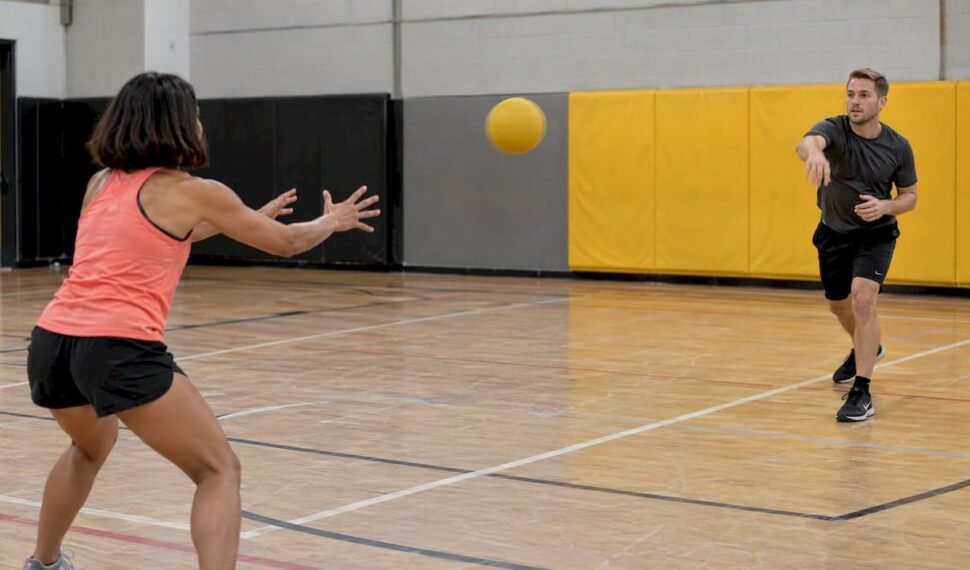
Good dodgeball practice comes down to six skills: throwing, catching, dodging, blocking, fakes and decision-making. You build them in that order, with a short dynamic warm-up first, paired drills in the middle and a small game at the end. Below you will find the drills, a ready-to-run 60-minute plan, and ways to adapt it for kids, beginners and small rooms.
TL;DR
- Warm up with a light jog, then skips, side steps, high knees, heel flicks and dynamic stretches before anyone throws a ball.
- Practice in this order: throwing technique, catching, dodging, blocking, then fakes and tactics. Revisit each skill every session.
- Pair drills (wall or cone targets, partner catching) build mechanics. Bulldogs-style games turn those mechanics into real dodging.
- Use soft foam balls, keep contact below the waist and mark boundaries away from hazards.
- Shrink the space, the target or the ball size to fit beginners and children instead of slowing the drill down.
Table of Contents
- The skills worth practicing
- Warm-up for dodgeball
- Throwing drills
- Catching and blocking drills
- Dodging drills
- A 60-minute practice plan
- Adapting drills for kids, beginners and small spaces
- Equipment and safety for practice
- Our perspective on practicing dodgeball
- Practice with us
- From practice to game night
- FAQ
- Sources
The skills worth practicing
The World Dodgeball Federation’s Player Development Framework lists the skills a player develops: throwing technique, accuracy and power, catching, dodging, blocking, fakes, trapping, rushing, movement in set positions and tactical decision-making. It also says skills should be revisited regularly, and that coaches should place beginners of any age at the right stage and confirm they have the skill before moving on.
That last point matters more than any single drill. A session where everyone rushes to full games teaches the strongest throwers and leaves everyone else flinching. A session where you check the basics first gives every player something to build on.
A practical way to think about it:
- Throwing: grip, elbow position and body rotation first. Accuracy and power come after. Variations such as the jump throw come last.
- Catching: soft hands, eyes on the ball, then speed.
- Dodging: reading the thrower, moving at the right moment, linking two dodges together.
- Blocking: using a ball in hand to stop an incoming throw.
- Fakes and tactics: only once the first four are reliable.
For the team-play layer that sits on top of these skills, see our guide to dodgeball strategies.
Warm-up for dodgeball
A dodgeball warm-up has two jobs: raise body temperature and prepare the shoulders and ankles, which take the most strain. A warm-up guide from ENAC suggests starting with a light jog, then gradually adding skips, side steps, high knees and heel flicks, and finishing with dynamic stretches.
A five-minute warm-up sequence
| Minutes | Activity | What it prepares |
|---|---|---|
| 0 to 1 | Light jog around the court | Heart rate, general warmth |
| 1 to 2 | Skips and side steps | Coordination, lateral movement |
| 2 to 3 | High knees and heel flicks | Hips, hamstrings, quads |
| 3 to 5 | Dynamic stretches: arm circles, trunk rotations, leg swings | Shoulders, core, hips |
Add a few easy partner throws at half effort at the end. Nobody should throw hard on cold shoulders.
Warm-up games where the ball is only for tagging
For younger groups, a game is a better warm-up than a drill line. A school district warm-up resource from British Columbia describes elementary tag games where dodgeballs are used to tag rather than throw. Flower Tag, Moose and Rooster Tag, and Foxes and Chickens Tag are examples. Kids get moving, learn to carry a ball and practice changing direction, with no throwing risk at all.
Why the warm-up is worth the time
Active & Safe Canada notes that a shoulder-injury-prevention warm-up can improve control, flexibility and coordination, and that regular balance training with a resistance component may reduce lower-body injury risk by up to 50%. Shoulders and ankles are exactly where dodgeball players get hurt, so these five minutes are not optional.
Throwing drills
Throwing is the first skill to build, because everything else in the game answers a throw.
Target throws in pairs
The ENAC guide describes a simple overarm and underarm target drill. Mark a target about one metre square (a taped square on a wall works) and have partners stand four to five metres away. One player throws at the target while the partner retrieves or catches the ball and returns it.
Coaching points to repeat every round:
- Grip: fingers spread, ball held in the fingers rather than jammed into the palm.
- Elbow: lifted to roughly shoulder height before the throw.
- Rotation: hips and shoulders turn together, so the arm is not doing all the work.
- Follow-through: the throwing hand finishes toward the target.
This mirrors the early throwing progression in the WDBF framework: grip, elbow position and body rotation first, then accuracy, power and variations.
Progressions
Once pairs are hitting the target consistently, change one thing at a time:
- Throw below the target, aiming at the lower edge to practice low, legal shots.
- Add snatch throws, where the player picks up a rolling ball and throws in one motion.
- Increase the distance gradually to build power.
- Switch between overarm and underarm throws.
Track hits out of ten for each round. A number on the wall gives beginners a goal and gives you a way to know when to move on.
Catching and blocking drills
Partner catching at speed
Start close together with soft, slow throws. Add pace and distance only when both partners are catching cleanly. The point is to teach players to watch the ball into their hands and absorb it by letting the arms give slightly.
Turn-on-“GO” reaction catch
The ENAC guide includes a reaction catch. One player stands facing away. The partner calls “GO,” the catcher turns, and the thrower sends the ball. It trains the quick turn and visual pickup that happen in real games when a throw comes from the side.
Blocking with a ball in hand
Blocking means using the ball you hold to stop an incoming throw. Practice it slowly: the thrower tosses a soft ball toward the chest, and the blocker raises the held ball to meet it. Speed up only once the technique is clean. Players learn to keep their grip firm and avoid dropping the ball they hold.
Dodging drills
Good dodgers do not simply move fast. They move at the right moment. British Dodgeball’s dodging lesson plan recommends combining or sequencing dodges and timing the movement to when the thrower begins the throwing motion. Moving too early lets the thrower adjust. Moving too late is a hit.
Bulldogs
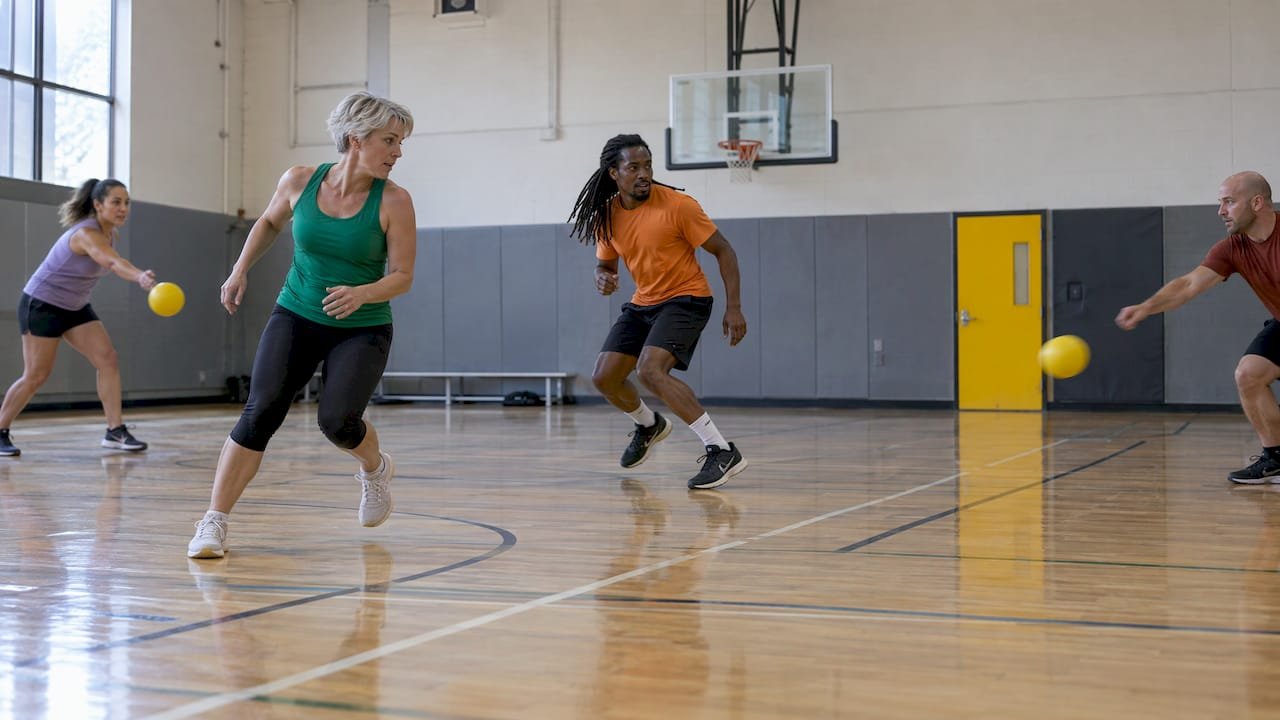
Bulldogs is a game-based dodging drill described in the ENAC guide. Runners cross the court while throwers on the sides try to hit them below the waist. Runners who are hit change roles or join the throwers, depending on how you run it. It teaches reading throwers, changing pace and using the whole width of the space.
Cross the river
A variation with cones and floor mats: two sides, a “river” in the middle, and a ball-and-dodge crossing. It keeps more players active than a single-line drill.
Dodge-cue drill
- Line players up facing a thrower at a safe distance.
- The thrower makes a slow, exaggerated wind-up.
- Players practice moving as the arm starts forward, not before.
- Add a second movement (a step then a duck) once the first timing is solid.
- Shorten the wind-up as skill improves.
A 60-minute practice plan
Use this as a template and adjust the times for your group.
| Time | Block | Focus |
|---|---|---|
| 0 to 5 min | Dynamic warm-up | Jog, skips, side steps, high knees, heel flicks, stretches |
| 5 to 20 min | Throwing | Paired target throws, then below-target and snatch throws |
| 20 to 30 min | Catching and blocking | Partner catching, turn-on-“GO” reaction catch, blocking drill |
| 30 to 42 min | Dodging | Dodge-cue drill, then Bulldogs |
| 42 to 55 min | Small-sided game | Three-on-three or four-on-four with foam balls, apply the skills |
| 55 to 60 min | Cool-down | Light walking, shoulder and leg stretches, short debrief |
A few notes on running it well:
- Keep lines short. Pairs and small groups beat one long queue.
- Change one variable at a time. Distance, then speed, then target size.
- End on a game. Players remember what they practiced when they have a reason to use it.
- Return to basics every session. The WDBF framework’s advice to revisit skills regularly applies to experienced players, too.
If you are planning a longer evening for a youth group, our 90-minute youth group dodgeball run sheet shows how to fit practice and play into one night. Game formats and rule templates are covered in our guide to dodgeball game modes.
Adapting drills for kids, beginners and small spaces
Use the STEP idea
British Dodgeball’s Inclusive Activity Guide uses a STEP principle to adapt any activity through Space, Task, Equipment and People. Examples include increasing the distance between attackers and targets, limiting target zones, using a smaller foam ball and changing attacker numbers or groupings.
In practice:
- Space: a small room works if you shrink the court and use fewer players at a time. Rotate groups in and out.
- Task: make the target bigger for beginners, smaller for advanced players.
- Equipment: switch to a smaller or softer ball.
- People: pair strong throwers with each other so newer players are not overwhelmed.
Ball size by age
The same guide recommends size-1 foam balls for under-11 players, size-2 cloth balls for under-15 players and size-3 cloth balls for under-17 players and adults. It notes that size-1 foam may also suit participants with disabilities or additional needs.
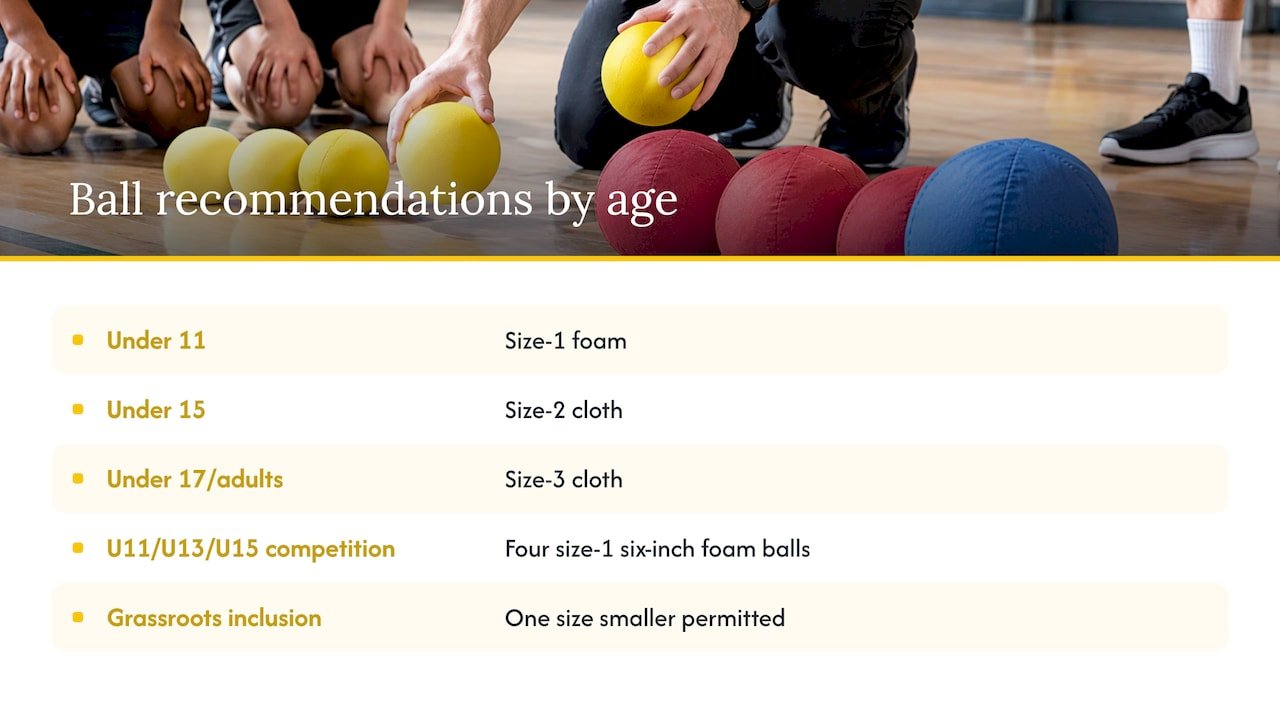
For competition, the WDBF’s 2026 youth foam adaptations use four size-1 six-inch foam balls for U11, U13 and U15 competitions, and let grassroots organizers use a ball one size smaller for inclusion. The same document defines U11, U13, U15 and U18 by the player’s age on the event end date, with adult beginning at 19. If your group mixes ages, use these categories to decide who practices together.
Group size
- Under eight players: all drills in pairs, rotate through stations.
- Eight to sixteen: two or three stations, swap every five to eight minutes.
- Larger groups: run Bulldogs-style games in multiple lanes, with a leader on each.
Equipment and safety for practice
The Ontario Physical Activity Safety Standards in Education set out clear guidance for school dodgeball, and it is sensible to follow it for any group practice in Ontario.
- Soft balls only: foam balls, sponges, beach balls, elephant-skin balls or utility balls. Under-inflated balls, beanbags and hard flying discs are not appropriate.
- Space and footing: check that footing is safe, close doors and mark boundaries away from hazards.
- No jewellery, and accommodate medical aids. Check equipment and any assistive devices.
- Supervision: directly supervise the initial safety and skill instruction and any throwing.
- Below the waist: keep ball contact below the waist. Controls include requiring a bounce first, penalizing above-waist hits, using the non-dominant hand and increasing throwing distance.
Active & Safe Canada identifies shoulder, ankle and head injuries as common dodgeball risks. Repetitive throwing can contribute to shoulder pain, jumping and rapid direction changes can injure ankles, and head or body impacts can cause concussion. That is why we cap throwing reps per block, keep the ground clear and aim low. If a player takes a hit to the head or shows concussion symptoms, stop their activity and have them seen by a doctor or nurse practitioner before they return.
Our dodgeball safety rules page goes deeper on how we run games safely.
Our perspective on practicing dodgeball
We see the same pattern with every group that walks into our venue: the people who enjoy dodgeball most are the ones who feel competent in the first ten minutes.
That is why we think practice should feel like play. A short warm-up, a few target throws, a dodging game and then a real match. Nobody sits in a line waiting for a turn, and nobody is thrown into a full game with no idea how to catch or block.
Our approach is built around the people in the room. We offer dodgeball alongside combat archery, Nerf battles, bazooka ball, ping pong, axe throwing and arcade games, so a group can mix skills practice with variety. Our event packages are designed to scale for different group sizes and ages, and our planning support is there to help you pick the right format, whether that is a birthday party, a team event or a school outing.
Safety is part of the fun, not a limit on it. Foam equipment, clear boundaries and supervised instruction let players commit to the game.
Archers
Practice with us
If you would rather play than set up cones, we run dodgeball at our indoor venue in Ontario. A dodgeball session is $30, and our group packages scale up from there. Teams can look at our sports team events, starting from $399 for Game On Team Battle, while companies can read our corporate dodgeball booking guide. You can also see our dodgeball activity page.

Parents planning a party can compare our kids birthday party packages, starting from $399 for Game On Birthday Party. For everything else we offer, visit our home page.
From practice to game night
Once your group has the basics, the next step is playing regularly. Mixing dodgeball with other activities keeps people coming back, and a guide to local activity ideas can help you plan a full evening out around a game. For smaller groups, our indoor game night ideas show how to start with six games and scale up.
FAQ
What are the best dodgeball drills for beginners?
Start with paired target throws at a wall or taped square about four to five metres away, then add partner catching and a simple dodging game such as Bulldogs. Keep balls foam and throws soft. Move to harder drills only when players show they can throw, catch and dodge reliably.
How long should a dodgeball warm-up take?
Five minutes is a practical minimum for a casual session: a light jog, then skips, side steps, high knees, heel flicks and dynamic stretches. Add a few easy half-speed partner throws at the end. Longer sessions or older players may want a few more minutes.
How can I practice dodgeball in a small space?
Shrink the court, use fewer players per station and rotate groups. Use pairs for target throws and catching, and choose foam balls. The STEP idea (changing Space, Task, Equipment or People) lets you scale most drills to fit a small room.
What size ball should kids use?
British Dodgeball recommends size-1 foam balls for under-11 players, size-2 cloth balls for under-15 and size-3 cloth balls for under-17 players and adults. The WDBF’s youth foam rules use size-1 six-inch foam balls for U11, U13 and U15 competition. Choose the smaller option when in doubt.
How do I make dodgeball practice safer?
Use soft balls, keep contact below the waist, clear the space of hazards, remove jewellery and supervise throwing directly. Ontario’s school safety standards suggest controls such as requiring a bounce first or using the non-dominant hand. Stop the activity for any head impact.
Sources
- WDBF Player Development Framework
- ENAC dodgeball warm-up and drills guide
- School District 33 mini games and warm-ups
- Active & Safe Canada: Dodgeball
- British Dodgeball dodging lesson
- British Dodgeball Inclusive Activity Guide
- WDBF Youth Ruleset Adaptations, Foam 2026
- Ontario Physical Activity Safety Standards: Dodgeball


