

A table tennis game is won by the first player or pair to reach 11 points, but only if they’re ahead by at least 2. Miss that margin at 10-10 and the game keeps going, point by point, until someone finally pulls two clear. Service rotates every 2 points during normal play, then flips to every single point once the score hits deuce, matches are decided across a set number of games, usually best-of-5 in club play and best-of-7 at higher levels of competition.
TL;DR:
- A game ends at 11 points with a two-point lead, but matches can extend indefinitely past deuce until one player leads by 2.
- Service switches every 2 points before deuce and every single point after 10-10, with the first server typically rotating in the next game by lot or coin toss.
- Legal serves require the ball to be tossed at least 16 centimeters straight up, visible continuously, and struck with an open palm without hiding the toss.
- Doubles serve must be diagonal from the right service court of the server to the right court of the receiver, with partners alternating hits strictly.
- Extended deuce games demand careful scorekeeping, as the score can run well past 20 points with no set maximum until someone wins by two points.
Table of Contents
- What’s the Difference Between a Game and a Match?
- How Do You Actually Win a Point in Table Tennis?
- What Actually Counts as a Legal Serve?
- How Does Serving Work in Doubles?
- What Happens at Deuce in Table Tennis?
- Which Match Format Should You Use?
- What Is the Expedite System and When Does It Apply?
- What Are the Most Common Scoring Mistakes?
- Why Trust This Breakdown of the Rules?
- How Do Scoring Rules Shape the Way People Actually Play?
- How Did Table Tennis Scoring Get to 11 Points?
- Do Recreational Players Follow the Same Scoring Rules as Professionals?
- What Happens When a Game Goes Deep Past Deuce?
- When Should You Bend the Rules for Casual Play?
- Book a Pong Room and Skip the Rulebook Arguments
- Sources
- FAQ
What’s the Difference Between a Game and a Match?
A game ends at 11 points, provided the winner leads by 2. A match is a set of games, and you need to win more than half of them to take the match. Best-of-3 (first to 2 games) is common for casual and school-level play. Best-of-5 (first to 3) shows up in most club and regional tournaments. Best-of-7 (first to 4) is reserved for higher-stakes competition, including many national and international events.
Ends switch after every completed game, so the player who served first in game one won’t necessarily have the same side or serve order in game two. In the deciding game of a match, players switch ends when one side reaches a mid-game point threshold, ensuring fairness regardless of who’s ahead.
- Games: played to 11 points with a win by 2 rule
- Matches: typically best-of-3, 5, or 7 depending on competition level
- Ends change after each game, and at a mid-point in the deciding game to maintain fairness
How Do You Actually Win a Point in Table Tennis?
Every rally ends with exactly one point, and the Laws of Table Tennis spell out precisely who gets it. If you’ve ever argued with a friend over a close call, the answer is almost always sitting in Law 2.10.
- The server fails to make a legal serve (net, wrong bounce pattern, illegal toss).
- The receiver fails to return the ball onto the opponent’s side after a legal serve.
- The ball is struck and lands off the table or into the net without clearing it properly.
- A player hits the ball twice in succession with the same stroke (a double hit).
- A player or their clothing obstructs the ball while it’s still traveling toward the table.
- A player touches the playing surface with their free hand while the ball is in play.
- The server, receiver, or in doubles the striking order, is out of sequence and a stoppage is called.
One exception interrupts a rally without awarding a point at all: a let. If the served ball clips the net edge and still lands legally, or if a rally is disrupted by something outside the players’ control (a ball rolling in from another table, an unexpected interruption), the point is replayed rather than scored.
What Actually Counts as a Legal Serve?
The serve looks simple until you watch it in slow motion, and that’s exactly why so many casual points get replayed over an argument. The rules require the ball to rest on an open palm, get tossed vertically at least 16 centimeters, and stay visible to the receiver throughout the motion. No spin tricks with a curled hand, no hiding the toss behind your body.
- Ball rests flat on an open palm before the toss
- Toss travels straight up, minimum 16 cm, no added spin
- Ball must stay visible to the receiver from toss to strike
- Server calls or the umpire displays the score, server’s points first
Service alternates every 2 points through most of the game. At 10-10, that changes: service switches every single point instead of every two. Whoever served first in the previous game usually receives first in the next one, and in a deciding game, the two sides typically pick the server by lot or coin toss unless a governing body specifies otherwise.
Pro Tip: If you’re running a casual tournament, hand a laminated card with the toss height and open-palm rule to whoever’s keeping score. Most disputes at the club level come from someone not knowing the serve has to be visible the entire time, not from actual cheating.
How Does Serving Work in Doubles?
Doubles often confuses new players because the serve must travel diagonally from the server’s right service court to the receiver’s right service court. Missing this results in a fault.
- Serve must be diagonal, from server’s right service box to receiver’s right
- Service rotates through all four players in a fixed sequence for the match
- Receiving pair selects who returns first after serving order is established
- Partners must alternate hitting; consecutive hits by the same partner lose the point
That last rule is where most doubles teams lose easy points early on. Partners have to strike the ball in strict alternation, and if one player gets excited and hits twice in a row, even by accident, the point goes straight to the other side. It forces real footwork and communication between partners, which is half the reason doubles feels so different from singles.
What Happens at Deuce in Table Tennis?
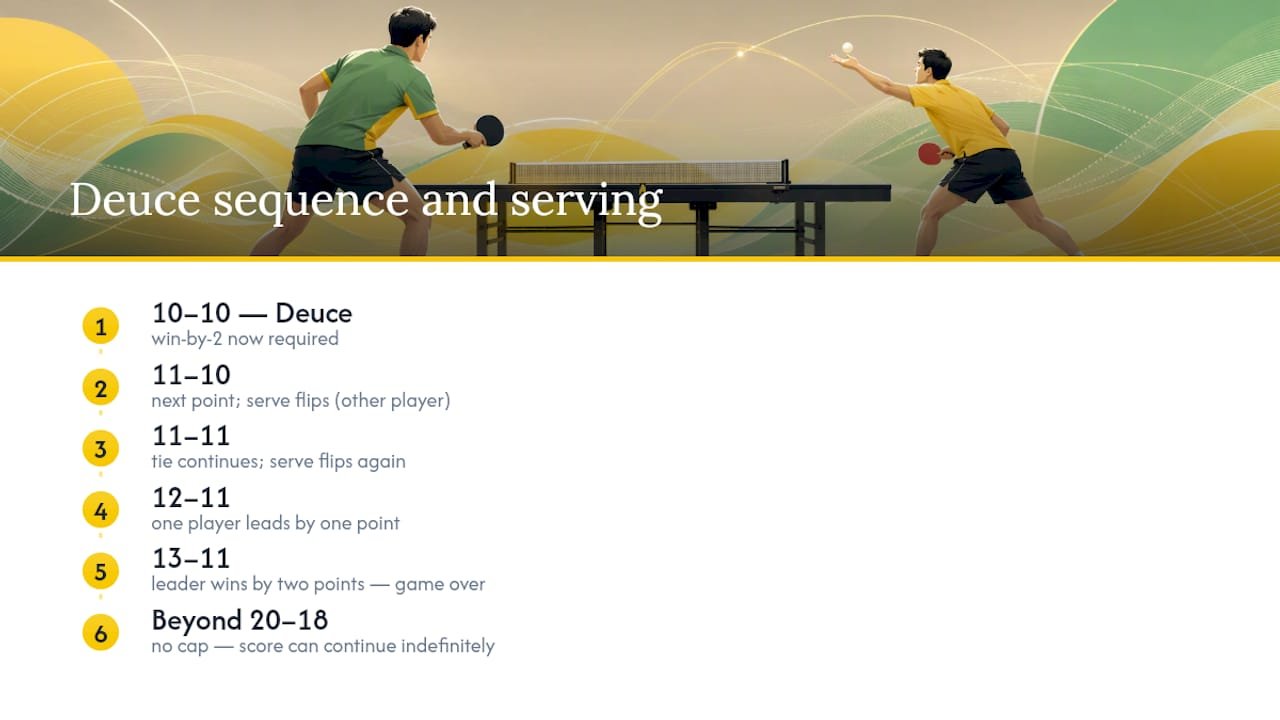
Deuce kicks in the moment the score hits 10-10, and from there the finish line moves with every point. The win-by-2 requirement has no upper limit, so a game can theoretically run to 20-18, 30-28, or beyond if both players keep matching each other point for point.
Service also changes rhythm at deuce. Instead of alternating every 2 points, it flips after every single point, so each player gets exactly one serve before the ball passes to the opponent. A real deuce sequence might read 10-10, then 11-10, 11-11, 12-11, and finally 13-11 once someone breaks the tie by two clear points. There’s no cap written into the rulebook. Games have gone well past 20 points at high levels of play when two players are evenly matched and neither will give an inch.
Which Match Format Should You Use?
Best-of-3 suits recreational nights and school matches where time matters more than drama. Best-of-5 is the standard for most club and regional tournaments, long enough to reward consistency without eating an entire evening. Best-of-7 belongs to national and international competition, where a single unlucky game shouldn’t decide the outcome.
- Best-of-3 is common in casual and school-level play
- Best-of-5 frequently used in sanctioned tournaments and team matches
- Best-of-7 typical for elite singles at international level
Team contests often combine multiple best-of-5 singles and doubles matches, with the overall winner decided by most individual match wins. End-change rules remain consistent: players switch sides after each game and again mid-game at a set point in the deciding game.
What Is the Expedite System and When Does It Apply?
The expedite system exists to stop marathon defensive rallies from stalling a match indefinitely. An umpire can introduce it after 10 minutes of play in a game, or earlier if both players agree, but not if 18 or more points have already been scored between them.
Once expedite kicks in, each server gets only one serve attempt per point instead of two chances, and if the receiver returns the ball 13 times successfully during that rally, the receiver automatically wins the point. Serving order doesn’t change under expedite, and once triggered, it stays in effect for the rest of the match, even into later games.
What Are the Most Common Scoring Mistakes?
Most disputes at recreational and club nights trace back to a handful of repeat offenders, not genuine rules disagreements.
- Touching the table with the free hand while the ball is live, which hands the point to the opponent immediately, even if the hand never touches the ball itself.
- Hiding the toss or serving with a closed or cupped palm, both of which are illegal serves under the visible-toss rule.
- Double-hitting the ball, intentional or not, which costs the point on the spot.
- Serving or receiving out of the correct rotation. When this happens, the score stands as is and play simply resumes with the correct server or receiver; nobody replays the match from scratch.
Pro Tip: Assign one dedicated scorekeeper for anything beyond a casual rally. Split attention between playing and counting is exactly how “was that 9 or 10?” arguments start.
Why Trust This Breakdown of the Rules?
Every scoring rule here traces back to the official Laws of Table Tennis and the national association documents that mirror them, not house tradition or half-remembered club habits. Archersbattlefield runs its own pong sessions regularly, which is where most of the practical scorekeeping tips in this guide come from. For formal disputes or tournament prep, always check the official PDF directly.
How Do Scoring Rules Shape the Way People Actually Play?
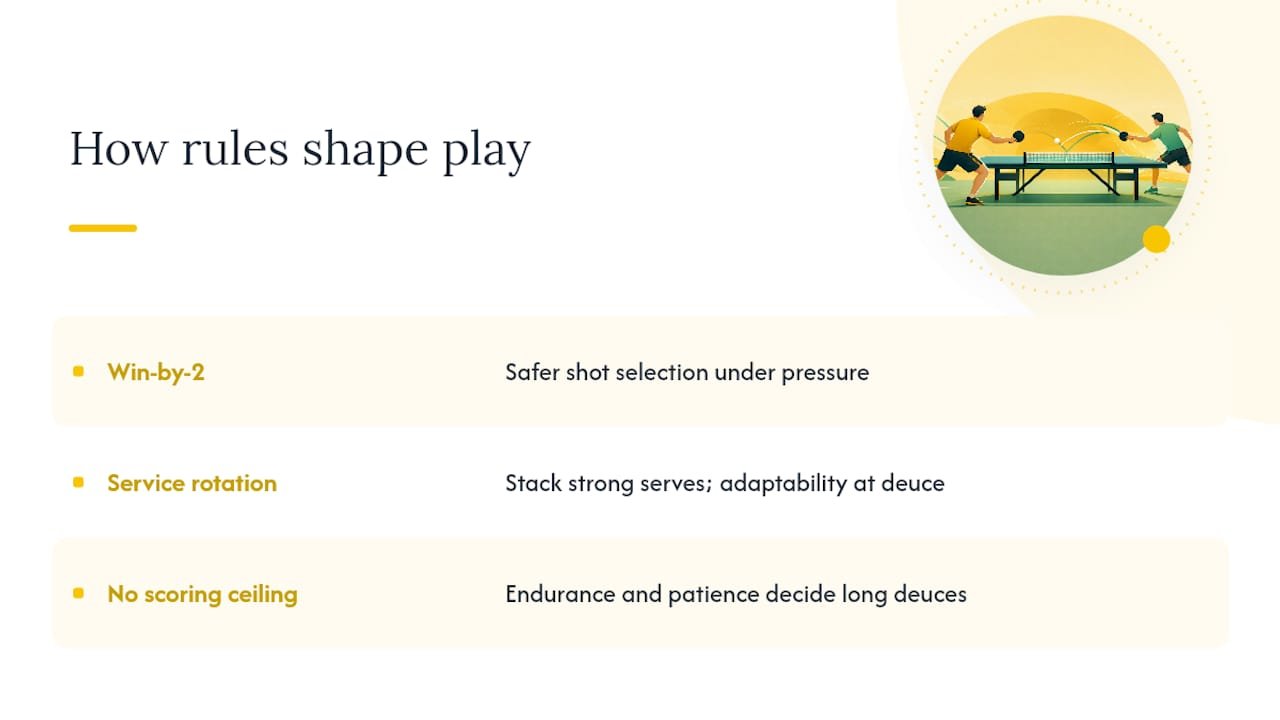
Win-by-2 changes how players approach a close game long before the score gets anywhere near 10-10. A player nursing a 1-point lead late in a game can’t afford to coast, because a single unforced error hands the opponent a tie, and from there the match resets into a pure point-for-point grind. That pressure shapes shot selection: players tend to favor safer, higher-percentage returns once the score tightens, rather than gambling on a risky winner that could just as easily hand back the point.
Service rotation adds a second layer of strategy. Because the server holds an inherent advantage, being able to place the ball and dictate the first shot, players often stack their strongest serves for the start of a 2-point rotation, then adjust their return posture when they know a switch is coming. At deuce, when rotation drops to every single point, that rhythm compresses. Players get fewer consecutive serves to settle into a groove, which rewards adaptability over habit.
The lack of a scoring ceiling also matters more than most casual players realize. Because deuce games can run indefinitely, endurance and mental composure start to count as much as raw shot-making. A player who thrives on quick, explosive rallies can find themselves worn down in a long deuce battle against someone who simply refuses to make the first mistake. Coaches often drill deuce scenarios specifically for this reason: the skill that wins a 15-13 finish is frequently patience, not power.
How Did Table Tennis Scoring Get to 11 Points?
For most of the twentieth century, table tennis was played to 21 points, and matches, especially defensive, grinding ones, could stretch on for a long time. That changed on September 1, 2001, when the ITTF switched the standard game from 21 points to 11, a deliberate move to shorten games and sharpen the pace of play.
The effect was immediate. Shorter games meant less room for a slow start, so every point carried more weight relative to the whole game. Rallies got sharper, matches moved faster, and broadcasters got a format that was easier to fit into a television slot, which mattered as the sport pushed for a stronger Olympic and international broadcast presence.
The 11-point system also changed how tournaments get structured. Because individual games run shorter now than under the old 21-point format, organizers can comfortably schedule best-of-5 or even best-of-7 matches without blowing up a tournament’s daily timetable. That single scoring change from 2001 is the reason today’s competitive matches look and feel the way they do, fast, point-dense, and rarely dragging past the audience’s attention span.
Service rotation also tightened alongside the point change, shifting from a longer serve cycle under the 21-point system to the current 2-point rotation, with the deuce exception layered on top. The rule changes worked together: shorter games, tighter serve cycles, and a format built for both club nights and Olympic broadcast.
Do Recreational Players Follow the Same Scoring Rules as Professionals?
Not always, and that’s fine within a casual setting. Plenty of clubs and backyard tables run informal variants, 21-point games, win-by-1 finishes, or relaxed serve-toss enforcement, because the point is fun, not certification. Nobody’s checking whether your toss cleared 16 centimeters during a backyard rematch.
Professional and sanctioned club competition is a different story entirely. Tournament referees enforce the 11-point, win-by-2 standard without exception, along with the visible open-palm serve, correct doubles rotation, and strict let calls. Equipment matters more too: regulation balls, approved paddle surfaces, and a room size for table tennis that meets competition standards (typically at least 14 feet by 7 feet of clear playing space, per most national association guidelines) become relevant once players move from casual rallies to sanctioned matches.
The practical advice for club organizers is simple: let recreational nights bend the rules for fun, but teach the official scoring system before anyone steps into a real tournament. A player who’s only ever rallied to 21 with loose serve rules is going to get caught off guard by deuce rotation and free-hand fouls the first time they enter sanctioned play. Bridging that gap early saves a lot of confusion and a few lost points from rules nobody explained beforehand.
What Happens When a Game Goes Deep Past Deuce?
Deuce at 10-10 is only the starting gate, not the ceiling. Once both players hit that mark, the win condition locks onto a 2-point lead and stays there no matter how long the game runs. A tied score of 15-15 doesn’t end anything; it just resets the target to 17-15 or 16-18, whichever side gets there first.
What actually shifts during an extended tie-break is the texture of play, not the rules themselves. Every single point now carries full weight, since a lost point at 16-16 undoes a hard-won point at 15-15. Players tend to slow their pace slightly, taking a beat between serves, resetting mentally after each rally rather than rushing into the next point. Serve rotation, remember, alternates every single point during this stretch, so neither player gets to build a serving rhythm over multiple points the way they could earlier in the game.
Extended deuce battles also put more pressure on a lone scorekeeper. A running score of 19-17 sounds simple, but after ten minutes of back-and-forth rallies, it’s remarkably easy to lose count by one point, especially without a visible scoreboard. This is exactly the kind of situation where appointing a dedicated umpire, even an informal one at a club night, pays off. Someone whose only job is tracking the score and calling faults catches disputes before they turn into an argument, which matters more in a long deuce fight than at any other point in a match.
When Should You Bend the Rules for Casual Play?
House rules work fine for backyard games, playing to 21 or skipping strict serve enforcement won’t hurt anyone. But once real stakes or a tournament bracket enter the picture, stick to the official scoring rules. Use one scorekeeper, a visible scoreboard, and bring in an umpire for anything competitive, briefed on lets, faults, and the free-hand rule before the first serve.
— Archers
Book a Pong Room and Skip the Rulebook Arguments
Reading the rules is one thing. Getting an actual room, a scoreboard, and someone who knows the serve rules on the night is another. Some venues offer private pong rooms for club nights, birthday parties, and corporate outings to avoid arguments about serve rules like toss height.

Instead of hunting down a public table and hoping nobody’s mid-match, book a private pong room with the space and setup sorted before your group even arrives. It fits naturally into a broader event package if you’re planning a birthday or team outing that mixes activities, or it works as a standalone booking for a straight-up pong tournament with friends. Either way, someone else handles the logistics while you focus on the score. Check availability and book your pong session directly to lock in a date.
Sources
- Laws of Table Tennis 2026-27 (Table Tennis England)
- Olympics
- Table Tennis Scoring System Explained | Topspin11
- Table Tennis rules (Memphis campus recreation PDF)
FAQ
Is table tennis played to 11 or 21 points?
Modern table tennis is played to 11 points, win by 2. The sport used 21 points until the ITTF changed the format on September 1, 2001 to shorten games.
What are the 5 basic rules of table tennis?
At the core: serve legally with a visible, 16 cm vertical toss; alternate service every 2 points (every 1 at deuce); win a game at 11 points with a 2-point lead; win rallies through the fault list in Law 2.10; and never touch the table with your free hand during play.
Is ping pong best-of-5 or best-of-7?
Both formats exist depending on the level. Club and regional tournaments typically use best-of-5, while elite international singles matches often use best-of-7.
What is the 10-10 rule in table tennis?
At 10-10, the game enters deuce: play continues until one side leads by 2 points, and service switches every single point instead of every 2.
Can a table tennis game have no winner if the score keeps tying?
No. Because win-by-2 has no upper score limit, the game simply continues past deuce until someone finally breaks the tie by two clear points, however long that takes.


