
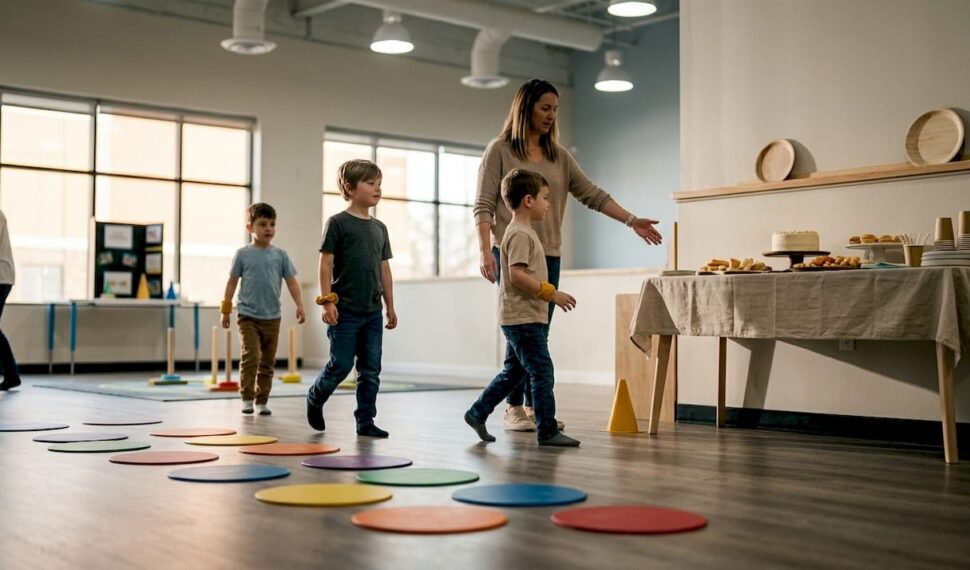
Toddler parties run best at 60 to 90 minutes, preschool parties at 90 minutes to two hours, elementary-age parties at two to two and a half hours, and tween parties can stretch past three. Each one of those lengths follows the same bones: arrival and free play, a main activity, a secondary activity or craft, food, cake, a short gift or free-play window, then goodbyes. Give yourself a few weeks and you can pull off almost any version of this. More time buys you room for a bigger guest list or a bigger venue.
TL;DR:
- Larger parties for bigger groups require longer transition buffers and extra planning time, especially for venues with multiple stations or larger guest lists.
- Scheduling should focus on core activities, with built-in 5 to 10 minute buffers, to avoid overloading the schedule and overwhelming kids.
- Booking entertainment, venues, and non-perishable party goods at least eight weeks in advance is crucial to secure popular options and avoid last-minute stress.
- Simplify planning with venue-managed or packaged parties, which include staff, equipment, and activity structure, reducing coordination and timing issues.
- Age-specific timing and downtime are essential; toddlers need more unstructured play, while elementary kids can handle multiple structured blocks with ample breaks.
Table of Contents
- Week-by-Week Birthday Party Planning Timeline
- Sample Day-Of Birthday Party Timelines by Length and Age
- How to Turn a Sample Agenda Into a Real Run-of-Show
- Day-Before and Day-Of Setup Checklist
- Common Timing Mistakes and How to Fix Them Mid-Party
- What a Venue-Managed Party Timeline Looks Like
- Adjusting the Timeline for Party Size and Venue Type
- Building In Breaks and Downtime by Age
- Getting Other Parents and Guardians Involved
- A Host’s Take on Sticking to the Plan
- Skip the Vendor Juggling: Book a Packaged Party Instead
- Sources
- FAQ
Week-by-Week Birthday Party Planning Timeline
A birthday party timeline works backward from the date, not forward from your to-do list. Big, hard-to-reverse decisions go first. Small, flexible ones go last. A four-week runway is genuinely enough for most parties, though Real Simple’s planning checklist recommends stretching to eight weeks once the guest list or venue gets bigger.
Eight weeks out is where you lock in the shape of the day. This is when venues and popular entertainers get booked solid, especially for Saturday afternoon slots.
- Settle on a theme, budget, and rough guest count.
- Book the venue or reserve your home date and any rental equipment.
- Reserve entertainment (characters, magicians, activity staff) before their calendar fills.
- Order any non-perishable party goods: decorations, tableware, favor bases.
Four weeks out, the 8-week planning blueprint from PartyChecklist suggests locking in the details that take lead time but aren’t urgent yet.
- Finalize the theme and send invitations with a clear RSVP date.
- Order the cake. Many bakeries want 2 to 4 weeks’ notice for a custom design.
- Confirm entertainment bookings and deposits in writing.
- Buy non-perishable snacks, drinks, and any decor you haven’t already.
Two weeks out is when the guest list turns into a real headcount. Vistaprint’s checklist recommends setting your RSVP deadline right around this point, which gives you enough runway to adjust food and favor orders without scrambling.
- Chase down any missing RSVPs and lock the final headcount.
- Order perishable food items and plan the exact menu.
- Assemble party favors and finish easy decor projects.
Running short on time? A last-minute timeline (one to two weeks, or even days) still works if you simplify ruthlessly. Trim the guest list to close friends and family, book a full-service venue package instead of DIY-ing every piece, and buy a ready-made cake plus pre-assembled favor kits instead of building from scratch.
Sample Day-Of Birthday Party Timelines by Length and Age
Once the date is locked, the party day itself needs its own birthday party schedule, built around how long the event runs and how old the guests are. These four templates cover the vast majority of real parties, and you can start with the closest match, then swap activities.
- The 1-hour toddler timeline. Ages 1 to 3 run out of steam fast, so this whole window stays low key: 10 minutes arrival and free play, 15 minutes of a simple sensory or music activity, 15 minutes for cake and a snack, 10 minutes of open play, and 10 minutes for goodbyes and favor pickup. Skip formal games entirely at this age.
- The 90-minute preschool timeline. Ages 3 to 5 handle one real organized activity well: 15 minutes arrival and free play, 20 to 25 minutes for a single guided activity (a craft, a simple game, a bounce house rotation), 15 minutes for snacks, 15 minutes for cake and singing, and the remaining time as open play before pickup.
- The 2-hour elementary timeline. Ages 6 to 10 can handle real structure. A typical flow, close to the template from Party Genius AI, runs 15 minutes arrival and free play, 20 to 30 minutes for a first organized activity, 20 to 30 minutes for a second activity or game rotation, 15 to 20 minutes for food, 10 to 15 minutes for cake, then a short window for gifts or free play before goodbyes.
- The 2.5 to 3 hour multi-activity timeline. Tweens, teens, and venue-based parties with several attractions (arcade games, laser tag, obstacle courses) need staggered scheduling: 15 to 20 minutes arrival, then two or three rotating activity blocks of 25 to 30 minutes each, a proper meal window of 20 to 30 minutes, cake and photos for 15 to 20 minutes, and a closing block for free time or a final group activity.
Start times matter more than most parents assume. The most-booked slot for kids’ parties is Saturday between 1:00 PM and 3:00 PM, which lands after nap time and before dinner. Sunday from 11:00 AM to 1:00 PM works well too, especially if you’re serving lunch instead of just cake and snacks.
The most common mistake across all four lengths is the same: packing in one more activity than the schedule can hold. Trying to pack too many organized games and a full meal into a 2-hour party doesn’t leave room to breathe, and kids feel that even if they can’t name it.
How to Turn a Sample Agenda Into a Real Run-of-Show
Start with the big blocks, not the minutes. Arrival, activity one, activity two, food, cake, wind-down, goodbyes. Once those blocks exist, assign real clock times to each one, then go back and insert transition buffers between every single block.
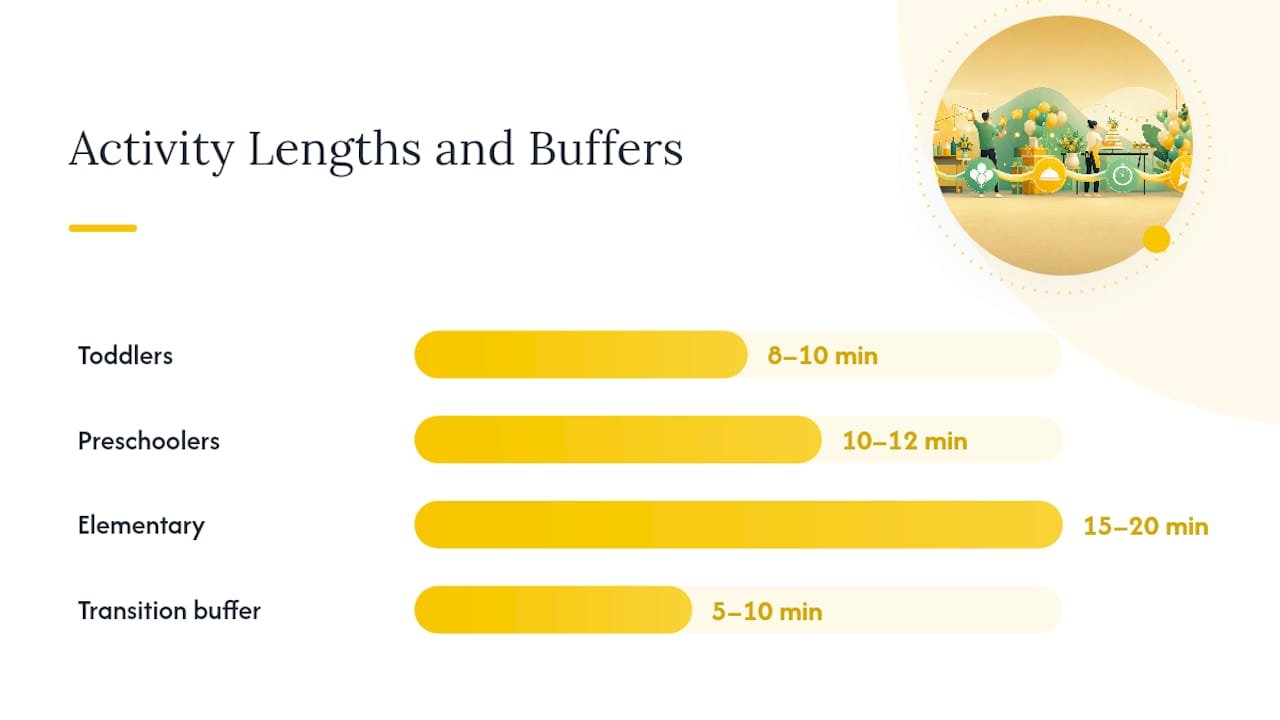
Those buffers matter more than people think. Experts recommend 5 to 10 minute transition buffers between activities, plus an extra 20% built into the overall schedule to absorb the small delays that always happen. A “10-minute game” often eats 18 to 22 minutes once you count gathering kids, explaining rules, and resetting the space. Build that padding in now, not after the party’s already running late.
Timing your entertainment and food matters as much as the activities themselves.
- Kick off the main entertainment 20 to 30 minutes after the official start time, once stragglers have arrived and free play has burned off the initial energy.
- Serve food during the middle part of the party, while kids still have energy for the activities before it and appetite for the wind-down after.
- Serve cake right after food, while everyone’s already gathered and seated.
- Match activity length to age: toddlers top out around 8 to 10 minutes per activity, preschoolers handle 10 to 12 minutes, and elementary-age kids can sustain 15 to 20 minutes before attention drifts.
Gift opening is the one block worth a firm decision in advance. It reliably drags, stalls momentum, and loses younger kids’ attention fast. Pick one: skip it and have the birthday child open gifts later at home, move it to the very end so it doesn’t interrupt the flow, or cap it at 10 to 15 minutes with a countdown you enforce.
Pro Tip: Write your buffers directly into the printed schedule instead of keeping them in your head. Seeing “12:15 to 12:25, transition” on paper makes you far less likely to skip it when things start running late.
Day-Before and Day-Of Setup Checklist
The day before a party is when the host does the invisible work that makes the actual event feel effortless. Confirm every vendor by phone or text, from the cake order to the entertainer, and settle any final payments so nothing’s outstanding on party day. Gather every physical supply into one staging area and charge anything with a battery, from speakers to cameras.
On the morning of the party, set up venue zones clearly: a spot for gifts, a games area, a food and seating zone, and a photo backdrop if you have one. Plan to start setup 30 to 60 minutes before guests arrive, and arrive even earlier if you’re setting up at a rented venue rather than your own home.
Put together a small emergency kit before the first guest shows up:
- Tape, scissors, and extra string for last-minute decor fixes.
- Stain remover and paper towels for the inevitable spill.
- Basic first-aid items: bandages, antiseptic wipes, ice packs.
- Extra utensils, napkins, and batteries for anything battery-powered.
Finally, assign one point person, ideally not the parent of the birthday child, who knows the full run-of-show and can handle problems without pulling you away from your own kid’s party.
Common Timing Mistakes and How to Fix Them Mid-Party
Over-scheduling is the single most common timing error. If the group looks tired or scattered rather than engaged, that’s your signal to cut something, not add more structure. Drop a planned game before you drop cake or free play.
- Signs of over-scheduling: kids wandering off mid-activity, parents checking watches, the birthday child looking overwhelmed. Fix it by cutting the next planned game and moving straight to food or free play.
- Hungry or cranky kids: serve a quick snack immediately rather than pushing through to the scheduled food block, and shorten whatever activity comes next.
- Entertainer running late: have a backup ready. A five-minute dance-and-music burst or a simple craft station buys time without anyone noticing the gap.
- Falling behind schedule overall: compress gracefully by shortening the second organized activity and skipping formal gift opening, never by rushing cake or cutting free play.
What a Venue-Managed Party Timeline Looks Like
A packaged venue party runs on a version of the same timeline, just with someone else holding the clock. A typical flow looks like this: the host arrives 15 to 20 minutes early to check in and set up personal touches like a cake table, staff run the organized activities in scheduled blocks, there’s a dedicated food and cake window, and staff handle cleanup while the host stays with the guests.
- Fewer vendor calls. One booking replaces separate calls to an entertainer, a rental company, and a cleanup crew.
- On-site staff run the games, which removes the biggest source of timing slippage: adults trying to referee and manage the schedule at the same time.
- Equipment and setup are handled, so there’s no rushing to inflate a bounce house or test a sound system before guests arrive.
Before booking, ask any venue what staff-to-child ratio they provide, how much setup time is built into your slot, and exactly what’s included in the party packages versus what you need to bring yourself.
Adjusting the Timeline for Party Size and Venue Type
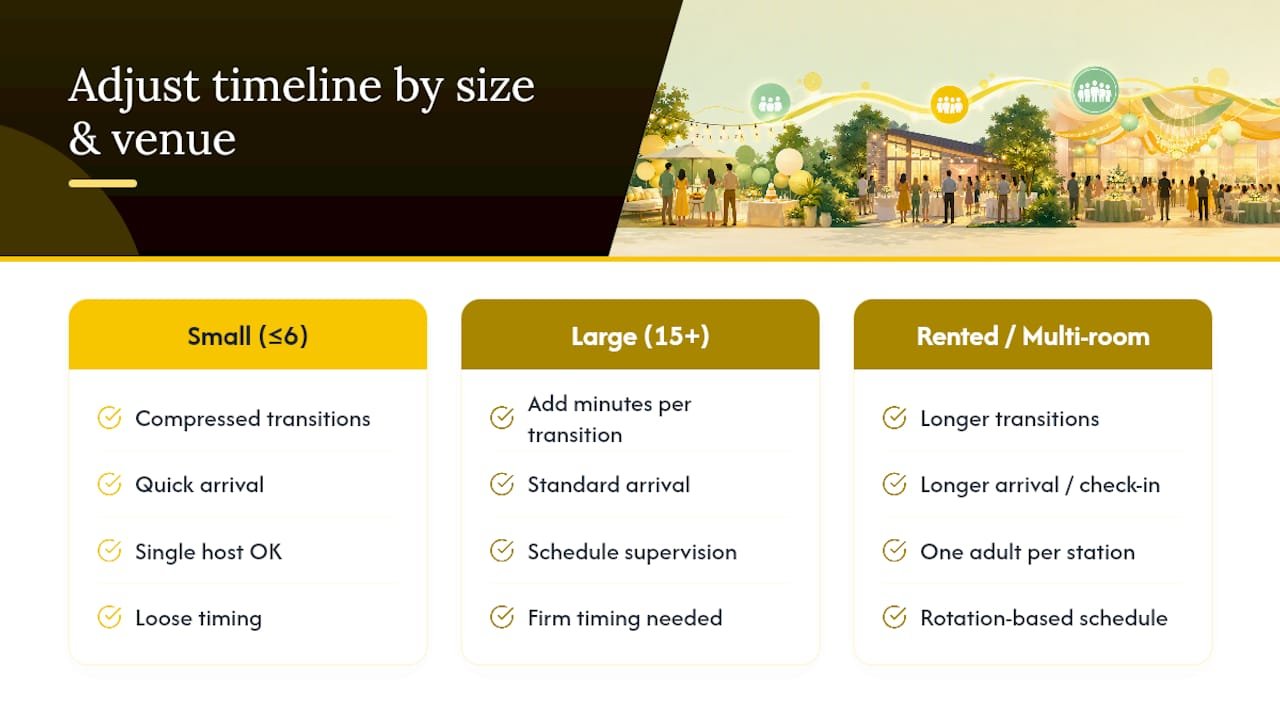
A backyard party for eight kids and a rented hall for forty run on different clocks, even at the same total length. Bigger groups need longer transition buffers, because moving twenty kids between activities simply takes longer than moving eight. Add extra minutes to every transition once your guest count climbs past 15 or so.
Venue type changes the math too. A home party lets you compress transitions because everything’s within a few steps, but it also means you’re managing setup, activities, and cleanup solo. A rented venue or activity-based space, whether that’s a park pavilion, a gym, or a dedicated party facility, usually needs a longer arrival block since guests are finding parking and a check-in point rather than walking in your front door.
Multi-room or multi-station venues change the flow entirely. Instead of one linear timeline, you’re often running staggered groups through different stations, which means your schedule needs a rotation plan rather than a single sequence. Build in a few extra minutes per rotation for the group that’s slower to transition, and designate one adult per station rather than trying to supervise the whole flow yourself.
Smaller parties, on the other hand, can afford to be looser. With six or fewer kids, rigid timing matters less because the group naturally self-paces, and you can let one activity run long if it’s working without throwing off the whole day. The bigger the group and the more spread out the venue, the more the schedule needs to do the work that a smaller, tighter group would handle on its own.
Building In Breaks and Downtime by Age
Downtime isn’t wasted time. It’s what keeps a schedule from collapsing under its own structure. Experts caution against over-scheduling kids’ parties, recommending three to four organized activities at most for a two-hour party, with real unstructured play filling the rest.
The right ratio shifts by age. Toddlers need the most downtime relative to structured activity. A one-hour toddler party can reasonably spend half its time on free play, since sustained group activities aren’t realistic for that age. Preschoolers do better with one solid activity block and generous free play on either side of it. Elementary-age kids can handle two or three structured blocks back to back, but they still need a genuine breather between them, not just a walk to the next station.
As a general rule, aim to leave roughly 25 to 30% of total party time unstructured, whether that’s a dedicated free-play block or just breathing room built into transitions. That downtime is also where the party actually feels social. Kids bond during the unscheduled minutes between the bounce house and the piñata, not usually during the piñata itself. Cutting all the slack out of a schedule to fit in one more activity almost always backfires, leaving a group of kids who are structured within an inch of their patience and a host wondering why the mood shifted.
Getting Other Parents and Guardians Involved
You don’t have to run the whole event solo, and trying to is often where the timeline actually falls apart. Recruit help early, ideally during the four-week planning window, so tasks get assigned before the week gets hectic rather than during it.
Ask one parent to co-run check-in and gift collection at arrival, freeing you to greet guests instead of managing logistics. Another can supervise a single activity station, especially useful during multi-activity timelines where you’re running two things at once. If any guardians are staying for the full party rather than dropping off, give them a specific, small job. It genuinely helps, and most parents appreciate having something concrete to do rather than standing around.
Share the actual run-of-show with co-hosting parents ahead of time, even just a simple text with block times. When helpers know that food starts at 1:45 and cake at 2:10, they can step in and keep things moving without needing you to direct every minute.
A Host’s Take on Sticking to the Plan
The schedule is a tool, not a contract. Pick two or three moments that genuinely matter, cake, one signature activity, maybe presents, and treat everything else as flexible. Delegate small jobs (drink refills, gift table, photos) to someone else so you can actually watch your kid enjoy their day. Kids remember the laughing, not whether the timeline ran on schedule.
— Archers
Skip the Vendor Juggling: Book a Packaged Party Instead
If reading through five sections of buffers, transition math, and vendor deadlines sounds like more than you want to manage, a packaged venue party solves that problem by design. Kids’ birthday party packages at Archersbattlefield bundle the staff, equipment, and activity structure into one booking, so you’re not coordinating a cake order, an entertainer, and a rental company separately.

A typical package includes staff running the games (combat archery, Nerf battles, bazooka ball, dodgeball, and more), all the equipment set up and ready before guests arrive, and staff handling breakdown afterward. That’s the exact kind of party that makes sense when you’re short on prep time, hosting a bigger group, or want more than one activity without building a rotation schedule yourself. If your group also wants a taste of precision play, the archery experience works well as a standalone activity or an add-on to a bigger celebration.
Check available dates and see package details through Archers Battlefield’s booking page and get the party timeline handled by someone else for a change.
Sources
- Birthday party planning 101: How long should the party last? | Savvy Mom
- Party planning checklist and timeline | Real Simple
- Party Timeline Generator | Party Genius AI
FAQ
What Is a Normal Length for a Birthday Party?
Most kids’ birthday parties run between 90 minutes and 2.5 hours, with the exact length depending on age: toddlers do best at 60 to 90 minutes, while elementary-age kids and tweens can handle 2 to 3 hours.
What Is a Good Timeline for a First Birthday Party?
A first birthday works best as a short, low-key event of about 60 to 90 minutes, with roughly half the time as free play and the rest split between a simple activity, cake, and goodbyes, since infants and young toddlers tire quickly.
How Long Should My Child’s Birthday Party Be?
Base the length on age and activity count: 60 to 90 minutes for toddlers, 90 minutes to 2 hours for preschoolers, and 2 to 3 hours for elementary-age kids or tweens with multiple planned activities.
Is Two Weeks Enough Time to Plan a Birthday Party?
Two weeks works for a simplified party if you book a packaged venue, order a ready-made cake, and keep the guest list small, though 4 weeks gives more breathing room for custom cakes and a bigger guest list.


