
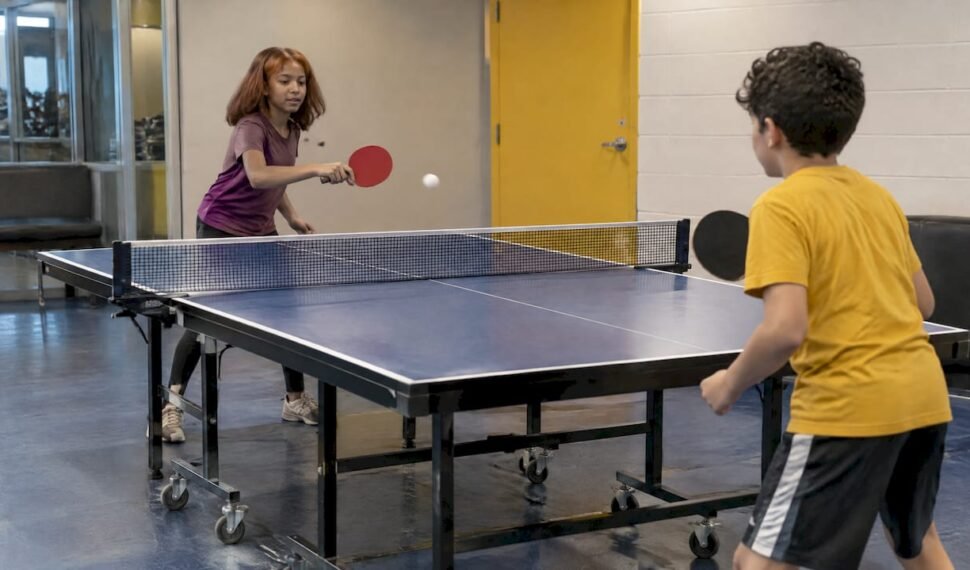
The best kid-friendly ping pong games are short, forgiving and built around a clear target: sink the ball in a cup, blow it across a table, or keep a rally going until the music stops. Most need only a handful of balls and some cups. Below you will find games that work with no table at all, games for a real table, and a simple way to adjust any of them for a five-year-old or a twelve-year-old. If you would rather have a room, a table and a host handled for you, our kids’ birthday party packages start at $399 for Game On Birthday Party.
TL;DR
- Cup, straw and spoon games need no table and give kids a win within a minute.
- Table games like Rollerball and 10-pin Table Tennis teach ball control before anyone has to learn a serve.
- Adjust Space, Time, Task, Equipment and People to fit any age: closer targets, bigger cups, shorter rounds.
- Team formats keep mixed-age groups even, because a ping pong ball bounces unpredictably.
- At Archers Battlefield, ping pong is $30 per session, and party packages begin at $299 with Pong & Party On.
Table of Contents
- Why ping pong games suit kids so well
- Cup, straw and spoon games (no table needed)
- Games on a real ping pong table
- Adapting the games by age and ability
- Choosing games for a mixed-age group
- Quick setup list
- Make it a party at Archers Battlefield
- FAQ
- Sources
Why ping pong games suit kids so well
A ping pong ball is light, cheap and easy to catch, so it is a gentle first ball for children. It bounces enough to be exciting and rolls slowly enough that a child can chase it. That is why teachers use it for hand-eye coordination work long before anyone plays a proper match.
The Canadian Olympic Committee’s table tennis activity challenge is a good example. It is written for classrooms and starts with rolling and bouncing rather than rallying, then moves to the tabletop for points. The idea is that kids enjoy the game first and pick up technique along the way.
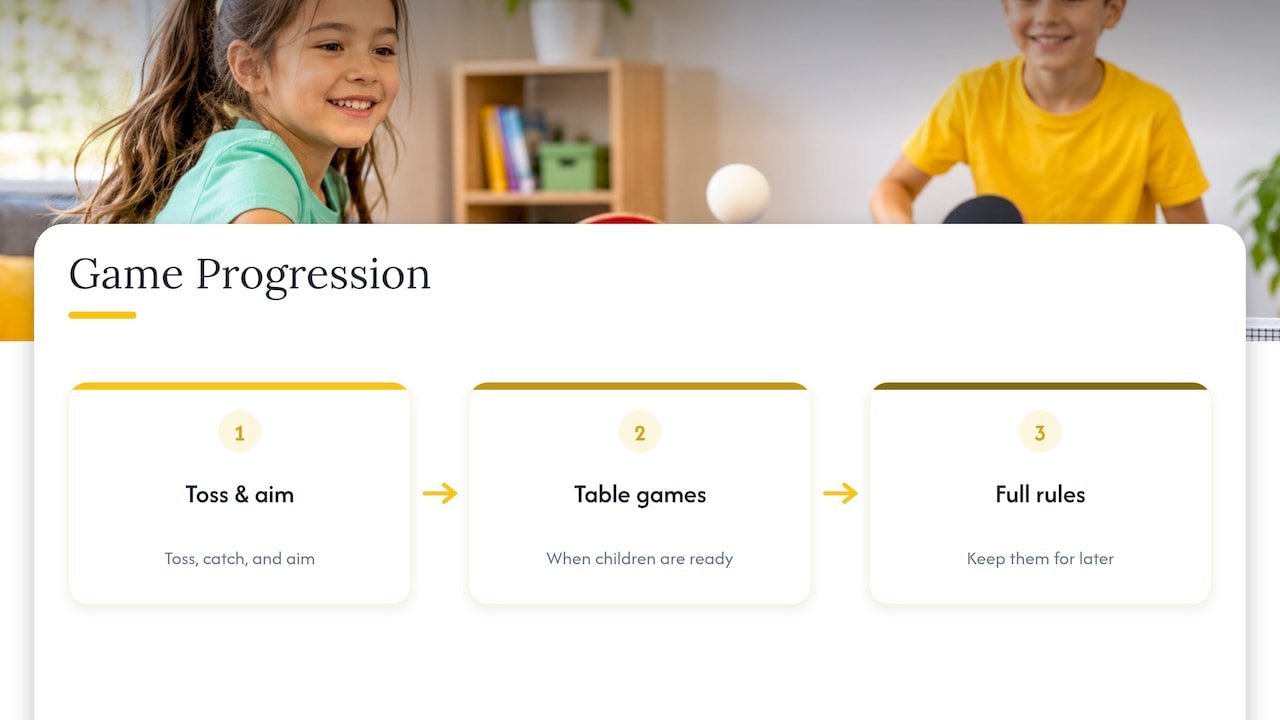
The games below follow that path. Start with the ones that ask only for tossing, catching and aiming. Move to table games when the kids are ready, and keep full rules for later. If your child wants to go further, our beginner ping pong rules explain the basics in plain language.
Cup, straw and spoon games (no table needed)
These work on a kitchen table, a floor or a picnic blanket. Gather ten or more ping pong balls, plastic cups, a few straws, two spoons and a bowl.
Cup catch and bounce
Place three cups in front of each child and give them a handful of balls. They throw or bounce each ball and try to land it in a cup. The family game-day list from All Pro Dad uses exactly this setup, and it works because the goal is instantly clear.
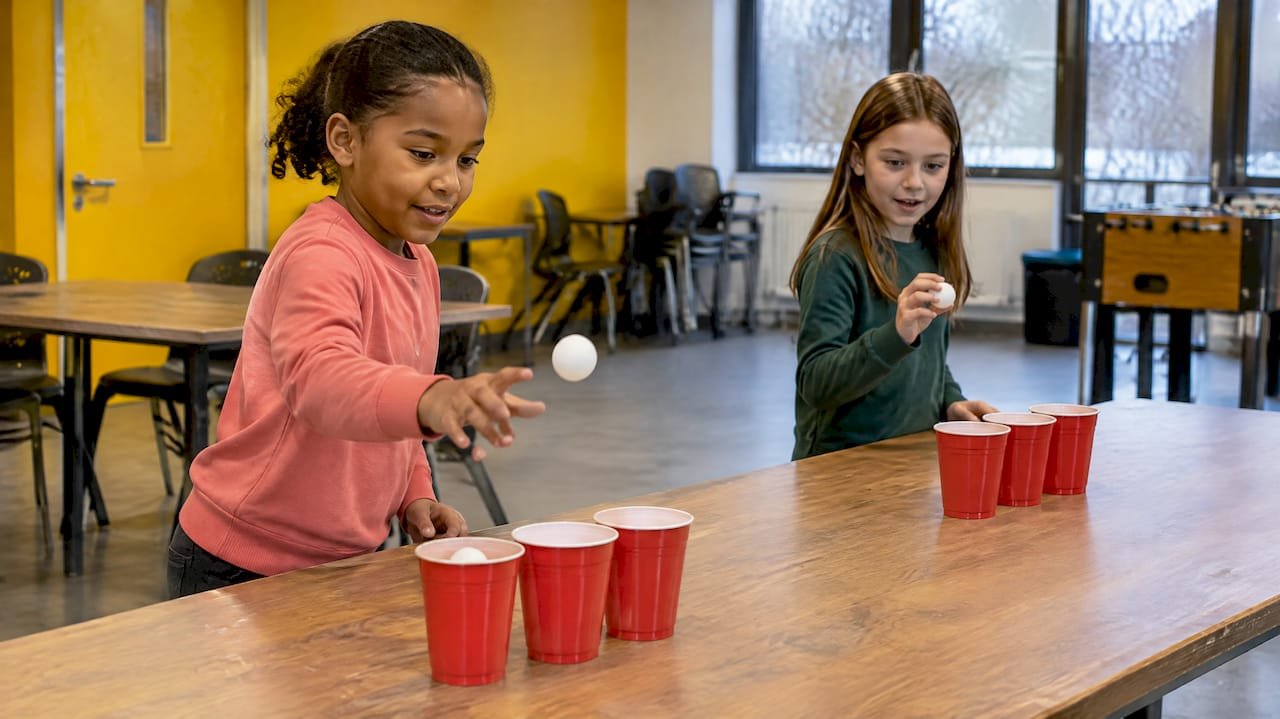
Make it harder by moving the cups back. Make it easier by letting the ball bounce once off the table first. A pyramid of cups turns it into a target game: Hands On As We Grow shows a cup-pyramid version where kids bounce the ball off the table and into the stack.
Older children can add a small data project. Put a little water in some cups, then tally which cups catch the most balls over twenty throws and graph the results. Younger kids simply enjoy the splash.
Straw race and blow soccer
Give each player a straw and a ball. Tape a cup at each end of a table, and each player tries to push their ball into the opponent’s cup using breath alone while blocking the other ball. What Do We Do All Day describes this as a ping pong ball battle, and it needs nothing else.
For a relay, line children up and have each one pass a ball to the next by sucking on a straw, or blow the ball along a row of water-filled cups. Both are quick, noisy and easy to reset.
Spoon transfer
Each child holds a spoon and moves six balls from one plate to another. It sounds simple until the ball rolls off. Give younger children a bigger spoon or a shallower plate, and let older ones hold the spoon in their mouth for a minute-to-win-it twist.
Cup tic-tac-toe
Set nine cups in a three-by-three grid. Two players take turns tossing a ball into a cup, using two colors of ball or cup marker. The first to claim three in a row wins. It is a good bridge between luck and strategy, because kids start choosing which cup to aim for rather than just throwing.
Ping pong bowling
Stand toilet paper tubes upright as pins and roll the ball at them. This is the gentlest game on the list and suits the smallest players well.
Games on a real ping pong table
Once a table is available, you can keep every ball game above and add games that use the table itself. None of these requires a legal serve or a scoring system.
Rollerball
The Olympic Committee’s guide describes Rollerball as rolling the ball across the table without bouncing it. You score a point when it gets across, and you lose a point if your racket touches the table. Children can start by rolling against a wall, then with a partner, then across the tabletop. It teaches control and quiet hands.
Target practice and 10-pin Table Tennis
Place paper targets on the table and have children serve or bounce the ball onto them. The same guide suggests a ten-cup extension, where players try to knock down 10 plastic cups, much like bowling. This is a good stepping stone to real serving, because the child thinks about where the ball lands rather than about the rules.
Bouncer
Each child bounces the ball on their racket, alternating forehand and backhand, and counts how many bounces they can make in a row. The guide suggests swapping in a balloon if the ball is too difficult. Beat your own record is a more motivating goal than beating a sibling.
The music-stop rally
Decathlon Canada describes a table tennis play list game for three people. Two players rally while a third acts as DJ and pauses the music at random. Whoever has the ball on their side when the music stops loses the round. Play to 10 points, then rotate roles. It works because it keeps both players focused on the ball and gives a third child a job.
Table Ball
Manitoba Education’s physical education resources list Table Ball, a modified table tennis game played with hands or rackets, using balloons or balls. It can be played one against one, three-way, or two against two, and is aimed at Kindergarten through Grade 6. If you have several children and one table, two-against-two is a natural way to keep everyone involved. When they are ready, our guide to table tennis doubles rules covers how partners alternate and what counts as a fault.
Adapting the games by age and ability
The same game can suit a five-year-old and a twelve-year-old if you change the right things. Manitoba Education recommends the STTEP principle, which stands for Space, Time, Task, Equipment and People. In practice that means asking five questions:
| Change | What to adjust | Example with a cup game |
|---|---|---|
| Space | Move the target closer or farther | Cups at arm’s length for ages 4 to 6, a full table length for ages 10 and up |
| Time | Shorten or lengthen the round | 30 seconds for little ones, a full minute for older kids |
| Task | Simplify or add a rule | Let the ball bounce freely, or require one bounce off the table |
| Equipment | Change the size of the ball, cup or racket | A bowl instead of a cup, or a balloon instead of a ball |
| People | Pair up or form teams | Match an older child with a younger one |
Keep scoring positive for younger kids. Count balls that land in the cup rather than subtracting points for misses, because a child who keeps losing points stops wanting to play.
A simple four-step skill ladder
If you are teaching a child who has never held a racket, follow an order that moves from easy to demanding:
- Ball feel, no rackets. Bounce, throw and catch the ball. Aim at cups.
- Racket handling. Balance the ball on the racket, bounce it upward, or use a balloon for the youngest children.
- Targets. Bounce the ball once on the table and aim for a spot, a cup or a paper circle.
- Play. Rally, play the music-stop game, or try two against two.
This mirrors the progression used by Canadian programs: hand-eye coordination first, then rackets, then targets, then free play. Skills like these grow through repetition that feels like play, which is also the thread running through this guide to skill-building through sensory play. When a child asks how to serve properly, our ping pong serving rules page explains what makes a serve legal, and the four-week ping pong skills plan gives a 15 to 30 minute daily routine.
Choosing games for a mixed-age group
A birthday party or a class rarely has children all the same age. Ping pong ball games are better than most at handling this, because the ball hops out of cups and rolls off spoons. A younger child has a real chance against an older one. You can use that on purpose:
- Make teams, not duels. Pair one older and one younger child on each side, so no one stands around waiting.
- Use stations. Set up three or four of the games above on separate tables and rotate every few minutes. Children who finish early do not wait, and those who struggle move on before they get frustrated.
- Give a job to everyone. The DJ in the music-stop game, the counter in Bouncer and the referee in tic-tac-toe all keep a spare child involved.
- Keep rounds short. One minute per game with a quick reset is the right rhythm. If a game needs a long explanation, it is the wrong game for the room.
For a group, plan one adult for each table or station. The more games you run at once, the more helpful an extra pair of hands becomes. Our birthday party checklist gives you a one-page timeline so the games fit into the afternoon without rushing.
Quick setup list
For a home or classroom session, keep a box ready with:
- 20 ping pong balls, so rounds are not interrupted by chasing
- 12 plastic cups and a few bowls
- Straws and spoons
- Painter’s tape for marking lines and attaching cups
- A timer, a speaker for the music-stop game and paper for targets
- Two or three rackets and a few balloons
Indoors, clear the floor of loose objects, because balls roll under furniture and a child chasing one can slip. Wear flat shoes with grip and keep drinks away from the play area, especially in the water-cup games.
Our view: start with fun, then build the skill
Every group that comes through our doors includes children who have never held a paddle and children who play every week. The games that work for both share one trait: the first success arrives fast. A ball in a cup, a ball across the table, a rally that lasts three hits. We build ping pong sessions on that idea.
Ping pong is one of the activities at our venue, along with combat archery, Nerf battles, bazooka ball, dodgeball, axe throwing and arcade games, so a party can switch between quiet table play and active games. We design our packages to be customized to different group sizes and ages, and we offer event planning support so the person organizing the party does not have to run every game.
Our advice to parents is simple: pick one or two games, keep each round short, and let the kids invent their own variations. The children who invent a rule are the ones who ask to come back.
Archers
Make it a party at Archers Battlefield
If you would rather enjoy the party than set up cups, we run ping pong as one of our indoor activities in Ontario. A ping pong session is $30, and our Pong & Party On package starts at $299 on our event packages page. For birthdays, Game On Birthday Party starts at $399 and Epic Birthday Party at $499, both on the kids’ birthday party packages page. You can also read more about Pong at Archers Battlefield before you decide, and our party add-ons guide shows what is worth adding first.

Schools and youth groups can look at our team building options, and coaches planning an outing can see the sports team event packages.
FAQ
What are the easiest ping pong games for young kids?
Cup catch, ping pong bowling and spoon transfer are the easiest. They need no rackets, no table and no rules beyond the goal. Use bigger cups, closer targets and short rounds, and count successes rather than misses.
What can kids do on a ping pong table without knowing how to play?
Try Rollerball, target practice with paper circles or cups, and Bouncer. These come from the Canadian Olympic Committee’s classroom table tennis activities and teach ball control without a serve or a scoring system. A music-stop rally with a child acting as DJ also works for beginners.
How do I run ping pong games for a group of different ages?
Use teams that mix older and younger children, set up short stations and rotate every few minutes. Ping pong balls bounce unpredictably, which lets younger players compete. Adjust distance, cup size and time for each group using the Space, Time, Task, Equipment and People approach.
Can we play ping pong games indoors at home?
Yes. Straw races, cup games and tic-tac-toe fit on a kitchen table. Clear the floor so nobody slips on a loose ball, and keep water cups away from electronics. If you want a full table and a host, our venue runs ping pong sessions and party packages in Ontario.
Sources
- Canadian Olympic Activity Challenge: Table Tennis
- Manitoba Education: Resources to Assist in the Delivery of Physical Education
- Decathlon Canada: 7 fun family sports activities
- All Pro Dad: 7 activities for a family game day
- Hands On As We Grow: catching the ping pong ball
- What Do We Do All Day: 20 indoor ball games for kids


