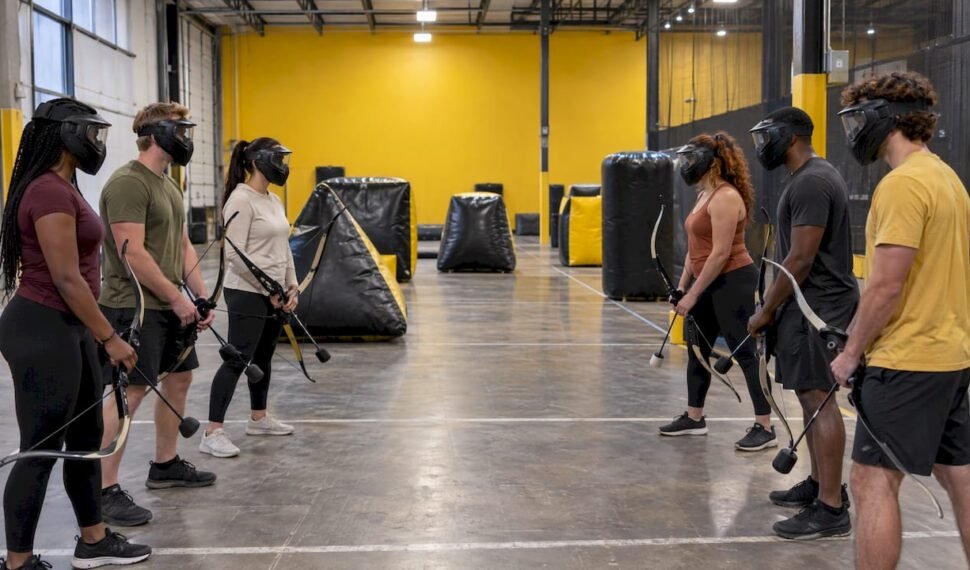
The short answer: archery tag is built around two teams of five, so a single game uses 10 players at a time. That does not cap your party or team event at 10 people. Larger groups simply rotate through the field in waves, and the real planning question is how many waves you need and how long each one lasts. This guide covers the official numbers, what changes between formats, and how to size a birthday, team-building day or school outing so nobody spends the event on the sideline.
At Archers Battlefield, combat archery is one of several indoor activities, which is why our packages are built to mix it with other games and keep a big group busy at once.
TL;DR
- A standard game is 5 vs 5, so 10 players on the field at a time. Recreational leagues use the same five-a-side format.
- Competitive leagues play four a side, and rosters can run larger than the number on the field, with substitutions.
- Groups bigger than 10 rotate in waves, or split between activities, so the group size you book is not the same as the number shooting at any moment.
- Age minimums, field size and staff supervision decide how many people a venue can run safely, so confirm them when you book.
- For a mixed group, pair combat archery with a second activity so half the group plays while the other half rotates.
Table of Contents
- What the official rules say about team size
- Why venues run different numbers
- How to size your event: groups of 5, 10, 20 and 40
- Splitting a large group so nobody waits
- Ages, safety and supervision
- Who this means what for
- A sample plan for 20 guests
- Our perspective
- Book the right package for your group size
- FAQ
- Sources
What the official rules say about team size
The governing rulebook for the branded version of the sport describes a regular game as two teams of five players, played over a five-minute period. That is where the “10 at a time” figure comes from. The same rules say recreational leagues also field five players per team, with stats kept for every player.
Competitive play is different. The official rules describe competitive leagues as four a side, played in four periods of six to eight minutes, and a team can keep playing with as few as two players. Teams with more than five players switch players between games, so a roster can be bigger than the number on the field. The sport’s own FAQ adds that competitive teams can have up to eight players, with four on the field and substitutions allowed.
Two practical points follow:
- Five a side is the number to plan around for any party, camp or office outing. It is the format most venues teach to first-timers.
- Nobody is eliminated. In the standard format a player who is hit stays in the game, which is why the sport suits mixed ages and abilities. A big group does not shrink as the game goes on.
Why venues run different numbers
The official numbers are a starting point. A venue adjusts them to its field, its staff and the group in front of it. Reporting on an indoor arena in Calgary described teams of up to 10 players per side using foam-padded arrows, with regular games for ages 10 and up running about an hour after a 15-minute training session. That is a larger team than the rulebook’s five, and it shows how much a field’s size and a facility’s own format can change the count.
Other operators stick closer to the rulebook. One public recreation program in the United States runs up to 10 players on the field, five per team, with games of roughly eight minutes, a reset of five to 10 minutes between games and three to four games an hour. A minimum age of 10 applies there. Those figures belong to that program, but they give you a useful rule of thumb for how quickly a rotation moves.
What decides the number at any venue:
- Field size. More players on a small field means more arrows in the air and less room to move. Our guide to combat archery field size explains dimensions, space and game length.
- Game mode. Capture-the-flag style modes, elimination-style rounds and standard point games all use team space differently. See the game modes venues use for how operators adapt them.
- Staff. A trained referee or host controls the line, the arrow retrieval and the pregame briefing. More players per game means more to watch.
- Age mix. A group of 8 year olds and a group of adults are not run the same way, even at the same headcount.
How to size your event: groups of 5, 10, 20 and 40
Here is how the same format scales. Game length varies by venue, so treat the timings as planning estimates and confirm them with the venue.
| Group size | How it plays | What to plan |
|---|---|---|
| 4 to 5 people | One team, or split into two small teams with a short game | Short sessions; add a second activity to fill the time |
| 10 people | One full 5 v 5 game, repeated with new teams | Several rounds, so everyone plays with and against different people |
| 20 people | Two waves of 10, or one wave playing while the other tries another activity | Roughly double the time, or two stations running at once |
| 30 to 40 people | Three or four waves, or several activities rotating | Needs a schedule printed or posted before arrival |
If a game runs a few minutes with a short reset, one wave of 10 takes roughly a quarter of an hour once you count fitting gear and the rules briefing. A 20-person group on a single field needs well over half an hour of field time per round of games. That is before anyone plays a second round.
The mistake most organizers make
Booking for the total headcount and forgetting the waiting time. A group of 24 on one archery field means 14 people watching at any moment. That works for a few minutes and then becomes boredom, especially with kids. The fix is not a bigger field. It is a second activity running alongside.
Splitting a large group so nobody waits
The most dependable way to handle more than 10 people is to run two or more activities and rotate teams between them. A practical pattern for 20 guests:
- Split into two teams of 10.
- Team A plays combat archery while Team B plays something different, such as dodgeball, ping pong or an arcade rotation.
- Swap after one round of games, then swap again to finish.
- Close with a mixed-team game so the final round feels like the main event.
This keeps arrows to a manageable number on the field and keeps every guest active. It is also how most of our packages are structured. Our birthday packages built around combat archery and our game night ideas for small groups that scale up follow the same rotating logic.
For a corporate group, mixing activities has an extra benefit: colleagues who would not choose to shoot a bow still have somewhere to be competitive. Our guide to indoor team building games covers what holds a mixed-ability group together.
Ages, safety and supervision
Group size and safety are tied together, because every extra player adds another bow and another set of arrows to supervise.
- Minimum age. Venues set their own. The U.S. program mentioned above asks players to be at least 10, and the Calgary arena described regular games for ages 10 and up. Younger children often need a smaller-format or foam-based alternative, so ask the venue what it offers for your age range before you book.
- Gear. The standard setup is a bow, foam-tipped arrows and a protective face mask for every player. Everyone wears the mask for the entire game.
- Briefing. Players should hear the rules before the first arrow is shot. Our seven pregame points to read aloud are a good model, and our archery tag safety guide covers gear, rules and setup.
- Adults for kids’ groups. For school and youth groups, line up enough adults to help with gear and to keep waiting children occupied.
If anyone in your group has a medical condition, a mobility need or an injury, speak to the venue before the day so the staff can plan around it. For anything health-related, a doctor is the right person to ask whether an activity is suitable.
Who this means what for
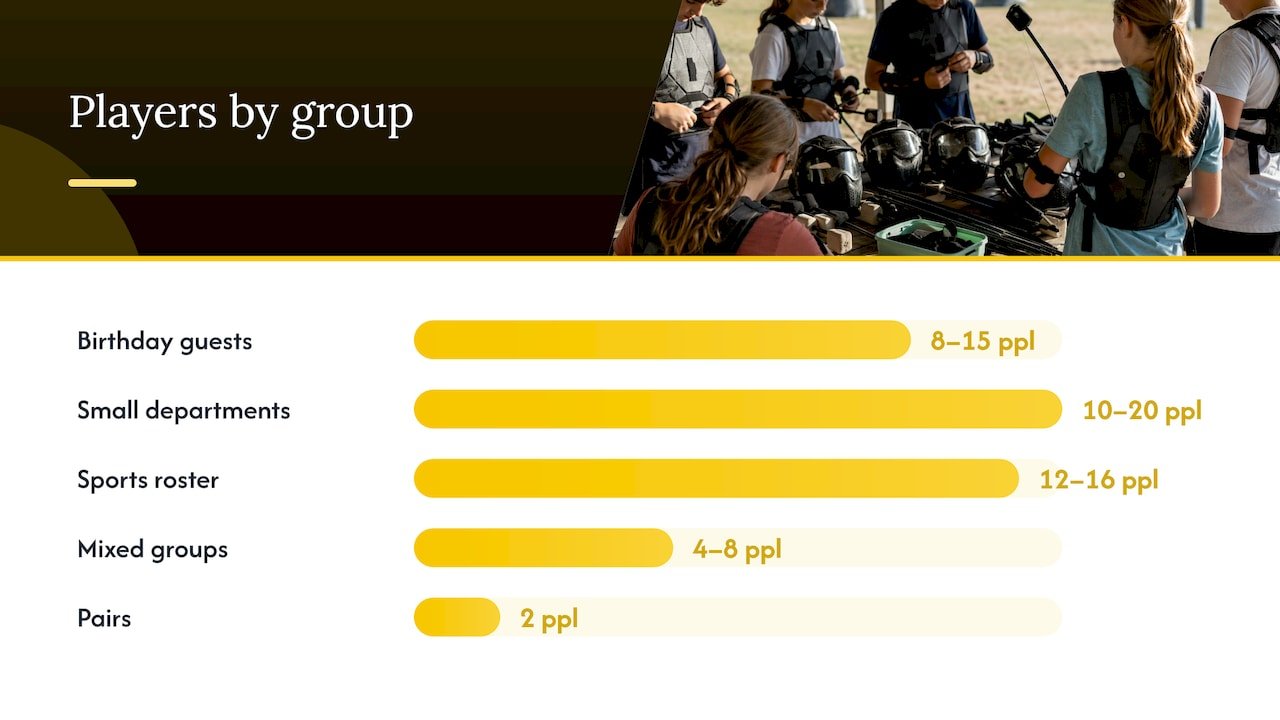
Kids’ birthday parties. Parents usually have 8 to 15 guests. That means one or two waves of five-a-side, plus something else to do. Our kids’ birthday packages start at $399 for Game On, $499 for Epic Birthday Party and $2,395 for Momentum.
Corporate teams. Small departments of 10 to 20 fit one or two waves nicely. Larger company events work best with rotating stations, as on our team building page.
Sports teams. A roster of 12 to 16 players is comfortable: two full teams plus substitutes who swap in, as in the official format. See our sports team events.
Schools and camps. Plan waves by class or camp group, with adults at each station.
Friends and date nights. Pairs and small groups can book individual sessions, and a mixed group of four to eight can play small-sided games.
A sample plan for 20 guests
Suppose you are organizing a 20-person office outing at a two-hour slot.
- First 15 minutes: arrival, gear and a safety briefing for everyone.
- Next 45 minutes: Group A plays combat archery in short games, while Group B tries a second activity. Rotate after each block.
- Next 45 minutes: swap, then run a mixed-team tournament so people finish playing with colleagues from the other group.
- Last 15 minutes: food, scores and photos.
Notice that nobody waits more than a few minutes and the busiest moment is always under 10 archers. That is the point of planning around the team size and not the headcount.
Our perspective
We plan every group by asking one question first: how many people are actually playing at any moment? Archery tag is a five-a-side game, so the number you invite and the number on the field are rarely the same.
Combat archery works best when it sits inside a longer, varied event. That is why we offer it next to Nerf battles, dodgeball, ping pong, axe throwing, bazooka ball and arcade games. A big group can move between them, and a mixed group of ages and abilities always finds something it enjoys.
Our emphasis is on safety, fun and a smooth day for the organizer. Tell us your group size, ages and goals, and our event planning support helps you shape a schedule that fits.
Archers
Book the right package for your group size
Our packages are customizable for different group sizes. Birthday parties start at $399, team-building packages start at $699 with the Collab Package, and Ultimate Paddle Package starts at $799. If you just want to play, combat archery is $35 per person and Nerf Battle is $35. See all event packages or go to the Archers Battlefield home page to get started.
If you are planning a corporate event, start with the team building packages, and for a team of players use the sports team events page.
FAQ
How many people do you need to play archery tag?
A standard game is two teams of five, so 10 players. Competitive formats use four per side and can continue with as few as two players, according to the official rules. For a group event, you can start with as few as a handful of players if the venue lets you split into small teams.
What is the maximum group size for archery tag?
There is no single maximum, because it depends on the venue’s field, staff and format. One arena has been reported to run up to 10 players per team, while recreational leagues field five. For larger groups, ask about rotations and combined activities.
How do you handle a group of 30 or more?
Split them into waves or stations. While one wave plays archery tag, others play different games and rotate. That keeps the field safe and everyone active.
What is the minimum age for archery tag?
It varies by venue. Examples include a minimum age of 10 at one public program. Ask your venue about its own age rules and any alternatives for younger children.
Sources
- Archery Tag game rules
- Archery Tag rules, team sizes and leagues
- Calgary Herald, archery tag in an indoor arena (2017)
- Archery Tag program format, ages and game length


