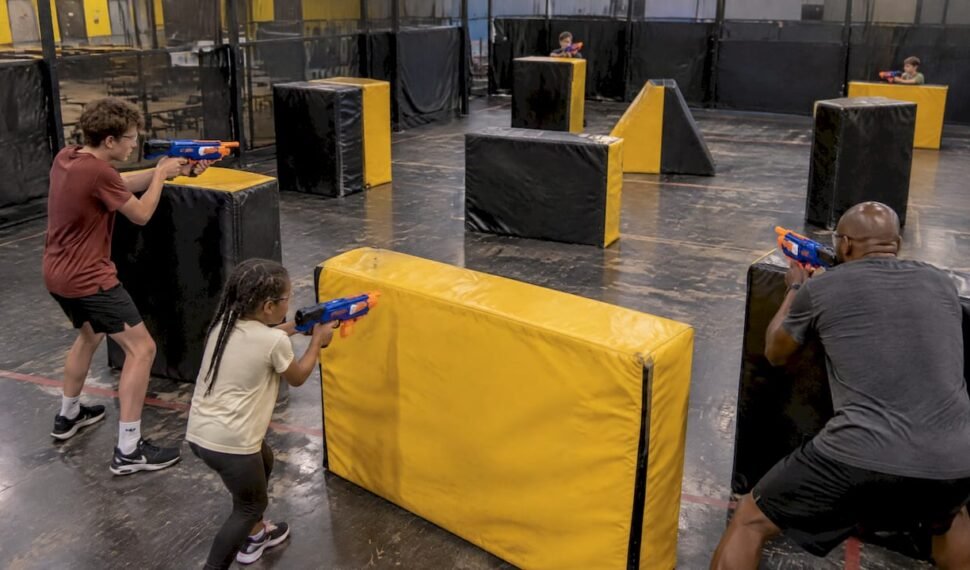
Most Nerf parties are built for kids aged 8 and up, because that is the age printed on the blasters themselves. Younger children can still join a well-run foam battle, but the game, the rules and the adult help need to change. Teens and adults are a natural fit, and mixed-age groups work well when you plan rounds around the youngest player. This guide explains where the 8+ line comes from, what to adjust below it, and how to book an age-appropriate party in Ontario.
TL;DR
- Nerf blasters are commonly rated 8+, and event organizers who follow that guideline usually set 8 as the minimum age.
- Children under 8 who already know foam blasters may be ready, but that is a parent decision made case by case.
- Teens and adults enjoy Nerf battles just as much as kids, and mixed groups work with team rounds and clear rules.
- Eye protection, a safety briefing and adult supervision matter more than the birthday child’s exact age.
- Our Nerf Battle sessions are $35 per person, and our birthday packages start at $399.
Table of Contents
- Where the “8 and up” rule comes from
- Age by age: what a Nerf party looks like
- Younger children: can they join?
- Older kids, teens and adults
- Planning a mixed-age group
- What affects whether a party suits a given age
- Safety rules for every age
- How much adult supervision is right?
- Choosing a party package that fits your group
- Planning checklist for parents
- Other activities for guests who want a change
- Common mistakes with age and Nerf parties
- FAQ
- Sources
Where the “8 and up” rule comes from
The age range for a Nerf party starts with the product, not with the party. Hasbro’s Canadian page for the Wolf LR-1 Nerf Alpha Strike blaster rates it for ages 8 and up. It also warns about small parts and a choking hazard, and says the toy is not for children under 3. The same 8+ label appears on the manual for the Nerf Strongarm N-Strike Elite, which also tells players not to aim at the eyes or face and not to modify the darts or the blaster.
Event organizers tend to follow the same line. A 2026 report on a foam dart battle fundraiser in Surrey, B.C. said the organizers recommended participants be at least 8 years old to follow Hasbro’s age guidelines. They added that some younger children who are experienced with Nerf toys may be developmentally ready, and that parents should use their discretion.
So the honest short answer is this: 8 is the standard starting age, and anything younger is a judgment call by the parent, informed by the child’s experience and maturity.
Age by age: what a Nerf party looks like
The label is a starting point. In practice, a good Nerf party feels different at every age. Here is how we would think about each group.
| Age group | What works well | What to adjust |
|---|---|---|
| Under 8 | Short rounds, simple team games, a parent standing close | Parent decides if the child is ready; shorter sessions; more rest breaks |
| 8 to 10 | Team rounds, capture-the-flag style games, clear start and stop signals | Keep rules few and repeat them often |
| 11 to 13 | Longer rounds, objectives, small tournaments | Manage competitiveness so nobody is left out |
| Teens | Strategy rounds, elimination games, team challenges | Reinforce eye protection and no-face-aiming rules |
| Adults | Corporate team battles, adult birthdays, friend groups | Mixed skill levels are fine with team balancing |
These are our planning suggestions rather than regulations. The only age figure that comes from a manufacturer is the 8+ rating above.
Younger children: can they join?
Parents of six and seven year olds ask this more than any other question. The decision belongs to the parent, and the Surrey organizers said the same: experience with foam blasters matters, and so does the child’s ability to follow instructions.
A few questions help you decide:
- Can your child stop playing the moment an adult calls it?
- Do they understand that blasters never point at faces?
- Have they used foam blasters at home or at another party?
- Are they comfortable in a group of louder, older kids?
If the answer to most of these is yes, a younger child may do well in a supervised round. If the answers are mixed, wait a year, or give them a role that suits them better, such as a ping pong table or arcade games while others play. Because we are an indoor venue with several activities, a party does not have to be all blasters. You can see the full list on our homepage.
If you have a mixed group of birthday guests with a few under-8s, shorter rounds help. Little ones tire faster, and long elimination games leave them sitting out. Rounds where everyone keeps playing, such as team objectives, keep them involved. Our guide on mixed age party games lays out ready-made rounds for groups like this.
Older kids, teens and adults
Nerf is not only a kids’ game. Teens enjoy the tactics, and adults tend to arrive skeptical and leave competitive. That is why the same activity sits in our team-building and adult party offers, not only in kids’ parties.
For teens, make the games more strategic. Give each team an objective, a base to defend and a time limit. Teens also tend to play faster, so remind them of the safety rules before every round, not just once at the start.
For adults, the main shift is purpose. A corporate group wants everyone to take part, including people who have never held a blaster. Balanced teams, short rounds and a few objective-based games keep the energy high without anyone feeling singled out. If you are planning one for work, read our guide to Nerf team building in Ontario.
Planning a mixed-age group
Birthday parties often bring cousins, siblings and parents together. The easiest way to handle a wide range is to plan around the youngest or least experienced player and let everyone else raise the challenge within that frame.
Practical ways to do it:
- Mix the teams. Put an older player and a younger one on each side so skill is spread out.
- Use objectives, not only elimination. Collect, defend or capture games keep every child moving.
- Keep rounds short. Five to ten minutes with a water break works better than one long battle.
- Give parents a role. Parents can referee, keep score or sit out as spectators with a clear view.
- Offer a break activity. A table game or arcade corner gives younger guests somewhere to go when they need a rest.
For more ideas on pitching entertainment at several ages, these party entertainment ideas for kids are a helpful read, and a step-by-step approach to organizing a kids’ birthday covers the timing and logistics around the game itself.
What affects whether a party suits a given age
Age is only one factor. Four others matter just as much.
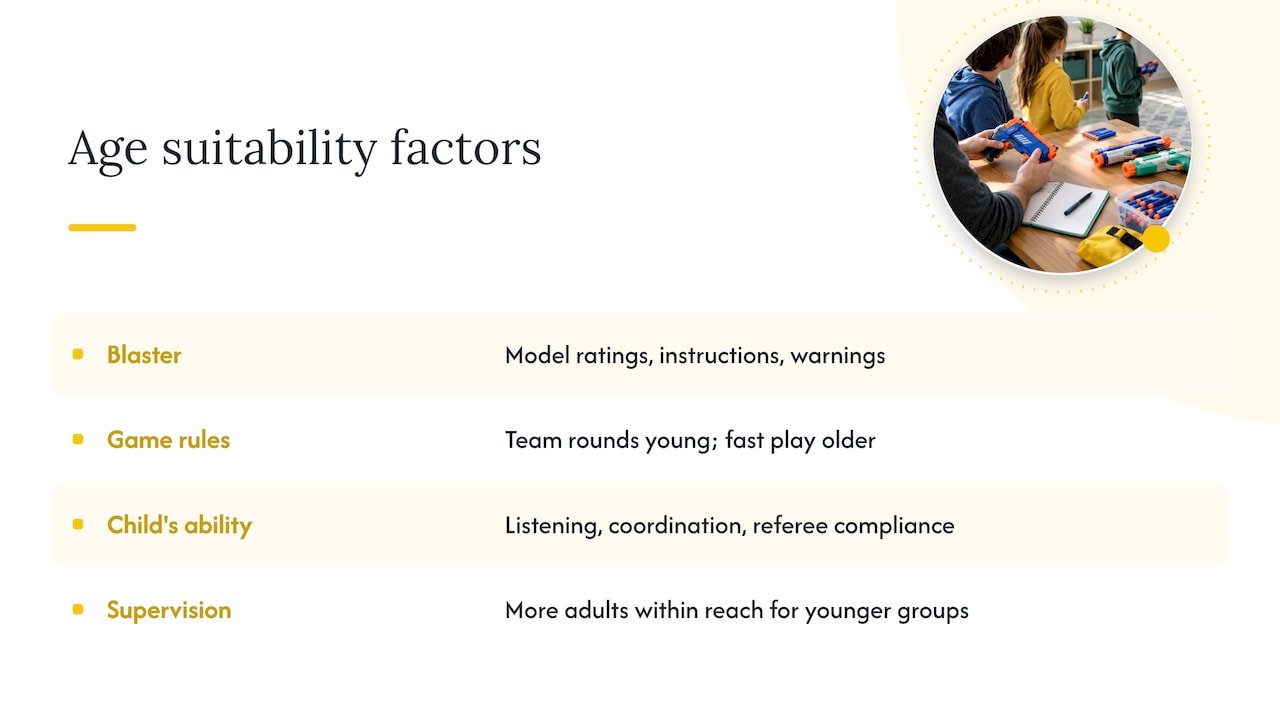
The blaster. Different models carry different ratings, which is why the exact model and its instructions matter. The Strongarm manual and the Wolf LR-1 page both state 8+, and both carry use warnings. Lighter blasters with simple priming are easier for younger hands, and a venue that supplies the equipment is responsible for choosing it.
The game rules. A free-for-all with fast movement suits older players. A structured team round with a referee suits younger ones. Clear rules about distance and aiming make any age safer.
The child’s ability. Some eight year olds are calm and careful. Some ten year olds are not. Listening, coordination and willingness to follow a referee count for more than the number of candles.
Supervision. Blaster safety guidance from a hobby retailer notes that blaster velocity and kinetic energy factor into age classifications and recommends adult supervision when playing with blasters. That is a good principle for any party: the younger the group, the more adults you want within reach.
Safety rules for every age
The following rules apply whether your guests are nine or fifty.
- Never aim at the face or eyes. The Strongarm manual says so directly, and it is the first rule in any briefing.
- Wear eye protection. Use the protection the venue provides, and do not play without it.
- Use only the darts supplied. Do not modify darts or blasters, as the manufacturer instructions warn.
- Stop when called. Everyone freezes and lowers their blaster at the referee’s signal.
- Keep blasters pointed at the play area. No aiming at people who are not playing.
- Watch for small parts. Hasbro warns that small parts may be generated and pose a choking hazard, so keep loose darts and pieces away from very young siblings.
A short briefing before play helps all ages. At a party it takes only a few minutes, and children listen better when the rules are short and the referee is clear.
What you wear also matters. Closed shoes and comfortable clothes make a difference, and our Nerf battle outfit guide covers what to wear and what to skip.
How much adult supervision is right?
There is no single legal ratio that applies to every Nerf party, so we plan by common sense and by group size. Younger children need an adult within reach and in sight. Older children and teens are fine with a referee leading the game while parents watch from the side. Adult groups need a briefing and a referee, not a babysitter.
At a venue, the host or referee runs the briefing and the rounds. As a parent, your job is to know your child, tell the host about anything that affects play, and step in if a younger guest looks overwhelmed. If a child has additional needs, see our guide to inclusive birthday party ideas for the kinds of adjustments you can ask about.
Our perspective on Nerf party ages
We run an indoor venue where groups of every age come to play, and we have found that the right party comes from matching the game to the group, not just the age on the invitation.
Our approach is to treat 8 and up as the starting point set by the blaster manufacturer, and to build the party around the people who are actually coming. A mixed group of cousins, friends and parents does best with team rounds, short games and a clear briefing from the host.
That is also why we offer more than one activity. Combat archery, dodgeball, ping pong, axe throwing and arcade games sit alongside Nerf, so a younger sibling or a guest who needs a break always has somewhere to go, and the party keeps its energy.
We design our packages around group size and age, with planning support so parents are not left to work out the details alone. Safety comes first at every stage, from the briefing to the final round.
Archers
Choosing a party package that fits your group
Once you know who is coming, the next step is choosing a format. Our Nerf Battle sessions are $35 per person, which suits friends, small groups and families who want to play without a full party.
For birthdays, our kids’ birthday party packages start at $399 for Game On, $499 for Epic and $2,395 for Momentum. For a broader mix of activities, our event packages include Pong & Party On from $299, Action & Chill Bash from $599 and Ultimate Paddle Party from $799. Adult birthdays have the Momentum Adult Birthday Bash from $2,395.
Workplaces and teams have their own options. Our team-building packages start at $699 for Collab, $799 for Ultimate Paddle and $2,395 for Momentum, and our sports team events start at $399 for Game On Team Battle, $499 for Epic Team Battle Event and $699 for Team Collab. All prices are the ones published on our site and are listed as starting prices, so check the package page for what is included.
When you contact us, tell us the number of guests, the youngest and oldest ages and anything a child may need. That lets us suggest the right package and plan the rounds around your group.
Planning checklist for parents
Use this list when you plan the party.
- Count your guests by age. Note the youngest and oldest, and how many are under 8.
- Decide on the under-8s. Talk to those parents ahead of time so nobody is surprised on the day.
- Choose the format. Nerf only, or a mix of Nerf and other games.
- Share the rules in advance. Tell guests about eye protection, closed shoes and the no-face-aiming rule.
- Plan the breaks. Water, snacks and a quiet corner help younger guests recover.
- Agree on adult roles. Decide who watches, who helps and who handles photos.
- Book early for weekends. Popular party slots fill up, so ask about availability when you inquire.
If you are still deciding between group games, our comparisons of Nerf and airsoft and Nerf and paintball explain how each one differs for families and mixed groups. For more setup ideas, see our Nerf party ideas.
Other activities for guests who want a change
A birthday group is rarely identical in energy. Some children want to run for an hour, others want a turn and then a sit. A venue with several games lets you plan for both.
- Dodgeball suits a wide range of ages, and our dodgeball safety rules explain how we keep it fair and safe.
- Bazooka ball is a foam ball game, and this explainer shows how it works.
- Combat archery is a team game with its own skills, covered in our combat archery tips.
- Ping pong and arcade games give a calmer option for guests who need a break.
Mixing two or three of these into one party keeps older kids challenged and younger ones comfortable.
Common mistakes with age and Nerf parties
A few patterns come up again and again.
Inviting a wide age gap without a plan. A seven year old and a thirteen year old can share a party, but only if the rounds are built for both. Mixed teams and short games solve most of it.
Skipping the briefing because the kids “know the rules”. Experienced players need the reminder as much as beginners. Fast, excited groups forget the basics.
Treating the age on the box as the only test. The 8+ rating is a useful line, but readiness also depends on the child. That is the reasoning behind the parent-discretion approach described in the Surrey report.
Letting competition take over. Younger or less confident guests can lose interest if every game ends in elimination. Objective rounds fix that.
Forgetting the adults. Parents who join in tend to enjoy the party more, and they set a good example on safety.
FAQ
What is the best age for a Nerf party?
Most Nerf blasters carry an 8+ rating, and event organizers commonly use 8 as the minimum age. Eight to twelve is a sweet spot for birthday parties because children can follow rules and still love the game. Teens and adults enjoy it too.
Can a 6 or 7 year old go to a Nerf party?
Possibly. The Hasbro rating is 8+, and organizers who follow it note that some experienced younger children may be ready, with parents using discretion. Think about whether your child follows instructions, knows the no-face rule and has used foam blasters before, and stay close to them.
Can adults and teens play Nerf battles?
Yes. Nerf battles work for teams, friends, workplaces and adult birthdays. Balanced teams and short objective rounds keep the game fun for people with different experience levels.
Do all ages need eye protection?
Yes. The manufacturer’s instructions say never to aim at the eyes or face, and eye protection adds a layer of safety for every age. Use the protection the venue supplies and keep it on throughout the game.
How many adults should supervise a kids’ Nerf party?
There is no single rule, but the younger the group, the closer the adults should be. Blaster safety guidance recommends adult supervision when playing with blasters. At our venue, a host leads the briefing and rounds, and parents help by staying nearby.
Sources
- Wolf LR-1 Nerf Alpha Strike Toy Blaster, Hasbro Canada
- Nerf Strongarm N-Strike Elite quick start manual
- Kids vs. firefighters Nerf gun battle fundraiser in Surrey, Cloverdale Reporter
- Blaster safety guidance


