
Start with your child’s closest friends, pick a number your space and budget can handle, then count everyone who will actually walk through the door, including siblings and parents who stay. A guest list that works is a headcount first and a list of names second. Below you will find a simple way to build it, starting numbers by age, what to do about classmates, and how to plan for a child who gets nervous in a crowd.
TL;DR
- Pick the number of guests first, then let your child choose the names within that limit.
- A common starting point is the child’s age plus one, but space, budget, temperament and activity matter more than any formula.
- Invitations are not headcount: add the birthday child, invited kids, siblings, staying parents and host adults.
- Never hand out partial-class invitations at school. Use email, text or a call.
- For shy or easily overwhelmed kids, a smaller group, a shorter party and a buddy make the day easier.
Table of Contents
- Start With Two Lists, Not One
- How Many Kids to Invite
- Invitations Are Not Headcount
- Let Your Child Have a Say, Within Limits
- Classmates: Whole Class or a Few Friends?
- Planning for a Shy Child or an Easily Overwhelmed Guest
- Make Room for Every Guest
- Invitations and RSVPs
- A Worked Example
- Choose a Party That Fits Your List
- FAQ
- Sources
Start With Two Lists, Not One
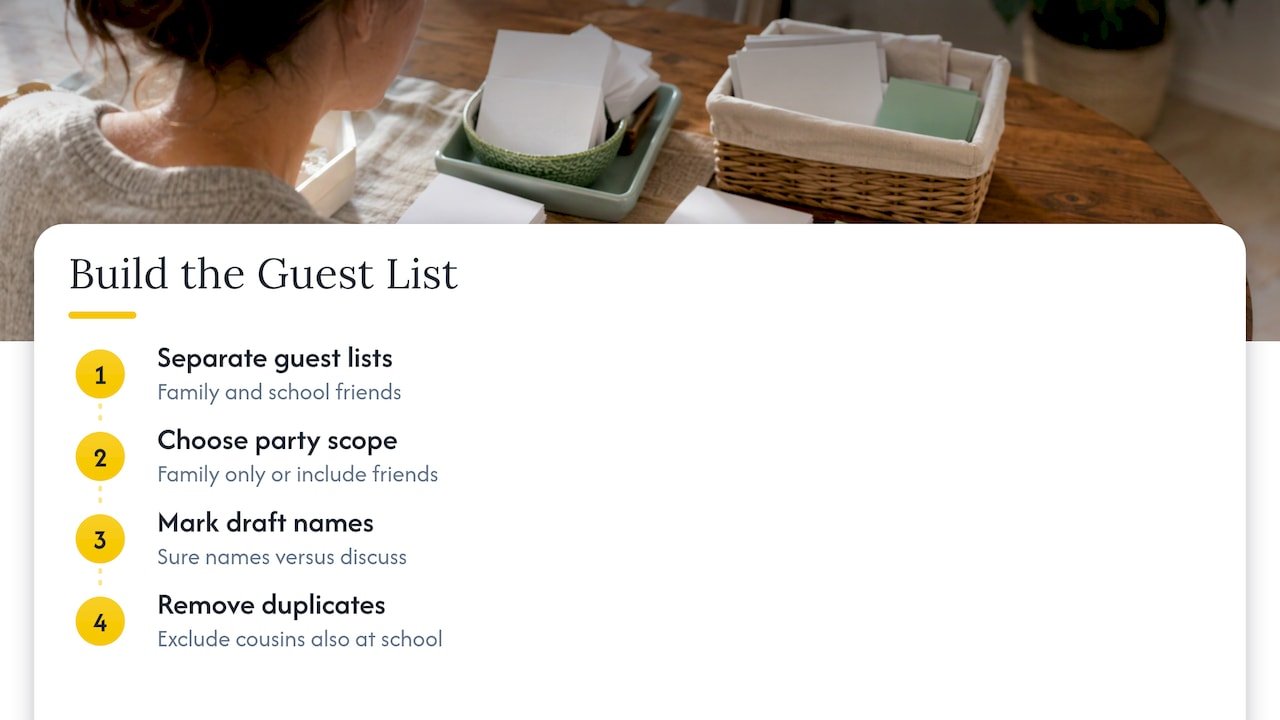
Before you think about numbers, write down everyone your child might want to celebrate with. Keep family and school friends on separate lists. Grandparents, cousins and neighbors answer to a different logic than classmates, and mixing them makes the total feel bigger than it is.
Then ask the real first question: is this a family-only party, or does it include friends? The CHOP Research Institute’s party planning guidance puts the guest list on the planning timeline for exactly this reason, and asks whether it is immediate family only or widens to cousins, grandparents and friends, and whether parents are invited too.
Once you have a rough picture, mark the names you are sure of and the ones still to discuss. Remove duplicates, such as a cousin who also goes to your child’s school. That gives you a working draft you can trim.
How Many Kids to Invite
The most quoted rule is age plus one. Emily Post says the age plus one rule is still a good one, and adds that you should weigh the type of party, the space and the budget. A turning-five party would be six guests under that rule.
It works as a starting point, not a law. A Quebec article in La Presse quotes a psychoeducator who calls one friend per year of age reasonable up to about age 6, after which kids are more independent. The same piece notes that a child’s temperament matters, and that around ten children is the practical ceiling if you want to run an organized activity.
Here is a rough planning table, built from those ideas and our own experience hosting group events:
| Child’s age | Comfortable starting range | What usually decides the final number |
|---|---|---|
| 3 to 5 | 4 to 6 kids | Parents staying, nap and energy levels, space |
| 6 to 8 | 6 to 10 kids | Activity type, supervision, budget |
| 9 to 12 | A few close friends up to about 10 | The friend group and what the child wants to do |
| Teens | Let the friend group and the activity decide | The activity and the venue’s group rules |
Treat the ranges as a first draft. If your list makes the basics hard, such as coats, seating for cake, or being able to see every child during play, invite fewer kids or choose a different activity.
Invitations Are Not Headcount
This is where most guest lists go wrong. Ten invitations can easily mean twenty people in the room.
Count these separately:
- The birthday child
- Invited children
- Invited siblings
- Parents or caregivers who will stay
- Adults hosting or helping
Younger children almost always arrive with a parent who stays. Older kids are often dropped off. Write both counts down, because a venue’s room limit, a package price and your food order may each count people differently.
When you call a venue, ask who counts toward the room limit and the package price, when the final count is due, and what happens if you need to add or remove guests. Our list of questions to ask an event venue covers the rest of what to confirm before you book.
Match the Number to the Activity
The activity decides how big a group works. Seated crafts and cake tolerate a crowd. Active games need space and enough adults to supervise. If your child loves team games, a group that splits evenly into two sides is easier to run than an odd, sprawling one. Our mixed-age party games playbook gives ready rounds that work when ages and group sizes vary.
Food is part of the same math. If you plan to serve treats, think about how guests will get them. An ice cream truck for birthday parties is one way to feed a group without a seated meal, but you still need to know your final count so the order fits.
Let Your Child Have a Say, Within Limits
Children feel more invested when they help choose who comes. Emily Post suggests that by about age four or five a child may be ready to help, and that parents can set the guideline first by choosing how many guests, then help the child choose who to invite.
Today’s Parent makes a similar point: kids should feel heard, while parents still set the boundaries on safety, budget and logistics. In practice that sounds like this: “We have room for six friends. Who are your six?”
A few things make that conversation smoother:
- Give the number before the names, so it never feels like you are vetoing a friend.
- Ask who they would pick for a favorite activity, not just who they like.
- Keep one or two spare spots in mind for a friend who turns out to be missing from the first round.
- Write the list together, then sleep on it.
Classmates: Whole Class or a Few Friends?
If you are inviting only part of the class, do not hand out invitations at school. Emily Post advises mailing or phoning instead, and La Presse notes that school distribution can cause jealousy among kids who were left out. It recommends email when you can, and suggests explaining to your child why the whole class cannot come.
If you cannot reach parents directly, ask the teacher whether the school shares contact details for this purpose, or ask your child’s friends’ parents at pickup. Both keep the invitations private.
The other side of the coin is gentle too. ParentsCanada points out that space, family obligations and budgets all shape who is invited, and recommends explaining to kids that they will not get an invitation to every party. That framing helps your child accept being left off a list, and helps you explain your own.
A few ways to keep a partial-class list fair:
- Invite by activity or team, such as the soccer group, rather than by whoever you like best.
- Invite a small circle of close friends and keep the party quiet.
- Choose a whole-class party only when the venue, budget and supervision genuinely allow it.
Planning for a Shy Child or an Easily Overwhelmed Guest
Short searches like shy kids at parties usually come from one of two places: your own child is the shy one, or one of the guests is. The planning tools are the same.
If the Birthday Child Is Shy
Ask what kind of party feels good. ParentsCanada’s advice for introverted kids is to ask them what party atmosphere they prefer, consider quieter activities, hold the party in the morning, and keep it to something like 90 minutes instead of two or three hours. It also recommends a child who is full and well hydrated, and mentions earplugs to take the edge off background noise.
A smaller list is the biggest lever. Three to five familiar friends can be a better party for a quiet child than fifteen classmates.
If a Guest Is Shy or Anxious
There are a few things a host can do. Today’s Parent’s piece by a Canadian family counselor suggests removing judgment and shame around shyness and making a concrete plan. For example, a child can bring a book and join the group for the birthday song. It also notes that arriving early helps, since the room is calmer before everyone is there.
Understood recommends finding out what specifically worries the child, then using social anchors, such as walking in with a buddy. As a host you can help by pairing a hesitant guest with a friendly peer, or by letting parents know a buddy is welcome.
If a Big Group Is Too Much
Today’s Parent notes that large parties are not always right for every child, and that for some neurodivergent kids a big gathering can feel overwhelming instead of joyful. In that case, shrink the list, shorten the party, or pick a format with a clear structure. CHOP’s guidance suggests a picture schedule and a quiet space for children who need one.
Our page on inclusive birthday party ideas goes through how to plan for different needs.
Make Room for Every Guest
Flexibility in the guest list can be a kindness. The Children’s Treatment Network, a Canadian organization, suggests keeping the list flexible because some children are more comfortable when a parent, sibling or support worker can come along. It also recommends thinking about sensory needs, including a quiet space.
An RSVP form helps you plan for all of this early. The same organization suggests collecting dietary restrictions, accessibility needs such as parking or seating, and similar details in the form itself. If you would like to know more, read how to send invitations and track RSVPs below.
Invitations and RSVPs
La Presse recommends email where possible, sent two to three weeks before the party, with parents replying about a week before. It also says to put allergies on the invitation, and to avoid excluding allergic children. Parents of kids with allergies are often used to accommodating and may offer to bring a slice of cake or a lunch box.
A short invitation that answers the questions parents always ask:
- Date, start and end time
- Address and where to park
- Whether siblings and parents are welcome
- An RSVP date and how to reply
- A line asking about allergies and anything else the host should know
Sending with an end time matters. It tells parents when to pick up and gives a shy child a clear finish line.
A Worked Example
Say your child is turning seven and loves active games. You write down eleven friends and four cousins. Your working number is eight to ten kids for an active activity, so you ask your child for their top eight friends, and invite the cousins to a family dinner on another day.
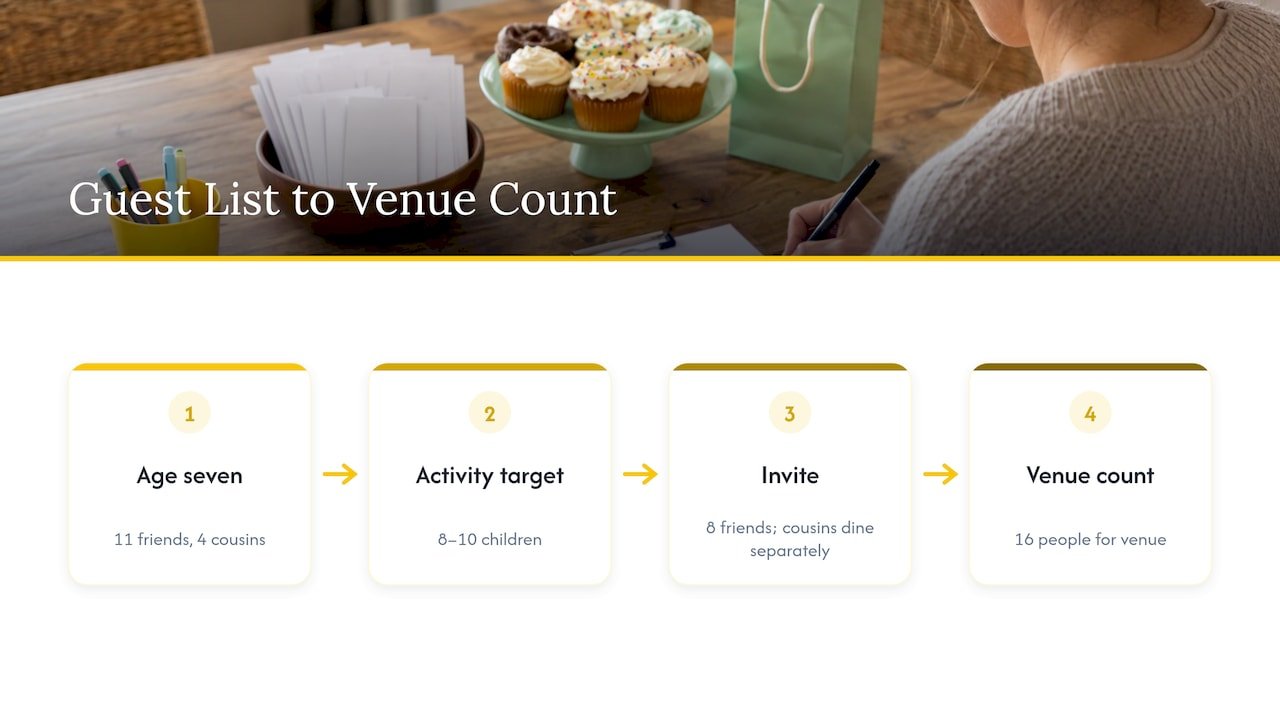
Now count headcount. Eight friends, the birthday child, two siblings who will tag along, three parents who plan to stay and two host adults make sixteen people. That is the number you give the venue, not eight.
Finally, set the RSVP date a week before, with the allergy question in the invitation. Two weeks out, you know who is coming and can plan food and favors for the real number. Our birthday party checklist and kids birthday planning timeline show when each of those steps usually falls.
Our Perspective
We run group parties every week, and the happiest ones share one habit: the family picked the activity and the number of guests before they wrote the names. A game that fits the group gives every child something to do, including the kid who would rather watch from the edge for the first ten minutes.
That is why we build our birthday packages around activities that work for mixed personalities. Combat archery, Nerf battles, dodgeball and ping pong are team games with clear rules, so children who do not know each other well have something to talk about right away. Our planning support is there to help you match the group size to the format, not to push the guest list bigger.
Our advice is simple. Keep the list small enough that you can greet every child by name, and large enough that your child is excited. Then let the activity do the work of getting everyone playing.
Archers
Choose a Party That Fits Your List
Once you have your number, the next step is matching it to a format. At Archers Battlefield we offer kids birthday packages built around combat archery, Nerf battles and other group games, and our planning team can help you work from your headcount.
Our kids birthday party packages start with Game On Birthday Party from $399 and Epic Birthday Party from $499, with Momentum Birthday Party from $2,395.

If your child is a Nerf fan, the Nerf party ideas page shows how to run it. If you want add-ons, see the party add-ons worth buying first. Have your headcount ready when you reach out, and ask us how the count works for your chosen package.
FAQ
How many kids should I invite to a birthday party?
A good starting point is your child’s age plus one, which Emily Post still calls a sound rule. For ages 6 to 8, six to ten children is common, and for an organized activity around ten is a practical maximum. Adjust for your space, budget and your child’s temperament.
Do I have to invite the whole class?
No. If you invite only some classmates, send invitations by email, text or phone instead of handing them out at school. Explain to your child that a party cannot include everyone, and keep the choice based on something clear, such as close friends or a team.
Should parents of guests stay at the party?
It depends on age and on the venue. Younger kids often come with a parent, and some children are more comfortable with a parent or support person nearby. Say on the invitation whether parents are welcome, and count them in your headcount.
How do I help a shy child enjoy a birthday party?
Arriving early, agreeing on a small goal such as joining for the birthday song, and pairing the child with a buddy all help. For your own shy child, a smaller list, a morning start and a shorter party reduce the pressure.
When should I send the invitations?
La Presse recommends two to three weeks before the party, with RSVPs about a week ahead. Put allergies, parent policy and the end time on the invitation.
Sources
- Emily Post: Kids’ Birthday Parties
- La Presse: Fêtes d’enfants, un party réussi
- Today’s Parent: Who Are Kids’ Birthday Parties Really For?
- Today’s Parent: Shy kids
- ParentsCanada: What to Do When Your Child Isn’t Invited to a Birthday Party
- ParentsCanada: How to throw a birthday party for an introverted kid
- Understood: Social anxiety and kids who are neurodivergent
- Children’s Treatment Network: 5 Tips to Make Birthday Parties More Inclusive
- CHOP Research Institute: Planning a Birthday Party


