
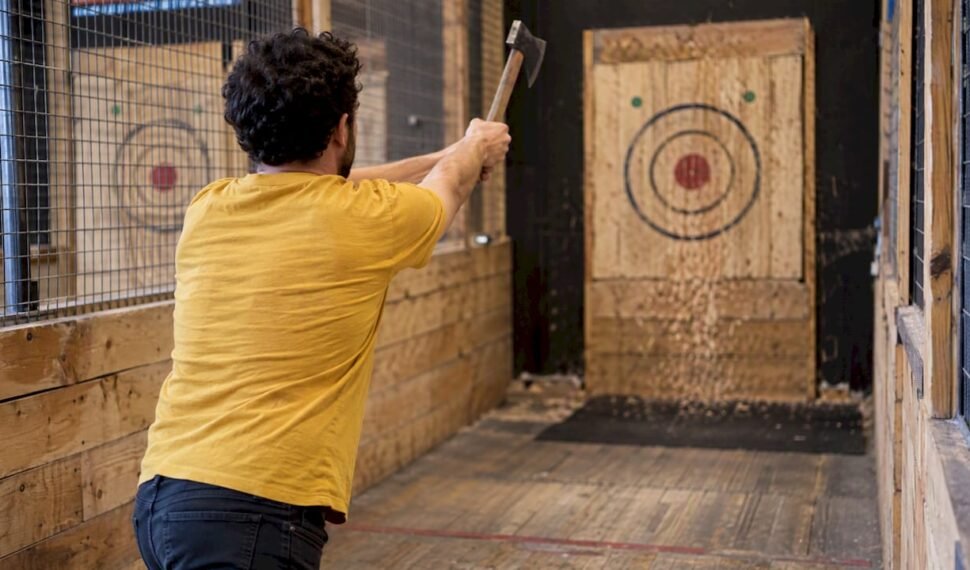
Most beginners can stick an axe within an hour if they learn four things in order: a relaxed two-handed grip, a balanced stance about 12 feet from the target, a straight overhead motion, and a release with a rigid wrist. After that, it comes down to adjusting your distance by half-steps until the blade lands flat. This guide walks through each piece, explains how to read what the axe is telling you, and covers the one-handed throw for when you are ready.
TL;DR
- Start with the two-handed overhead throw. It is the easiest to learn and the easiest to repeat.
- Hold the axe at the base of the handle, firmly but not in a death grip, and keep your arm, hand and axe in one straight line toward the target.
- Power comes from shifting weight from back foot to front foot, not from flicking your wrist.
- If the handle hits first, step back half a step. If the top of the head hits first, step forward half a step.
- Side-to-side accuracy matters more than height, so focus on a small point on the target and point your whole body at it.
Table of Contents
- Before you throw: the setup that makes technique easier
- The two-handed overhead throw, step by step
- Read the axe: how to fix distance and rotation
- Aim with your whole body, not your hands
- The one-handed throw
- Six common mistakes and how to correct them
- Perspective: what we see from the lane
- Practice plan for your first session
- Techniques for different groups
- Book a session with us
- FAQ
- Sources
Before you throw: the setup that makes technique easier
Good technique starts before the axe leaves your hands. Wear closed-toe shoes, make sure the lane is clear, and throw only when it is your turn. In a league or venue setting, the standard distance is about 12 feet from the target, and the World Axe Throwing League (WATL) rules list 12 ft as the standard lane distance, with 15 ft for its Big Axe discipline.
The axe itself matters too. Under WATL’s 2026 regulations, a competition axe weighs a maximum of 3 lbs (1.36 kg), is no longer than 19 inches (48.26 cm) from the top of the eye, and has a single sharp bit no wider than 4 inches (10.16 cm). That is a throwing axe, not a wood-splitting axe from a hardware store. If you want to know how different axe styles compare, our guide to throwing axe types explains which meet WATL or IATF specs and which are historical.
Those numbers also tell you something practical: a lighter, shorter axe rewards smooth motion over muscle. You do not need to be strong to throw well.
The two-handed overhead throw, step by step
This is the technique we recommend every first-timer start with. It uses both hands, so the axe tracks straighter, and it is easy to coach because there are fewer moving parts.
1. Grip
Hold the axe near the base of the handle with both hands, a bit like you would hold a baseball bat, with your dominant hand at the bottom. Hold it firmly enough that it will not slip, but not so hard that your forearms tense. A tight grip makes it harder to let go cleanly, and a clean release is what keeps the axe traveling straight.
2. Stance
Stand square to the target, directly in line with the bullseye. Keep your knees slightly bent and your shoulders relaxed. Many throwers place the foot opposite their dominant hand slightly forward, but the rule that matters most comes from WATL’s own coaching: any footing should be solid, stable and balanced, whether you step into the throw or keep your feet planted. An unsure stance forces balance corrections in the middle of the throw, and that ruins your aim.
3. Wind-up
Raise the axe straight up and back over your head, keeping your elbows pointed forward rather than flaring out. Think of the motion as a straight line: arm, hand and axe all point toward the target throughout the wind-up and release. If the axe drifts left or right behind your head, it will drift on the way out.
4. Release
Bring the axe forward in one smooth arc and let go at about eye level, with your arms extending toward the target. This is where beginners go wrong most often. Avoid flicking your wrist at the moment of release. Keep the wrist rigid and let the power come from shifting your weight from your back foot to your front foot rather than from arm strength alone.
5. Follow-through
Finish with your arms pointing at the target and stay balanced for a second. If you fall forward or step off the line, your weight transfer was too rushed. The follow-through is not decoration: it is how you check that the throw stayed on one line.
Read the axe: how to fix distance and rotation
An axe thrown from 12 feet rotates a set amount. Whether it arrives blade-first depends on your release height, your arm speed and exactly where you stand. Instead of changing your swing, change your position.
WATL’s coaching guidance gives a simple rule:
| What you see | What it means | The fix |
|---|---|---|
| Handle hits the target first | Under-rotating, too close to complete the spin | Take a half-step backward |
| Top of the axe head hits first | Over-rotating, too far into the spin | Take a half-step forward |
| Blade lands flat and sticks | Right distance | Stay and repeat the same motion |
This is per WATL’s guide to getting better, which also notes that small adjustments of around 10 cm can decide whether the blade sticks. Make one change at a time. If you change your distance and your swing together, you will not know which fixed the problem.
A handy habit: once you find the spot where the axe sticks, note where your feet are relative to the line, then return to exactly that spot every throw.
Aim with your whole body, not your hands
Coaches often say that left-to-right accuracy matters far more than vertical precision. On a round target, missing the bullseye by a small amount horizontally is a miss, while vertical variance can be forgiven if the blade still lands in a scoring zone. The takeaway: stop trying to steer the axe with your hands. Instead, point your entire throwing motion at the target.
Two habits help:
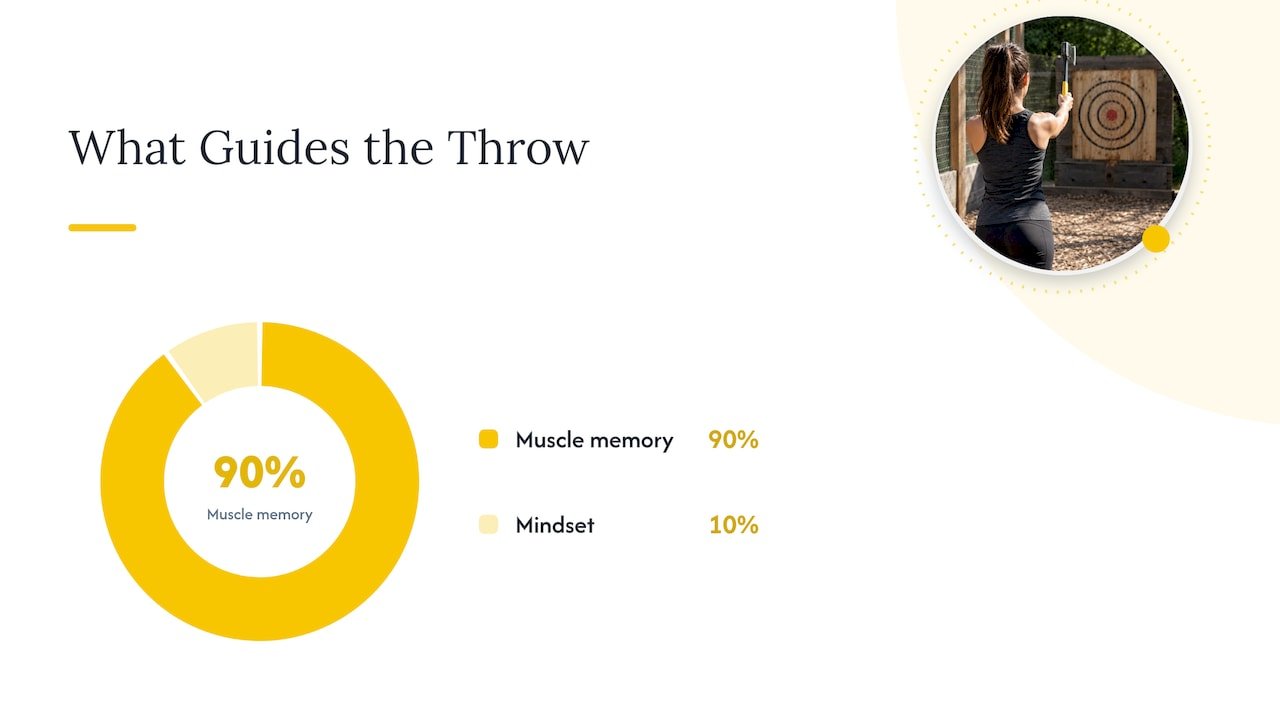
- Pick a tiny target. Choose a very small point on the board, not the whole bullseye, and keep your eyes on it during the backswing and release. WATL experts describe the sport as 90% muscle memory and 10% mindset, and a small focal point helps train your brain to line up the trajectory.
- Stop overthinking. Once your stance and grip are set, trust the motion. Running through a checklist mid-throw is how good throws turn into bad ones.
The one-handed throw
Once the two-handed throw sticks reliably, many people move on to throwing with one hand. It looks more dramatic, but it has less margin for error, because the axe can twist sideways if your grip is too tight or your wrist tilts.
For the one-handed throw, line up with the shoulder of your throwing arm in line with the bullseye rather than facing the target square. Take the axe back past your ear without tilting the head, then bring it forward on the same vertical plane and release at about eye level. The principles are unchanged: a straight line from arm to target, a rigid wrist, a weight shift through the legs, and half-step distance adjustments.
If you try it and the axe keeps arriving crooked, go back to two hands for a few rounds. There is no prize for switching early.
Six common mistakes and how to correct them
- Flicking the wrist. Lock it through the throw and let your legs and torso supply the power.
- Gripping too hard. Loosen your hands until the axe feels secure but not strangled.
- Changing your stance mid-throw. Set your feet before you lift the axe.
- Chasing the bullseye vertically. Focus on the horizontal line first.
- Changing everything after one miss. Adjust only distance, using half-steps.
- Throwing out of turn or into an occupied lane. Wait until the lane is clear and throw only as instructed by your coach or host.
Perspective: what we see from the lane
We run an indoor entertainment venue where axe throwing sits alongside combat archery, Nerf battles, dodgeball and ping pong, so we watch a wide mix of people pick up a new skill: families, coworkers, sports teams and friends on a night out. The pattern is consistent. People who try to throw hard fail. People who slow down, settle their feet and treat the throw as a smooth push toward one small spot get it to stick far sooner.
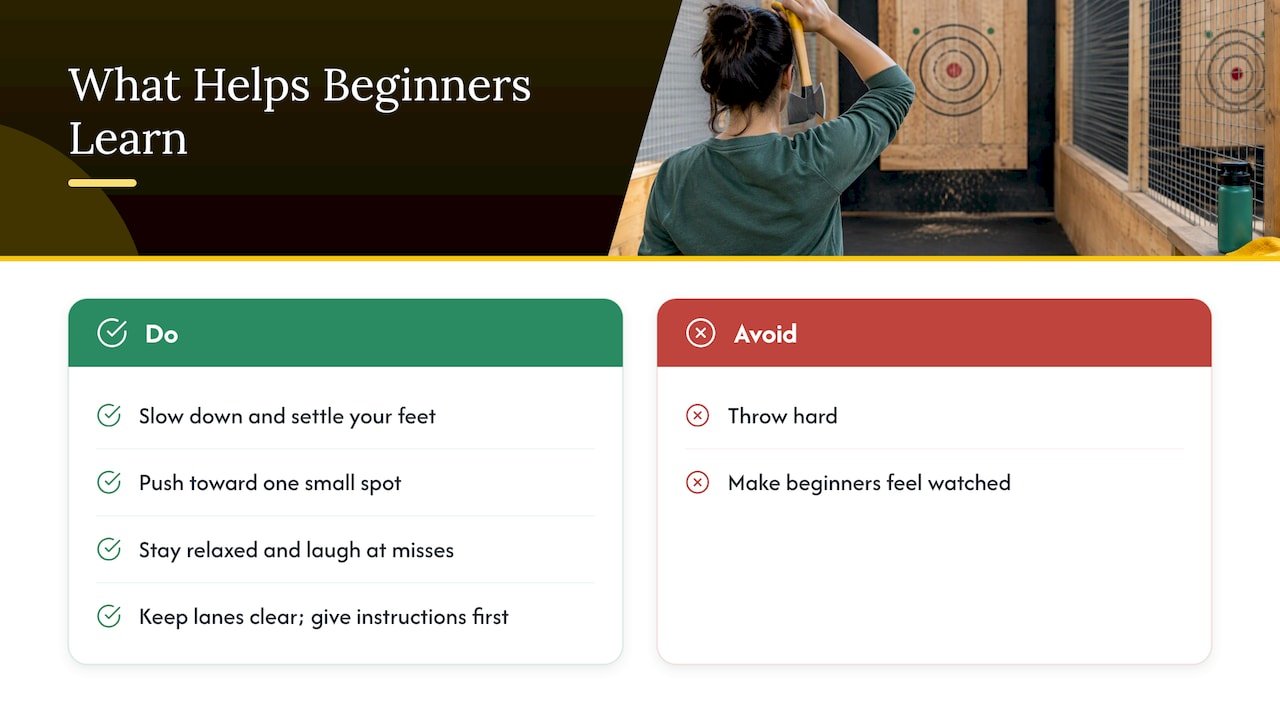
We also see how much the group matters. A beginner who is relaxed and laughing at their misses learns faster than one who feels watched. That is why we pair activities with planning support and keep safety front and centre: clear lanes, one thrower at a time, and instructions before anyone picks up an axe. Technique is learnable in a single session, but only if the setting lets you relax.
If you want to turn technique into a game, our axe throwing games guide covers formats that keep everyone engaged, and our scoring guide explains how points work once your axe starts sticking.
— Archers
Practice plan for your first session
Here is a simple way to structure your first 30 to 45 minutes so you improve instead of just throwing:
- Warm up (5 minutes). Loosen shoulders, wrists and hips. Take a few slow practice swings with no release.
- Find your distance (10 minutes). Throw with a two-handed grip, and move in half-steps based on how the axe lands. Stop adjusting when the blade is landing flat.
- Repeat your spot (10 minutes). Return to the same foot position and throw ten times in a row without changing anything. Count how many stick.
- Narrow your focus (10 minutes). Choose a small point on the target and throw at that point. Notice whether your misses are left, right, high or low.
- Try something new (5 to 10 minutes). Switch hands, try a one-handed throw, or play a game with friends.
Do not worry about score during steps 2 and 3. Consistency comes first, and points follow.
Techniques for different groups
The basics stay the same, but how you teach them changes by group.
- Couples. Throwing is a good low-pressure activity for two. Take turns coaching each other on the half-step adjustment. If you are planning a night out, see our axe throwing date night guide and date ideas for couples.
- Coworkers. Mixed experience levels are normal, so start everyone on the two-handed throw and add friendly competition later. Our team building page explains how Ontario organizers approach it.
- Friends and parties. Rotate quickly, keep rounds short, and let beginners watch one or two good throws before their first attempt.
Book a session with us
If you would rather learn with coaching than from a page, we can set up axe throwing as part of a group event. Our event packages start at 299 $ for Pong & Party On, and our team building packages start at 699 $ for the Collab Package. Axe throwing itself does not have a published price on our site, so ask us about it when you book. You can see all our activities on the Archers Battlefield homepage.
FAQ
What is the easiest axe throwing technique for beginners?
The two-handed overhead throw. You hold the axe at the base of the handle, stand square to the target, bring the axe back over your head and release at eye level. Both hands keep the axe straight, and you only need to adjust your distance in half-steps.
How far should I stand from the target?
Start at about 12 feet, which is the standard lane distance in WATL rules. Then move half a step forward or backward depending on how the axe lands. Small shifts matter more than you would expect.
Why does my axe keep bouncing off the target?
Usually it is a rotation problem. If the handle hits first, step back half a step. If the top of the head hits first, step forward half a step. A flicked wrist or a very tight grip can also send the axe off line, so keep your wrist rigid and your hands relaxed.
Is the one-handed throw better than the two-handed throw?
Not necessarily. The one-handed throw looks more advanced, but it has less margin for error. Many people use two hands until they can stick the axe consistently, then try one hand as a second skill.
Do I need to be strong to throw an axe?
No. Power comes from shifting your weight from the back foot to the front foot, not from muscle alone. A smooth motion with a straight arm line beats a hard throw.
Sources
- How To Get Better At Axe Throwing: A Detailed Guide, World Axe Throwing League
- Official Rules, World Axe Throwing League


