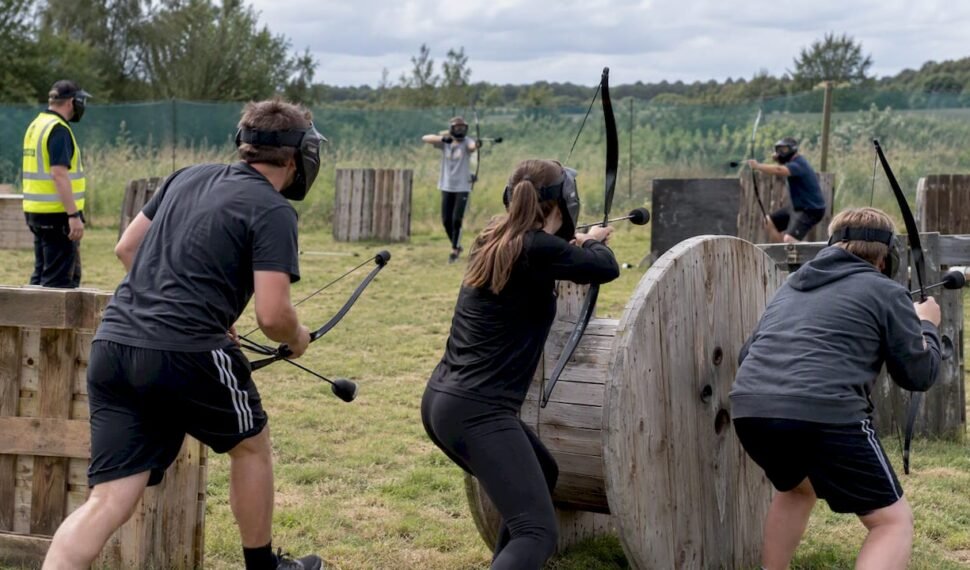
Archery tag has a small set of common modes: Elimination (classic), League or points play, Capture the Flag, Medic, and target knockouts. Each one uses the same foam-tipped arrows and masks, but venues and leagues formalize their own scoring, respawn, and period structures, so the exact rules you play by will depend on where you show up.
TL;DR:
- League and points-based modes keep all players active throughout the match, rewarding constant participation and scoring for hits, catches, and target knockouts.
- Elimination and classic formats remove players upon being hit, emphasizing teamwork and zone discipline for a more intense and strategic experience.
- Most venues modify rules like revive methods and opening rush procedures to suit their space, age groups, and session lengths, affecting game pace and flow.
- Safety gear is standardized, with masks, foam-tipped arrows, and designated zones, while equipment and field setups adhere to strict safety and gameplay basics.
- Choosing the appropriate mode depends on participants’ age, skill level, and event goals, with options tailored for kids, corporate teams, or competitive players.
Table of Contents
- 1. Common archery tag modes and how each one works
- 2. Core rules and mechanics behind every mode
- 3. League and points play versus elimination and classic
- 4. House rules and venue variants operators actually use
- 5. Safety, equipment, and setup you should expect
- 6. Choosing a mode for your group or event
- 7. How Archers Battlefield adapts modes for parties and camps
- 8. Book your archery tag session
- 9. Where these rules come from
- Sources
- FAQ
1. Common archery tag modes and how each one works
Every mode uses the same equipment and field, but the objective and the way players return to the game change from one format to the next.
- Classic or Elimination: a hit puts you out, and teammates bring you back either by catching an arrow you throw or by knocking out a target spot on the enemy side, according to the Archery Tag instructions.
- League or Points: matches run on a clock and award points for hits, catches, and target hits rather than ending play when someone is tagged, based on the scoring structure described in Archery Tag’s official rules.
- Capture the Flag: teams try to grab an object from the opposing side and carry it back, and a hit while carrying usually forces a drop and reset.
- Medic or Medic Tag: one designated player on each side can revive eliminated teammates until the medic is tagged out, a variant listed among the common formats used by venues and camps venues and camps use.
- Target knockout or 5-spot: players win points, or bring eliminated teammates back, by knocking down the five target centers on the opponent’s rack, per the objective described in the equipment instructions.
Beyond these five, operators run quick variants to keep sessions fresh. Respawn Rush shortens the time eliminated players sit out. VIP Escort tasks one team with protecting a single marked player while the other hunts them. Arrow Hoard rewards the team that controls the most arrows at a set interval. Bullseye turns the match into a pure target-shooting contest with no player elimination at all.
2. Core rules and mechanics behind every mode
Most archery tag formats share the same skeleton of zones, timing, and scoring rules, regardless of which mode you play.
- Opening rush: both teams start at their end line and rush into the neutral zone to grab arrows, which are typically placed to each team’s right side before players retreat to their attack zone to shoot, according to Archery Tag’s rules.
- Zone limits: players shoot and get shot only within their attack zone, and stepping into the neutral zone to collect arrows is allowed for a short window, commonly a 10-second limit, before a player must return, as outlined in the intramural rules.
- Hit versus catch: getting hit by an arrow eliminates you or costs your team points depending on the mode, while catching an opponent’s arrow out of the air usually earns bonus value or an instant revive.
- Team size and timing: intramural and league formats commonly run several timed periods of around 6 to 8 minutes each, according to the Tennessee Tech intramural rules, though youth and party sessions at commercial venues often run shorter rounds.
- Penalties and conduct: stalling, shooting into the neutral zone, or unsafe arrow handling draws penalties in most rule sets, and masks are required equipment throughout play, per the intramural rulebook.
3. League and points play versus elimination and classic
The biggest split in archery tag is pacing: does the match end when players are tagged out, or does it run on a clock while everyone keeps shooting?
- Point values follow a common pattern across rule sets: a hit is worth 1 point, a catch is worth 3 points, and a target spot knockout is worth 2 points, though individual venues adjust these numbers.
- League and points formats keep every player active for the full match, which makes them a better fit for beginners, mixed-skill groups, and anyone watching from the sideline.
- Elimination and classic formats raise the intensity because getting hit actually removes you from the round, which rewards tighter teamwork and better zone discipline.
- Tournament settings often add pool play before a bracket, along with seeding based on regular-season results and overtime periods to break ties, a structure reflected in intramural tournament rules.
For a birthday party or a first-time corporate group, points-based play tends to hold interest better because nobody sits out for long. Competitive leagues and adult groups chasing a real challenge usually gravitate toward elimination.
4. House rules and venue variants operators actually use
Written rulebooks give you the baseline, but almost every venue tweaks something to fit its space, its age groups, or its session length.
- Some facilities swap catch-based revives for target-knockout revives, since it is easier to referee and keeps eliminated players engaged in a secondary objective.
- Others change the opening rush by pre-placing arrows closer to the center line or assigning one player per team to collect first, which slows the initial scramble and reduces early collisions.
- Youth groups and camp sessions often get shorter periods and a delayed or limited opening rush so younger players have time to understand the zones before the action starts, a common adaptation noted among variant lists for youth programs.
Pro Tip: Ask the venue which revival rule and neutral-zone timing they use before you book, since that single detail changes how fast-paced your session will feel.
5. Safety, equipment, and setup you should expect
Every reputable venue builds its field and gear around the same safety basics, whatever mode you end up playing.
- Equipment: foam-tipped arrows, bows built specifically for archery tag, and mandatory protective masks are standard across rule sets, per the intramural equipment rules.
- Field layout: a 5-spot target rack, a marked neutral zone, attack lines, and inflatable barriers for cover are typical fixtures.
- Conduct rules: masks stay on at all times during play, arrows are only nocked and drawn inside your own attack zone, and unsafe shooting draws a penalty or ejection.
- What to wear: closed-toe shoes and clothing you can move in are enough. Most venues supply everything else, including the mask and bow.
6. Choosing a mode for your group or event
The right mode depends less on preference and more on who is playing and why.
- Kids’ parties: League or points play, or a simplified Capture the Flag, keeps young players moving instead of sitting out after one hit.
- Corporate or team-building groups: points-based or objective modes like Capture the Flag reward coordination over individual shooting skill, which fits the goals of a team-building event.
- Competitive adult groups: Elimination or Classic with strict zone enforcement and fixed periods delivers the sharper, higher-stakes experience players are usually looking for.
- Before booking, ask the venue which modes they offer, how many facilitators supervise per group, what rule tweaks they use for your age range, and how much explanation new players get before the clock starts.
7. How Archers Battlefield adapts modes for parties and camps
Running combat archery for birthday parties, camps, and corporate groups means adjusting the mode to the room, not the other way around. We lean on points-based play and simplified objectives for younger or first-time groups, and tighten zone rules for adult sessions that want more intensity. Safety gear and staff guidance are provided to help groups participate without prior experience.
— Archers
8. Book your archery tag session

A good archery tag session should fit your group’s age, size, and energy level without you having to guess at the rules ahead of time. We build that flexibility into every package, whether you’re planning a kid’s birthday, a camp day, or a corporate outing.
- Event packages covering Pong & Party On, Action & Chill Bash, and Ultimate Paddle Party.
- Kids’ birthday party packages, including the Game On, Epic, and Momentum tiers.
- Team-building packages built around Collab, Ultimate Paddle, and Momentum formats.
- Archery booking for a straightforward combat archery session on its own.
Groups planning a larger outing sometimes find it useful to lock in dates early with a group scheduling tool before locking in a venue. Check availability and book your session today.
9. Where these rules come from
These formats draw on published Archery Tag rules, intramural rule PDFs, and equipment instruction sheets used by venues and leagues.
Sources
- Basic Rules of an Archery Tag® Game
- Archery Tag Rules (Intramural rules PDF)
- Archery Tag instructions (equipment and play styles)
- Archery Tag play variations (Venture Scouts)
FAQ
How do you play Archery Tag?
Two teams shoot foam-tipped arrows at each other from opposing attack zones, aiming to hit opponents or knock out target spots while avoiding getting hit themselves. Players wear protective masks throughout, and matches run either on a timer with points for hits and catches or end when one team is fully eliminated, depending on the mode being played.
What do you call a girl who does archery?
There is no separate term. Female participants in archery, including archery tag, are simply called archers, the same as their male counterparts.
What is a 720 in archery?
A 720 round is a target archery scoring format, not a term used in archery tag. It refers to a competition where archers shoot a set number of arrows for a high possible score, which is unrelated to the hit-and-catch scoring used in archery tag.
What are the different levels of archery?
Archery levels generally range from beginner and recreational shooting through club, regional, and competitive tournament play, with skill and equipment requirements increasing at each stage. Archery tag sits closer to the recreational and team-based end of that spectrum, built around group play rather than solo target accuracy.
What is the difference between League and Elimination modes?
League or points play keeps every player active for a timed match, scoring hits, catches, and target knockouts instead of removing players from the round. Elimination, or Classic mode, ends a player’s turn when they get hit, which raises the intensity and rewards tighter teamwork.


