

Your job as a chaperone is simple: keep your assigned students safe and accounted for by following the teacher’s plan, using frequent head counts, and escalating problems immediately. Everything else, snacks, scripts, seating charts, exists to support that one job. Know the itinerary, bring your roster and emergency contacts, use the buddy system, and loop in the teacher the moment something feels off.
TL;DR:
- Confirm the full itinerary, student count, and emergency contacts with the teacher days before to prevent communication gaps on the day of the trip.
- Pack essential items such as photo ID, charged phone, roster, emergency contacts, and allergy or medication notes, and wear weather-appropriate clothing with comfortable shoes.
- Conduct head counts at every move, enforce the buddy system, and set clear rules like staying within sight to quickly identify and address missing children.
- Know supervision ratios, prioritize safety, and immediately involve the teacher for serious issues or safety risks rather than handling them independently.
- Clarify logistical details such as bus seating, meal payments, restroom policies, and access accommodations to avoid delays and confusion during the trip.
Table of Contents
- Before the Trip: Paperwork, Orientation, and What You Must Confirm
- What to Bring and Wear: A Morning-Of Checklist
- On the Trip: Head Counts, Buddy System, and Group Movement
- Keeping Kids Engaged Without Overstepping Your Role
- Emergency Procedures and Supervision Ratios to Know
- Bus Rules, Lunches, and Bathroom Logistics
- Making the Trip Accessible for Every Student
- How Venues Can Make Chaperoning Easier
- Primary Sources Worth Bookmarking
- Sources
- FAQ
Before the Trip: Paperwork, Orientation, and What You Must Confirm
Most chaperone problems trace back to a gap that opened before the bus even left the parking lot. Fix that by confirming three things with the teacher a few days ahead, not the morning of.
- Get the full itinerary, including pick-up and drop-off times, and a printed roster with emergency contacts for your assigned group.
- Ask exactly how many students you’re supervising and confirm the teacher is the designated trip supervisor, since Scholastic’s chaperoning guide recommends volunteers know student names and roles before departure.
- Complete any required volunteer forms, and attend orientation if one’s offered. Many boards require this.
- Ask whether the trip needs a criminal-record check. Some districts require it depending on destination, and higher-risk trips can involve background check timelines that run several weeks, so ask early.
Leave a copy of the roster and emergency contact list at the school office too, a step Scholastic flags as a simple but frequently skipped safeguard.
What to Bring and Wear: A Morning-Of Checklist
Pack the night before. A rushed morning is how chaperones forget the one item they actually needed.
- Photo ID, your volunteer form, the student roster, and emergency contact sheet.
- A charged phone with the teacher’s number saved, plus a portable charger if the day runs long.
- A small amount of cash for emergencies (a forgotten lunch, an unexpected fee).
- Comfortable, weather-appropriate clothing and shoes you can walk or stand in for hours.
- A tiny first-aid kit: bandages, hand sanitizer, and any allergy information for your group.
- Copies of permission slips and medication notes if your students carry any, along with a note on the school’s photo or media release policy so you know what’s allowed.
Skip the loose jewelry, open-toed sandals, and anything you’d hate to lose or damage. Field trips are not the day for new shoes.
On the Trip: Head Counts, Buddy System, and Group Movement
Head counts are the single habit that prevents almost every “missing child” scare. Do one every time your group moves: before boarding, after unloading, entering a building, leaving a building, before and after lunch. That’s not excessive, it’s the routine that catches a wandering kid in seconds instead of minutes.
- Pair students into buddies and have them check in on each other, not just on you.
- Snap a quick photo of your group at the start of the day so you have instant visual reference if someone gets separated.
- Position adults at the front, middle, and back of the line when walking as a group, never clustered together.
- Give students one simple rule: “If you can’t see a chaperone, stop and wait.”
- Set a clear meeting point before you enter any large space, museum floor, zoo path, amusement park zone.
Pro Tip: Use a short, repeatable script for regrouping: “Count off by buddy pairs, hands up if you’re missing your partner.” It takes ten seconds and catches problems before they become emergencies.
The count → move → confirm rhythm sounds basic, but it’s the same structure Scholastic’s field trip guidance points to as the backbone of a well-run day.
Keeping Kids Engaged Without Overstepping Your Role
Passive chaperones lose kids to boredom, and bored kids wander. Chaperones who actually participate, asking questions, pointing things out, reacting with the group, keep attention on the activity instead of on finding trouble. Research on active versus passive learning backs this up: engaged adults produce more engaged kids and fewer discipline issues.
Ask two or three simple questions about whatever you’re seeing. “What do you notice about this?” works almost anywhere.
- Redirect small stuff quietly and privately: a hand on the shoulder, a calm “let’s walk with the group now.”
- Set clear boundaries early: no running ahead, no splitting off, hands to yourself.
- Praise good behavior out loud. Kids repeat what gets noticed.
Pro Tip: Never handle a serious situation alone. If a student won’t listen after two calm redirections, involve the teacher immediately rather than escalating on your own.
Notify the teacher right away for anything involving safety risk, repeated defiance, or a medical issue, and jot down a quick note of what happened and when. Field-trip manuals like Grand Erie’s excursions guide are explicit that the teacher is the final authority and needs a documented trail for anything beyond minor.
Emergency Procedures and Supervision Ratios to Know
Supervision ratios vary by grade, but the pattern holds across most Ontario boards: closer to 1 adult per 6 students for kindergarten, loosening to roughly 1:15 for older grades, with the classroom teacher always designated as the trip’s lead supervisor. That teacher makes the final call in an emergency. Your role is to execute the plan, not improvise one.
If something goes wrong, the sequence is short and doesn’t leave room for guessing:
- Secure your group first. Get them together and away from the immediate issue.
- Notify the lead teacher immediately, in person or by the agreed communication method.
- Call 911 for anything medical or safety-critical. Don’t wait for permission if it’s urgent.
- Identify who’s handling parent communication so one person, not five, is fielding calls.
- File a written incident report as soon as possible afterward, while details are fresh.
Higher-risk trips (water activities, overnight stays, skiing) usually require designated supervisors with documented first-aid or CPR certification and a formal emergency-action plan, including a set reunification point. Ask the teacher ahead of time who on the trip is first-aid trained and where the kit is kept. District field-trip manuals require exactly this for anything beyond a standard day trip.
Bus Rules, Lunches, and Bathroom Logistics
Most of the friction on a field trip has nothing to do with safety and everything to do with logistics nobody clarified in advance. Settle these before you board:
- Sit near your assigned group on the bus, not with other adults, and count students on and off every single time.
- Confirm with the teacher who pays for admission or meals. Some schools cover it, some ask chaperones to front costs and get reimbursed.
- Ask about allergy protocols for your group before lunch, and keep any medication notes on hand rather than relying on memory.
- Clarify the gift-shop or snack-purchase policy so you’re not making judgment calls on the spot.
- Send students to the restroom in buddy pairs, and confirm with the teacher whether media releases are signed before you take any photos.
None of this is complicated, but guessing wrong on any one item eats up time you don’t have.
Making the Trip Accessible for Every Student
A trip that works for every student in the group takes a few extra minutes of planning, nothing more. Ask the teacher ahead of time whether any student in your group needs specific accommodations, and confirm the venue’s accessible routes and restrooms before you arrive.
- Carry any comfort items, fidgets, or sensory tools the teacher has flagged for a specific student.
- Confirm dietary restrictions before lunch, not after food is already purchased.
- Coordinate directly with support staff if a student has an aide assigned for the day.
- Ask whether a student would benefit from a preview or “social story” about the day’s schedule, some kids do much better with anxiety when they know what’s coming.
Pro Tip: If a student seems overwhelmed, ask the teacher in advance whether a quiet space or short break is built into the schedule. A five-minute reset often prevents a much bigger disruption later.
How Venues Can Make Chaperoning Easier
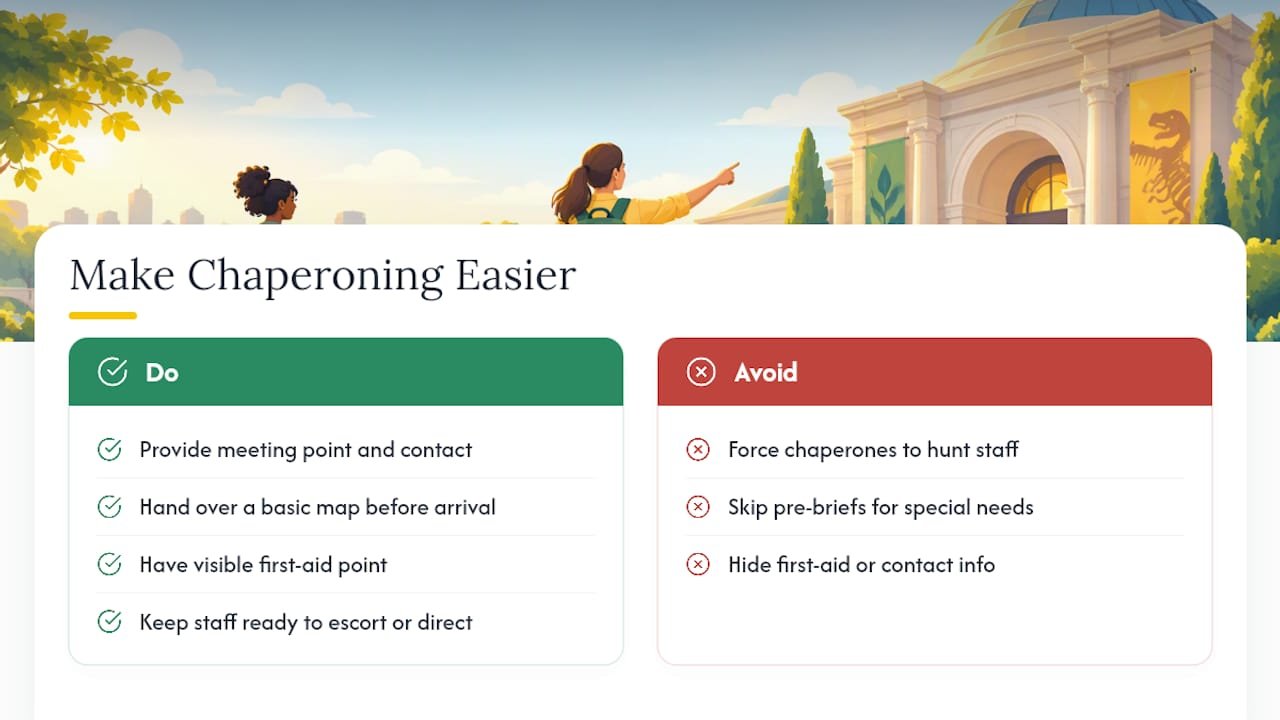
Hosting school groups regularly has taught us that most chaperone stress isn’t about the kids, it’s about the unknowns. A clear meeting point, a staff contact’s name, and a basic map handed over before the group even arrives eliminates half the confusion chaperones deal with on a normal day.
We think every venue hosting field trips should have a visible first-aid point and staff ready to escort groups or point them in the right direction without a chaperone having to hunt someone down. For groups with specific needs, a quick pre-brief with a staff member on what to expect makes a real difference, and a quiet room on request matters more than most venues realize. Some venues build their group bookings around exactly this kind of clarity, treating a chaperone’s first question (“where do I go and who do I ask?”) as something the venue should answer before it’s asked.
If you’re organizing a school group outing or a supervised youth event, Archersbattlefield’s event packages are built for groups of varying sizes, with staff support designed to reduce exactly the kind of logistical guesswork that wears chaperones out. Groups running youth programs or seasonal outings can also look at Kids Camps for a sense of how supervised activity days get structured around safety and staffing.
Primary Sources Worth Bookmarking
Policy specifics vary by district, so verify against your own school board’s documents before the trip. A few worth checking:
- York Region District School Board’s Field Trip policy (POL-642) for supervision ratios and teacher authority.
- Grand Erie District School Board’s SO15 manual for volunteer orientation and first-aid requirements.
- Near North District School Board’s Administrative Guideline for water activity and emergency-plan rules.
Sources
- York Region District School Board – Field Trip policy (POL-642)
- Scholastic – Helpful Tips for Chaperoning School Field Trips
- Grand Erie District School Board – SO15 Out of Classroom Field Trips and Excursions Manual
FAQ
What Should a Chaperone Wear on a Field Trip?
Wear comfortable, weather-appropriate clothing and closed-toe shoes you can stand or walk in for hours. Skip loose jewelry, sandals, or anything you’d hate to lose while chasing down a wandering student.
What Should I Pack as a Field Trip Chaperone?
Bring photo ID, your student roster, emergency contacts, a charged phone, a small first-aid kit, and some cash for emergencies. If your group includes students with medication notes or allergies, carry those details on paper, not just in your memory.
What Makes a Good Chaperone?
A good chaperone stays actively engaged with their group instead of passively watching, since research on active learning shows engaged adults produce fewer discipline problems. They also run frequent head counts, follow the teacher’s lead on every decision, and escalate serious issues right away instead of trying to handle them solo.
What Are the Main Responsibilities of a Field Trip Chaperone?
Chaperones keep an assigned group of students safe, together, and accounted for throughout the trip. That means constant head counts, enforcing the buddy system, redirecting minor behavior issues, and reporting anything serious, safety risks, medical issues, repeated defiance, to the teacher immediately, since the teacher remains the designated trip supervisor at all times.


