

The best arcade birthday themes skip the single console and build the party as a series of physical “levels” that mix screen-style challenges with real movement. That structure keeps every kid busy at once instead of queued behind one joystick. It suits ages five and up with the right activity scaling, and some venues already run a version of this as a bookable party format.
TL;DR:
- A successful arcade birthday involves multiple physical challenge levels rather than waiting behind a single game, keeping all kids engaged at once.
- Choosing one visual theme lane, like retro, pixel, modern esports, or a single game franchise, simplifies setup and enhances recognition.
- Age-specific activities, such as obstacle courses for kids five to eight and tournaments for teens, prevent long waits and maintain energy.
- Lighting, zoning, and food placement are critical to create an authentic arcade atmosphere without overwhelming the space or causing congestion.
- Booked party packages offer level-based, activity-first experiences that eliminate the need for DIY setup, with costs starting around $399.
Table of Contents
- What Makes an Arcade Birthday Theme Actually Work?
- Which Games Keep Every Kid Playing, Not Waiting?
- How Do You Decorate and Feed a Crowd Without Overdoing It?
- What Does an Arcade Party Cost and How Far Ahead Should You Plan?
- How Should a Two-Hour Arcade Party Actually Flow?
- What Safety and Space Rules Matter for Home Arcade Setups?
- How Do You Send Invitations That Set the Right Tone?
- What Music Fits an Arcade Party Without Overpowering It?
- Should You Add VR or Mobile Games to the Party?
- How Do You Manage a Party With 10 Kids vs. 30?
- Why an Activity-First Arcade Party Beats a Screen-Heavy One
- Book an Arcade-Style Party Without the DIY Guesswork
- Sources
- FAQ
What Makes an Arcade Birthday Theme Actually Work?
An arcade birthday theme succeeds when the visuals say “arcade” instantly and the activities keep kids moving instead of standing in line for a turn at one machine. The winning formula pairs a strong retro or gaming aesthetic with a level-based structure: short bursts of physical challenge that mimic beating a stage, not sitting through a screen session.
This is the “phygital” approach: blending digital-game themes with physical, co-play activity. Guidance on balancing digital and physical play points out that active, movement-based versions of video game concepts build coordination and social skills in ways passive screen time doesn’t. Translate that into a party and you get obstacle courses instead of a Mario Kart queue, and team missions instead of one kid hogging the Pac-Man cabinet.
The theme choice matters, but the flow matters more. A packed arcade backdrop with a boring rotation still drags. A modest setup with tight, level-based pacing feels electric.
Retro, Pixel, Modern, or Single-Game: Pick One Lane
Trying to cram every arcade era into one party usually backfires. Committing to one visual lane makes setup faster and the theme instantly recognizable.
- Retro 80s arcade: Neon grids, joystick cutouts, and classic marquee fonts. Best for ages 6 to 12 and for adults who grew up on quarters and cabinets. Signature prop: a cardboard arcade cabinet photo booth. Rent real cabinets for the big moment; DIY the smaller decor.
- Pixel/8-bit party: Blocky mushroom and heart cutouts, pixelated cake, block-print invitations. Works great for ages 5 to 10 who know the visual language from mobile and console games. Signature DIY: pixel-art paper garlands, which cost almost nothing and take one evening to assemble.
- Modern esports/gaming: Team jerseys, controller centerpieces, tournament brackets on a whiteboard. Fits 9 to 15-year-olds who play competitively online. Rent gaming stations if the budget allows; otherwise a bracket wall and team colors carry the theme.
- Single-game universe (a favorite platformer, racer, or battle-royale title): Everything themed to one franchise’s colors and icons. Best when the birthday kid has one clear obsession. Skip generic arcade signage entirely and go deep on that one world instead.
- Neon night arcade: Black light, glow paint, and UV-reactive tape marking game zones. Works well for tweens and teens wanting a “party,” not a “kids’ party” feel.
Picking pixel motifs, marquee lighting, and one clear theme moment beats scattering five different design ideas across one room. A single photo backdrop or activity station does more visual work than decorating every wall.
Which Games Keep Every Kid Playing, Not Waiting?
The activities you choose to decide whether the party feels electric or turns into a line for the one good machine. Age-scaled stations and short-turn games solve that problem better than any single big-ticket rental.
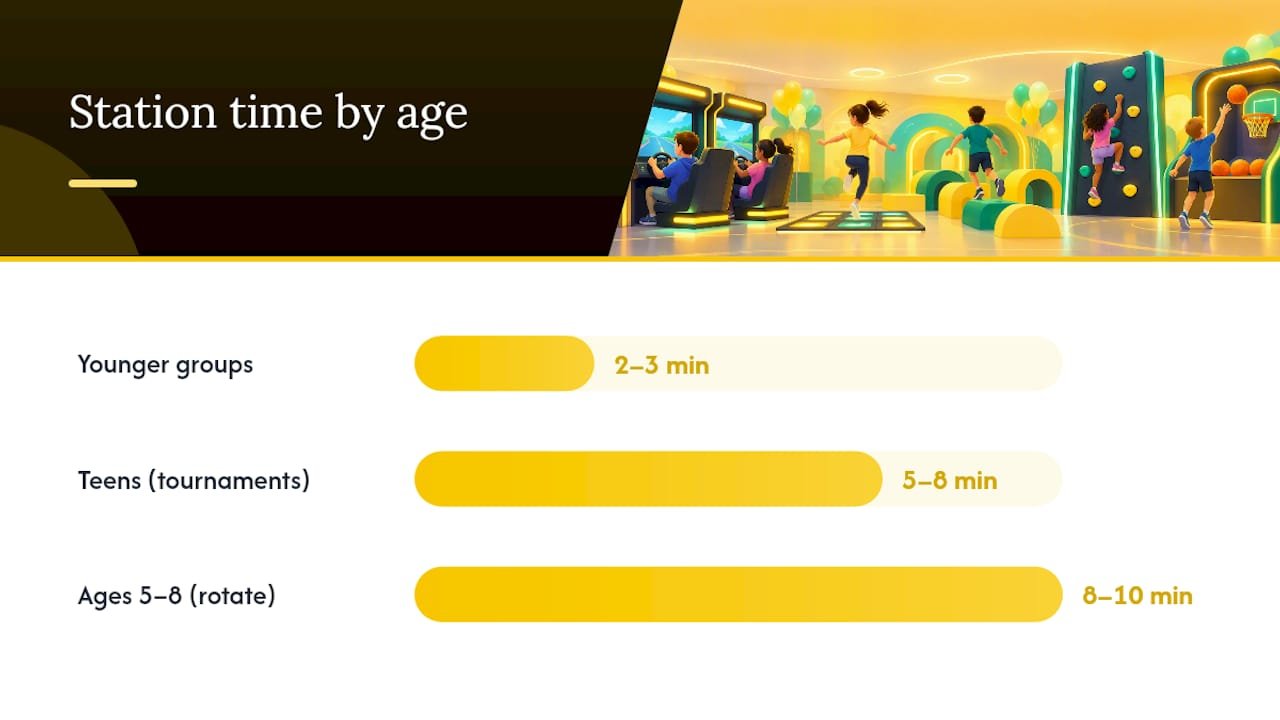
Ages 5 to 8: Keep it simple and forgiving. Bean-bag toss framed as “boss battles,” a giant Jenga tower as a “level,” and a balloon-pop station with tickets underneath. Attention spans are short, so rotate stations every 8 to 10 minutes.
Ages 9 to 12: This is prime territory for real arcade rentals, a bazooka ball round, or a mini obstacle course timed like a speedrun. Team relay races themed as “co-op levels” work well because they force cooperation instead of one-kid domination.
Ages 13 and up: Teens want competition with stakes. Bracket-style tournaments (cornhole, ping pong, foosball if you have it) with a leaderboard, a VR headset station if you can rent one, and a dodgeball round as the “final boss” round out this age group nicely.
- Design 4 to 6 “levels,” each a distinct station or challenge, scaled from easy to hardest.
- Give every guest a punch-card stamped at each level instead of running a strict leaderboard, so slower or younger kids still finish with something to show.
- Set a 2 to 3 minute cap per station for younger groups, 5 to 8 minutes for teens running tournament brackets.
- Build in one “boss level” near the end, a bigger physical challenge (obstacle course, dodgeball, bazooka ball round) that everyone remembers.
Punch-cards work better as souvenirs than as a ranked leaderboard, since ranking systems tend to leave younger or less coordinated kids feeling left out at their own celebration.
For gear, weigh renting real cabinets or a mobile arcade trailer against DIY stand-ins like cardboard cabinets, a cornhole set repainted with pixel art, or a home Nerf-style battle station. Rentals win on wow factor; DIY wins on budget and setup flexibility.
Pro Tip: Bring a stash of identical small prizes as backup for redemption-style games. Ticket totals almost never come out even, and a pre-made goody bag guarantees nobody leaves feeling shortchanged.
How Do You Decorate and Feed a Crowd Without Overdoing It?
Lighting and zoning do more heavy lifting than most people expect. Focusing on lighting and spatial zoning as much as game selection turns a modest setup into something that feels like a real arcade the moment guests walk in.
- Hang marquee-style letters spelling the birthday kid’s name or “GAME ON” over the main activity zone.
- String LED or neon rope lights to separate the play area from the food area visually, not just physically.
- Rent a few real arcade cabinets if budget allows. Even one machine plus marquee lighting elevates the whole room, an approach that shows up repeatedly in at-home arcade party accounts that pair rentals with candy and soda bars.
- Label ordinary snacks with gaming names: “Power Pellets” for popcorn, “Extra Lives” for gummy candies, “Level-Up Lemonade” for drinks.
- Bake or order a pixel-art cake using a simple grid pattern; cupcakes with 8-bit fondant toppers are easier to serve mid-party than a full sheet cake.
- Set up one clear photo backdrop tied to the punch-card levels, ideally near the finale station, so the “boss level” moment doubles as the photo op.
- Keep food in a separate zone from active games so nobody’s holding a plate during the obstacle course.
What Does an Arcade Party Cost and How Far Ahead Should You Plan?
Budget and timeline depend heavily on format. Typical options split into three: fully DIY at home, mobile arcade rentals delivered to your space, or a venue package that bundles games, staff, and a private area, a range confirmed by format comparisons across home, rental, and venue events.
- Two weeks out: Lock in any cabinet or mobile arcade rental, confirm your venue or space, and finalize the guest list and invitations.
- One week out: Buy or print decor, prep punch-cards, confirm helpers, and shop for themed snacks that can be assembled the morning of.
- Two to three days out: Bake or order the cake, charge any rented equipment, and do a dry run of the level rotation with whoever’s helping host.
- Day before: Set up lighting and the photo backdrop, stage prizes, and print a simple run sheet for helpers.
Staff up appropriately: for active, multi-station parties, one adult helper per 6 to 8 children keeps stations moving and supervision solid. Home DIY setups run leanest on cost but heaviest on your own labor; mobile rentals add convenience at a higher price point; full venue packages cost more upfront but remove almost all the planning burden. Always have a backup plan, an indoor rain fallback for outdoor stations, and a spare device or controller for anything tech-dependent.
How Should a Two-Hour Arcade Party Actually Flow?
A tight run sheet is what separates a party that feels fast-paced from one that drags. The proven two-hour arcade schedule breaks into arrival, core levels, a boss level, and food, in that order.
- 0 to 20 minutes: Arrival and warm-up level, something low-stakes like a bean-bag toss, so early guests aren’t standing around.
- 20 to 80 minutes: Four to five core levels, rotating in small groups or parallel stations so nobody waits more than a few minutes between turns.
- 80 to 95 minutes: The final boss level, your biggest physical challenge, timed to peak energy right before food.
- 95 to 115 minutes: Cake, themed snacks, and the photo moment at the backdrop, ideally timed right after the boss level while everyone’s still buzzing.
- 115 to 120 minutes: Free play and goody bag or punch-card prize handout as families start leaving.
Run parallel stations rather than one line for one game. Splitting into two teams that swap activities halfway through cuts wait time roughly in half.
Pro Tip: Stagger start times by five minutes if you’ve got a wide age range in the group. Younger kids finish stations faster, and staggering keeps a 6-year-old from bottlenecking behind a 12-year-old still working through a harder challenge.
What Safety and Space Rules Matter for Home Arcade Setups?
Space planning determines whether an arcade party feels fun or cramped. Arcade cabinets and racing simulators are heavy and need stable, level flooring, plus clearance on all sides for cords and foot traffic. A good rule: leave at least 3 feet of walking space around any rented cabinet or simulator, more if young kids will be running between stations.
Cords are the single biggest hazard at a home arcade party. Tape every cable flat to the floor or route them along walls, never across a walkway where a running kid might catch a foot. If you’re running multiple electrical stations, check that you’re not overloading one outlet or extension cord, especially with lighting, speakers, and game consoles all pulling power at once.
Indoors, keep active stations (obstacle courses, relay races, dodgeball rounds) away from breakables and hard furniture corners. Outdoors, check the weather and have an indoor fallback ready, since a rained-out bazooka ball round or bounce house can derail an entire schedule fast.
Adult supervision ratios matter more during active levels than during quiet ones. One helper per 6 to 8 children is a solid baseline for stations involving running, throwing, or team contact. Venue-based options remove much of this planning burden entirely, since staff manage crowd flow, equipment safety, and space limits as part of the package. That’s one reason a supervised setup like an archery tag or Nerf battle station, built for active group play from the ground up, often beats squeezing an obstacle course into a living room.
How Do You Send Invitations That Set the Right Tone?
Invitations are your first chance to signal “this isn’t a sit-and-watch party.” A ticket-style invite, printed to look like an arcade token or game pass, tells guests immediately what kind of energy to expect.
Digital invitations work well for coordinating RSVPs and communicating logistics, especially for parties with multiple activity stations that need headcounts in advance. Include a line about what to wear (sneakers, not sandals, if there’s an obstacle course) and whether the party is indoor, outdoor, or both.
Use gaming language throughout the communication chain, not just on the invite itself. Frame the RSVP as “confirming your player slot,” and if you’re sending a reminder text or email the week before, call it a “mission briefing.” It’s a small touch, but it keeps the theme alive before the party even starts.
For parties with tournament brackets or team-based levels, consider assigning teams in the invitation itself. Kids arrive already knowing their squad, which cuts down on the awkward standing-around period while teams get sorted on the day. If allergies or dietary needs are a concern, ask for that information in the RSVP rather than scrambling to accommodate on party day, especially important once you’re planning themed snacks that might include nuts, gluten, or dairy-heavy items.
What Music Fits an Arcade Party Without Overpowering It?
Sound does as much atmosphere-building as lighting, and it’s often the last thing planners think about. Classic 8-bit chiptune soundtracks work as background music during setup and early arrival, since they’re recognizable, upbeat, and rarely have lyrics that clash with conversation.
Once activities ramp up, switch to higher-energy instrumental tracks or synth-heavy 80s hits for a retro arcade night theme. The tempo should match the activity: slower, ambient game music during the food and photo segment, faster upbeat tracks during obstacle courses and relay races.
Layer in real arcade sound effects if you can find a sound library or app with classic coin-drop, power-up, and game-over sounds. Playing a “level complete” chime every time a group finishes a station reinforces the level-based structure without anyone having to announce it.
Keep volume moderate near conversation areas and louder near active stations. If you’re running the party in a space with an echo, like a garage or gym, err on the quieter side. Music that’s too loud makes it hard for helpers to give instructions between rotations, and that’s when stations start running behind schedule.
Should You Add VR or Mobile Games to the Party?
Digital add-ons work best as one station among many, not the centerpiece. A rented VR headset set up as a single “bonus level” gives kids a taste of an immersive digital experience without turning the whole party into screen time.
Keep VR sessions short, 90 seconds to two minutes per turn, with a helper managing the queue and resetting the headset between players. Motion-based VR games (boxing, rhythm games) fit the phygital theme better than seated experiences, since they keep the player moving instead of just watching a screen strapped to their face.
Mobile games work well as a rainy-day backup or a quiet-corner option for kids who need a break from high-energy stations. A tablet loaded with a couple of simple, quick-round games (never anything requiring long single-player sessions) can double as a chill zone without pulling focus from the main activities.
The mistake to avoid: making any digital station the party’s main event. The whole appeal of a phygital arcade party is that it keeps kids physically engaged. A VR or mobile station should feel like a fun detour, not a destination that pulls the crowd away from everything else you planned.
How Do You Manage a Party With 10 Kids vs. 30?
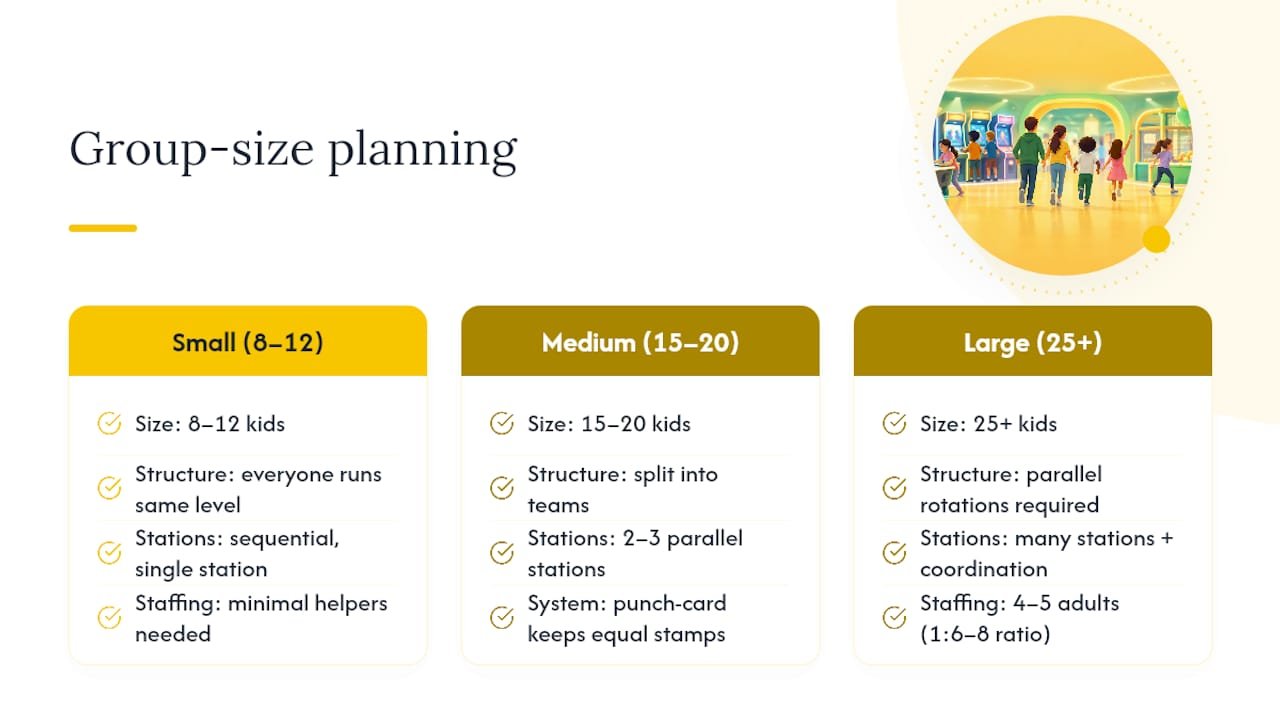
Group size changes almost everything about how you structure levels and stations. For smaller parties, roughly 8 to 12 kids, you can run activities sequentially with everyone doing the same level together, since wait times stay short even without parallel stations.
Once you cross into 15 to 20 kids, parallel stations become necessary. Split the group into two or three teams that rotate through different levels simultaneously, then regroup for the boss level and cake. This is where the punch-card system earns its keep: even with multiple teams moving through stations at different paces, every guest ends up with the same trail of stamps by the end.
For larger groups, 25 kids and up, staffing becomes the limiting factor before space does. At a 1 helper to 6 to 8 children ratio, a 30-kid party needs 4 to 5 dedicated adults just managing stations, on top of whoever’s running food and photos. This is the point where a home DIY setup starts straining, and a venue package with built-in staff and pre-planned station rotations, like Archers Battlefield’s kids birthday packages, starts making more practical sense than trying to coordinate that many moving parts in a living room or backyard.
Whatever the size, build in one buffer period, roughly 10 minutes, between the core levels and the boss level. Larger groups almost always run behind schedule slightly, and that buffer keeps cake and favors from getting rushed at the end.
Why an Activity-First Arcade Party Beats a Screen-Heavy One
Most arcade party ideas online still center on one console or one big rental, and that’s backwards. The parties that actually work are the ones where kids are moving between stations, not waiting behind a single screen for a turn. Some group experiences are built on exactly that logic: active, level-based formats where combat archery, Nerf battles, and bazooka ball rounds replace passive downtime with constant motion.
What surprises most parents is how much staffing and space planning determines the outcome, more than theme choice or decor budget. A beautifully decorated arcade room with poor station rotation still drags. A modest setup with tight timing and enough helpers per child feels electric from start to finish. That’s the piece DIY planners underestimate most, and it’s the piece a supervised venue solves by default.
— Archers
Book an Arcade-Style Party Without the DIY Guesswork
Some kids party packages follow the level-based, activity-first structure this whole article recommends, so you skip the cord-taping, cabinet-renting, and staffing math entirely.

The Game On Birthday Party starts at $399 and covers a straightforward activity-first celebration, while the Epic Birthday Party at $499 adds more games and party time for groups wanting a bigger event. For older guests of honor or mixed adult and teen groups, the Momentum Birthday Party at $2,395 scales up the format for a longer, fuller celebration.
Before booking, have your guest count, any food allergies, and your preferred activity mix (archery tag, Nerf, bazooka ball, or arcade-style games) ready. That’s the same information a good DIY host needs anyway, but here it just goes on a booking form instead of a shopping list. Check the kids birthday party packages for full details, or head straight to book now to lock in a date.
Sources
- Video game party theme ideas — Yombu
- Arcade birthday party ideas — Dreamy Party Ideas
- Arcade party planning guide — Dream Event
- Arcade party ideas: How to throw the ultimate arcade party — Dreaming of Homemaking
FAQ
What Are Some Cool Arcade Birthday Themes?
Retro 80s neon, pixel/8-bit, modern esports, single-game universe, and black-light neon arcade are five distinct directions that each work for different age groups. Picking one lane instead of mixing several makes setup faster and the theme instantly recognizable, following the approach outlined by Dreamy Party Ideas.
What Are Some Fun and Unique Names for an Arcade Theme?
Names like “Level Up,” “Game On,” “Insert Coin,” “Boss Level Birthday,” or “Power Up Party” work well because they double as invitation copy and decor headlines. Archers Battlefield uses similar language in its own Game On Birthday Party and Epic Birthday Party packages.
What Are Some Creative Birthday Party Ideas for a Gamer?
Build the party around one favorite game’s color scheme and characters rather than generic arcade decor, then add one physical “boss level” challenge tied to that game’s theme. A team-based tournament bracket with a real physical activity, like a bazooka ball round or obstacle course, gives gamers the competitive structure they’re used to without keeping them seated the whole time.
What Are Some Creative Themes for a Birthday Party Beyond Arcade?
Outside arcade themes, movement-first formats like combat archery tournaments, Nerf battle missions, or dodgeball leagues borrow the same phygital logic: physical activity organized into levels or brackets instead of passive entertainment. These work particularly well for kids and teens who’d otherwise spend a party glued to a single device.
How Much Does an Arcade-Style Birthday Party Cost?
Costs vary by format. Archers Battlefield’s arcade-style birthday packages start at $399 for the Game On Birthday Party, with the current lineup and full pricing available on the kids birthday party packages page.


