
The best team awards night ideas share three traits: value-based categories instead of department awards, one clear anchor moment instead of a dozen small ones, and a ceremony that stays under 45 minutes. Six formats work as a starting shortlist: a themed host-led ceremony, an activity-venue battle-for-bragging-rights night, peer-nominated values awards, rapid-fire humor categories, story-driven trophy reveals, and team-challenge trophies won on the spot. Pick one vibe and one anchor moment, and build the rest of the night around that single choice.
TL;DR:
- Most awards nights should be limited to 30 to 45 minutes, focusing on one anchor moment and avoiding excessive extras to maintain audience engagement.
- Value-based award categories, such as “Most Collaborative” or “Best Problem Solver,” are more inclusive and fair, especially when judged by a diverse, rotating committee.
- Pairing awards with a shared activity or event increases energy, keeps the team engaged, and fosters bonding beyond mere trophy presentation.
- Personalizing awards through specific moments, inside jokes, or handwritten notes creates lasting recognition and makes recipients more likely to remember the achievement.
- Easy, low-cost prizes like gift cards, experience vouchers, or symbolic objects, combined with quick recognition speeches, maximize impact without heavy planning or expense.
Table of Contents
- Creative Team Awards Ideas by Vibe
- How Do You Pick Fair Award Categories?
- How Long Should an Awards Night Run?
- What Are the Best Low-Prep, High-Impact Awards?
- How Do You Give a Recognition Speech People Remember?
- Where Should You Hold an Awards Night?
- What Entertainment Works Beyond Handing Out Awards?
- How Do You Make an Award Feel Personal?
- How Much Should a Team Awards Night Cost?
- Why Pairing Awards With Activities Changes the Energy
- Ready to Host Your Team’s Awards Night at Archers Battlefield?
- Sources
- FAQ
Creative Team Awards Ideas by Vibe
Every team has a different appetite for formality, and matching the format to that appetite matters more than the props or the trophies. Below are ready-to-run concepts sorted by how much setup they need and how big a group they suit.
Formal and polished
- Themed host-led ceremony. Pick a theme (Oscars, sports draft, retro game show), assign one person as emcee, and run 8 to 10 categories. Prep time: two to three hours. Best for teams of 15 to 50. Reveal winners with a short story about their contribution before the name drops.
- Story-driven trophy awards. Skip the generic “Employee of the Quarter” plaque. Write a two-sentence anecdote for each winner and read it aloud before announcing them. This story-driven reveal technique builds real anticipation instead of a flat name-and-clap moment.
Playful and fast
- Rapid-fire humor awards. Categories like “Most Likely to Reply to Slack at 11 PM” or “Best Reaction to a Fire Drill.” Prep time: under an hour. Works for any group size and doubles as an icebreaker for newer hires.
- Peer-nominated values awards. Team members nominate each other for categories tied to company values (collaboration, resilience, initiative). Prep time: a few days for nominations, then 30 minutes to tally. This format tends to feel the most personal because the recognition comes from peers, not management.
Activity-first
- Team-challenge trophies. Split into small groups for a scavenger hunt or trivia round, then hand out a trophy on the spot to the winning team. Instant, low-prep, and it works well as an opener before the main awards ceremony.
Hybrid
- Combined ceremony plus activity. Run a 20-minute formal awards segment, then transition straight into an activity block. This keeps the emotional high point of the awards intact while giving the group a physical outlet afterward.
Prize ideas that scale across all six formats: experience vouchers, branded swag, symbolic trophies (a rotating “golden stapler” style award), and small charitable donations made in the winner’s name.
How Do You Pick Fair Award Categories?
Categories tied to company values beat department-based lists because they recognize contributions that would otherwise go unnoticed. Workhuman’s guidance on recognition awards points out that a “Best Sales Team” award only ever goes to sales, but a “Most Collaborative” or “Best Problem Solver” award can go to anyone who embodies that value, regardless of title.
Fairness also depends on who picks the winners. A single manager choosing every category invites bias and repeat winners. Setting up a cross-functional selection committee of four or five people from different teams spreads out the judgment and keeps the same three names from winning every quarter.
Here’s a workable three-step process:
- Set categories first. Draft five to eight value-based categories before you touch nominations. Keep the list short enough that the ceremony doesn’t drag.
- Open nominations with published criteria. Share exactly what each category rewards when nominations open. Publishing criteria upfront makes the process feel legible instead of arbitrary, and teams start anticipating it as a regular part of the calendar.
- Committee review, then announce a timeline. Have the committee review nominations against the published criteria, then tell the team exactly when winners will be announced.
Pro Tip: Rotate committee members every cycle. A fresh set of eyes every few months keeps the process from feeling like an inside club, and it spreads the workload so no one person becomes the de facto “awards person.”
How Long Should an Awards Night Run?
Keep the ceremony itself to 30 to 45 minutes. Anything longer and attention drops, especially once you’re past category six or seven. The fix is the two-list method: write a “must-do” list (the anchor moment, the top three awards, closing remarks) and a “nice-to-have” list (extra games, bonus categories, a slideshow). Zoom’s planning guidance recommends limiting any event to one clear vibe and a single anchor moment, then cutting anything from the nice-to-have list the moment time gets tight.
A sample agenda for a 90-minute night:
- 0 to 10 minutes: Welcome and quick recap of the quarter or year.
- 10 to 40 minutes: Anchor moment (the main awards ceremony, story-driven reveals included).
- 40 to 75 minutes: Activity or social block (games, an activity-venue booking, or open mingling).
- 75 to 90 minutes: Closing remarks and a group photo.
Assign four roles so nothing falls through the cracks: a host to run the mic, a timekeeper watching the clock so the ceremony doesn’t run long, an awards coordinator managing the order and the trophies, and someone on AV for music and slides. Clear, single-owner role assignments cut down on the vague “can someone help with setup” scramble that derails most office events.
Quick checklist: confirm the venue or room 48 hours out, print or prep the trophy order, test the mic and any AV, and send a one-line agenda to attendees so nobody wonders what’s coming next.
What Are the Best Low-Prep, High-Impact Awards?
Not every team has a planning budget or a spare afternoon, and the good news is the highest-impact awards nights don’t require either. Batch your lighter, funnier categories together and announce three or four winners back to back rather than pausing between each one. Long, unstructured award lists lose the room’s attention fast, while a tight batch of quick, funny wins keeps energy up.
Prizes that scale without extra logistics:
- E-gift cards (coffee, streaming, food delivery)
- Experience vouchers for an activity outing
- Small charitable donations made in the winner’s name
- Printable certificates for a quick, zero-cost option
- Mailed swag for remote team members
For hybrid or remote teams, live-stream the anchor moment so nobody misses the main reveal, mail physical prizes a few days in advance so they arrive on time, and use a simple digital form for nominations instead of a spreadsheet nobody remembers to update.
Pro Tip: If your budget is tight, swap a big trophy for a rotating physical object, an old bowling pin, a rubber chicken, whatever fits your team’s humor, and hand it off each cycle. It costs nothing after the first purchase and becomes its own inside joke.

How Do You Give a Recognition Speech People Remember?
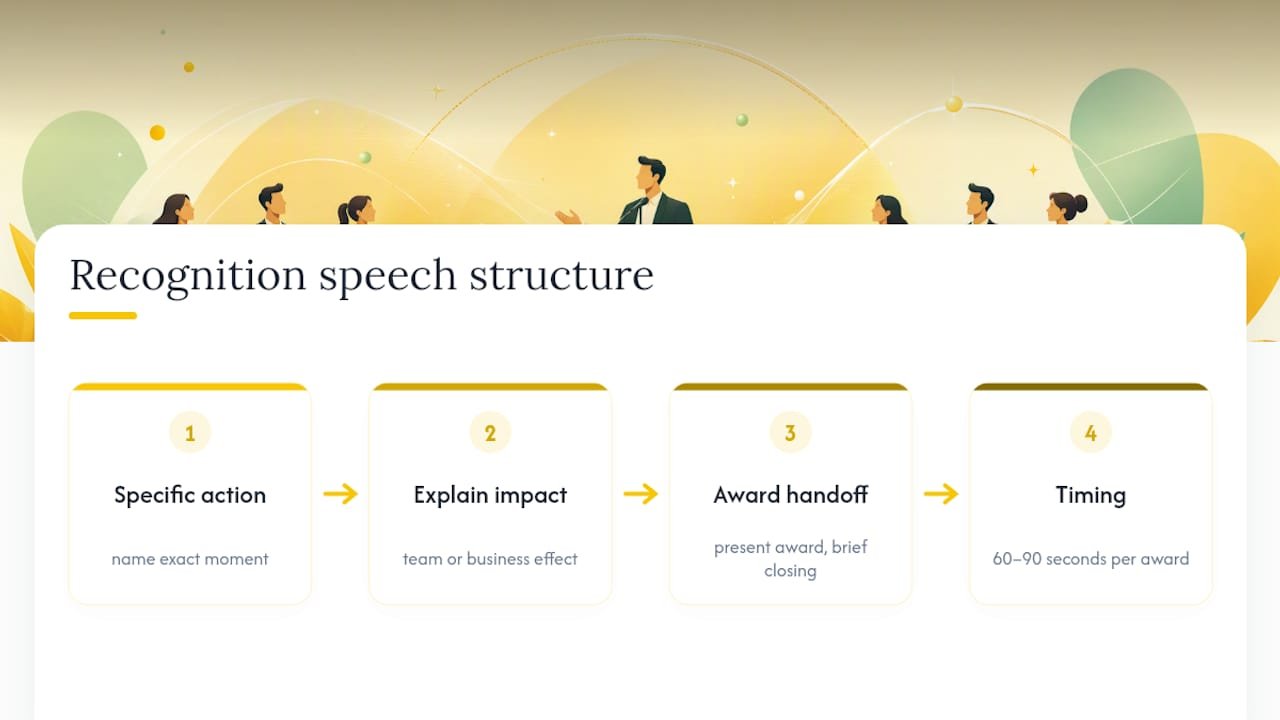
The best recognition speeches are specific, brief, and about the person, not the department’s numbers. Naming an exact moment, a client save, a late-night fix, a mentoring conversation, lands harder than a general “great work this year” line. Aim for 60 to 90 seconds per award. Longer speeches tend to wander into generic praise that stops feeling personal.
Structure each speech in three parts: name the specific action, explain the impact it had on the team or the business, then hand over the award. Skip any joke that pokes at a weakness, even a lighthearted one, since award nights are one of the few moments where the tone should stay unambiguously positive.
Avoid comparing winners to each other (“she’s better at this than most of the team”). It turns a moment meant to celebrate one person into a subtle dig at everyone else in the room. Stick to what the winner did, not how they rank against colleagues.
If you’re nervous about winging it, write the first and last sentence of each speech in advance, the opening line and the handoff line, and leave the middle loose enough to sound natural. That structure keeps you from rambling while still sounding like you mean it. And if the honoree is visibly uncomfortable with long applause, keep the moment moving. A quick, warm handoff beats an awkward, extended spotlight nine times out of ten.
Where Should You Hold an Awards Night?
Room choice shapes the mood of the whole event before a single award is announced. A fluorescent-lit conference room signals “mandatory meeting.” A venue with music, activity stations, or even just dimmer lighting and a stage area signals “this is actually a celebration.”
Three venue directions work well depending on team size and budget:
- In-office with atmosphere upgrades. String lights, a portable speaker, and rearranged seating (circles or clusters instead of rows) turn a break room into something closer to an event space, at close to zero cost.
- A rented function room or restaurant private room. Good middle ground for teams of 20 to 60 that want a night out without full event production.
- An activity venue. Booking a space built for group activities, like team-building packages designed for corporate groups, solves the atmosphere problem automatically. The energy of a physical activity carries straight into the awards portion, and you’re not stuck decorating a beige room to make it feel like an occasion.
Lighting and seating matter more than most organizers expect. A dim, focused light on the “stage” area (even a lamp and a cleared corner) does more to signal “this is the moment” than any decoration budget. Arrange seating so the group faces one direction, not scattered around tables, so every winner gets a clear moment of attention rather than half the room turned away.
What Entertainment Works Beyond Handing Out Awards?
An awards night that’s only awards, no matter how well run, runs out of energy around the 20-minute mark. Pairing the ceremony with something interactive keeps the momentum going before and after the anchor moment.
Trivia is the easiest add. A themed round about the company’s year, inside jokes, or pop culture works as a pre-show warmup while people are still arriving. Ready-to-run trivia themes built for office settings can be adapted for a 15 to 20 minute segment with zero prep beyond printing the questions.
Other options that work well as a before-or-after block:
- A short team challenge (scavenger hunt, quick trivia bracket) right before the main ceremony to warm up the room.
- A physical activity segment, archery, dodgeball, or a bazooka ball round, that turns “watch people get trophies” into “we did something together.”
- An open mic or shout-out round where anyone can give a quick, unofficial recognition outside the formal categories.
- A photo booth or rotating slideshow of team moments running during the social block.
The mistake most organizers make is stacking entertainment on top of an already-long awards segment instead of trading time for it. If you add a 15-minute activity block, cut a category or two from the ceremony to keep the whole night under 90 minutes.
How Do You Make an Award Feel Personal?
Generic plaques get set on a desk and forgotten within a week. Awards that reference a specific moment, joke, or project tend to get kept, photographed, and talked about long after the night ends.
A few ways to add that personal layer without much extra work:
- Name the trophy after the person’s specific contribution. “The Fire Drill MVP” beats “Best Under Pressure” because it points to an actual event everyone remembers.
- Reference an inside joke. If the team has a running bit, work it into the award title or the speech. It signals the recognition came from someone who actually pays attention, not a template.
- Include a handwritten note. A printed certificate with a short, specific line from a manager or peer outlasts the trophy itself in most people’s memory.
- Let peers write part of the speech. A two-line quote from a coworker read aloud during the presentation adds a voice besides the host’s, and it usually gets the biggest laugh or the biggest “aww” of the night.
Personalization costs almost nothing in dollars. It costs a little extra thought, five minutes per winner to recall a specific moment instead of writing a generic line. That five minutes is usually what separates an award people mention a year later from one they forget by Monday.
How Much Should a Team Awards Night Cost?
Budget for a team awards night breaks into three buckets: venue or space, prizes, and extras (decor, AV, food). For an in-office ceremony with printable certificates and small gift cards, total cost can stay relatively low for a team of this size. For a night that includes a rented space or an activity venue plus real prizes, expect a wider range depending on group size and format.
If you’re combining the ceremony with a booked activity, pricing shifts based on the package. Entry-level shared activities run $30 to $35 per person for single games like dodgeball or combat archery, while packaged team events built specifically for corporate groups, like the Collab Package starting from $699, bundle multiple activities and space rental into one line item.
If the budget is genuinely tight, prizes are the easiest place to trim without hurting the experience, since a well-written speech and a story-driven reveal matter more to most winners than the dollar value of what’s in their hands.
Why Pairing Awards With Activities Changes the Energy
Recognition lands differently when it’s attached to something people did together an hour earlier. We’ve noticed that teams who pair an awards segment with a shared activity, a round of dodgeball, a combat archery match, tend to stay energized through the whole night instead of fading after the trophies are handed out. The shared adrenaline gives everyone a common story to reference in speeches, which makes the recognition feel earned rather than assigned.
That said, an activity venue isn’t the right call for every team. A smaller group focused purely on formal recognition might do better with a quiet dinner and a tight ceremony. But for teams that want the night to double as a bonding experience, not just a trophy handoff, a venue built for group activities and customizable event packages tends to outperform a standard conference room by a wide margin.
— Archers
Ready to Host Your Team’s Awards Night at Archers Battlefield?
Most teams either book a generic banquet hall or try to run everything in a conference room with a projector and a fruit tray. Archers Battlefield gives you a third option: a venue where the activity and the recognition happen in the same space, so you’re not paying separately for a room, decor, and something for people to actually do.
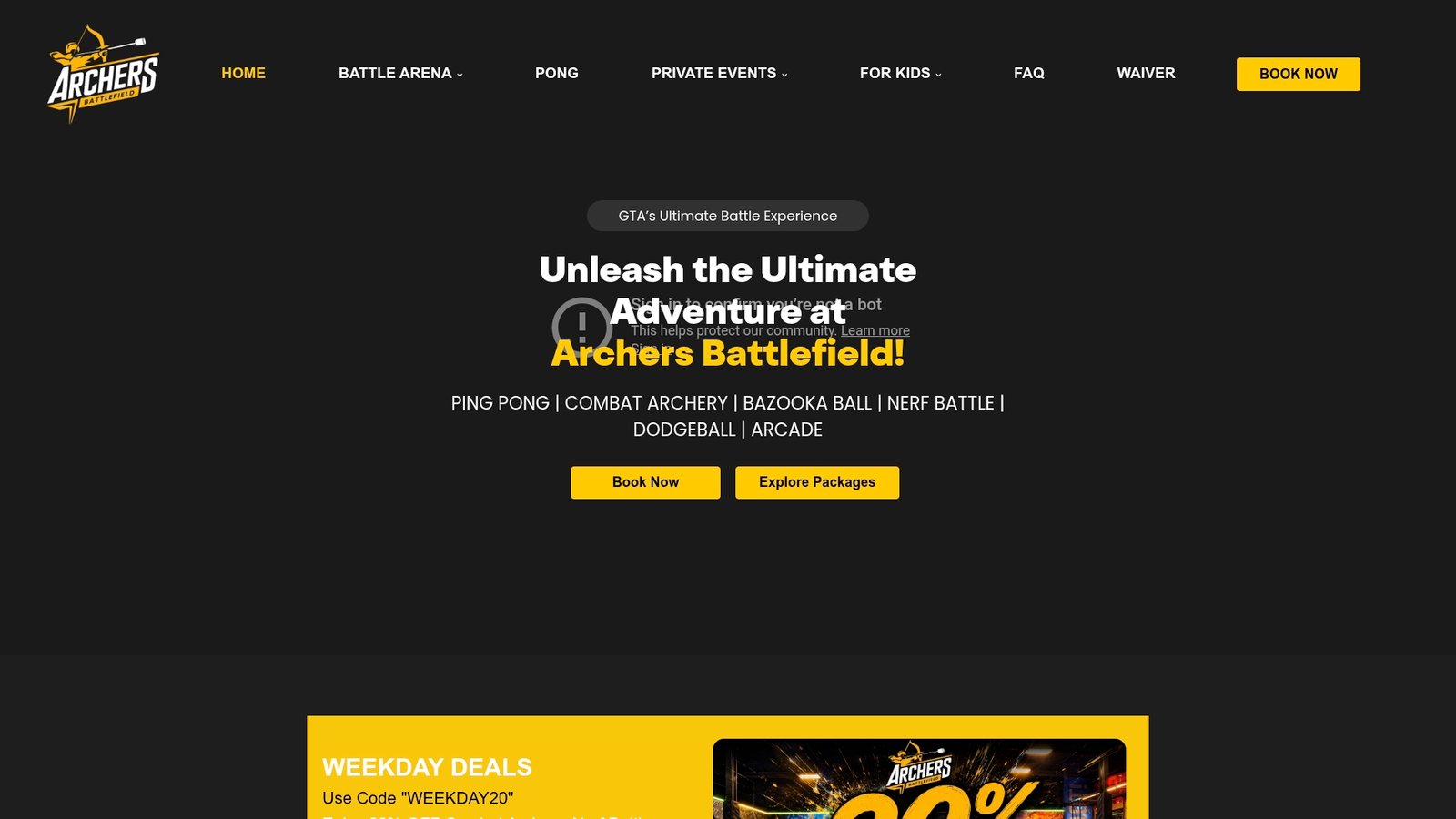
Corporate groups can book a team-building package built around combat archery, dodgeball, bazooka ball, or a mix of activities, with the Collab Package, Ultimate Paddle Package, and Momentum Package scaled to different group sizes and budgets. If your team is more sports-driven, the sports team-building event packages add a tournament structure that fits naturally with a trophy-and-awards format. Every package is customizable, and the venue’s planning support means you’re not left figuring out logistics alone, from safety briefings to activity sequencing.
To get started, check the event packages page for current pricing and options, or reach out directly to talk through group size and the vibe you’re going for. Booking early gives you first pick of time slots, especially for larger teams planning around a specific date.
Sources
For ready-to-run trivia rounds that fit a pre-ceremony warmup, Gatherilla’s work trivia themes offer copy-paste rounds built for HR teams. For prize ideas beyond gift cards, wellness incentive guidance covers options that tend to boost participation more than cash equivalents. On the recognition side, Workhuman’s award idea list and Assembly’s guidance on recognition awards both cover category design and fairness in more depth than a single article can.
FAQ
How Long Should a Team Awards Ceremony Last?
Keep the core ceremony to 30 to 45 minutes, even if the full event runs longer with an activity or social block attached. Zoom’s event planning guidance recommends limiting the event to one anchor moment so attention doesn’t drop halfway through.
What Are Good Award Categories Besides “Employee of the Month”?
Value-based categories like “Most Collaborative,” “Best Problem Solver,” or “Above and Beyond” work better than department-specific titles because anyone on the team can win them. Workhuman’s list of recognition award ideas has dozens of examples organized by the value each one rewards.
How Do You Choose Winners Fairly?
Use a small cross-functional committee instead of one manager picking every winner, and publish the criteria before nominations open. Setting up a structured awards program with a committee reduces repeat winners and makes the process feel more legitimate to the whole team.
Can You Combine an Awards Night With a Team Activity?
Yes, and it’s one of the most effective ways to keep energy up through the whole event. Booking an activity-led team-building package lets you run a short ceremony followed by a shared activity, so the recognition and the bonding happen in the same night instead of two separate events.
How Much Does an Activity-Based Awards Night Cost?
Single activities like dodgeball, ping pong, or combat archery run $30 to $35 per person, while bundled team packages built for corporate groups start from $699 for the Collab Package. Exact pricing depends on group size and which activities you combine, so check current packages directly on the site.


