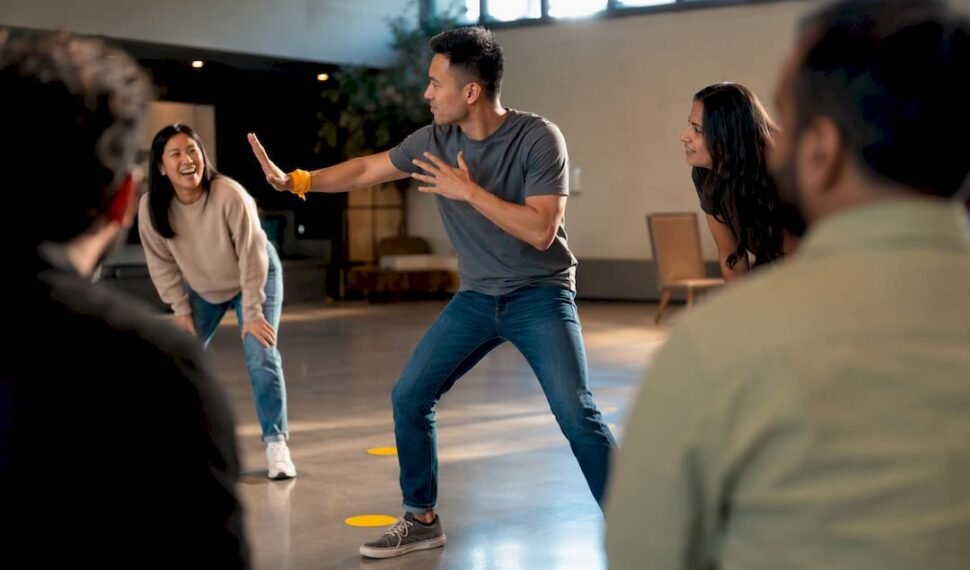
Short, constrained games that isolate one communication skill at a time beat long workshops for most adult groups. Three to start with: Back-to-Back Drawing for instruction clarity, Virtual Pictionary for remote teams that need shared focus, and Two Truths and a Lie as a low-stakes icebreaker that still teaches active listening. Pick based on the skill gap you actually have, not what looks fun on a slide.
TL;DR:
- In-person communication games like Back-to-Back Drawing and The Minefield require minimal setup and are effective for practicing instruction clarity and active listening.
- Virtual exercises such as Virtual Pictionary and Online Escape Rooms help preserve turn-taking and shared visual cues, compensating for remote interaction challenges.
- Games should be selected based on specific skill gaps, with physical activities like dodgeball building trust and coordination, especially when added to virtual or mental exercises.
- Facilitators should debrief immediately after activities, focusing on concrete behaviors and specific commitments to reinforce learning and improve future communication.
- Adjusting activities for cultural and hierarchical sensitivities, as well as offering optional participation, enhances inclusivity and effectiveness across diverse groups.
Table of Contents
- Why Communication Games Work (And When to Use Them)
- In-Person Games: 10 Practical, Facilitator-Ready Exercises
- Remote and Hybrid Games: 8 Reliable Exercises for Screens
- Icebreakers and Quick 5 to 10 Minute Games for Adult Groups
- Facilitation and Debrief: Turning Play Into Learning
- Quick Session Templates: 5, 15, and 60 Minute Plans You Can Run Today
- Adapting Games for Different Professional and Cultural Contexts
- Author Perspective From Archers Battlefield
- How Archers Battlefield Can Help You Run This In Person
- Sources
- FAQ
Why Communication Games Work (And When to Use Them)
Games work because they trap people inside a rule they can’t talk their way around. Remove eye contact, ban a word, add a timer, and suddenly the polite fog that covers daily miscommunication burns off. LeadershipIQ’s guide to communication team building frames this as a diagnostic function: constraints force interactions that reveal vague language, poor listening, or a lack of psychological safety long before those problems show up in a real project.
The same games teach negotiation, sharpen active listening, and push people toward more assertive communication, especially in groups where one or two voices usually dominate. Adding a restriction, like no questions allowed or a strict time limit, reliably surfaces coordination problems that everyday politeness tends to hide.
Five skills show up again and again across well-designed games:
- Active listening under pressure
- Giving instructions clearly enough that a stranger could follow them
- Reading nonverbal cues when words are limited or banned
- Speaking up without dominating the room
- Giving and receiving feedback without defensiveness
Use games for onboarding new hires, low-stakes skill practice, quick diagnostics before a bigger training investment, or a morale reset after a rough quarter or reorg. Save formal training for skills that need repeated coaching over weeks, not a single afternoon.
In-Person Games: 10 Practical, Facilitator-Ready Exercises
Each of these works with minimal setup. Time and group size are estimates; adjust down for smaller rooms and up if you split into parallel groups. TeamDynamics notes that copy-and-run details, meaning exact time, group size, and materials, are what separate a usable activity from a Pinterest board nobody runs twice.
- Back-to-Back Drawing. Pairs sit back to back; one describes a simple image, the other draws it without seeing it. Takes 10 to 15 minutes for pairs, needs only paper and pens. Facilitator note: ban the phrase “like a circle” and force specific measurements instead.
- The Minefield. One blindfolded partner navigates a floor scattered with obstacles using only verbal directions from a partner. Runs 15 to 20 minutes for groups of 4 to 10, using cones or bags as markers. Always walk the space first and keep a spotter within arm’s reach.
- The PB&J Instruction Game. One person writes literal steps for making a sandwich; another follows them exactly, including the absurd parts. Ten minutes, pairs, real kitchen props or substitutes like blocks. Read instructions aloud verbatim, no interpreting.
- Human Knot. Groups of 6 to 10 tangle arms in a circle and untangle without letting go. Fifteen minutes, no materials. Works best as a wordless warmup before a verbal debrief.
- Blindfold Navigation. Similar to The Minefield but through a longer course or hallway. Twenty minutes, pairs or trios, blindfold and floor tape.
- Silent Birthday Lineup. The group lines up by birth month with zero talking, only gestures. Ten minutes, any group size, no materials. Great opener before a verbal exercise to highlight what nonverbal communication alone can and can’t do.
- Broken Phone. A message passes person to person by whisper; compare the start and end result. Ten minutes, groups of 6 or more, no materials.
- Puzzle Challenge. Split a jigsaw or building set across subgroups who must trade information to finish. Twenty minutes, groups of 6 to 12, one puzzle or building kit.
- Charades or Mime Relay. Standard charades rules, timed rounds, teams guess concepts under a clock. Fifteen minutes, groups of 6 or more, prompt cards.
- Feedback Circle. Each person gives one specific piece of positive feedback and one growth note to a partner, structured with sentence starters. Fifteen minutes, pairs or small circles.
Pro Tip: Run one high-energy, physical game (like Human Knot) before a quieter, language-based one (like the Feedback Circle). The contrast in pace makes people more willing to be vulnerable in the second round.
For groups that want the physical, cooperation-under-pressure version of this, a venue built for it changes the dynamic. Archery Tag and Nerf Battle sessions at Archers Battlefield force teams to call plays, cover teammates, and adjust strategy out loud in real time, all inside a supervised space with trained staff running the safety side so the group can focus on the communication side.
Remote and Hybrid Games: 8 Reliable Exercises for Screens
Distance kills tone and body language first, so remote games need to compensate with structure. VantageCircle points to Virtual Pictionary, collaborative story relays, and lightweight virtual escape rooms as reliable formats because they preserve turn-taking and give everyone a shared visual workspace instead of a wall of talking heads.
- Virtual Pictionary. Use Zoom’s built-in whiteboard or a Miro board; one person draws, the group guesses in chat. Fifteen minutes, works for 4 to 20 people. Set a visible timer so nobody drags out a turn.
- Collaborative Story Relay. Open a shared Google Doc, each person adds two sentences, no planning ahead. Fifteen to twenty minutes, any group size. Set a rule that nobody erases another person’s line, only builds on it.
- Virtual Escape Room Lite. Build a simple puzzle chain in a shared doc or use a low-cost online kit rather than a full production. Thirty minutes, groups of 4 to 8.
- Decode the Emoji Message. Send a string of emojis representing a phrase or movie title; teams race to decode it in chat.
- Chat-Based Broken Phone. Same rules as the in-person version, but typed instead of whispered, which shows how much meaning gets lost in text alone.
- Two Truths and a Lie. Works over video with zero setup, ten minutes, any group size.
- Poll Quizzes. Use built-in polling to guess teammates’ answers to light personal questions before revealing them.
- Adapted Back-to-Back Drawing. One person shares their screen with a hidden image, describes it verbally while a partner draws on paper off-camera.
Accessibility matters more on screens than in a room. Turn on live captions, slow down verbal instructions by roughly a third, and write text prompts in plain, short sentences so screen readers handle them cleanly. If your group wants something with a real time-pressure edge, Keep Talking and Nobody Explodes is a cooperative video game built around one person reading a manual and another defusing a bomb using only verbal instructions, a sharp example of training precise, directional language under a countdown.
Icebreakers and Quick 5 to 10 Minute Games for Adult Groups
Icebreakers aren’t lesser versions of communication games, they solve a different problem: building enough comfort that people will actually engage with the harder exercises later.
- Two Truths and a Lie. Each person shares three statements, group guesses the false one. Works for newly formed groups where nobody knows each other yet.
- Human Bingo. A grid of prompts like “has traveled to three continents” that people fill by mingling and asking questions.
- One-Word Check-In. Everyone shares a single word describing their current state. Fast, low-pressure, useful before a meeting that might get tense.
- Speed Prompts. Rotate through partners answering one quick question each round, similar to speed networking.
- Five-Finger Consent. Before a physical or higher-energy game, each person shows one to five fingers indicating comfort level, keeping participation visible and voluntary.
Pick icebreakers for parties, networking events, or the first ten minutes with a brand-new group. Save diagnostic games like Back-to-Back Drawing for once people are warmed up. For adult groups specifically, offer optional prompts and let people pass on personal questions. Nobody should feel cornered into revealing more than they’re comfortable with just because the group is having fun.
Facilitation and Debrief: Turning Play Into Learning
The debrief is where the actual learning happens, not the game itself. VantageCircle identifies the post-activity conversation as the single most critical phase, and facilitators get the most value by naming specific behaviors immediately, while the experience is still fresh in the room.
Run a five-question script right after the game ends:
- What happened, in plain terms?
- Where did communication break down?
- Who noticed the breakdown first, and what did they do?
- What would we change if we ran this again?
- Who will try that change, and when?
Naming the exact behavior, saying “instructions lacked a clear sequence” instead of a vague “communication could be better,” is what turns a fun ten minutes into something people remember on Monday. Keep a psychological safety checklist handy: no one is called out by name for a mistake, observers get a chance to speak before the loudest person, and every session ends by converting at least one insight into a concrete next step.
Pro Tip: Ask for one or two specific commitments before people leave the room, then schedule a two-week check-in to see if the change stuck.
Quick Session Templates: 5, 15, and 60 Minute Plans You Can Run Today
Short, repeatable formats get run more often than one big annual workshop, and VantageCircle’s research backs that pattern: teams that repeat brief sessions embed the learning better than teams that do one long session and never revisit it.
- 5-minute huddle. One micro-icebreaker like One-Word Check-In, then sixty seconds of silent reflection, then one shared takeaway out loud.
- 15-minute micro-workshop. Five minutes to set up rules, seven to eight minutes running a game like Back-to-Back Drawing, five to six minutes debriefing with one action item.
- 60-minute session. Ten-minute warm-up icebreaker, two full games at twenty to twenty-five minutes each, fifteen to twenty minutes of debrief, ending with specific commitments and a follow-up date.
| Template | Total Time | Games Included | Best For |
|---|---|---|---|
| Micro-huddle | 5 minutes | 1 icebreaker | Daily standups, meeting openers |
| Micro-workshop | 15 minutes | 1 diagnostic game | Weekly team check-ins |
| Full session | 60 minutes | 2 to 3 games | Onboarding, quarterly resets |
Adapting Games for Different Professional and Cultural Contexts
A game that lands perfectly with one group can fall flat, or worse, alienate someone, in another. Adjust before you run anything, not after someone pulls you aside afterward.
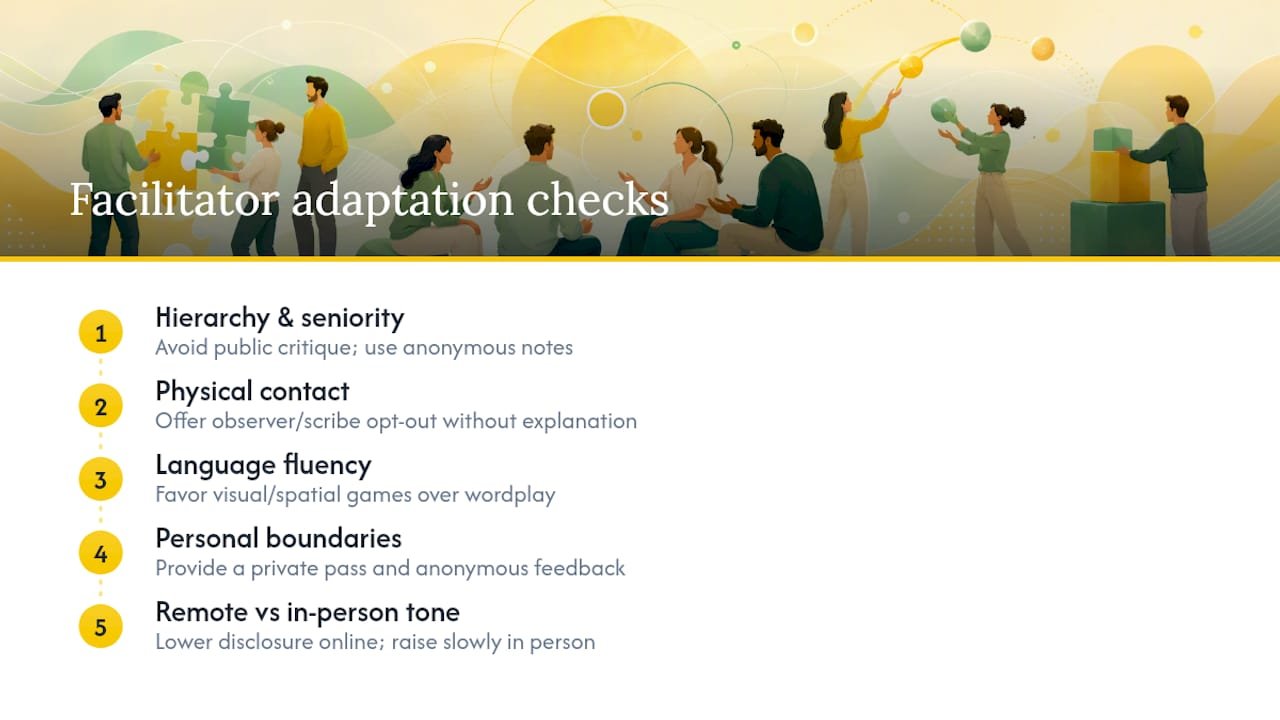
Hierarchy matters. In groups where seniority carries real weight, games that force junior staff to critique a manager’s instructions in front of peers can backfire. Swap direct feedback rounds for anonymous written notes instead, and let the facilitator read them aloud without attribution.
Physical contact and proximity vary. The Human Knot and Blindfold Navigation both involve close physical contact. Offer an observer or scribe role for anyone who opts out, no explanation required, per the standard practice recommended by TeamDynamics.

Language fluency changes the difficulty curve. Games built entirely around wordplay or idioms, like certain Broken Phone variants, disadvantage non-native speakers. Favor visual and spatial games like Puzzle Challenge or Charades when the group speaks multiple first languages.
Religious and personal boundaries need real opt-outs, not token ones. Icebreakers touching on personal history, family, or travel should always include a pass option that doesn’t draw attention to who used it. Collecting feedback anonymously afterward tells you whether a game actually worked for everyone or just the people comfortable enough to say so out loud.
Remote versus in-person changes tone, not intent. A game that reads as playful in a room can feel invasive over video, where everyone’s face fills the screen. Lower the personal-disclosure bar for virtual sessions and raise it slowly as trust builds.
Author Perspective From Archers Battlefield
Running group events for years has taught us one consistent thing: the games people remember aren’t the cleverest ones, they’re the ones where someone had to actually communicate under pressure and it worked. Our combat archery, Nerf, and dodgeball sessions put groups in exactly that position without a whiteboard in sight. Adults loosen up faster when the stakes are physical and low-consequence rather than personal and high-consequence. If your team has outgrown trust falls, a facilitated session built around real coordination might be worth a conversation.
— Archers
How Archers Battlefield Can Help You Run This In Person
Reading about back-to-back drawing exercises is one thing. Getting a room of adults to actually loosen up, listen, and coordinate is another, and that’s where a facilitated, physical session earns its keep over another slide deck. The venue runs corporate groups through combat archery, Nerf battles, dodgeball, and bazooka ball inside a supervised space built specifically for this kind of high-energy, team-based play.
The Collab Package, Ultimate Paddle Package, and Momentum Package are built around exactly the outcomes this article covers: groups have to call plays, cover each other, and adjust strategy verbally in real time, which surfaces the same communication gaps a whiteboard game would, just with more adrenaline attached. For a broader mix of activities and pricing across formats, the full event packages lineup starting at $299 covers everything from a quick paddle session to a full adult birthday bash. Booking takes a few minutes: pick a package, confirm your group size, and a coordinator handles the rest, including a safety briefing before anyone picks up a weapon or paddle. If your next team offsite needs something people will actually talk about afterward, check dates on the team-building page and get a session on the calendar.
Sources
- Comprehensive Guide to Communication Team Building Activities — LeadershipIQ
- Communication games for teams — VantageCircle
- 10 communication team-building activities — TeamDynamics
- Keep Talking and Nobody Explodes — official site
FAQ
What Are Some Fun Communication Games?
Back-to-Back Drawing, The Minefield, and Virtual Pictionary all rank among the most reliable options because they force clear instruction-giving under a real constraint. For adult groups wanting something more physical, sessions built around coordinated team play, like combat archery or Nerf battles at a venue such as Archers Battlefield, work the same muscle without a whiteboard.
What Are the 5 C’s of Communication?
Definitions vary across sources, but a common version lists clear, concise, concrete, correct, and complete as the core traits of effective communication. These principles show up directly in games like the PB&J Instruction Game, where vague or incomplete instructions fail immediately and visibly.
What Are 10 Communication Activities?
A solid set includes Back-to-Back Drawing, The Minefield, the PB&J Instruction Game, Human Knot, Blindfold Navigation, Silent Birthday Lineup, Broken Phone, Puzzle Challenge, Charades, and a structured Feedback Circle. Each targets a distinct skill, from instruction clarity to nonverbal awareness, and all ten are detailed with time and group size above.
What Are Some Good Communication Icebreakers for Adults?
Two Truths and a Lie, Human Bingo, One-Word Check-In, and Five-Finger Consent all work well for adult groups because they’re low-pressure and take under ten minutes. They’re best used with newly formed groups or before a more demanding diagnostic game, not as a replacement for one.
How Much Does a Facilitated Team Communication Session Cost?
Archers Battlefield’s team-building packages, including the Collab Package, Ultimate Paddle Package, and Momentum Package, start at $699 for groups seeking a facilitated, activity-based session. Broader event packages for parties and mixed groups start at $299; current pricing for every package is listed on the event packages page.


