Pick one thing by two choices: the team goal (icebreaker, problem-solving, communication, or active) and the time you have (5, 15, 30, or 60+ minutes). That’s the whole decision. Once you know those two variables, the right indoor team building game almost picks itself.
If you need high energy and don’t want to plan a thing, Archers Battlefield runs booked indoor sessions like archery tag and Nerf battles with staff who handle setup, safety, and pacing. If you’ve got five minutes at the top of a meeting, you don’t need a vendor at all. You need a good icebreaker and a timer.
Here’s the fast version before you scroll further:
- 5 minutes, low stakes: two truths and a lie, lucky penny, quick show-and-tell.
- 15 minutes, still casual: back-to-back drawing, instant meme, rapid trivia.
- 30 to 60 minutes, collaborative: paper tower, indoor scavenger hunt, escape-room-style puzzles.
- 60+ minutes, high energy: archery tag, Nerf battles, dodgeball variants, ideally run by someone else.
Whatever you choose, close it with a 10-minute debrief. Skip that step and you’ve just run a fun 45 minutes that nobody remembers by Friday.
Key Takeaways
The right indoor team building game comes from matching activity type to available time and team goal, then closing with a short debrief to make the experience stick.
| Point | Details |
|---|---|
| Choose by goal and time | Pick icebreaker, problem-solving, communication, or active based on your objective, then fit it to 5, 15, 30, or 60+ minutes. |
| Short games need no prep | Two truths and a lie, lucky penny, and back-to-back drawing all run in under 15 minutes with zero materials. |
| Longer games build real skills | Paper towers, scavenger hunts, and escape-room puzzles develop planning and joint decision-making over 30 to 60 minutes. |
| Debrief every time | A 5 to 10 minute reflection with three questions converts a fun activity into lasting behavior change. |
| Book professional facilitation for high energy | Archers Battlefield runs archery tag, Nerf battles, and dodgeball indoors with supervised equipment and structured packages for teams that want it done for them. |
Table of Contents
- Quick Pick: Match Goal, Team Size, and Time
- 5- and 15-Minute Games: Quick Icebreakers and Energizers
- Problem-Solving and Collaboration Games (30 to 60+ Minutes)
- Communication and Trust-Building Games
- Active, High-Energy Indoor Games Plus Low-Impact Substitutes
- Low-Prep, Pen-and-Paper and Large-Group Games
- Virtual and Hybrid Adaptations for Indoor Games
- Why These Activities Work: Mapping Games to Evidence-Based Bonding Mechanisms
- How to Choose, Run, and Debrief an Indoor Team-Building Game
- Facilitator Notes From Archers: Real-World Lessons and Practical Shortcuts
- Book Professionally Run Indoor Team Building With Archers Battlefield
- Frequently Asked Questions
- Sources
Quick Pick: Match Goal, Team Size, and Time
Most people overthink activity selection. It’s really a five-question decision: what’s the goal, how much time do you have, how many people are coming, how much space do you have, and does anyone in the room have a physical limitation or a strong dislike of being put on the spot.
Career guidance on structuring team outings makes a similar point: length should follow purpose, not the other way around. A short outing works for social bonding, while a longer block suits skill-building. Don’t book a 90-minute escape room when what your team actually needs is 15 minutes of laughing together before a hard meeting.
Here’s a decision grid you can scan in under a minute:
A few notes worth flagging before you commit to a category:
- Groups under six do better with paired or trio activities than whole-group games. There’s nowhere to hide, which is usually the point.
- Physical activities need a real safety plan, not just enthusiasm. That means a supervisor, clear boundaries, and an opt-out that doesn’t embarrass anyone.
- Introvert-friendly doesn’t mean boring. Silent brainstorming, written reflection, and paired tasks all build connection without forcing anyone into the spotlight.
If your team skews toward newer hires or people who don’t know each other well, start lower on the intensity scale. Asana’s research on team-building selection backs this up: match activity pressure to team maturity, not to how much fun you personally think dodgeball is.
5- and 15-Minute Games: Quick Icebreakers and Energizers
When you’ve got a stand-up meeting, a training session, or the first five minutes of an all-hands, you don’t need equipment. You need a script and a clock.
-
Two Truths and a Lie. Objective: surface interesting facts and get people talking. Team size: any, works best in groups of 4 to 8. Materials: none. Each person shares three statements about themselves, two true and one false, and the group votes on which is the lie. Facilitation tip: model it yourself first so people see the tone you’re going for (funny, not confessional).
-
Lucky Penny. Objective: quick storytelling warm-up. Team size: any. Materials: a coin per person (or any small object with a date). Ask each person to share what happened in their life during the year printed on their coin. Facilitation tip: cap each share at 60 seconds or this one runs long fast.
-
Show-and-Tell, Adult Edition. Objective: humanize remote or hybrid coworkers. Team size: 5 to 15. Materials: whatever’s on someone’s desk. People grab an object within arm’s reach and explain its story in 30 seconds. Facilitation tip: give a 10-second warning before switching speakers.
-
Back-to-Back Drawing. Objective: practice giving and following clear instructions. Team size: pairs. Materials: paper, pens, and one simple image per pair. One partner describes a shape or image without naming it; the other draws blind. Facilitation tip: ban the actual object name (“it’s a house”) to force more precise language.
-
Instant Meme. Objective: light creative collaboration. Team size: groups of 3 to 4. Materials: a shared doc or whiteboard app. Give teams two minutes to caption a random image related to office life. Facilitation tip: read the captions aloud yourself so nobody feels put on blast reading their own joke.
-
One-Word Check-In. Objective: surface mood or energy level fast. Team size: any. Materials: none. Go around and have everyone say one word describing how they’re feeling. Facilitation tip: this is the single best low-prep option for a group that’s tired or stressed. Don’t force elaboration.
-
Desert Island Ranking. Objective: light debate and personality reveal. Team size: pairs or trios. Materials: none. Give a scenario (“you can bring three items to a desert island”) and a two-minute negotiation window. Facilitation tip: give a silly constraint (no phones, no food) to keep it playful.
-
Would You Rather, Work Edition. Objective: fast laughs, zero prep. Team size: any. Materials: a short list of prepared questions. Ask work-relevant either/or questions (“would you rather answer emails only by phone call or never use email again”). Facilitation tip: prep 10 questions in advance so there’s no dead air.
-
Speed Networking Rounds. Objective: connect people who rarely interact. Team size: 10+. Materials: a timer. Pair people for 90 seconds, then rotate. Facilitation tip: give a single prompt per round (“what’s a skill you have that nobody on this team knows about”) so pairs don’t stall.
-
Guess the Coworker. Objective: playful trivia about the team itself. Team size: 8+. Materials: a pre-collected list of fun facts, anonymized. Read a fact aloud and let the group guess who it belongs to. Facilitation tip: collect the facts a day ahead through a quick form; don’t ask people on the spot or you’ll get nothing usable.
Pro Tip: Run one of these at the very start of a recurring meeting, not as a special event. A regular five-minute exercise integrates into the workflow far better than a once-a-quarter blowout that everyone forgets by the next sprint.
For teams with introverts or anyone managing social anxiety, swap out anything requiring public performance (charades-style reveals) for written or paired formats. Two Truths and a Lie works fine as a written poll instead of a verbal share. Back-to-back drawing already protects quieter personalities since only one person talks at a time.
Problem-Solving and Collaboration Games (30 to 60+ Minutes)
Once your team has some baseline comfort, longer collaborative games build something icebreakers can’t: shared decision-making under mild pressure.
-
Paper Tower Challenge. Give teams of 4 to 6 a stack of paper, tape, and 20 minutes to build the tallest freestanding tower. Score by height and stability (does it survive a light shake). Common pitfall: one person takes over the build. Fix it by assigning roles (builder, materials manager, timekeeper) before starting.
-
Indoor Scavenger Hunt. Teams of 4 to 8 race to find or photograph items on a list within the building, roughly 30 to 45 minutes. Materials: a printed or digital checklist. Success criteria: most items found, plus bonus points for creative photo evidence. Pitfall: teams sprint off without reading the full list. Fix it by requiring a huddle and strategy check before the clock starts.
-
Escape-Room-Style Puzzle. A series of linked clues teams solve to “escape” a room or unlock a final answer, usually 45 to 60 minutes for 5 to 8 people. Materials range from a purchased kit to homemade riddles. Pitfall: one strong problem-solver dominates. Fix it by splitting the group into two smaller competing teams instead of one large one.
-
Barter Puzzle. Give each small group a random object and a goal item they need to trade up to, using only negotiation with other groups, in 20 to 30 minutes. Builds negotiation and improvisation. Pitfall: shy teams get stuck and stop trying. Fix it by setting a minimum number of trades required, which forces engagement.
-
The Minefield. One blindfolded team member navigates a floor scattered with soft obstacles, guided only by a partner’s verbal directions, for about 15 minutes per pair. Builds trust and precise communication. Safety note: use only soft, low objects and clear the space of anything with sharp edges.
-
Reverse Pyramid Planning. Teams get a fictional problem (launch a product in 48 hours with no budget) and 30 minutes to build a plan backward from the deadline. Good for teams that already trust each other and want a harder challenge.
The biggest facilitation mistake across all of these is the same: letting one dominant personality run the show while the rest of the group watches. Assign explicit roles up front, rotate who speaks first, and you’ll fix most of it before it starts.
Communication and Trust-Building Games
These games slow the pace down on purpose. The goal isn’t speed, it’s clarity, listening, and enough psychological safety that people actually say what they mean.
-
Blind Drawing. One partner describes an image using only words; the other draws without seeing it. Setup: paper, pens, a simple reference image, 5 to 10 minutes per round. Low-pressure adaptation: let the describer see the drawing-in-progress if the group is new to this. Debrief prompts: What made instructions clear or confusing? Did you check for understanding along the way? How does this map to how we brief projects at work?
-
Perfect Square. A blindfolded group holds a single rope and must arrange it into a perfect square using only verbal coordination, roughly 15 minutes. Safety and accessibility note: never require anyone to wear a blindfold if they’re uncomfortable; offer a “closed eyes, no blindfold” alternative instead.
-
Back-to-Back Drawing (Trust Variant). Same setup as the earlier icebreaker version, but push the images to something more abstract or emotionally themed to raise the difficulty and the payoff.
-
Trust Circle. A tighter, supervised version of the classic trust fall, done in small groups of 6 to 8 standing close together. This one carries real physical risk if run poorly. Skip it entirely with any group that includes injuries, mobility limits, or simple discomfort with physical contact, and never make it mandatory.
-
Role-Play Negotiations. Pairs act out a workplace scenario (asking for a raise, pushing back on a deadline) for 10 minutes, then swap roles. Low-pressure adaptation: give scripts to anyone who wants a starting point instead of improvising cold.
-
Empathy Storytelling. Each person shares a short story about a time they struggled and what helped them through it, capped at two minutes per speaker. This one needs a skilled facilitator and a genuinely safe room. It’s the wrong choice for a brand-new team or a mandatory all-hands.
Pro Tip: For any game involving blindfolds, physical contact, or personal disclosure, always announce it in advance and offer a no-questions-asked opt-out. Forcing participation in emotionally exposed games does more damage to trust than skipping the activity entirely.
Three debrief prompts work across nearly all of these: What did you notice about how we communicated? What would you do differently next time? Where does this show up in how we actually work together?
Active, High-Energy Indoor Games Plus Low-Impact Substitutes
Energy games solve a specific problem: teams that spend all day sitting in the same three meeting rooms need something that gets blood moving and breaks the routine. The tradeoff is that active games carry real safety considerations that quiet icebreakers don’t.
Dodgeball-style games need a clear, obstacle-free space, soft foam balls (never anything harder), and clearly marked boundaries. Run a quick safety briefing before the first throw: no head shots, no diving into walls, and a designated “safe zone” for anyone who wants to sit out a round without leaving the group. Archers Battlefield’s dodgeball sessions build this structure in from the start, with supervised play and equipment that’s actually designed for it rather than improvised gear from a supply closet.
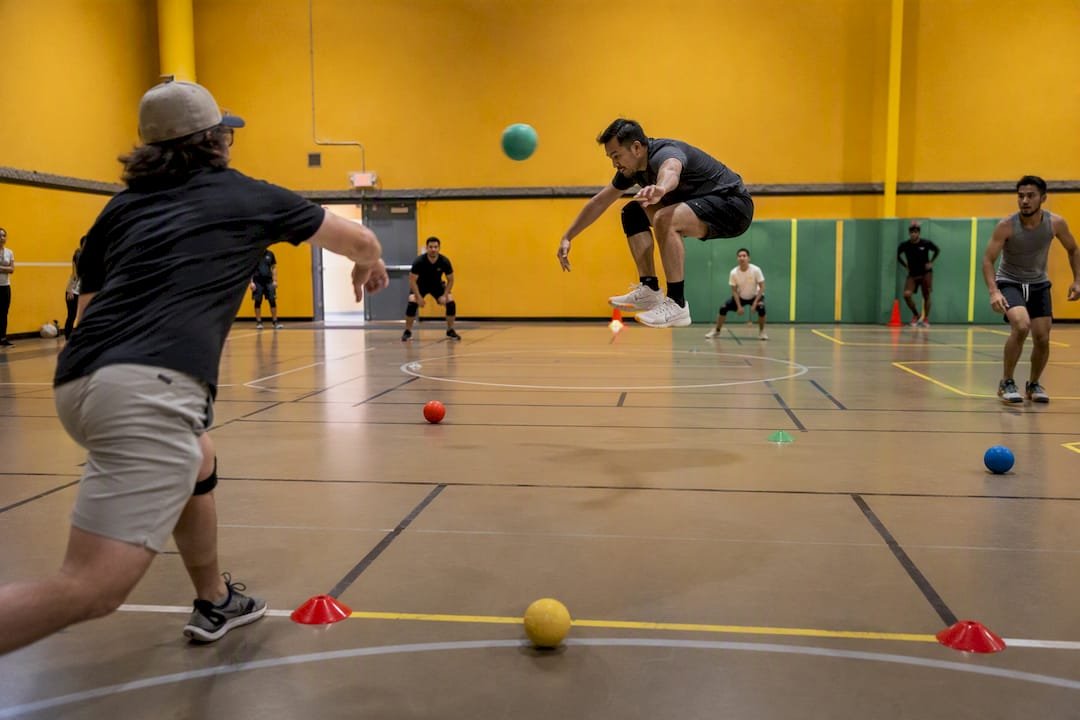
Nerf and soft-foam battles work well indoors because the equipment is genuinely low-risk, but you still need eye protection and a briefed no-close-range-shooting rule. A facilitated Nerf battle session handles that structure automatically, which matters more than people expect once 15 competitive adults are running around a room.
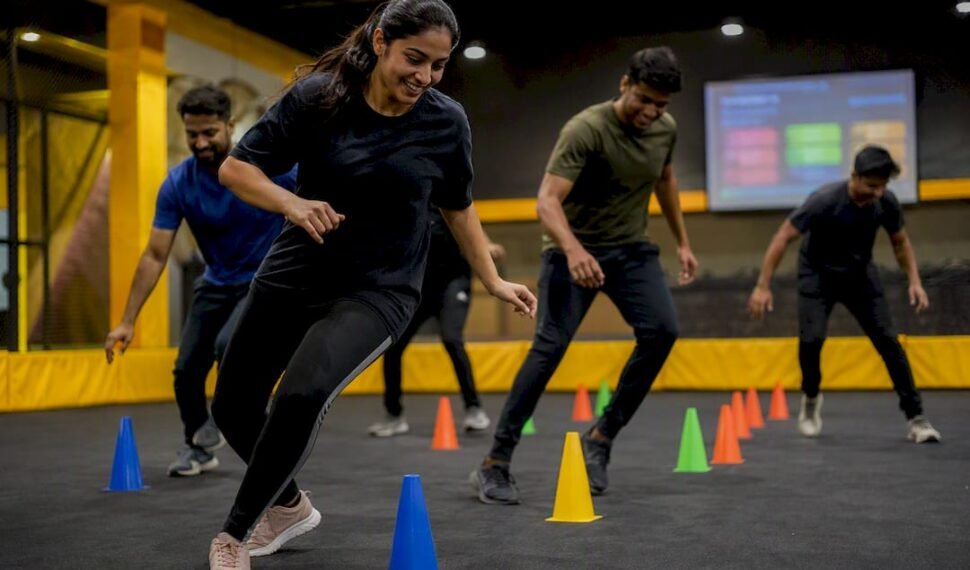
Relay races scale from simple (pass an object down a line) to elaborate (obstacle courses built from office furniture). Space needs are the limiting factor. If your floor plan doesn’t allow a clear 20-foot lane, skip it.
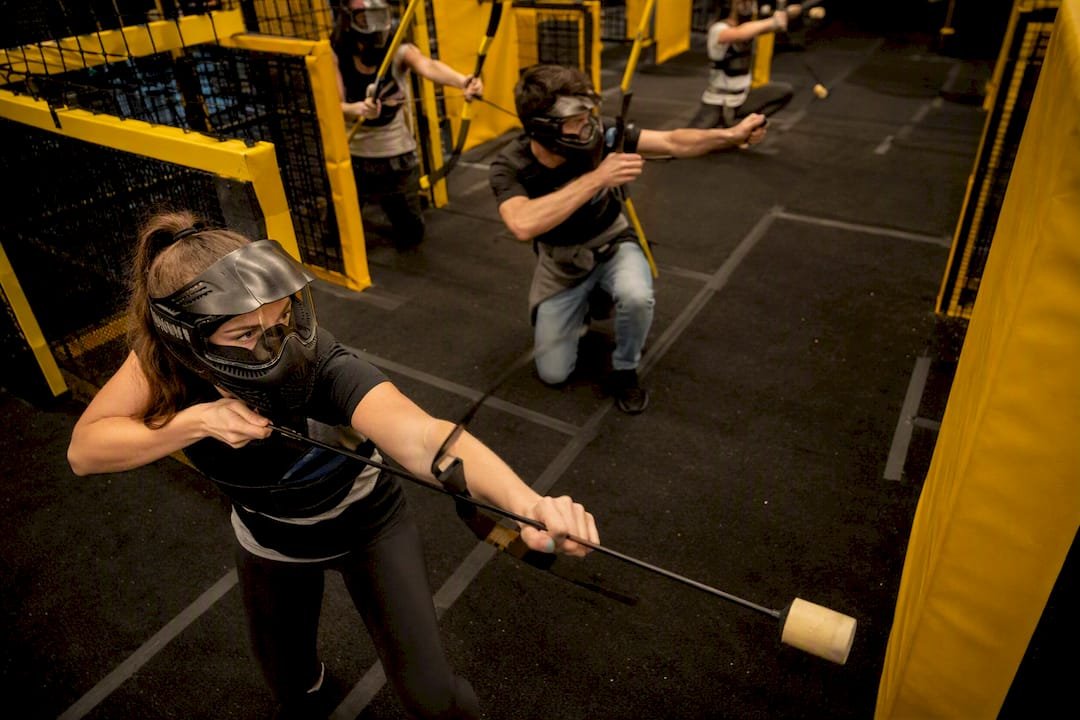
Archery tag and similar combat-style formats deliver the highest energy payoff on this list, but they absolutely require trained supervision, protective gear, and a controlled space. This is the category where booking a venue built for it, like Archers Battlefield’s archery tag format, beats improvising with borrowed equipment in a conference room.
For mixed-ability groups, build in low-impact roles from the start rather than as an afterthought: scorekeeper, referee, photographer, or strategist. Nobody should have to explain why they’re not running.
Low-Prep, Pen-and-Paper and Large-Group Games
Large groups create a different problem than small ones. It’s not intimacy, it’s logistics: how do you keep 40 or 100 people engaged when only a handful can be actively “doing” something at once. These games solve that by using team-based scoring and a strong moderator.
-
Office Trivia. Split into teams of 5 to 8, run 20 to 30 minutes across 4 to 5 rounds. Moderator reads questions aloud and keeps score on a visible board. Works at any size once you have enough tables.
-
Memory Wall. Post a large sheet of paper and have every person add one memory, joke, or milestone from the past year, running the whole meeting as an ambient activity rather than a timed one.
-
Team Timeline. Groups reconstruct the company’s or team’s history from memory using sticky notes, then compare against a real timeline. Good for onboarding new hires alongside veterans.
-
Charades, Office Edition. Classic format, themed around office jargon or inside jokes. Runs in 15 to 20 minutes with teams of 6 to 10.
-
Fishbowl Discussion. A small group discusses a topic in the center while the rest of the room observes, then rotates. Works for 30+ people and doubles as a communication exercise.
-
Human Bingo. Print bingo cards with traits (“has traveled to 3+ continents,” “can juggle”) and have people mingle to fill squares. Self-paced, works for groups of any size.
-
This or That, Live Vote. Ask a series of quick either/or questions and have people physically move to one side of the room. High energy, zero materials beyond a list of questions.
-
Collaborative Storytelling. Groups build a story one sentence at a time, passed around the circle. Scales down to small teams or up to a whole room split into pods.
For hybrid groups, assign remote participants a specific role rather than letting them watch passively: someone in the room can serve as their “hands,” relaying instructions or votes on their behalf. A shared screen with a live scoreboard keeps remote attendees oriented even when they can’t see the room.
Moderator staffing matters more than people plan for. For anything over 25 people, you want one person running the game and a second person handling scoring or tech. Doing both solo guarantees dead air.
Virtual and Hybrid Adaptations for Indoor Games
A fully in-person game with three remote attendees usually fails the same way: the remote folks end up watching a video feed of people having fun without them. The fix is giving them an actual job, not just a screen.
- Virtual Escape Room. Run a browser-based escape puzzle alongside the in-person version, with mixed breakout teams pairing remote and in-office staff.
- Online Trivia with Shared Scoring. Use a shared quiz tool so remote and in-room teams compete on the same leaderboard in real time.
- Remote Charades via Video. The performer acts on camera for a mixed team that includes both remote and in-person guessers.
- Collaborative Doc Challenges. Teams race to complete a shared document task (build a plan, solve a riddle) with edit access split evenly between remote and in-person members.
- Shared Whiteboard Puzzles. Use a digital whiteboard tool so remote participants can draw, vote, or move pieces exactly like someone standing at a physical whiteboard.
Facilitation tactics that actually work: put people in breakout rooms with an explicit remote co-host, run one synchronized timer visible to everyone, and assign each remote participant a named role before the game starts rather than announcing “everyone jump in.”
Pro Tip: The most common hybrid failure is the silent remote observer, someone logged in but never given a task, a vote, or a turn. If you can’t name their specific role in the first two minutes of the activity, redesign the game before you run it.
Tech delays are the second most common failure. Build in a two-minute buffer before any game that depends on shared screens or synced tools, and have a low-tech backup ready (a verbal round, a simple poll) in case the platform stalls.
Why These Activities Work: Mapping Games to Evidence-Based Bonding Mechanisms
Some of these games work better than others, and the reason isn’t mysterious. Four mechanisms explain most of the effect: synchrony, shared challenge, ingroup identity, and group flow.
Synchrony means moving or acting in time with others. Relay races, rhythm-based warm-ups, and even simple synchronized countdowns tap this directly. Shared challenge means facing a real obstacle together, which is what makes paper tower building or escape-room puzzles stickier than a casual chat. Ingroup identity forms when a group does something distinct together, which is part of why team trivia or memory walls build lasting affinity. Group flow shows up when a task is hard enough to require full attention but not so hard it causes frustration, the sweet spot most well-designed collaborative games are aiming for.
Synchronized activities and shared challenges produce measurable cooperation gains between participants, a pattern documented across psychology research on group bonding.
Mapping mechanisms to games: relay races and rhythm exercises activate synchrony. Paper towers and escape rooms activate shared challenge. Trivia and memory walls build ingroup identity. Archery tag and Nerf battles tend to hit shared challenge and group flow at once, which is part of why high-energy formats often produce stronger recall of the event weeks later than a quiet icebreaker does.
Stacking two mechanisms in a single activity generally beats relying on one. A synchronized relay race that also requires a shared strategic decision (which order should the team run) checks both boxes at once.
One caution matters more than any specific game choice: mandatory participation tends to backfire. HR guidance on team-building selection consistently recommends offering choices and real opt-outs, because forced fun reliably produces resentment rather than bonding, no matter how well-designed the activity is.
How to Choose, Run, and Debrief an Indoor Team-Building Game
Good facilitation isn’t about picking the flashiest activity. It’s a short checklist you run through before, during, and after.
Before you book anything, answer these:
- What’s the actual goal? Name it in one sentence (“help two departments that never talk actually talk”).
- How much time do you truly have, including setup and debrief?
- What’s the budget, and does it include a facilitator or just materials?
- Does everyone in the group have equal physical ability, or do you need low-impact roles built in?
- What’s the opt-out plan, and have you told people about it in advance?
Before the event, poll your team with a few quick questions:
- Any physical limitations we should plan around?
- Do you prefer competitive or collaborative formats?
- Is there a time of day that works better for you?
Facilitation staffing note: for groups under 15, one skilled facilitator is usually enough. Past that, add a second person to manage logistics, scoring, or tech so the lead facilitator can focus on reading the room.
During the activity, watch for these signals and adjust:
- Someone visibly disengaged? Give them a role instead of pulling them in cold.
- Energy dropping mid-activity? Cut it short rather than dragging it to the planned end time.
- One person dominating? Redirect a question to someone quieter by name.
Pro Tip: Build a 10 percent time buffer into every session for transitions, and if you’re running multiple activities back to back, keep no more than about a third of them physically demanding. Burning everyone out by activity three kills the debrief before it starts.
The debrief, every time, no exceptions:
Close with three questions, spoken aloud or written on index cards if the group is large:
- What did you notice about how we worked together just now?
- Where does that show up in our actual day-to-day work?
- What’s one thing we should do differently next time, based on what just happened?
A structured five-to-ten-minute reflection is what actually converts a fun activity into a behavior change. Skip it, and you’ve spent budget and time on a memory that fades by the following Monday.
Facilitator Notes From Archers: Real-World Lessons and Practical Shortcuts
Reading the room matters more than any activity script. Watch body language in the first five minutes: crossed arms and side conversations mean you’re starting too intense. Dial it back to something lower-stakes before pushing into a harder challenge.
Stagger intensity across a session rather than front-loading the hardest activity. Open light, build to something physical or collaborative in the middle, and close with something reflective. Groups that jump straight into high-pressure problem-solving without a warm-up tend to underperform and disengage faster.
Opt-outs work best when they’re built into the activity, not bolted on as an apology. Give the “sitting out” role a real job, scorekeeping, photography, timing, so nobody feels like they’re missing the point of the day.
If your team has never done a structured activity before, or the stakes are genuinely high (a merger, a reorg, a group that’s been in conflict), book professional facilitation rather than running it yourself.
Book Professionally Run Indoor Team Building With Archers Battlefield
Skip the venue-hunting and the safety-gear scramble. Archers Battlefield runs archery tag, Nerf battles, dodgeball variants, and full team packages indoors, with staff who handle setup, supervision, and pacing so you can focus on the group instead of logistics.
That’s the real gap between running a DIY active game and booking one: someone else owns the safety briefing, the equipment, and the timing, which means your job shrinks down to just showing up and running the debrief afterward. Every package includes structured time blocks, so you’re not guessing how long archery tag actually takes for a group of 20 versus a group of 8.
If a single session works well, it’s also worth knowing when to escalate. Some teams graduate from a one-off session into a broader employee engagement or incentive program once they see the return on a well-run event.
Check dates and group sizes on the team-building page, or head straight to Book Now to lock in a session for your team.
Frequently Asked Questions
What are the best indoor team building games for a small office?
For groups under 15, pick activities that don’t require anyone to hide: paired icebreakers like back-to-back drawing, short trivia rounds, or a collaborative paper tower challenge. Small groups do better with paired or trio formats than whole-group games because there’s nowhere to fade into the background.
How long should an indoor team building activity last?
That depends entirely on your goal. Social bonding works fine in a 15 to 30 minute block, while skill-building activities like problem-solving puzzles need 45 to 60 minutes to actually land, according to guidance on structuring company outings. Always add a buffer for setup and a 10-minute debrief on top of the activity time itself.
What indoor team bonding games work for large groups?
Trivia, human bingo, fishbowl discussions, and team-based charades scale well past 30 people because they use team scoring instead of requiring everyone to participate individually at once. Assign a dedicated moderator and a second person for scoring once you pass roughly 25 attendees.
How do you make indoor team building activities inclusive for introverts?
Swap public-performance formats for written or paired ones. A verbal two truths and a lie becomes a written poll; charades becomes a small-group task instead of a whole-room reveal. Always announce blindfold or physical-contact games in advance with a real, no-questions opt-out.
Do indoor team building games actually improve communication at work?
Games built around synchrony and shared challenge measurably increase cooperation between participants, based on psychological research on group bonding. The gains fade quickly without a structured debrief that links what happened in the game to how the team actually works day to day.
Should indoor team building be mandatory?
No. Forced participation tends to produce resentment rather than the bonding you’re aiming for. Offer real choices between activity types and intensity levels, and make opt-outs genuinely acceptable rather than something people have to justify.
Sources
- 45 team-building games that will bring your team together
- 50 Indoor Team-Building Activities Your Team Will Actually Enjoy
- Reflection methods for teams (SessionLab)
- Psychology of group bonding (GRASS)


