
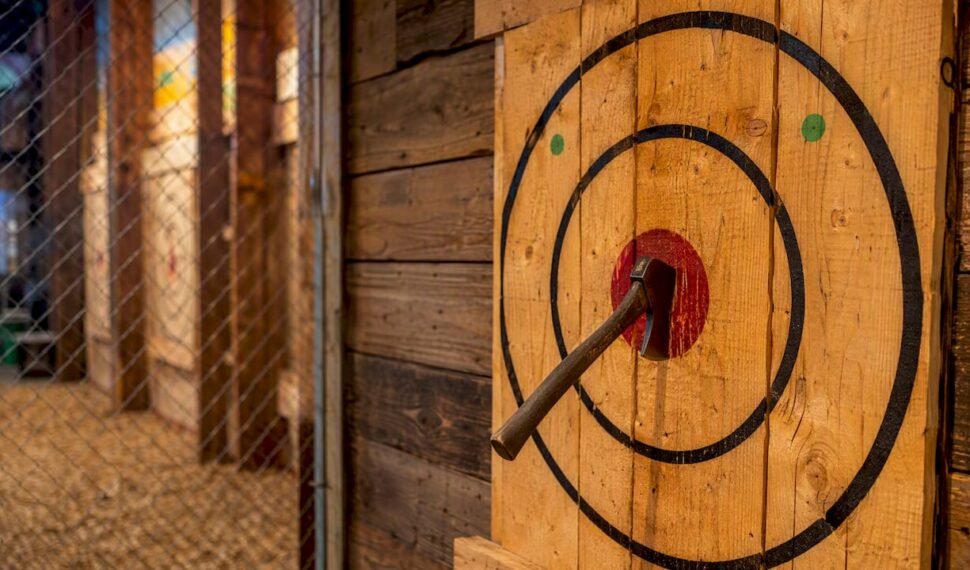
Axe throwing scoring works by measuring where the axe blade touches the target’s painted zones: the closer to center, the more points you earn, and whoever has the highest total after the scheduled throws wins the match. Three things matter most before you pick up a hatchet. First, the two governing bodies, the World Axe Throwing League (WATL) and the International Axe Throwing Federation (IATF), both use touch scoring and a standard match of 10 throws per player from 12 feet away. Second, point values differ between them, so a bullseye is not worth the same everywhere. Third, high-value “clutch” or “killshot” throws exist in both systems but come with their own rules about when you can call them.
Before you throw your first hatchet at any venue, here’s what to lock down:
- Ask which ruleset the venue follows. WATL and IATF scoring differ enough to change your strategy.
- Confirm how many throws make up a match, and whether clutch shots need to be called out loud before you throw.
- Learn the drop rule. An axe that doesn’t stick, or falls out before the score gets recorded, counts as zero no matter how well it was aimed.
Key Takeaways
Axe throwing scoring rewards precision over power: points come from where the blade touches the target, matches run 10 throws per player, and clutch or killshot calls carry real risk if declared and missed.
| Point | Details |
|---|---|
| Scoring is touch based | The blade’s contact point at the target surface determines the zone, not how deep it sticks. |
| Point values differ by league | WATL’s bullseye scores 6 and killshot scores 8; IATF’s bullseye scores 5 and clutch scores 7. |
| Drops always score zero | An axe that falls before or during measurement earns no points for that throw. |
| Clutch must be declared | Both leagues require calling a killshot before the throw, usually only on designated throws. |
| Archers Battlefield uses staff-confirmed scoring | Trained lane judges score each throw and offer simplified rules for casual, first-time groups. |
Table of Contents
- What Are the Standard Axe Throwing Points Systems?
- How Is Axe Throwing Scoring Determined on Each Throw?
- How Does a Full Axe Throwing Match Work?
- What Are the Official Target and Lane Specifications?
- How Do Tie-Breakers and Killshot Rules Work?
- How Do Officials Confirm and Record Scores?
- What House Rule Variations Should You Expect at Casual Venues?
- How Does Archers Battlefield Score Axe Throwing?
- Do Knife Throwing and Axe Throwing Use Different Scoring Rules?
- What Safety Rules Protect Players Near the Scoring Zone?
- What New Throwers Should Know About Scoring Strategy
- Ready to Put These Rules to Work?
- Frequently Asked Questions
- Sources
What Are the Standard Axe Throwing Points Systems?
Both major leagues break the target into concentric scoring zones, but the numbers on those zones aren’t identical. That distinction trips up more casual players than any other part of the rulebook.
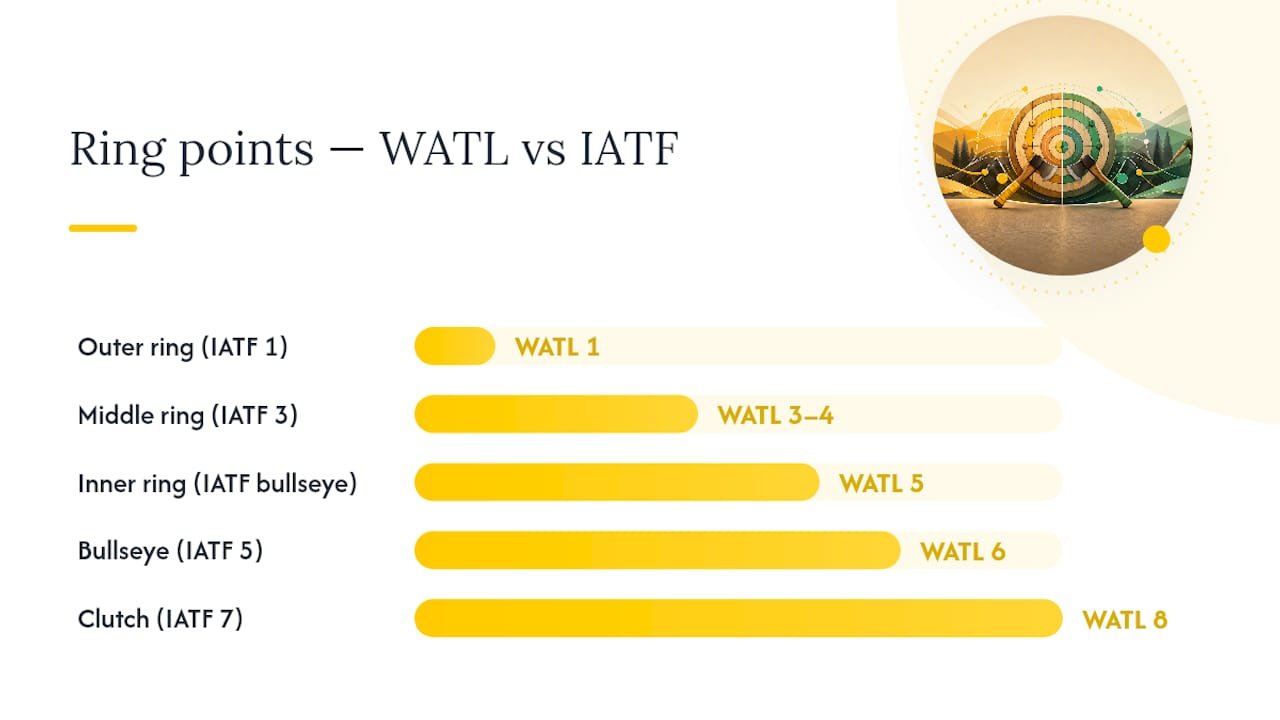
Under IATF’s standard scoring rules, the target uses three point values: the outer ring scores 1, the middle ring scores 3, and the bullseye scores 5. The clutch, IATF’s term for the killshot, is worth 7 points when properly declared and hit. WATL runs a more granular system with six regular scoring zones, giving the bullseye a value of 6 points, and its killshot pays out 8 points when called correctly according to the WATL rulebook.
That granularity gap changes how you play. WATL’s extra ring values reward a near-miss on the inner rings more generously than IATF’s simplified three-tier band, which means players chasing consistent mid-range scores tend to fare better under WATL rules, while IATF rewards a more binary “hit center or don’t” approach, based on this comparison of scoring granularity.
| Scoring Zone | WATL Points | IATF Points |
|---|---|---|
| Outer ring | 1 | 1 |
| Middle ring | 3–4 | 3 |
| Inner ring | 5 | (rolled into bullseye tier) |
| Bullseye | 6 | 5 |
| Clutch / killshot | 8 | 7 |
Ring lines matter just as much as ring zones. If the axe blade straddles a black marker line separating two values, both leagues score it at the lower of the two, per IATF’s ring-line rule. A blade sitting half in the 5 zone and half in the 3 zone scores 3, not 5, and not some average between them.
Every official match runs 10 throws per player before a winner gets decided, per IATF’s standard match format. That single number is worth memorizing. It’s the backbone of how a full game gets scored, whether you’re playing casually or in a sanctioned tournament.
How Is Axe Throwing Scoring Determined on Each Throw?
Scoring an individual throw comes down to one governing idea: touch, not depth. The blade doesn’t need to bury itself deep into the wood to earn points. It just needs to make contact with the highest-value zone at the plane of the target’s surface, according to WATL’s official rules.
Here’s how officials work through an ambiguous throw:
- Look at where the blade’s edge touches the target surface, not where the handle points or where the axe head appears to be leaning.
- The valid scoring area of the axe runs from the bit (the cutting edge) up to the front of the eye, the hole where the handle passes through. Anything behind that line doesn’t count.
- If a blade is genuinely too close to call by eye, officials use a measuring device, typically a set of calipers, to determine the exact zone, following the CPAF abridged rules.
- Axes cannot be moved, wiggled, or removed to help determine a score. Move it and you risk losing the throw’s actual result.
- If an axe falls out of the target before it’s scored, or falls during measurement, it counts as a drop, worth zero points under CPAF’s tournament guidelines.
A caliper measurement exists specifically to remove guesswork from close calls; once a blade is measured, that reading is final, and pulling the axe out before the measurement is complete can turn a scoring throw into a drop.
Pro Tip: Don’t yank your axe out of the target the second it lands. If the placement looks close to a ring line, let it sit until the scorekeeper confirms the zone. Pulling it early to “check it yourself” is one of the most common ways players accidentally turn a good throw into a disputed zero.
Multi-bit axes and axes with a hard-to-see eye get handled the same way: officials look at the blade’s actual point of contact, not the tool’s overall shape or orientation. If you’re throwing a double-bit axe in a league that allows it, only the working edge that struck the target counts toward your score.
How Does a Full Axe Throwing Match Work?
A standard match is built around 10 throws per player, split into two halves of five throws each, with a short pause at the midpoint. Tournament play often extends that structure into a best-of-5 games format, meaning the first competitor to win three games takes the match, according to CPAF’s tournament rules.
Order of play isn’t left to chance. A coin toss (or house equivalent) decides who throws first in game one. From there, the rule flips: whoever scored higher in the previous round throws first in the next one, an approach that rewards consistency instead of just raw power, per CPAF’s sequencing rules. If scores tie, the previous throwing order stays in place until someone breaks the tie.
Warm-ups follow their own schedule:
- Before the first match of the session, players typically get 5 warm-up throws to get a feel for the axe and the lane.
- Before each subsequent match, that allowance drops to just 1 warm-up throw, per CPAF’s warm-up rules.
- Warm-up throws never count toward score, even if you stick a perfect bullseye.
Foot faults matter too. Step over the marked fault line while releasing the axe, and that throw scores zero regardless of where the blade lands. A typical match flow looks like this: warm-up throws, five scored throws in the first half, a brief halftime pause, five more scored throws, then a final tally to determine the winner.
What Are the Official Target and Lane Specifications?
Consistent scoring depends on consistent equipment. Both leagues standardize the throwing distance, the target layout, and what counts as a legal axe, so a bullseye in one lane means the same thing in the next lane over.
The standard hatchet throwing distance sits at 12 feet (about 3.66 meters) from the face of the target to the fault line, a figure confirmed across IATF’s standard scoring rules. Big axe throwing, where it’s offered, typically uses a longer distance to account for the heavier tool and different throwing mechanics.
| Spec | Standard Value |
|---|---|
| Hatchet throwing distance | 12 ft (~3.66 m) |
| Match length | 10 throws per player |
| Regular scoring zones (WATL) | 6 |
| Regular scoring zones (IATF) | 3 |
| Valid axe scoring area | Bit to front of eye |
Target boards use a stenciled or painted set of concentric rings surrounding a bullseye, with black marker lines separating each value band. Clutch or killshot targets sit outside the main ring system, usually in the top corners of the board, and only come into play on designated throws.
Equipment rules are just as specific as the target layout. A legal hatchet has a defined blade, eye, and handle length, and the scoring area is limited to the bit up to the front of the eye, meaning a glancing hit from the handle or poll doesn’t register. Venues that allow big axes or double-bit axes apply the same touch principle: only the edge that struck the wood counts.
Lane separation matters for safety as much as for scoring accuracy. Adjacent lanes need enough buffer space that a bounce-back or a missed throw in one lane can’t put a thrower or spectator in another lane at risk, a standard most venues build directly into their lane construction.
How Do Tie-Breakers and Killshot Rules Work?
Killshots and clutches are the highest-risk, highest-reward calls in the sport, and they come with strict conditions on when you’re allowed to attempt one.
You have to declare your intent before you throw. Both WATL and IATF require a player to call “clutch” or “killshot” out loud before releasing the axe, and that declaration is typically only permitted on specific throws, most often the last throw of a half or game, according to IATF’s clutch declaration rules. Call it and miss, and you don’t just lose the killshot bonus. You often forfeit any other points that throw might have earned, since the ruleset treats a called clutch attempt as all-or-nothing.
Hit it, and the payout differs by league: IATF awards 7 points for a successful clutch, while WATL awards 8 points for a successful killshot. That one-point gap doesn’t sound like much until you’re trailing by exactly that margin in the final half of a close match.
Calling a clutch is a bet against yourself. You’re trading a near-certain smaller score for a shot at a bigger one, and if you miss, the house rules usually mean you walk away with nothing for that throw.
Tiebreakers vary more than the base scoring system does. Sudden-death formats are common: tied competitors each throw once, and the higher score wins outright. Some venues run sudden-death killshot rounds instead, where the first player to land a successful killshot attempt takes the match. Where big axes are part of the tournament format, a big-axe tiebreaker throw sometimes replaces the standard hatchet sudden-death round, adding an extra layer of pressure to an already tense moment.
How Do Officials Confirm and Record Scores?
Getting the score right on paper matters as much as getting it right on the target. Venues handle this in one of two ways: manual scorekeeping, where a designated official calls out and records each throw, or electronic scoring, where sensors or camera systems assist the human scorekeeper in confirming a zone.
Electronic systems reduce disputes, but they don’t replace the judge’s authority. A lane official is still responsible for the final call, especially in ambiguous placements near a ring line, based on WATL’s officiating standards.
Here’s the general process when a throw is contested:
- Either player, or the assigned official, can call for a measurement if the blade’s placement looks close between two zones.
- The official retrieves a caliper or measuring device and checks the blade’s position relative to the ring lines, without touching or removing the axe until the measurement is complete.
- The reading is announced and recorded. If the axe falls during this process, the throw typically scores as a drop rather than being remeasured.
- Both players acknowledge the recorded score before the next throw begins, closing out any dispute for that round.
Officials are trained to check touch at the surface plane, not how deep the blade sank, and to confirm which zone holds the majority of the blade’s contact. A referee calling “measure” or “hold” before touching the target is standard practice at any venue running a sanctioned event.
What House Rule Variations Should You Expect at Casual Venues?
Not every axe throwing venue runs official WATL or IATF scoring, and that’s not a knock against them. Plenty of casual spots simplify the system on purpose to make the game more approachable for first-timers.
Common variations include:
- A simplified 1/3/5 point system instead of the full six-zone WATL breakdown or the graded IATF bands.
- Open clutch rules, where players can attempt a killshot on any throw instead of only designated ones, or without calling it out loud first.
- Looser foot-fault enforcement, with staff coaching form instead of zeroing out a throw for a first-time offender.
- Extended or unlimited warm-up throws for groups new to the sport, rather than the standard 5-then-1 allowance.
Each of these changes the math and the strategy. An open clutch rule, for instance, turns killshot attempts from a calculated end-game gamble into a low-risk option you can try on nearly every throw, which shifts the whole scoring rhythm of a casual session, according to this breakdown of common venue variations.
Before your first throw at any venue, ask staff three quick questions: which scoring system they use (WATL, IATF, or an in-house simplified version), how clutch or killshot attempts are called and scored, and how the score gets recorded, whether that’s a paper scorecard, a chalkboard, or an electronic system tied to a screen at your lane.
Pro Tip: If you’re used to official league scoring but land at a venue running a simplified system, don’t assume your strategy transfers directly. A venue with open clutch rules rewards aggressive killshot attempts far more than a strict, called-shot format does, so ask before you start planning your throws around a rule that may not be in play.
How Does Archers Battlefield Score Axe Throwing?
Archers Battlefield runs axe throwing scoring with clarity in mind, because confusion about points ruins the fun faster than a bad throw ever could. For league nights and competitive sessions, we follow standard touch scoring principles consistent with the major governing bodies, with 10 throws per player as the baseline match length. For casual group bookings, birthday parties, and first-time throwers, we run a simplified scoring format so new players can focus on technique instead of memorizing ring values before their first hatchet leaves their hand.
A trained staff member acts as lane judge and scorekeeper for every session, confirming each throw’s zone and recording it as the match progresses. If a placement looks close to a ring line, any player can ask staff for a manual check rather than trying to eyeball it themselves. That single rule prevents most of the disputes that come up in casual play.
Booking a lane is straightforward whether you’re bringing a group of two or organizing a corporate team-building event. Group formats range from small friend outings to larger private events, and staff will walk you through scoring rules on arrival so nobody’s guessing halfway through a round.
Pro Tip: If you ever feel unsure about how a throw was scored during your session, flag it with staff immediately. Score confirmation happens throw by throw, not at the end of the match, so speaking up early keeps the game fair and fast for everyone in your group.
Do Knife Throwing and Axe Throwing Use Different Scoring Rules?
Knife throwing and axe throwing are related but distinct disciplines, and venues that offer both typically run separate scoring systems for each. Knife throwing generally uses lighter targets, shorter throwing distances, and different valid scoring criteria, since a thrown knife doesn’t have the same blade-to-eye contact area as a hatchet.
Where a venue offers both activities, it’s worth asking staff directly whether the same point values and ring layout apply, or whether knife throwing runs its own simplified scale. Most casual venues that add knife throwing as a secondary activity treat it as a distinct game with its own house rules rather than trying to map it onto WATL or IATF’s axe scoring standards.
What Safety Rules Protect Players Near the Scoring Zone?
Scoring zones sit at the far end of the lane, which means the area right around the target carries real risk if someone wanders into it during a throw. No player, spectator, or staff member should ever stand near the target face while a throw is in progress, and axes should never be retrieved until every thrower at that lane has finished their turn.
Lane boundaries exist for a reason beyond keeping the game fair. Standing behind the fault line during another player’s throw protects you from a bounce-back, a broken handle, or a blade that doesn’t stick cleanly. Most venues mark a clear waiting area behind the throwing line specifically so the next player isn’t standing in the release path.

Retrieving an axe safely means waiting for a verbal all-clear from whoever’s running the lane, then walking, not reaching, to the target to pull the blade free. Rushing this step is one of the more common ways minor injuries happen at otherwise well-run venues, and it’s a rule worth treating as absolute regardless of how casual the session feels.
What New Throwers Should Know About Scoring Strategy
Most new throwers overvalue the killshot and undervalue consistency, and that’s the single biggest strategic mistake I’d flag after watching hundreds of casual sessions play out. A steady string of outer-ring and middle-ring hits beats one lucky bullseye surrounded by drops, every time the math gets run.
Here’s what actually helps early on:
- Aim for the inner rings before you ever think about calling a killshot. Building a reliable base score matters more than chasing a bonus you’ll probably miss as a beginner.
- Only call clutch when you’re already comfortable with your grouping. A called killshot that misses can cost you the whole throw under most rulesets, so it’s not a move to gamble with early in a match.
- Take the early throws of a match to find your rhythm rather than trying to force a big score right out of the gate. Consistency compounds across 10 throws far more than one flashy attempt.
Etiquette matters just as much as strategy. Wait until the lane is completely clear before retrieving your axe, never touch another player’s thrown axe, and confirm which ruleset your venue uses before your first competitive throw, whether you’re playing casually with friends or entering a sanctioned WATL or IATF event.
Pro Tip: In casual play, where open clutch rules are common, lean into more killshot attempts since the downside risk is lower. In league play, save your clutch calls for the moments the rules actually allow it, and treat every other throw as a chance to build a steady, defendable score.
Ready to Put These Rules to Work?
Reading the rulebook is one thing. Standing 12 feet from a target with a hatchet in your hand is another, and that’s where Archers Battlefield comes in. Unlike a lot of venues that leave you to figure out scoring on the fly, our staff walks every group through the exact system we’re using, official or simplified, before the first axe leaves anyone’s hand.

Booking a session means:
- Trained staff supervising every lane for safety and scoring accuracy.
- Flexible formats for casual friend groups, birthday parties, corporate outings, and league-style competitive play.
- Clear scoring confirmation on every throw, so nobody leaves arguing about a close call.
- Event packages that pair axe throwing with other activities like Nerf battles or dodgeball for groups who want more than one game in a single visit.
If you’re ready to put these scoring rules into practice, book your axe throwing session and let our staff handle the scorekeeping while you focus on landing that bullseye.
Frequently Asked Questions
How many points is a bullseye worth in axe throwing?
A bullseye is worth 6 points under WATL scoring and 5 points under IATF scoring, with a called killshot or clutch worth 8 points (WATL) or 7 points (IATF) when hit successfully.
How many throws are in an axe throwing match?
A standard match runs 10 throws per player, typically split into two halves of five throws each, according to IATF’s standard match format.
What happens if the axe doesn’t stick to the target?
An axe that fails to stick, or that falls out before the score is recorded, counts as a drop worth zero points, regardless of where it initially landed.
Do you have to call a killshot before you throw it?
Yes. Both major rulesets require declaring “clutch” or “killshot” before the throw, and it’s usually only permitted on specific throws like the last one in a half or game.
Why do casual venues score differently than league rules?
Many venues simplify scoring, sometimes down to a 1/3/5 point system, or relax rules like foot-fault enforcement and clutch calling, to make the game more approachable for first-time players.
Sources
Readers who want the full rulebooks rather than a summary can go straight to the source:
- Standard Scoring – IATF
- Official Rules – World Axe Throwing League
- AXE THROWING – 2025 – PAGE 1 (CPAF abridged rules)
- Axe Throwing Rules and Scoring: Complete WATL and IATF Guide (2026) | AxeThrowingPlaces


