

A birthday party waiver is a short release form that a child’s parent or legal guardian signs to acknowledge activity risks and consent to participation. Send it digitally before the event; collecting a separate signature for every child attending is standard, and treat it as settled before guests walk through the door. Paper forms scrawled at check-in cause delays and gaps; a signed waiver in hand ahead of time does not cause delays.
TL;DR:
- Digital waivers streamline check-in by allowing parents to sign from home, ensuring signatures are complete and legible before the event.
- Each child requires a separate signed waiver, and vague language or group signatures may lead to legal issues or delays at check-in.
- Embedding waiver links in booking confirmations with reminders a few days prior boosts participation and reduces last-minute signings.
- Short, clear language in the waiver emphasizes real risks, avoids legal jargon, and ensures parents understand what they are consenting to.
- Properly signed waivers do not eliminate liability for gross negligence or intentional harm and should be combined with active supervision and safety protocols.
Table of Contents
- Why Digital Birthday Party Waivers Beat Paper Forms
- How to Build a Clear Birthday Party Waiver Form
- Getting Waivers Signed Without Slowing Down Arrivals
- Sample Wording and Printable Template Tips
- What a Waiver Can and Cannot Protect Against
- How Archers Battlefield Handles Waivers Day to Day
- An Organizer’s View on Why This Actually Matters
- Book a Party Where the Waiver Process Is Already Handled
- Where to Read More on Waiver Law and Templates
- Sources
- FAQ
Why Digital Birthday Party Waivers Beat Paper Forms
Paper waivers get lost in diaper bags, left in cars, or forgotten entirely. A parent who signed at drop-off last time may not remember to bring a copy this time, and a clipboard at the door creates a line of frustrated adults while cake is getting warm.
Digital waivers fix the bottleneck at the source. Parents sign from a phone before they leave home, and the organizer sees who’s done and who isn’t in real time.
- Faster check-in with fewer missing or illegible signatures
- Secure storage of emergency contacts and allergy details in one searchable place
- Automated reminders to parents who haven’t signed, sent before the party instead of during it
Pro Tip: Set your reminder to fire a couple of days before the party, not the morning of. That gives a distracted parent time to actually open the link instead of signing on a cracked phone screen while their kid is already climbing out of the car.
How to Build a Clear Birthday Party Waiver Form
A birthday party release agreement doesn’t need a law degree to draft. It needs the right fields, in the right order, written so a tired parent can read it in ninety seconds and understand exactly what they’re agreeing to.
- Organizer and event details. Name of the host, venue or address, date, and the specific activities covered (climbing wall, trampolines, combat archery, whatever applies).
- Participant and guardian information. Full name of the child, plus the parent or guardian’s name, phone number, and email.
- One signature block per child. If three siblings are attending, that’s three separate signature lines, not one family signature covering the group. Courts have pushed back on group sign-in sheets that try to cover multiple minors with a single signature.
- Plain-language risk acknowledgment. A sentence or two describing the actual physical risks of the activity, not vague legal filler.
- Release and assumption-of-risk clause. The parent’s written agreement not to hold the organizer liable for ordinary risks inherent to the activity.
- Medical and allergy questions. Food allergies, mobility limitations, and an emergency contact different from the signing parent if possible.
- Photo and video consent checkbox. A simple yes/no so you’re not guessing whether that adorable photo can go on social media.
- Signature block. Printed name, relationship to the child, and date signed.
Skip any of these and you’re left guessing at check-in, which is exactly the moment you have zero time to sort it out.
Getting Waivers Signed Without Slowing Down Arrivals
The best moment to ask for a signature is the moment a parent is already paying attention. That’s the RSVP step, not the party itself.
- Embed the waiver link directly in the booking confirmation or digital invitation, so signing feels like one step in the process rather than an extra chore
- Send a follow-up reminder three to five days out, then a final nudge the day before
- Keep a tablet at check-in for any parent who missed the email, so nobody gets turned away over a technical hiccup
- Set a clear policy in advance: no signed waiver, no participation in the activity, full stop
Venues that build the waiver into the RSVP or booking flow consistently see fewer no shows and fewer forms chased down at the door.
Sample Wording and Printable Template Tips
You don’t need dense legal paragraphs to write an enforceable birthday celebration terms document. You need clarity. A risk acknowledgment clause might read: “I understand that [activity name] involves physical movement and equipment, and that injuries, though uncommon, can occur.” A release clause: “I release [organizer/venue name] from liability for injuries resulting from ordinary risks of participation.” A photo clause: “I consent to my child being photographed or filmed during this event for the organizer’s promotional use” with a checkbox to decline.
- Keep sentences short. A parent skimming on their phone should understand each clause on first read.
- Avoid stacked legal jargon like “heretofore” or “party of the first part.” It doesn’t add protection, and it slows people down.
- Leave a distinct signature line for each child, clearly labeled with that child’s name printed above it.
- Date-stamp the template itself (bottom corner, small print) so you’re never using an outdated version.
Legal commentators consistently note that plain-English phrasing holds up better than legalese dense enough to confuse the person signing it. A waiver only works if the person reading it actually understands what they’re agreeing to.
What a Waiver Can and Cannot Protect Against
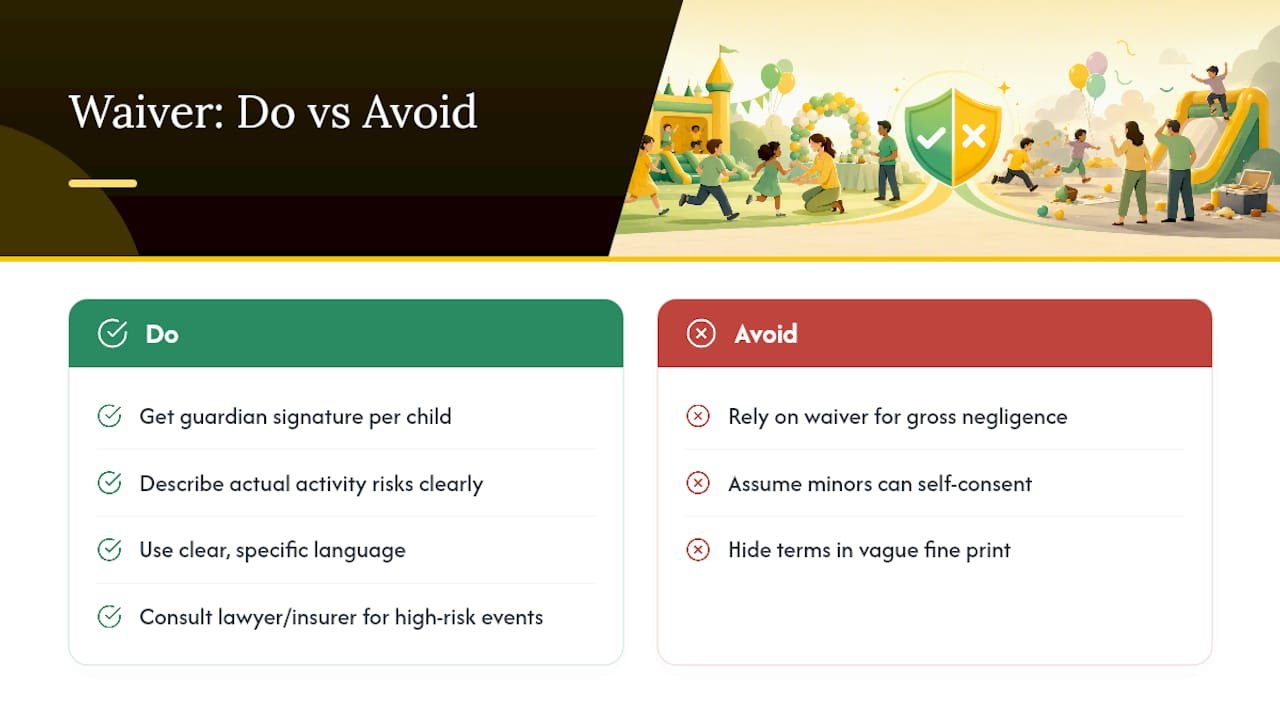
A signed waiver is not a force field. It’s a risk-communication tool with real legal limits, and knowing those limits keeps you from over-relying on a form when you should be relying on supervision and safety protocols.
Minors can’t legally consent for themselves, which is why a parent or legal guardian must sign on their behalf to ensure legality and why one signature per child is the standard, not a formality. A waiver covering ordinary risks rarely shields an organizer from claims involving gross negligence or intentional harm. If a staff member ignores a known equipment defect, no signature fixes that.
A waiver that’s clearly written, properly signed, and specific about the activity’s actual risks stands a far better chance of holding up than a vague, boilerplate form buried in fine print. Courts look closely at whether the person signing genuinely understood what they were giving up.
If your event involves higher-risk activities, or if you’re running events regularly rather than hosting one party, talk to a lawyer or your insurer about an indemnity clause covering third-party damage. It’s a small conversation that closes a real gap.
How Archers Battlefield Handles Waivers Day to Day
Running combat archery, dodgeball, and axe throwing for kids’ parties means waivers aren’t paperwork on the side. They’re part of how the day runs.
- Waiver links go out as part of the booking confirmation, so parents sign before arrival instead of scrambling in the lobby
- Staff verify a separate signed waiver for every child at check-in, matching names against the guest list
- Emergency contact and allergy notes stay in a system staff can pull up instantly if something comes up mid-party
Pro Tip: If your child has an allergy or a mobility need, flag it in the notes field when you sign rather than mentioning it verbally at drop-off. Written notes make it to the floor staff running the activity; a quick comment at the door sometimes doesn’t.
An Organizer’s View on Why This Actually Matters
Run enough of these parties and you notice the pattern fast: the events with a clean waiver process are the ones where nobody’s standing around at 2:05 for a party that was supposed to start at 2:00. Clear paperwork upfront isn’t the opposite of a fun party. It’s what lets everyone skip the friction and get straight to the fun part.
— Archers
Book a Party Where the Waiver Process Is Already Handled
Some venues are the option for parents who want the paperwork solved before they show up, not sorted out at the door. Booking a party here means the waiver link goes out with your confirmation, not as a separate scramble the night before.

Every kids birthday party package folds waiver collection into the booking flow, and staff cross-check a signed form for every attending child before anyone touches a bow or a foam blaster. If your group has specific medical needs, food allergies, or a child who needs extra accommodation, it’s helpful to reach out ahead of time so it’s on file before the party starts. Ready to lock in a date? Head to archery booking to check availability and get your party on the calendar.
Where to Read More on Waiver Law and Templates
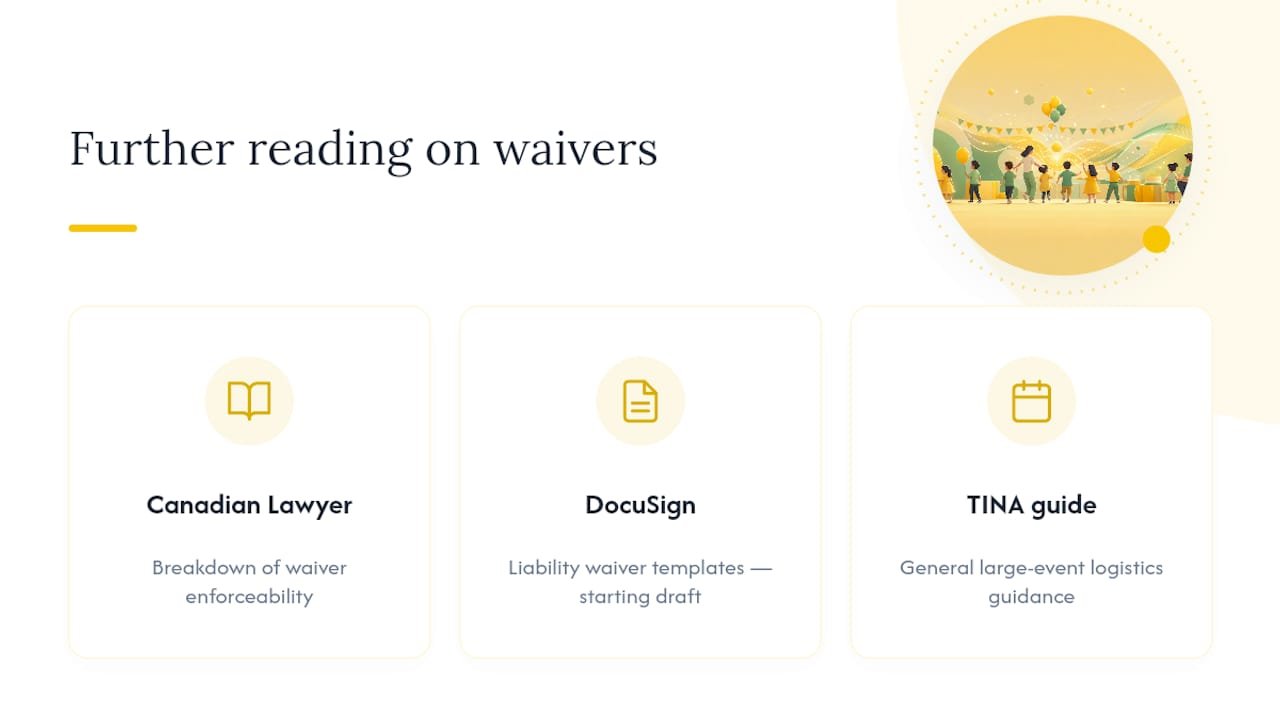
For deeper legal context, read the Canadian Lawyer breakdown of waiver enforceability and browse DocuSign’s liability waiver templates for a starting draft. For general large-event logistics, TINA’s guide to event hosting is worth a look too.
Sources
- Liability waivers — when courts ‘wave’ them goodbye?
- Can a child sign a contract?
- Waivers: format and management during COVID-19 and beyond
- Liability waivers and personal injury claims
FAQ
Is a Waiver Necessary for Kids’ Parties?
Yes, for any party involving physical activity. A signed release protects everyone by making risks explicit and confirming guardian consent, and it’s standard practice at any venue offering active play.
Who Has to Sign a Child Party Waiver?
The parent or legal guardian of each participating child signs, since minors can’t legally consent to a release themselves. One signature per child is the standard, not one signature covering a whole group.
What Are the Requirements for a Birthday Party at a Venue?
Most venues require a signed waiver for each child, an accurate headcount, and advance notice of any allergies or medical needs. Some also set minimum age or group-size rules depending on the activity.
Is $500 a Lot for a Birthday Party?
It depends heavily on guest count and activities included. A modest venue-based party for a smaller group can be covered comfortably by a typical budget, but larger groups or add-on activities can push costs higher fast.
What Are Some Good Excuses to Skip a Birthday Party?
Common, honest reasons include a scheduling conflict, illness, or a prior family commitment. A short, polite decline sent as soon as you know is always better than a last-minute no-show.
How Should I Handle a Child Not Being Invited to a Party?
Keep the explanation age-appropriate and calm, and avoid framing it as a reflection of the child’s worth. Redirecting attention to another activity that day often helps more than a long explanation does.


