
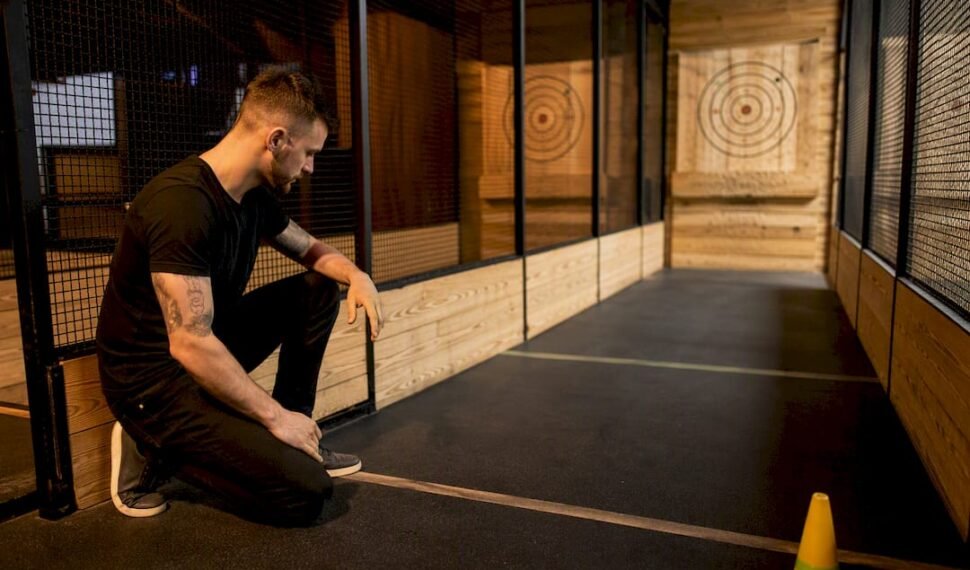
Supervised axe throwing at a certified venue is safe when three rules hold: closed-toe shoes, one thrower per lane at a time, and everyone waits for the coach’s all-clear before walking toward the target. Most reported incidents at professional venues are minor scrapes or splinters, not serious injuries, and the World Axe Throwing League sets the lane and distance standards most trained coaches enforce on-site.
TL;DR:
- Proper lane design, separation, and backstops reduce risk even if axes bounce or ricochet during throws.
- Coaches continuously monitor sessions to correct grip and stance, preventing most bounce-related accidents.
- Wearing closed-toe shoes, pulling axes straight out, and avoiding loose clothing significantly lower injury chances.
- Alcohol consumption is monitored, with venues enforcing age restrictions and removing intoxicated participants from lanes.
- Staff are trained in basic first aid, ensuring immediate response for minor injuries and prompt evacuation for severe ones.
Table of Contents
- Axe Throwing Safety Rules Every Venue Enforces
- How Lane Design and Sharp Axes Cut Down Risk
- What Coaches Actually Do During Your Session
- Dress and Behave Right, and You’ll Never Notice the Risk
- Alcohol and Age Policies You Should Know Before Booking
- What Happens If Someone Gets Hurt
- Why Archersbattlefield’s Safety Setup Holds Up
- What We Tell Nervous First-Timers Before They Throw
- Book a Safety-First Axe Throwing Session
- Where to Find the Official Rules
- Sources
Axe Throwing Safety Rules Every Venue Enforces
Every certified venue runs on the same short list of non-negotiables. They exist because someone, somewhere, learned the hard way what happens when they get skipped.
- Only one person throws per lane at a time. Nobody else steps onto the mat.
- Stay behind the toe line (the fault line) until the axe has fully left your hand.
- Wait for the coach’s verbal all-clear before walking up to retrieve your axe.
- Never hand an axe directly to another thrower. Set it down, or hand it to the coach.
- No sidearm throws, no backward throws, no trick shots. One axe per thrower, thrown straight and standard.
- Closed-toe shoes are required. Skip the loose hoodies, dangling necklaces, and rings on your throwing hand.
The certification standard that most trained coaches follow defines these as separate roles: participant, thrower, and coach, each with a job to do. That separation is what keeps a birthday party or a corporate outing from turning into chaos the moment someone gets excited and forgets where the fault line is.
Pro Tip: If you’re not sure whether your sneakers count as “closed-toe,” the test is simple: if your toes would touch the ground during a fall, they’re not covered enough.
How Lane Design and Sharp Axes Cut Down Risk
The rules matter, but the physical setup does most of the quiet work. Lanes are built with separators between throwers and backstops behind the targets, so a bounced axe has nowhere to go but down. Practical lane design positions the throw line so even an unusual ricochet lands short of the walkway, with separator height and backstop depth measured against worst-case trajectories, not average ones.
Standard throwing distance sits between 12 and 16 feet, a range WATL settled on because it gives the axe enough rotation to stick blade-first most of the time. Too close and the axe hits handle-first; too far and it over-rotates and clatters off the board.
- Purpose-built throwing axes, not hardware-store hatchets, with edges maintained for a clean stick
- Regular blade checks, since a dull axe is more likely to bounce than a sharp one
- Taped or fenced target zones that keep foot traffic out of the throw path
A sharp axe that sticks reliably is safer than a dull one that skips off the wood, which is the opposite of what most first-timers assume.
What Coaches Actually Do During Your Session
Every session opens with a mandatory safety briefing and a live demonstration, not a waiver you skim and forget. From there, coaches stay on the floor watching lanes, not sitting behind a counter.
- Brief the group on stance, grip, and release before anyone picks up an axe.
- Call the all-clear after each throw, and only then does retrieval happen.
- Watch every lane continuously, correcting grip or foot placement before it becomes a bounce.
- Pause or stop a session outright if someone ignores instructions or shows signs of intoxication.
Coach interventions almost always target the same two problems: bad grip and stepping over the fault line early, since those two mistakes cause most bounces and near-misses. That’s why a good coach interrupts constantly during the first few throws and rarely afterward.
Dress and Behave Right, and You’ll Never Notice the Risk
What you wear and how you carry the axe matters more than most first-timers expect.
- Closed-toe shoes, fitted clothing, no loose sleeves that could catch on a swing.
- Leave rings and bracelets off your throwing hand.
- Carry the axe with the blade pointed down, never swinging loosely at your side.
- Pull the axe out of the target with two hands, straight back, not twisted or yanked sideways.
Pro Tip: If your axe won’t budge on the first pull, don’t force it with one hand. Grip with both, rock it gently side to side, and it comes free without straining your wrist.
The most common beginner mistake is over-gripping, which throws off release timing more than raw strength ever helps. Relax your hand and let the axe leave cleanly.
Alcohol and Age Policies You Should Know Before Booking
Plenty of venues serve drinks, but coaches typically monitor consumption closely and reserve the right to cut anyone off. Standard practice includes enforceable limits tied to how many throws are left in a session.
- Alcohol is often allowed in moderation, with staff empowered to refuse service or pull someone from a lane.
- Age minimums commonly run 13 and up with a guardian, or 16 to 18 for venues serving alcohol, depending on the venue and local rules.
- Anyone showing signs of intoxication or refusing to follow instructions gets removed from the lane, no exceptions.
Policies vary by location, so it’s worth confirming specifics with whichever venue you’re booking.
What Happens If Someone Gets Hurt
A first-aid kit on-site and staff trained in basic first aid are baseline expectations, not extras. Axe throwing’s own safety literature is blunt about this: axes are inherently dangerous tools, and controlled throwing areas paired with real first-aid readiness are what keep that danger theoretical instead of literal.
- Minor cuts, blisters, or bruises get cleaned and bandaged on-site by trained staff.
- Anything beyond minor, like a deep cut or suspected fracture, means calling a paramedic immediately, no waiting to see if it settles down.
- Venues should log incidents, even small ones, so patterns (a wobbly axe, a slippery lane) get caught before they repeat.
Ask about first-aid readiness before you book if it matters to your group, especially for kids’ parties or corporate events.
Why Archersbattlefield’s Safety Setup Holds Up
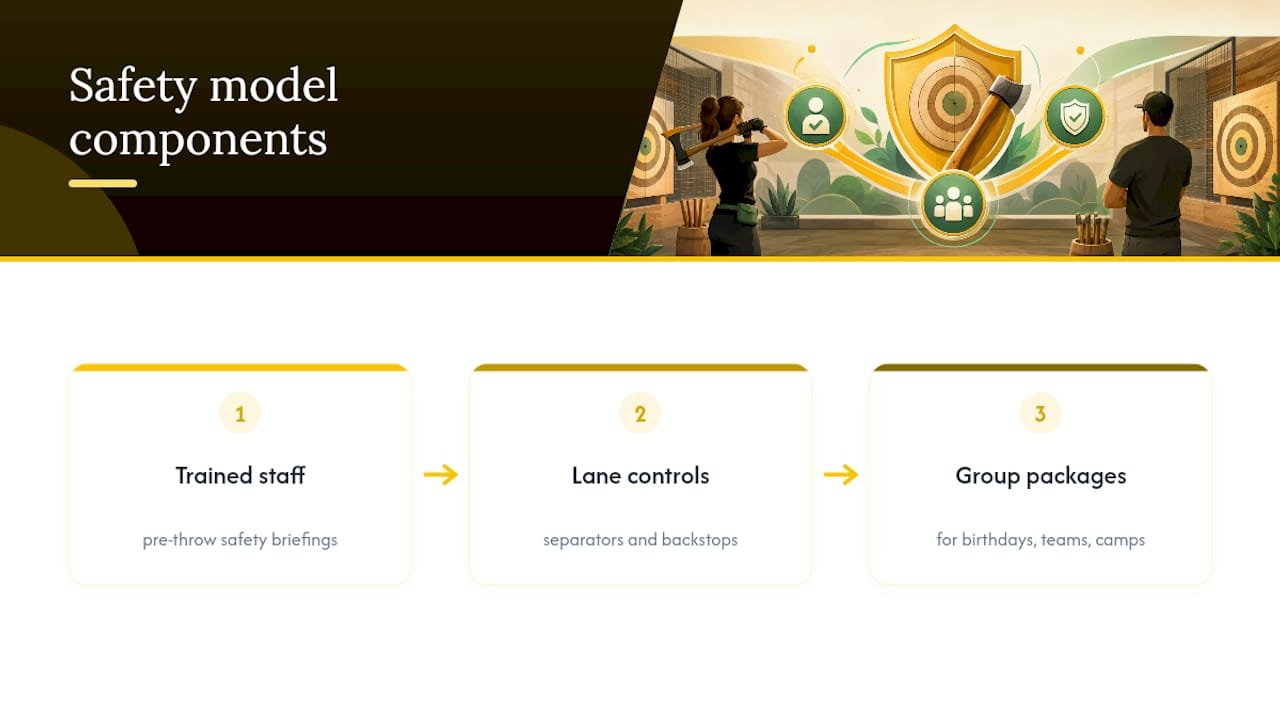
Archersbattlefield runs axe throwing the way the standards above describe it on paper: trained staff running safety briefings before anyone throws, lanes built with separators and backstops, and group packages sized for birthdays, corporate teams, and camps alike. The archery booking page and team building page both spell out how sessions are structured for groups of different sizes. That consistency across activities, from dodge ball to axe throwing, comes from applying the same coach-led, lane-controlled model everywhere.
What We Tell Nervous First-Timers Before They Throw
People walk in expecting axe throwing to feel like a stunt. It doesn’t. Once you’ve heard the briefing and watched the coach demonstrate the release, the whole thing feels closer to bowling than to anything dangerous.
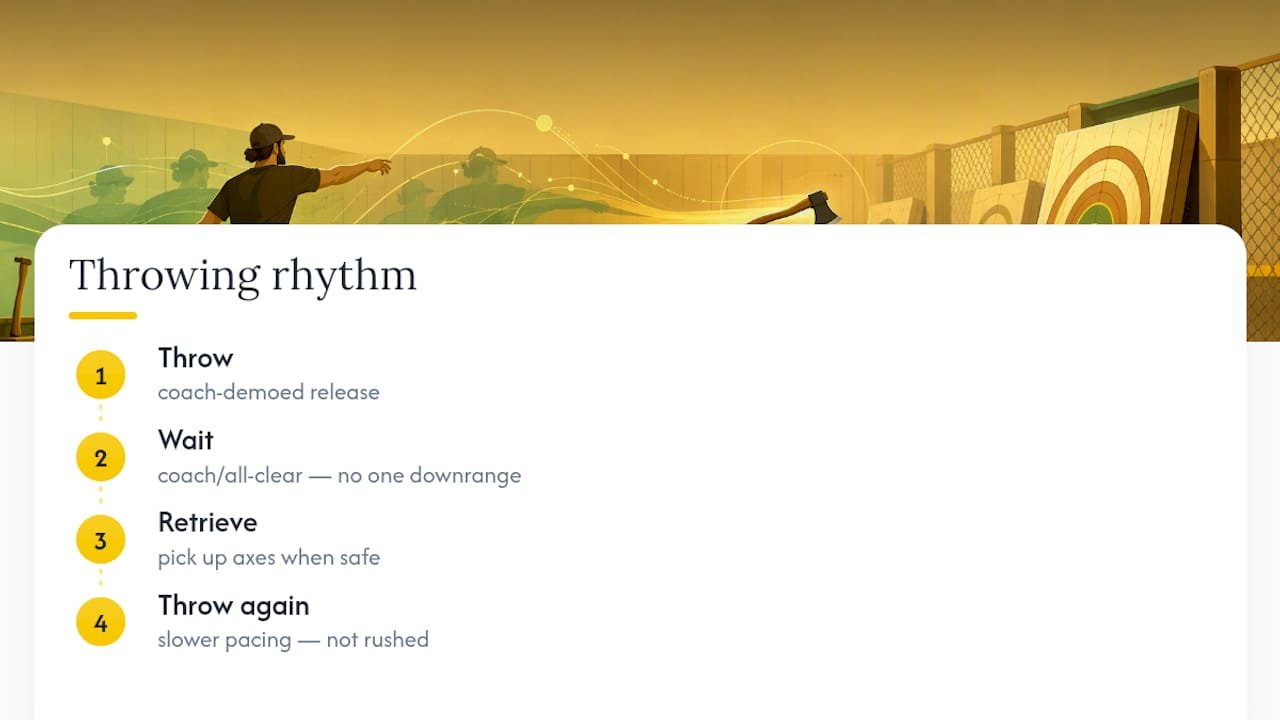
Three things settle nerves fast: the coach never leaves the floor, the all-clear rule means nobody’s ever downrange when axes are flying, and the pacing is slower than people expect. You’re not rushed. You throw, you wait, you retrieve, you throw again. That rhythm is the whole safety system, and once you feel it, the tension goes away by the second round.
— Archers
Book a Safety-First Axe Throwing Session
Archersbattlefield’s coaches run a live safety briefing before every group picks up an axe, not a quick disclaimer read off a clipboard, and someone stays on the floor watching every lane for the entire session.

That’s the real difference between a session that feels like a stunt and one that feels like bowling with sharper stakes. Group packages scale from small birthday parties to full corporate outings, and every package includes the same lane design, coach supervision, and briefing regardless of group size. If you’re planning a party, a team event, or just want to try it with friends, check available dates and lane slots on the archery booking page, or browse the archery activity page for details on group sizes and what a session actually includes.
Where to Find the Official Rules
For the full rulebook on lane dimensions and throwing distances, see the World Axe Throwing League’s official rules. The Axe Throwing Safety Certification covers coach and participant roles in detail. Event organizers coordinating larger group visits may also find this event day coordination guide useful for logistics planning.


