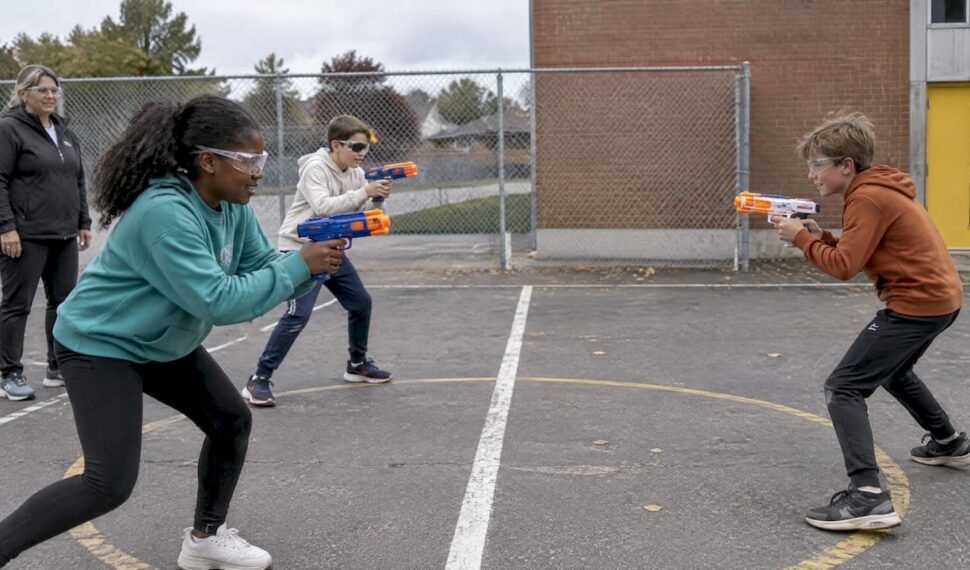
A school Nerf battle works when three things are settled before the first dart flies: eye protection for everyone in range, enough adults watching at all times, and rules sized to the age and number of students. A venue built for foam-dart games lets a teacher or youth leader hand most of that planning over. At Archers Battlefield, our indoor venue runs Nerf battles for schools and youth groups, and the sections below give you the plan either way.
TL;DR
- Everyone within firing range needs CSA-approved eye protection, and darts never go at the face. That rule is non-negotiable.
- Canadian school boards ask for constant visual supervision, and volunteers or senior students should never be the only supervisor.
- Rules should change with age and ability: softer play and simpler games for younger students, more objectives for older ones.
- A Nerf battle at our venue is $35 per person for a single session, and group packages start from $399.
- Plan a short warm-up, two or three varied games, a clear finish and a dart-collecting routine.
Table of Contents
- What actually happens at a school Nerf battle
- Matching the format to age, ability and group size
- Safety rules to set before anyone plays
- Logistics: teams, space and timing
- Booking a school Nerf battle with us
- Our view: structure is what makes it fun
- FAQ
- Sources
What actually happens at a school Nerf battle
It is easy to picture chaos, but a good Nerf battle is structured. One Canadian example is a teen Nerf event run by a regional library in British Columbia. It opened with a warm-up obstacle course, moved on to target challenges, freeze tag and a standoff-style game, and finished with capture the flag, which the participants liked best. Parents watched from a safe zone.
That shape is worth copying for a class, team or camp group:
- Briefing and gear. Explain the rules, hand out eye protection, and show where the play area starts and ends.
- Warm-up. A short obstacle course or target game lets students learn how the blasters handle before any team play.
- Two or three team games. Mix one running game, one objective game such as capture the flag, and one low-pressure game for those who tire quickly.
- Finish and reset. Collect darts, return blasters, drink water, and talk through what went well.
If you wonder how long all this takes, we cover timing in how long a Nerf battle lasts. For the format we run at our venue, see our Nerf battle page.
Matching the format to age, ability and group size
Students in a single class can differ widely in size, coordination and confidence. School divisions say so directly: Saskatchewan’s Prairie South guidelines tell staff to modify rules for ability, age and physical development, limit participants to the size of the space, mark boundaries clearly and build in chances to drink water.
Younger students (roughly ages 6 to 10)
Keep games short and simple. Use clear zones, small teams and objectives that do not depend on being the fastest runner. Games where a player is tagged and returns after a short pause keep everyone involved. Our guide to Nerf party age ranges explains how to adapt the rules as players get older.
Middle and older students
Older groups enjoy objectives and strategy: capture the flag, base defence, or timed rounds where teams rotate roles. A Gatineau library program for school-age players set its range at ages 11 to 18, required a signed waiver for each event and kept play to designated areas. That is a useful model for any group that mixes ages.
Group size
More players means more dart traffic and less space per person. A smaller number per match keeps rounds manageable. If the whole grade comes along, run rotations: while one group plays, another is on a different activity. This is the reason many schools book a venue with several activities rather than one big room. Our venue also offers dodgeball, ping pong, combat archery and arcade games alongside Nerf battles, and our packages are customized to group size.
Safety rules to set before anyone plays
This is the part to get exactly right. Foam darts feel harmless, but eyes are the concern.
Eye protection
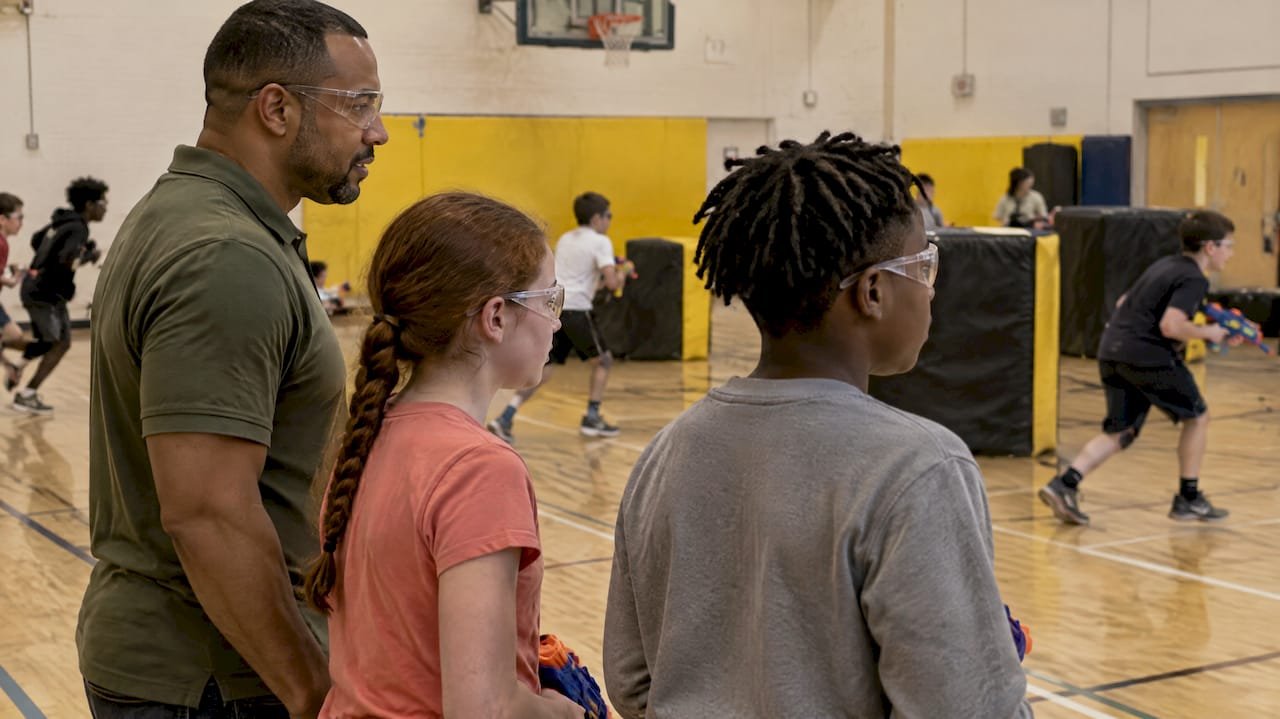
The College of Optometrists of Saskatchewan recommends CSA-approved eye protection at all times for anyone within firing range of a Nerf or other nonpowder projectile weapon. Its position statement also says children should use these only under adult supervision, and that they should never be aimed at the face or eyes. It notes that high-velocity ball technology can reach 45 m/s. That includes teachers, helpers and photographers standing at the edge of the play area, not just the players.
Contact and aiming rules
A federal workplace event in Ottawa gives a clear template. At the Canada.ca ADM(Mat) NERF Battle, goggles and closed-toe shoes were required. There were no shots within two metres or at the face, players aimed at the torso or limbs, and all equipment was inspected before use. Read a version of those rules aloud before every session.
Footwear, jewelry and the floor
School boards agree on the basics. Prairie South guidelines for dodgeball-type games call for a soft ball such as a foam ball, removal of jewelry, a clean obstacle-free surface and an accessible first aid kit. Lloydminster Catholic School Division adds closed access and exit doors and contact rules, such as no contact above the shoulders. For what students should wear, see our Nerf battle outfit guide.
Supervision
School divisions treat supervision as a duty, not a courtesy. Manitoba School Boards’ guidelines say teachers are held to the standard of care of a careful parent, that rules must be strictly enforced, and that an assisting senior student must not be the sole supervisor. Prince Edward Island’s guidelines define three levels of supervision: constant visual, on-site and in-the-area. They also require that volunteers never be the only supervisor of an intramural activity.
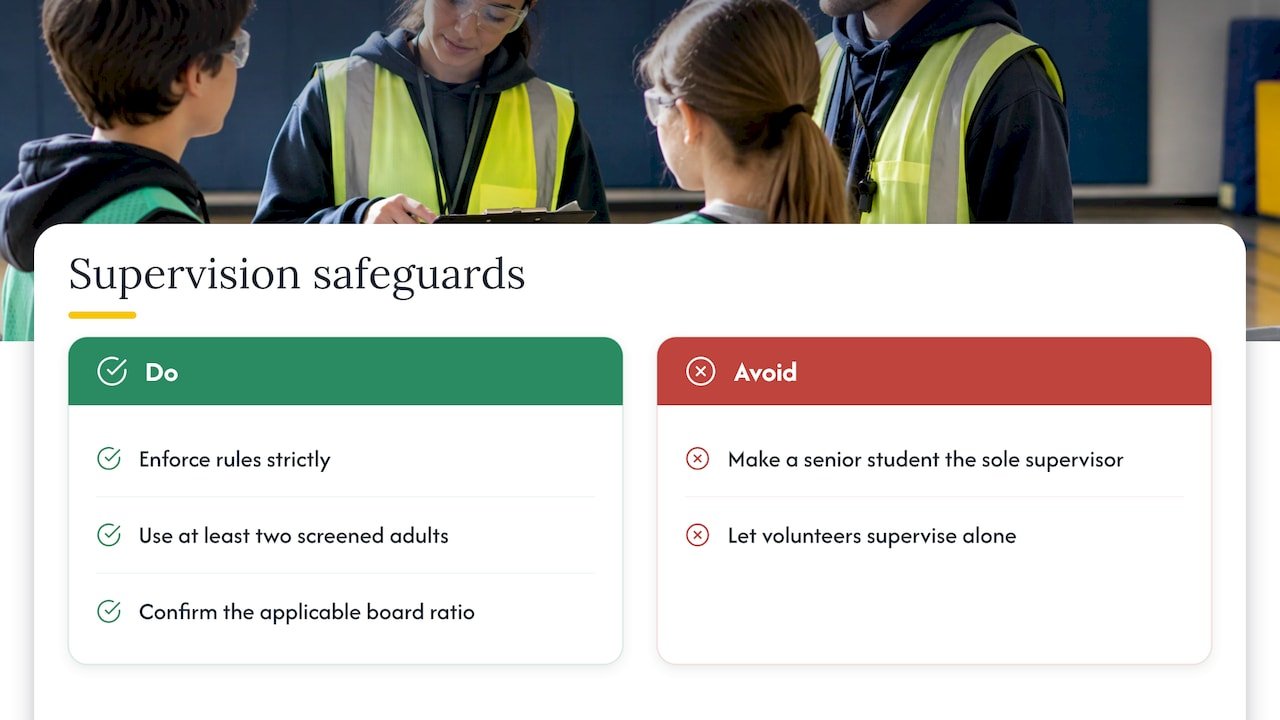
For numbers, 4-H Canada’s youth safety policy is a helpful reference point. It asks for at least two screened adults at every youth event. Its daytime low-risk ratios start at 2:10 for ages 6 to 8, with one more adult per five additional children, and at 2:30 for ages 9 and up, with one more per 15 additional. Your own school board’s policy comes first, so confirm which ratio applies to an off-site trip before booking.
A quick pregame checklist
- Eye protection on every person in the play area, adults included.
- Blasters and darts inspected, with damaged ones set aside.
- Boundaries and safe zones shown to the group.
- Aim at torso and limbs, never the face, and no close-range shots.
- Water break scheduled, first aid kit and a phone within reach.
- One adult named as the person in charge of safety.
Our approach to every event puts safety first, and our dodgeball guidance in dodgeball safety rules follows the same logic of clear rules read before play.
Logistics: teams, space and timing
Choose a space
In a school gym, you need a clear floor, closed doors and a plan for stray darts. Space is also a booking question: the City of Calgary, for example, restricts school gym rentals to registered non-profit groups, requires a named activity supervisor, and allows only clean indoor shoes. It also requires foam or sponge balls for indoor soccer. Rules differ by city and board, so a school that wants to hold the event in another gym should check local terms first.
An indoor venue removes much of that. You are not borrowing space, rearranging furniture or sweeping up darts, and the arena is set up for the game. That matters for field trips and summer camps, where teachers are already counting heads and managing buses.
Build the teams
- Mix friend groups so no one is picked last.
- Keep teams close in size and, in mixed-age groups, close in age.
- Give each team a color and a captain who helps gather darts between rounds.
Plan the timing
Work backward from the end of the session. Allow time for the briefing, gear fitting, a warm-up, the games and a cool-down. Then add a buffer for water and bathroom breaks. Younger groups run out of energy sooner, so shorter games repeated are better than one long one.
Set up a dart routine
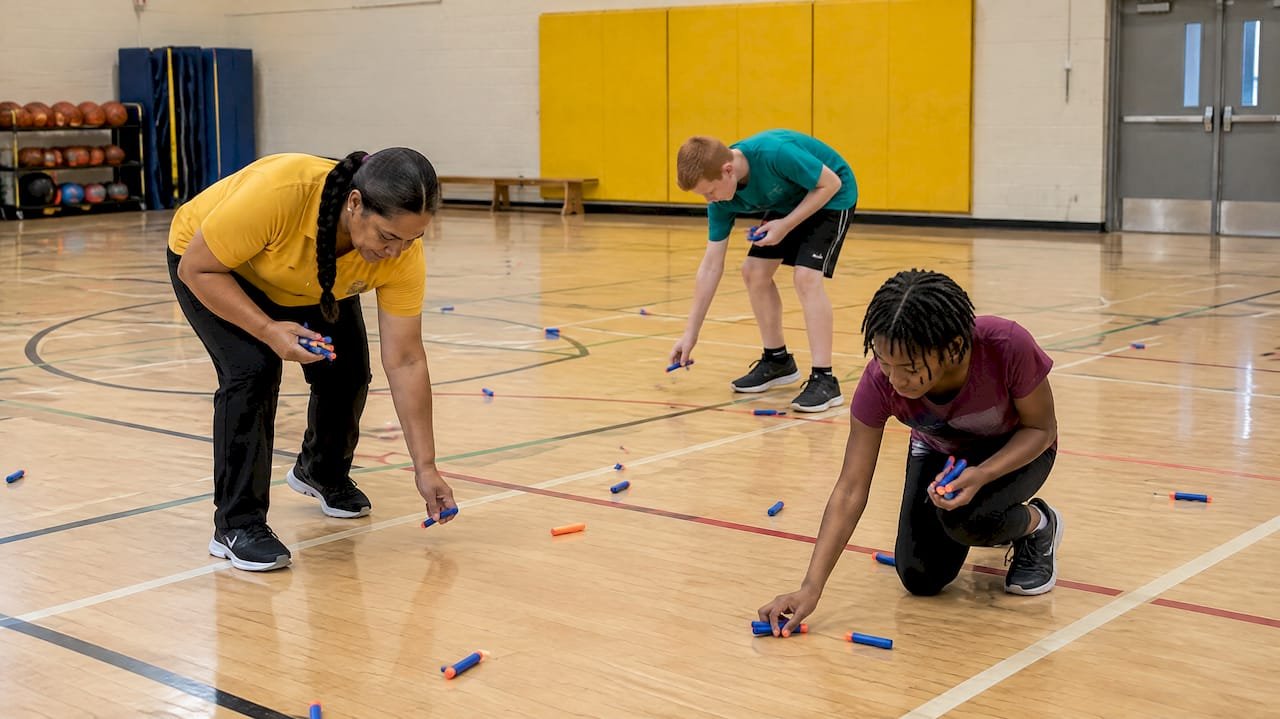
Gathering darts between rounds is part of the event. The Gatineau program has participants help collect darts between rounds, and staff can take away a blaster that is misused. A simple rule of one warning, then sit out a round, keeps it fair.
Booking a school Nerf battle with us
We run Nerf battles in our indoor arena for schools, youth groups and sports teams. A single Nerf battle session is $35 per person. For groups, our team battle packages are on the sports team event page: Game On Team Battle from $399, Epic Team Battle Event from $499 and Team Collab Package from $699. Our packages are customized to group size, and we offer planning support so the person organizing does not have to build the day from scratch.

For a class outing, camp day or end-of-year reward, see our event packages or send an inquiry through our home page with your group size, ages and preferred date.
Our view: structure is what makes it fun
We have seen it in how groups respond to organized play: the best Nerf battle is the one where every student knows the rules in the first minute. When the briefing is clear, the games are varied and the adults are watching, kids stop worrying about being hit and start working together.
That is why we build our events around safety, fun and a memorable experience for each group. Different ages and group sizes need different formats, so we customize packages rather than run one script for everybody. For a school, that means the teacher can take part in the day instead of spending it managing equipment.
If you want students to remember a day for the right reasons, start with the rules, give them objectives that need teamwork, and let the game do the rest.
Archers
FAQ
Are Nerf battles safe for school-age children?
They can be when run with rules. Eye protection should be worn at all times by everyone within firing range, and children should only use these blasters under adult supervision. Darts must never be aimed at the face or eyes, according to the College of Optometrists of Saskatchewan.
How many adults do we need?
Your school board sets the number, so check its field trip and activity policy first. As a reference, 4-H Canada’s policy asks for two screened adults minimum, with 2:10 for ages 6 to 8 and 2:30 for ages 9 and up. A volunteer or senior student should never be the only supervisor.
What ages can join a school Nerf battle?
Broad ranges work if the rules are adapted. Younger children do better with simple objectives and softer play, while older students enjoy capture the flag and team strategy. Our guide to Nerf party age ranges covers how to adapt play.
How much does a school Nerf battle cost with us?
A single Nerf battle session is $35 per person. Group packages for teams and schools start from $399 for the Game On Team Battle, $499 for the Epic Team Battle Event and $699 for the Team Collab Package. Packages are customized by group size.
Can we combine Nerf with other activities?
Yes. Our venue also offers dodgeball, ping pong, combat archery and arcade games, so a large group can rotate through activities. For team-focused ideas, see Nerf team building in Ontario.
Sources
- Nerf Battle in the Library Stacks, Thompson-Nicola Regional Library
- Physical Activity Safety Guidelines, Prairie South School Division
- Position Statement on the Use of Nonpowder Projectile Weapons, College of Optometrists of Saskatchewan
- Sport Activity Handbook, Lloydminster Catholic School Division
- ADM(Mat) NERF Battle, Canada.ca
- Nerf Challenges Rules, Gatineau Public Library
- Youth Safety at 4-H in Canada
- Safety Guidelines, Manitoba School Boards Association
- Physical Education Safety Guidelines K-12, Prince Edward Island
- Book a school gymnasium, City of Calgary


