
The best camp dodgeball games keep every camper moving, give every age group a role, and use soft balls under steady supervision. Classic elimination is only the starting point. Medic, Doctor, Jailbreak and a few other variations keep campers in the game and make it easier to run with mixed ages. Below you will find the rules that matter, eight games to run, how to adjust them by age and group size, and the safety standards Canadian school authorities set for dodgeball. If you would rather have a venue handle the space, the balls and the staffing for a group, we host dodgeball for camps, schools and youth groups at Archers Battlefield in Ontario.
TL;DR
- Use soft balls only (foam, sponge or similar) and keep hits below the waist or shoulders, depending on the age group.
- Pick games where eliminated players can return: Medic, Jailbreak, Doctor and Revenge keep campers from sitting out.
- Change the rules, not the kids: floor-first throws, non-dominant hand or a shorter throwing distance make the same game work for ages 6 to 16.
- Supervise closely while balls are being thrown, check the space for hazards, and keep a first aid kit and a working phone nearby.
- Our venue runs dodgeball at $30, and group packages start from $399.
Table of Contents
- The rules every camper needs before the first throw
- Eight dodgeball games for camp
- Adapting the game to age, group size and skill
- Equipment and setup
- Supervision and safety on the court
- Keeping everyone in the game
- A 60-minute camp block
- Dodgeball at Archers Battlefield for camps and groups
- Our view on camp dodgeball
- FAQ
- Sources
The rules every camper needs before the first throw
Dodgeball is a simple game: two teams throw balls at each other, and a player who is hit is out. Most of the confusion at camp comes from unclear boundaries on who is out and when. Spend two minutes on these points before you hand out a single ball.
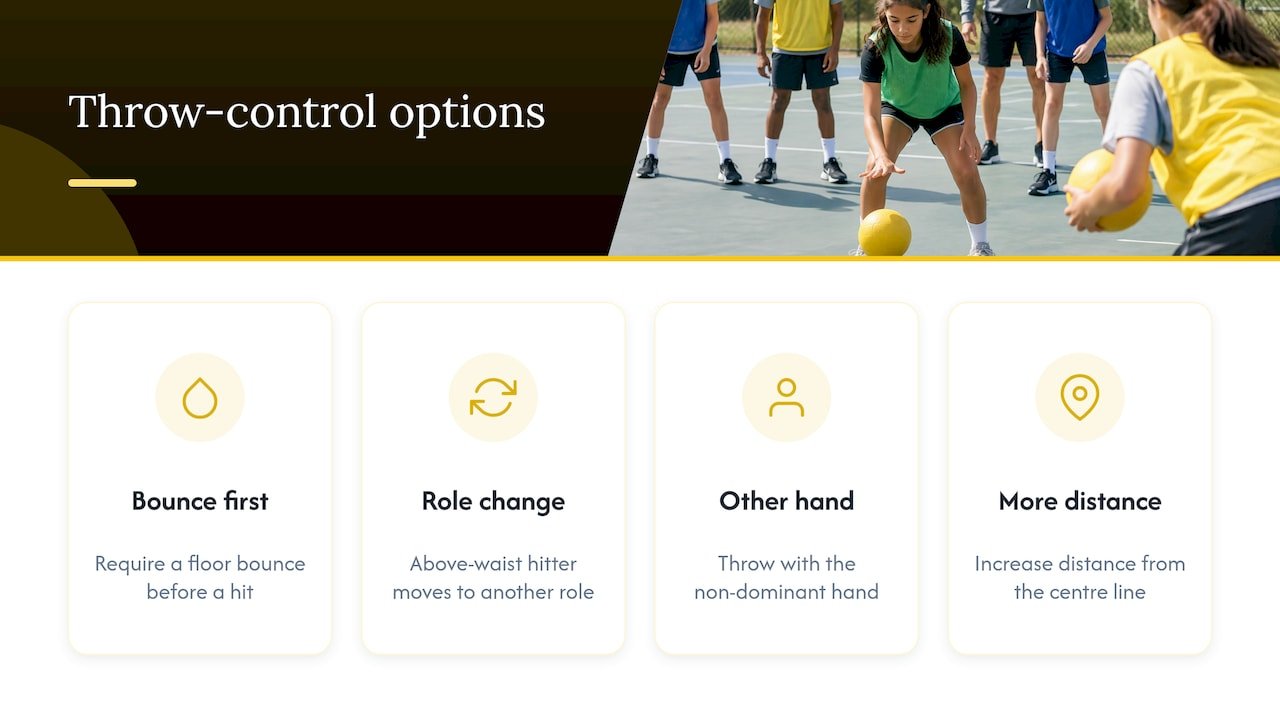
Where a hit counts. Ontario’s elementary dodgeball safety standard from Ophea, the provincial health and physical education body, requires contact below the target’s waist. It offers control options: the ball must bounce on the floor first, a thrower who hits above the waist moves to another role, throwers use their non-dominant hand, or the throwing distance from the dividing line is increased. Saskatchewan’s Prairie South School Division guidelines allow contact below the shoulders or below the waist, and rate dodgeball-type games for Grades K to 12 as low risk when the rules are followed.
How a player gets out. In the classic version, a player is out when a thrown ball hits them in the legal zone, or when they drop a ball they tried to catch. Many camps add that a thrower is out if their ball is caught. Decide which of these you use and say it out loud.
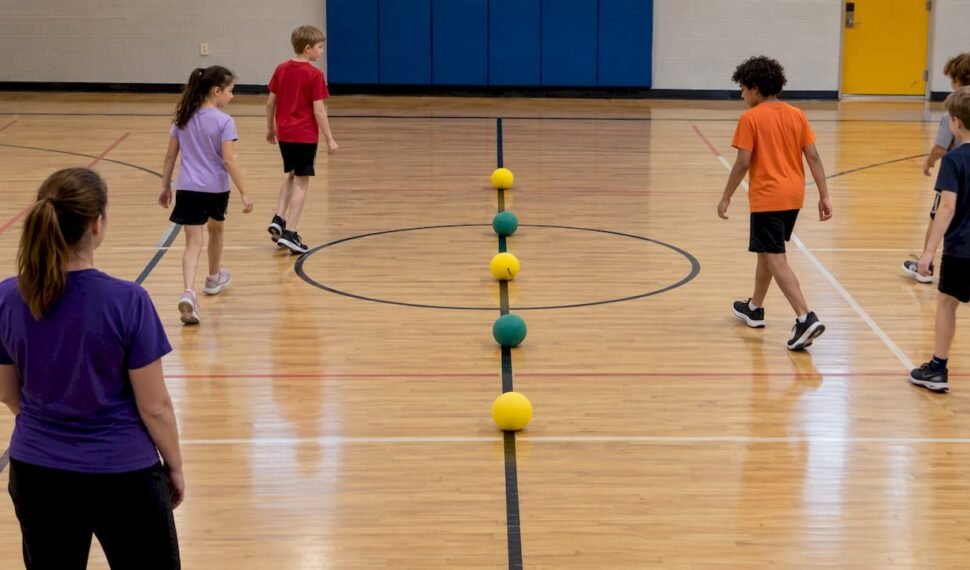
Where the balls start. Line the balls up down the centre line and have both teams start behind their back lines. On the whistle, players run for the balls. This opening rush is the most chaotic moment of the game, so some leaders place the balls and have younger players start by walking.
Boundaries. Mark the dividing line and the sidelines clearly. Players who step over the centre line to throw are out or lose the ball, whichever your house rule says.
If your group is new to the game, a short warm-up with throwing and catching helps a lot. Our dodgeball skills practice guide has warm-ups and drills you can fit into a camp block.
Eight dodgeball games for camp
These are well-known variations, and each one solves a specific camp problem: too much sitting out, too many campers, or too wide an age gap.
1. Classic dodgeball
Two teams, a line of balls at centre, and elimination by hits and failed catches. Play it first so everyone knows the baseline. Use short rounds of five to eight minutes and rotate teams so nobody spends the whole block as the first one out.
2. Medic dodgeball
Each team secretly or openly names one or two medics. A medic cannot be eliminated by a hit in the usual way, and tagging an eliminated teammate brings them back in. Teams have to protect the medic and decide when to rush. It is the easiest upgrade from classic because the rules barely change.
3. Doctor dodgeball
Each team picks a Doctor in secret, and the other team does not know who it is. If the Doctor is hit, the team loses unless a catch revives them, depending on your rule set. The bluffing layer gives quieter campers a strategic job, because the Doctor does not need to be the best thrower. It also suits a camper who prefers not to be a target, since the role can be taken on the sidelines with the right rules.
4. Jailbreak
Players who are hit go to a “jail” behind the opposing team’s back line. Teammates free them by catching a ball thrown across to jail, or by passing balls back. Nobody sits out for long, and jail players get plenty of throwing and catching practice. It works well for large groups because it spreads players across the whole space.
5. Gauntlet
One team lines the sides of a corridor with balls while the other runs through it one at a time. It is a good fit for mixed ages if you keep the throwers close to the edges and use only soft foam balls.
6. Protect the Pin
Each team guards a set of cones or pins at its back line. Knock down all the other team’s pins and you win. Because the goal is pins, not people, it takes pressure off players who are anxious about being hit and gives defenders a clear job.
7. Circle dodgeball
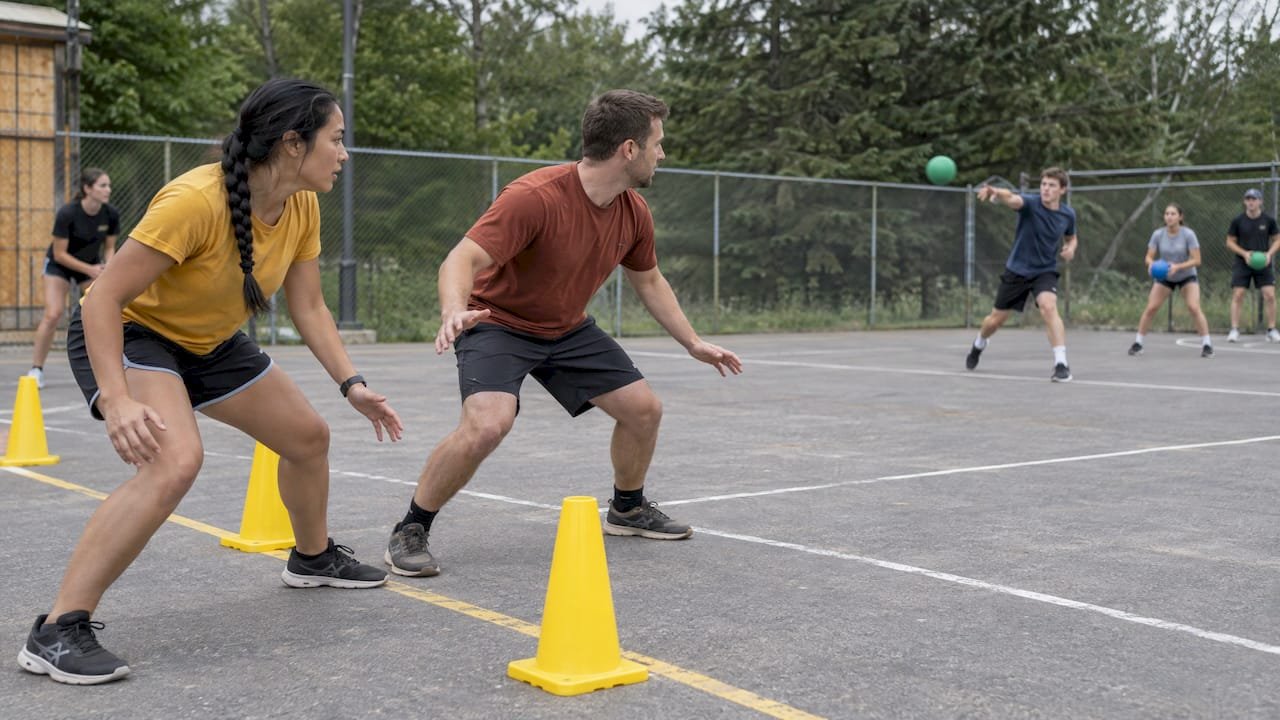
Half the group stands in a circle with balls while the other half stands inside. Circle players throw to hit the inside players, who dodge. Hit players join the circle. The last one in the middle wins. It needs little space and suits younger groups or rainy-day sessions.
8. Revenge or Last Player Standing
When a camper is hit, they leave the court, but a catch by someone on their team brings one eliminated teammate back. It keeps hope alive late in the round. Use Last Player Standing for a closing round, when energy is high and the group knows the rules.
Want to see how these fall into game families you can mix and match? Our dodgeball game modes guide breaks them into four families with three rule templates you can hand to your staff.
Adapting the game to age, group size and skill
No single rule set works for a mixed group of six-year-olds and fourteen-year-olds. Canadian safety guidance is clear that you adjust the activity, not the participants. Ophea says activities must be modified for age, ability, language, experience, participant numbers and facility. Alberta’s physical activity safety guidelines say the same, and add that leaders must make sure instructions are clear, direct and understood.
Here is how that looks in practice.
| Group | Good game choices | Rule changes to try |
|---|---|---|
| Younger kids (about 5 to 8) | Circle dodgeball, Protect the Pin | Floor-first throws, walking only, shorter rounds, extra time on starting and stopping skills |
| Middle group (about 9 to 12) | Medic, Jailbreak, Doctor | Non-dominant hand, a throwing distance limit, rotating roles |
| Teens | Doctor, Revenge, Last Player Standing | Normal throws, below-the-shoulder hits, longer rounds |
| Mixed ages | Protect the Pin, Gauntlet, Jailbreak | Split by age band or pair older campers as coaches |
A few more adjustments worth knowing:
- Large groups. Run two courts at once rather than one crowded court. More balls per player means more action and fewer players waiting.
- Skill gaps. Offer a thrower-only role, as Ophea lists, for campers who would rather throw than dodge. Alternatively, increase the throwing distance from the line for strong throwers.
- Younger campers. Prairie South requires that Grade K to 3 students are taught starting and stopping skills before playing dodgeball games. Teach them how to stop on a whistle before you ever introduce a ball.
The New Brunswick safety guidelines for secondary physical education note that the school district decides which activities suit which ages and modifies them for ability. For a camp, the equivalent is the director: decide the age bands in advance and write the rules down.
Equipment and setup
The ball is the most important choice you make. Ophea requires soft objects only for dodgeball: foam balls, sponges, beach balls, elephant-skin balls or utility balls. It prohibits under-inflated balls such as volleyballs, beanbags and hard flying discs. Prairie South mandates a soft ball such as Nerf, soft foam or Gatorskin, with no partially deflated balls. Manitoba’s school board guidelines say the same.
Your setup checklist:
- Balls. Enough soft balls that nobody waits for one, and none that are flat or hard.
- Space. An obstacle-free playing area with clearly marked boundaries, away from hazards. Ophea asks for closed doors in the space. Manitoba asks that outdoor games happen in a confined area away from streets and sidewalks.
- Clothing. Appropriate clothing and footwear. Prairie South bans stocking feet, jewellery, gum and candy.
- Sun and water. Manitoba requires sun protection outdoors. Prairie South calls for opportunities to re-hydrate.
- Cones, pinnies and markers. Cones for boundaries and pins, coloured pinnies to separate teams, and a whistle.
- First aid and communication. Ophea requires a fully stocked first aid kit and a working communication device that you can reach quickly.
Supervision and safety on the court
Supervision is where camp dodgeball is won or lost. Ophea requires direct supervision during safety and initial skill instruction and whenever participants are throwing balls, with on-site supervision for the other parts of the session. A volunteer working under a teacher’s direction can help monitor. Manitoba and Prairie South both call for constant visual supervision.
To put that into practice:
- Give a short safety talk before play: legal hit zones, no throwing at heads, stop on the whistle.
- Keep staff on the edges of the court with eyes on the throwers, not busy with the scoreboard.
- Include concussion-awareness instruction, which Ophea requires, and know your camp’s procedure for a suspected head injury.
- Make accommodations for anyone wearing medical aids, as Ophea says to.
- If a camp activity is run by an outside provider, Prince Edward Island’s physical education safety guidelines say the safety guidelines should be shared with the provider before trip confirmation and the provider must agree to follow them. It is a sound habit for any camp director in any province.
We lay out the full routine in our dodgeball safety rules page.
Keeping everyone in the game
The most common complaint about dodgeball is that the first players out spend the longest time watching. Fix that with the game design, not with a pep talk.
- Pick return mechanics. Medic, Jailbreak and Revenge bring players back quickly.
- Offer roles. Besides thrower and dodger, give campers a Doctor, a medic or a pin guard. A camper who is not comfortable being thrown at can still have a central job.
- Let players step out. Agree a signal, such as raising both hands, so a camper can leave and rejoin without fuss.
- Check the intensity. Pause after five minutes and ask whether the pace works. Slow it down with walking-only rounds if it does not.
- Rotate teams. Mix groups between rounds so the same kids do not always win or lose.
A 60-minute camp block
Here is a plan you can run as written.
- Minutes 0 to 10: Warm-up and safety talk. Light jogging, throwing and catching in pairs, and a review of the hit zone and stop signal.
- Minutes 10 to 20: Classic dodgeball in short rounds, so everyone learns the baseline.
- Minutes 20 to 35: Medic or Jailbreak, with returning players and the first team switch.
- Minutes 35 to 50: Protect the Pin or Doctor, for a more tactical round and a role for every camper.
- Minutes 50 to 60: Last Player Standing or Revenge, then a cool-down and water break. Ophea asks for both a warm-up and a cool-down.
If you are planning a longer evening, our youth group dodgeball night run sheet lays out a 90-minute plan for a venue setting.
Dodgeball at Archers Battlefield for camps and groups
Running dodgeball yourself takes balls, a court, boundary markers and enough staff to watch every throw. At Archers Battlefield, we offer dodgeball as an indoor activity at $30, and we offer group packages for schools, youth groups and sports teams. Our team battle packages start with Game On Team Battle from $399, Epic Team Battle Event from $499 and Team Collab Package from $699. We customize event packages to your group size and give planning support so you are not building the day alone. You can also read more on our dodgeball page or send a booking inquiry through the site.

School field trips and summer camp outings are part of what we host, and safety is something we put at the front of every event.
Our view on camp dodgeball
We see dodgeball as a team game first and an elimination game second. The camps that get the most out of it keep the rules short, keep the balls soft and keep everyone throwing, catching or protecting someone from the first whistle to the last.
That is why we like variations such as Medic, Jailbreak and Protect the Pin. They give a nervous camper a clear job and give a confident one a bigger stage, and nobody spends ten minutes on the bench.
Our venue is built for groups of different ages and sizes, with activities like dodgeball, Nerf battles, bazooka ball and combat archery under one roof, and with packages we tailor to the group. For a camp director, that means a rainy day does not cancel the plan, and the planning support takes work off your list.
Pick the right game for the age band, set the rules before play, and keep staff eyes on the throwers. Do that, and camp dodgeball is some of the best fun you can give a group.
Archers
FAQ
What is the best dodgeball game for a camp with mixed ages?
Protect the Pin and Jailbreak work well because the goals are shared and the action spreads across the whole space. Older campers can take roles such as medic or pin guard while younger ones throw from a set distance. Keep soft balls and the same hit zone for everyone.
How do I keep campers from getting hurt in dodgeball?
Use soft balls only, keep hits below the waist or shoulders as your age group requires, and supervise closely whenever balls are thrown. Check that the space is free of obstacles, keep a stocked first aid kit and a working phone handy, and teach concussion awareness. These are the points in Ontario’s Ophea standard.
How do I stop kids from getting bored after they are out?
Choose a game that brings players back, such as Medic, Jailbreak or Revenge, and keep rounds short. Assigning roles like Doctor or pin guard gives every camper something to do. Rotating teams between rounds also helps.
Can we play dodgeball indoors if the weather is bad?
Yes, as long as the room is clear of obstacles, doors are closed and boundaries are marked. We run dodgeball indoors at our venue, so a rainy camp day can still go ahead.
Sources
- Dodgeball, Ontario Physical Activity Safety Standards in Education (Ophea)
- Physical Activity Safety Guidelines, Prairie South School Division (May 2025)
- Alberta physical activity safety guidelines (2014)
- Safety Guidelines for Physical Education in New Brunswick, secondary curricular
- Manitoba school boards safety guidelines (2016)
- Physical Education Safety Guidelines K-12, Prince Edward Island


