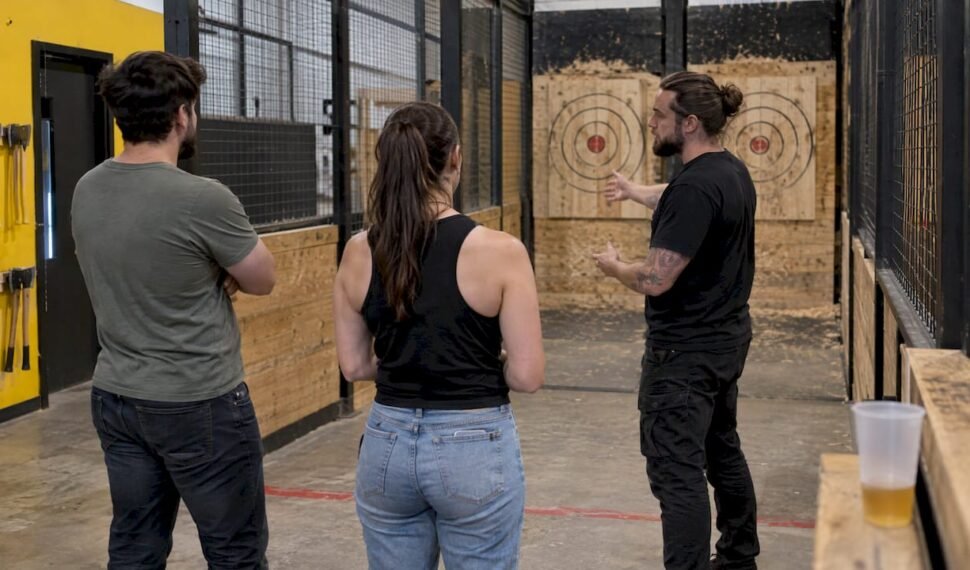
In Ontario, you can only drink at an axe-throwing venue if that venue holds a liquor licence or permit, and even then the law bars anyone from serving you once you appear intoxicated or letting you stay if you are. So the real question for a group is not “is alcohol allowed?” but “how will this event be run so that everyone throws safely?” If you are planning a birthday, a team outing or a night out with friends, the answer comes down to the venue’s policy, the number of drinks in the mix and who is supervising the lanes. Our axe-throwing sessions and event packages are built around that safety-first planning.
TL;DR
- Drinking is legal in Ontario only in a residence, on licensed or permitted premises, or in a place a municipal by-law designates. A licensed venue qualifies. A street or park does not.
- The legal drinking age is 19. Staff serving alcohol must be at least 18, and no one may be served to the point of intoxication.
- A licensee or employee may make an intoxicated person leave. An impaired guest does not get an axe.
- Alcohol and thrown blades do not mix well, so the best group events keep the drinking light, separate and supervised.
- If you are organizing a group, ask the venue about its policy before you book, and plan the day so throwing comes first.
Table of Contents
- What Ontario law says about drinking in a public place
- Why blades and alcohol get extra attention
- Municipal rules and recent changes
- How a safe alcohol policy looks at a group event
- Planning a group event around the rules
- A short checklist before you book
- Our view
- Book your group event
- FAQ
- Sources
What Ontario law says about drinking in a public place
Ontario’s alcohol rules sit in the Liquor Licence and Control Act, 2019, known as the LLCA. Three of its provisions matter most for an axe-throwing night.
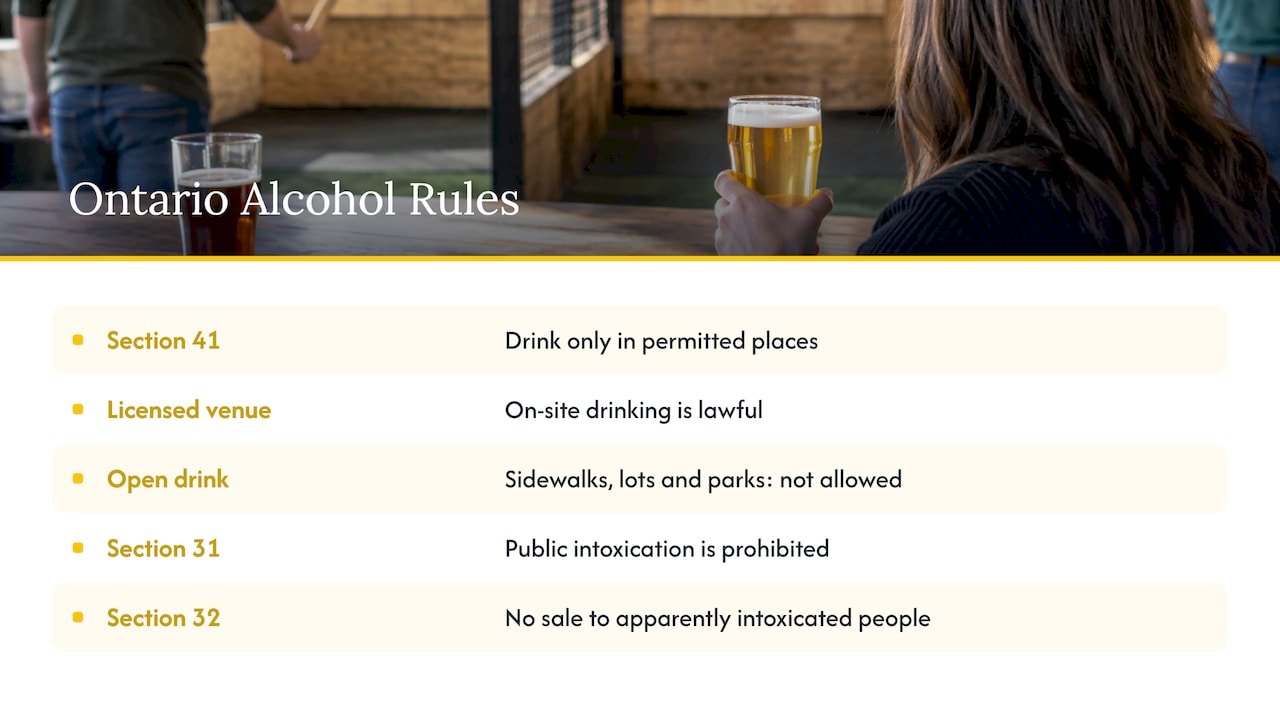
The first is about where you may drink. Section 41 says no one may have or consume liquor anywhere other than a residence, premises with a licence or permit that allows consumption, a prescribed private place, or a public place designated by a municipal by-law. A venue with a liquor licence falls in the licensed-premises category, so a drink there is lawful. Carrying that open drink out onto the sidewalk, into a parking lot or into a park is not.
The second is about being drunk in public. The Act prohibits being intoxicated in a place the public can access (section 31). That applies to guests, not only to servers.
The third is about serving. It is an offence to sell liquor to someone who appears intoxicated (section 32). Section 44 lets a licensee or employee tell an intoxicated or unlawfully present person to leave immediately, using no more force than necessary.
The Smart Serve course reference materials that most Ontario servers train from sum up the same rules: alcohol may be served only to customers 19 or older, staff who handle it must be at least 18, consumption must be monitored, and intoxicated people must not enter or remain on the premises.
What it means for your group
Two practical points follow. First, if your group’s drinking plan involves bringing your own bottles or cans to an unlicensed space, you are outside the law unless there is a permit. Second, even in a licensed space, the venue’s staff can end anyone’s evening if they judge the person to be intoxicated. That is not an insult. It is the law working as designed.
Why blades and alcohol get extra attention
Throwing a heavy axe requires balance, timing and a clear head. Alcohol affects all three. The LLCA does not single out axe throwing, but its ban on serving or admitting intoxicated people applies with obvious force when the activity involves sharp objects.
The Alcohol and Gaming Commission of Ontario (AGCO), the provincial regulator, has been firm on this. In April 2025 it proposed a 60-day licence suspension for a Woodstock bar after a patron’s death, citing the service of an intoxicated person, permitting intoxication and an untrained server. The AGCO’s Registrar said adherence to responsible service standards is not optional. The case involved a bar, not an axe venue, but it shows how seriously Ontario treats over-service.
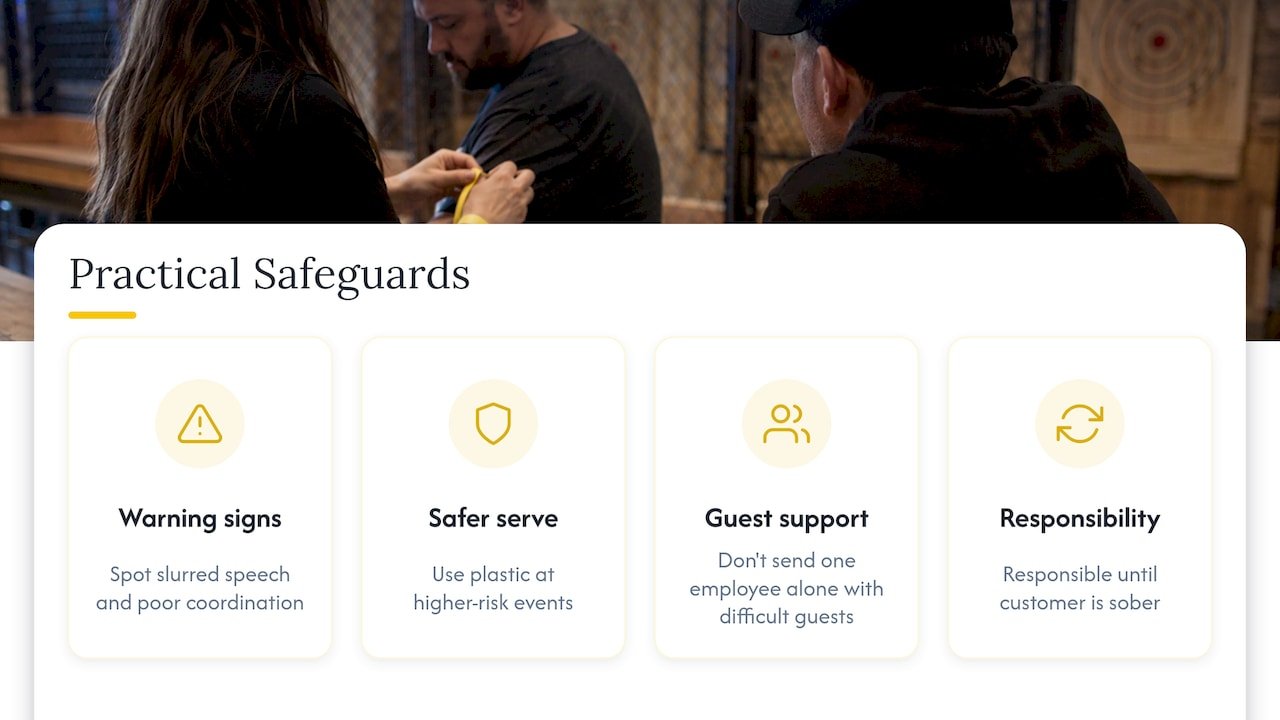
Smart Serve’s Managers Library adds a practical note for venues: train staff to spot slurred speech and poor coordination, use plastic rather than glass at higher-risk events, and never send one employee alone to deal with a difficult guest. Smart Serve materials also say staff remain responsible for an intoxicated customer until the person is sober, which is why an impaired guest is not simply shown the door and forgotten.
Municipal rules and recent changes
Provincial law is only one layer. In Toronto, By-law 492-2024 lists axe throwing as an “amusement activity” in the city’s licensing code, alongside archery, bowling and miniature golf. Other Ontario municipalities set their own rules on noise, occupancy and business licensing.
On the liquor side, the AGCO announced in September 2025 that it was removing duplicative, outdated or unnecessary licence conditions. Licensees still have to follow the LLCA, its regulations and the Registrar’s Interim Standards. For a guest, nothing about the core rules changed: licensed premises only, no service to intoxicated people, and 19 as the legal age.
If an organizer wants to run a bar at an unlicensed space for a private event, the AGCO’s special occasion permit rules say conditions can include drink limits per person, licensed security staff, ID checks for patrons who look under 25 and serving only in approved or shatterproof containers. Those conditions show what the regulator considers sensible for a crowd with alcohol in the room.
How a safe alcohol policy looks at a group event
A venue’s house policy should be easy to understand before you arrive. According to Smart Serve, a good one covers a code of conduct, ID checks, monitoring of doors and tables, and how to handle an intoxicated guest. It also supports staff when a guest pushes back and informs patrons about the law.
Here is what you can expect from a well-run axe-throwing session, whatever the venue:
- A briefing before anyone throws. Participants are shown the rules and given a demonstration. Forbes’ look at the axe-throwing bar trend describes exactly this, and notes that the first axe-throwing bar in North America is believed to have opened in Toronto in 2011.
- ID checks. The drinking age is 19, so anyone who looks young should expect to be asked. Our guide to the axe throwing age limit in Ontario explains what parents and groups need to know about who can throw.
- A coach or staff member on the floor. Someone should watch the lanes, not just the bar.
- Authority to stop a throw. If a guest looks unsteady, staff should be able to pause their turn or end their session.
A useful rule for any group: drink after the last axe is thrown, not during. Ordering a round for the end of the session keeps the lanes safe and the scores honest.
Planning a group event around the rules
The readers who ask this question are rarely lone drinkers. They are an HR coordinator planning a team night, a friend organizing a 30th birthday or a league captain sorting out a social. Each has a different alcohol question, and each is better served by planning than by improvising.
Team building and corporate nights
A work event has the strictest reputational stakes. People of different ages, comfort levels and roles share the lanes, and some do not drink at all. Plan the activity so the competition is the draw, not the bar. Our axe throwing team building page covers how Ontario organizers can set this up, and the team building packages start with the Collab Package from $699 and the Ultimate Paddle Package from $799. A mixed format, with axe throwing alongside other games, keeps people moving and gives non-drinkers plenty to do.
Adult birthdays and date nights
Adult celebrations tend to be where the drinking question comes up most. The Momentum Adult Birthday Bash starts from $2,395, and the other event packages begin at $299 for Pong & Party On. For a couple, our axe throwing date night guide walks through booking, and the date ideas give you ways to make the night feel like more than a drink and a few throws.
Leagues and recurring groups
League nights depend on fair scoring and fair play. Impairment undermines both. If you run a league, the league rules on scoring, faults and judging give you a base for a clear conduct policy, and you can add the Ontario legal points above to your own code of conduct.
Kids and youth groups
Birthday parties for children and school or camp outings are a separate case. Alcohol is not part of them, and the age rules apply. Our kids’ birthday party packages start at $399 for Game On Birthday Party.
A short checklist before you book
- Confirm the plan with the venue. Ask how the day will run and what the policy is for any drinks in the group. Do this in writing for a work event.
- Check ages. Anyone ordering a drink needs to be 19 or older, and the venue may ask for photo ID.
- Set the order of the day. Throwing first, socializing after.
- Name a point person. One organizer should be responsible for the group’s conduct and for arranging safe rides home.
- Dress for it. Closed-toe shoes and comfortable clothing matter; our axe throwing essentials page covers what to wear, know and bring.
- Plan the way home. Smart Serve is clear that venues carry a duty of care toward an intoxicated customer, but your group should not depend on it. Organize taxis or designated drivers beforehand.
Our view
We think the best axe-throwing night is one where nobody has to worry about the lane next to them. Axe throwing is a skill game: the fun comes from the thunk of a clean stick, the friendly rivalry and the way a group cheers on its quietest member.
That is why we plan events around the activity first. Our packages are built for different group sizes, and our team helps you shape the day so it fits your people, whether that is a corporate team, a birthday group or a league. Safety and positive guest experiences are the reason groups come back.
Ontario’s liquor law gives a clear frame: licensed premises only, 19 and up, no service to intoxicated people. A group that plans its event around those facts, and around good coaching and a clear order of the day, gets the best version of the night.
Archers
Book your group event
If you are planning an outing for friends, colleagues or family, start with the event packages: Pong & Party On from $299, Action & Chill Bash from $599, Ultimate Paddle Party from $799 and the Momentum Adult Birthday Bash from $2,395. Sports teams can look at the team battle events, which start at $399. Tell us your group size and the kind of night you want, and we will help you plan it.

If you want to try other games on the same visit, you can also browse the full list of activities, including combat archery at $35, Nerf battles at $35, and ping pong and dodgeball at $30 each.
FAQ
Can you drink alcohol before or during axe throwing in Ontario?
It is lawful only on licensed or permitted premises, and the venue’s own policy sets the limits. The LLCA bars serving anyone who appears intoxicated, and staff can ask an impaired guest to leave. The safest approach for a group is to throw first and drink afterward, if at all.
Can you walk around with open alcohol in Ontario?
No. Section 41 of the LLCA limits having or drinking liquor to a residence, licensed or permitted premises, a prescribed private place or a place a municipal by-law designates. Taking an open drink from a licensed venue onto a street or into a park is not allowed.
What is the drinking age at an axe-throwing venue in Ontario?
It is 19. Smart Serve training materials state that alcohol may be served only to customers 19 or older and that staff handling it must be at least 18. Younger guests can still take part in some axe-throwing sessions under the venue’s own age rules, which we explain in our age limit guide.
What happens if someone seems too drunk to throw?
Under section 44 of the LLCA, a licensee or employee can require an intoxicated person to leave and may remove them using no more force than necessary. In practice, staff will usually stop the person’s turns first and arrange a safe way home.
Do Ontario cities license axe throwing separately?
Some do. Toronto’s By-law 492-2024 lists axe throwing among the amusement activities in its licensing code. Rules elsewhere vary by municipality, so the venue’s licence and policies are the best guide for your event.
Sources
- Liquor Licence and Control Act, 2019
- AGCO: 60-day suspension of Woodstock bar’s liquor licence
- AGCO: modernizing risk-based licensing conditions
- AGCO: special occasion permits, risk-based permitting
- City of Toronto By-law 492-2024
- Smart Serve course reference materials
- Smart Serve Managers Library
- Forbes: axe-throwing bars trend


