
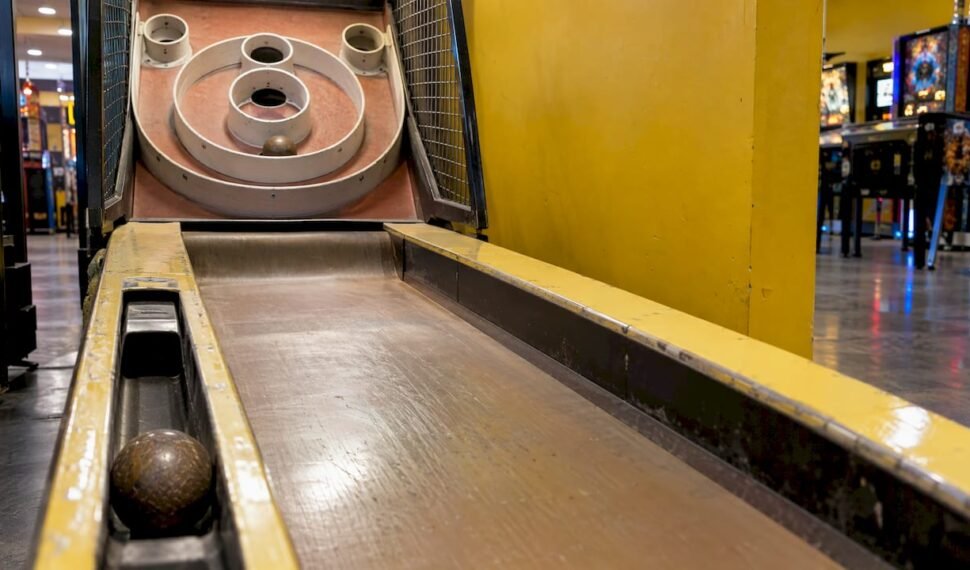
In a standard arcade game of Skee-Ball you roll nine balls up a ramp, each ball lands in a scoring pocket, and your final score is the sum of all nine rolls. Pockets farther back and smaller are worth more. Most lanes run 10, 20, 30, 40 and 50 points, with two 100-point corner pockets. That is the whole engine. The rest of this guide covers what changes around it: what a perfect-looking 360 means, how leagues rewrite the arithmetic, and how to turn a pile of points into a smarter target.
TL;DR
- A normal game gives you nine balls, and the machine adds up all nine rolls for your final score.
- Typical pocket values are 10, 20, 30, 40 and 50, plus two 100-point corner pockets. Smaller, farther pockets pay more.
- Nine balls in the 40 pocket make 360, a result players call a “circle”.
- League play often divides machine scores (by 10 or by 1,000), adds bonuses, and uses its own frame rules, so always read the house rules.
- Arcade points are not the same as prize tickets. Redemption depends on the venue.
Table of Contents
- How Skee-Ball scoring works
- What each pocket is worth
- How a full game adds up
- Do the rules change by machine or venue?
- League and team scoring
- Bonus points in Skee-Ball
- Game score is not prize tickets
- Aim like a scorer
- Scoring at a group event
- Plan a competitive event with us
- FAQ
- Sources
How Skee-Ball scoring works
You roll balls up a lane, over the ball-hop, and into a ring-shaped pocket. Skee-Ball’s own guide describes the basic idea: nine balls, and the farther-back pockets are worth more points. A ball that lands in a pocket scores that pocket’s value. A ball that never makes it into a target and rolls back is a zero for that turn. The Skee-Ball Classic service manual says the same thing from the machine’s side: points are awarded when balls enter the target holes, and balls that fail to reach a target return and register as zero.
The machine decides when your game ends. According to the same manual, it normally stops once the programmed number of balls, usually nine, has been counted by its ball-count and playfield sensors. So you never tally anything yourself. The display climbs ball by ball, and the last ball locks in your total.
There is one subtle point worth knowing. Because scoring is sensor-based, what counts is the pocket the ball settles in, not where it bounced on the way. A ball that jumps the 50 ring, clips the rim and drops into a 20 scores 20. The ramp is a lottery at the top end, which is exactly why smart players think in probabilities, not hopes. More on that below.
What each pocket is worth
The layout is a set of concentric rings, with two smaller holes in the top corners. A Billiard Factory guide says traditional machines typically have rings worth 10, 20, 30, 40 and 50 points plus two 100-point corner pockets. Mental Floss reported the same pattern in 2021: most lanes score by tens from 10 through 50 and have two 100-point corner pockets.
Here is the standard layout in one place:
| Typical value | Where it sits | Difficulty | |
|---|---|---|---|
| Outer ring, lowest | 10 | Closest to you, widest | Easiest |
| Second ring | 20 | Just behind the 10 | Easy |
| Third ring | 30 | Middle of the board | Moderate |
| Fourth ring | 40 | Upper middle | Moderate to hard |
| Smallest ring | 50 | Top centre, smallest | Hard |
| Two corner pockets | 100 | Upper left and right | Hardest, small and off to the side |
At the 2019 New York State Fair, a Syracuse.com piece noted that pockets were worth 10, 20, 30, 40 and 50 points, with the smallest worth 50. Some machines add a 100-point bonus hole instead of two corner pockets, according to Gaming Weekender’s guide. In other words, the common progression is dependable, but the top end is not identical on every machine. Glance at the numbers printed on the playfield before your first ball.
Why the 100s are not the best target
The corner pockets look like the jackpot, and they are tempting. They are also the most punishing to aim for, because the holes are small and sit away from the centre line where your ball naturally travels. A miss usually lands in a low ring or rolls back for nothing.
The pros agree. Mental Floss reports that a champion favoured hitting the 40 on command, and that he aimed for the 100 in his first championship match and lost. Skee-Ball’s official guide recommends the 40 pocket as a practical target for the same reason: nine hits yield 360, while near-misses can still land in the adjacent 30 or 50 pockets.
How a full game adds up
The final score is the sum of nine throws, and a few benchmark totals help you read your own results. All of these assume the common 10 to 50 layout.
| Nine-ball result | Total |
|---|---|
| Every ball in the 10 | 90 |
| Every ball in the 20 | 180 |
| Every ball in the 30 | 270 |
| Every ball in the 40 | 360 |
| Every ball in the 50 | 450 |
A game of all 40s is the famous 360. Mental Floss explains that nine balls in the 40-point pocket total 360, commonly called a “circle”. It is a respectable score and a deliberately reachable goal, because the 40 is not the smallest pocket.
A worked example
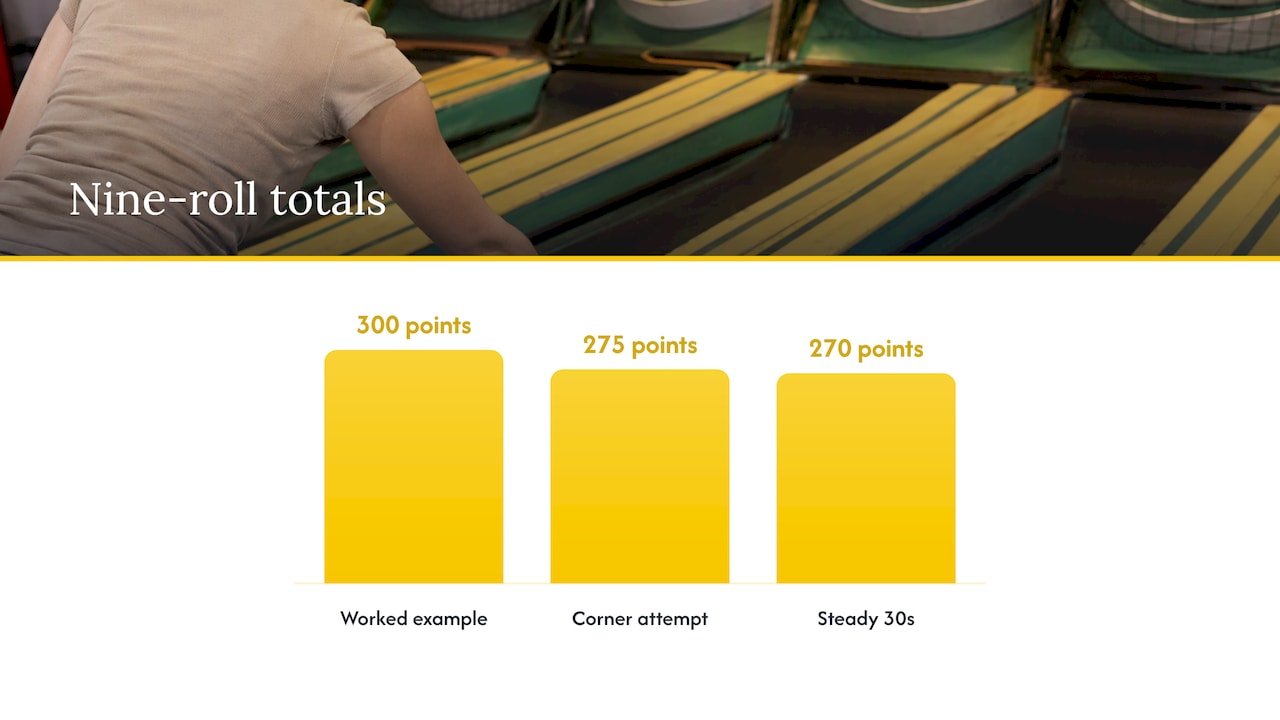
Suppose your nine rolls go like this: 30, 40, 40, 20, 40, 50, 30, 40, 10. Add them and you get 300. Notice what happened: five balls hit the high pockets, one dropped to a 10, and you still beat the 270 you would get from a perfectly steady run of 30s. Consistency in the middle rings beats a few heroic shots and a lot of zeros.
Now compare a swing for the corners. Say you aim at the 100 on every ball and hit it twice, the rest landing on a mix of 10s, 20s and two rollbacks. Two 100s give 200, and five low balls averaging 15 give 75, for 275. You worked harder and took more risk than the steady 40 strategy for less return than a 300. That is the arithmetic behind the champion’s advice.
Do the rules change by machine or venue?
Yes. The pocket values above are common, not universal, and the way you add games together depends on who is running the night.
DC Fray’s December 2024 rules describe machines of different ages, models and styles. Its traditional format has 12 regular frames and a specialty frame, while its alternate format is a best-of-nine-frames series. Scores are divided by 10 for league math, and scoring errors that cannot be settled are decided by the host. Penn Social Sports similarly warns that mixed machine models, styles and ages can produce scoring errors, and that you must report one immediately. Unresolved corrections are decided finally by the host, not by a replay.
The conversion differs too. Bell Music’s league rules divide the machine score by 1,000 and drop three zeros, which shows that league arithmetic belongs to the ruleset, not to the game itself.
A practical takeaway: before a social league night or a friendly tournament, ask three things. How many balls make a frame? Is the machine score divided before it is added? Who settles a dispute?
League and team scoring
In a league, you are rarely trying to hit a single high number. You are trying to win frames or accumulate a team total.
- Full frames per player. DC Fray’s rules require each present, able team member to roll a full nine-ball frame.
- Frame wins. Bell Music’s league rules say a match is two teams rolling 10 frames, with each frame treated as its own game. The team with the higher frame total takes the frame win. Their example adds three players’ scores, 280 + 210 + 360 = 850, against 300 + 360 + 410 = 1,070, and records the frame for the higher total.
- Combined totals. JAX Fray’s rules say the team with the highest combined total across its 12 frames wins, after frame scores are divided by 10 for addition. They also award a 100-point bonus to the roller with the highest score after a single nine-ball round.
The divide-by-10 habit exists for readability. A team total of 4,200 on the machine becomes 420, which is far easier to keep on a sheet. It also means the unit digit is always dropped, so a 5-point cheer bonus in machine terms looks different from a raw score.
Bonus points in Skee-Ball
The machine itself has no bonus round on a standard lane. Bonuses belong to leagues and house rules. JAX Fray’s bonuses include 50- or 100-point cheers, a mystery round and a 100-point skee-off bonus. In its system, an opponent-inspired cheer earns 100 machine points and a team-only cheer earns 50, and because league scoring drops a zero, these count as 10 and 5 points respectively.
If you are running your own game night, bonuses are an easy way to keep a lopsided match lively. A good rule of thumb is to keep bonuses small relative to a frame total, so that skill still decides the result. Write them down before the first ball, because arguments about bonuses are the quickest way to sour a friendly evening.
Game score is not prize tickets
Skee-Ball scoring and redemption are two separate things. The general description of the game on Wikipedia distinguishes game score from payout: points determine coupons or prizes according to the individual machine’s or venue’s thresholds. A 300 at one arcade might hand you a long strip of tickets, and at another a modest one. If prizes matter to you, check the ticket chart on the machine, not the pocket values.
Aim like a scorer
Skee-Ball is mostly a game of repeatable motion. A few habits help whether you are chasing a circle or a team total.
- Pick the 40 and stay there. Using the 40 as your main target gives you a safety net: a slight miss usually lands in the 30 or 50 instead of a disaster.
- Standardize your release. Same starting spot, same grip, same arm swing, every ball. Changing three things at once makes it impossible to learn.
- Roll smoothly, not hard. A ball that hits the ramp hop with too much speed bounces over the target. Control beats power.
- Treat the first two balls as calibration. Notice where the ball lands relative to the 40 and adjust by a hand’s width.
- Do not chase. After a bad ball, return to your target. Aiming for the 100 to “catch up” mostly adds zeros.
If you like the idea of building a skill in short, structured sessions, the same principle applies to table sports. Our four week ping pong skills plan uses 15 to 30 minutes a day for exactly that reason.
Scoring at a group event
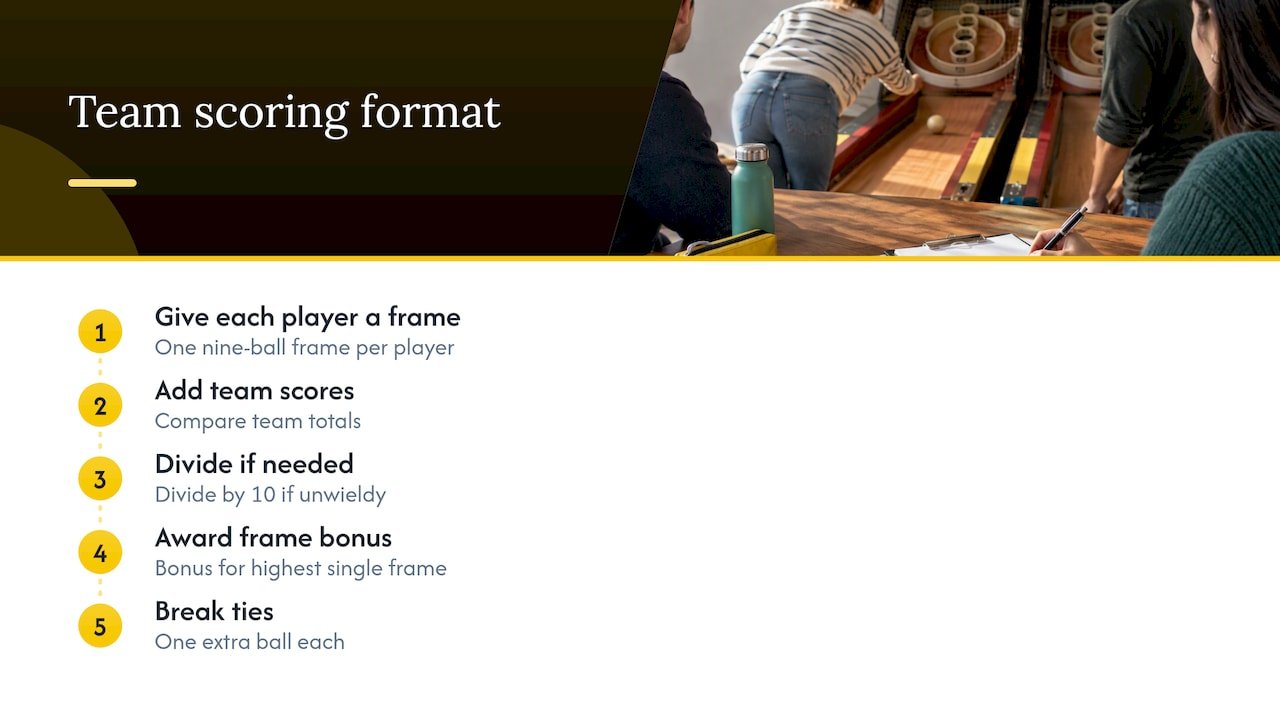
If you are planning a party and want Skee-Ball style competition, the cleanest format is a simple team frame system. Give each player one nine-ball frame, add the team’s scores, and compare totals. Divide by 10 if the numbers get unwieldy. A bonus for the highest single frame keeps individuals invested, and a tie can be settled with one extra ball each.
That format works for other games too. Scoring clearly in advance is as important in arcade rooms as it is on an axe throwing lane, where scoring rules and league rules decide who wins. If your group likes a lot of variety, our guide to arcade party games walks through what is included and how to book. For more machines to try, see our picks of classic arcade games.
Our perspective
We run group events, and the pattern is the same whether the game is darts, dodgeball or an arcade lane: people enjoy competing most when the scoring is simple, visible and agreed before the first turn. A nine-ball frame, a clear target and one tiebreaker give a mixed group of kids, parents, coworkers and teammates a fair shot at winning.
That is why we build our packages around a mix of activities, from combat archery and Nerf battles to ping pong, dodgeball and arcade games, with planning support so someone else handles the details. Scoring is part of the design: we want the quietest person in the group to feel a good roll is as satisfying as a loud win.
Archers
Plan a competitive event with us
If the scoreboard is what your group is after, a party or team event built around several games keeps everyone engaged. Our kids’ birthday party packages start with Game On Birthday Party from $399 and Epic Birthday Party from $499. For corporate groups, the team building page lists Collab Package from $699, and sports teams can look at Game On Team Battle from $399. Adults looking for a party can compare the event packages, which start at $299 with Pong & Party On.

If you want arcade games in the mix, mention it when you inquire, and we will help plan the format and the scoring that suits your group.
FAQ
How many balls do you get in a game of Skee-Ball?
A standard arcade game normally gives nine balls, and the final score is the sum of the nine throws. Gaming Weekender describes this as the standard. League formats can use different frame structures, but each player’s frame is usually nine balls.
What is a perfect score in Skee-Ball?
In theory, nine balls in the highest-value pocket is the maximum, but that is nearly impossible on most lanes. The score people celebrate is 360, nine balls in the 40 pocket, often called a circle. It is a realistic and impressive target.
Are Skee-Ball points the same as tickets?
No. Your game score is the total of the pockets you hit, while tickets or prizes depend on the venue’s or machine’s redemption thresholds. Check the chart on the machine to see how your points convert.
Why do league scores look smaller than machine scores?
Many leagues divide the machine score so the numbers are easier to add. JAX Fray and DC Fray divide by 10, while Bell Music’s rules divide by 1,000. If you join a league, ask which conversion it uses.
Sources
- Tips and Tricks: How to Play Skee-Ball
- Skee Ball Classic service manual
- 7 Pro Tips for How to Improve Your Skee-Ball Game, Mental Floss
- Skee-Ball Guide: Origins, Rules & Tips, Billiard Factory
- NYS Fair 2019: How to beat Skee Ball on the Midway
- Skee-Ball: How To Play and Improve Your Score, Gaming Weekender
- DC Skeeball Rules, updated December 2024
- Social Skeeball Rules, Penn Social Sports
- Skeeball League Rules, Bell Music
- Skeeball Rules, JAX Fray
- Skee-Ball, Wikipedia


