
The simplest safe ruleset works like this: everyone wears eye protection, nobody takes an intentional face shot, physical contact is banned, and you pick one life or respawn system before the whistle blows. Everything below breaks that headline into a printable rulesheet, five ready-to-run game modes, and the setup details that keep a backyard battle or a hosted event running without arguments.
TL;DR:
- Eye protection is mandatory for all players and referees, with no exceptions for spectators, to prevent serious eye injuries.
- The recommended respawn systems include single elimination, three lives with 15-second respawns, or five-hit eliminations, depending on group size.
- Safety violations such as face shots or unauthorized contact result in immediate game hold and referee intervention, with penalties for repeated offenses.
- Field boundaries should be clearly marked, and teams balanced by age and skill to ensure safe, fair gameplay with appropriate supervision ratios.
- Using trained staff from a professional venue can simplify safety management and eliminate setup complexities for large or mixed groups.
Table of Contents
- Nerf Battle Rules for Safety and Equipment
- How Hits, Lives, and Respawns Actually Work
- Popular Nerf Game Modes and Their Basic Rules
- Setting Up the Field, Teams, and Supervision
- A Ready-to-Print Rulesheet and Pre-Game Checklist
- Why a Hosted Venue Handles Safety Better
- Getting Players and Gear Ready Before the First Round
- Handling Disputes and Rule Violations Mid-Game
- Running a Tournament or Multi-Round Nerf Event
- What Actually Matters More Than the Rulebook
- Book a Supervised Nerf Battle and Skip the Setup
- Where to Find Official Rule Templates and Safety Guidance
- Sources
Nerf Battle Rules for Safety and Equipment
Eye injuries are the real risk in any Nerf fight, not bruises or scraped knees. Medical reporting on toy blaster injuries points to the eyes as the primary site of serious harm, which is why every credible ruleset treats eye protection as non-negotiable rather than optional gear. Safety glasses or full-coverage goggles go on before anyone picks up a blaster. No exceptions for “just watching” from the sideline, either, since stray darts don’t check spectator status.
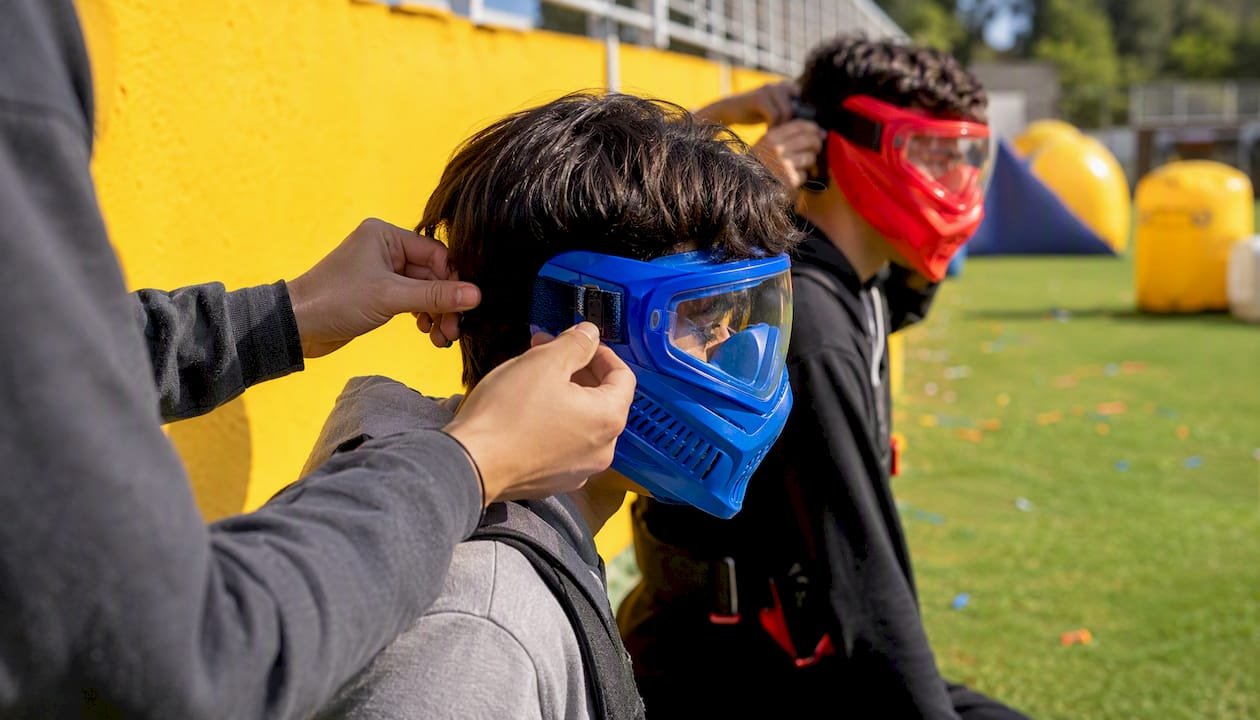
Face shots are banned outright, even when they’re accidental. Call it a friendly-fire violation and move on. Physical contact is banned too. Melee combat, if you allow it at all, means a light tap with a foam blade or hand, never a shove, tackle, or grab. This is a projectile game, not a wrestling match.
On equipment, allow spring-action and flywheel blasters that ship stock from the manufacturer. Modified blasters (spring upgrades, rewired motors) are the gray zone: only allow them if every other player on the field consents to being shot with one, or if you’ve velocity-tested it against a house limit. Ban CO2 conversions and anything that clearly outperforms stock ammo speed. That’s not a judgment call you want to make mid-game.
Ammo limits matter more than most organizers realize. Cap magazine sizes and total dart counts so players can’t just spray and clear a room. A hit counts if a dart makes visible contact or sticks to clothing, and blind firing around a corner without a visual on the target isn’t allowed, since it defeats the entire point of tactical play.
- Eye protection mandatory for every player and referee on the field
- No intentional face shots, ever, even in the heat of a round
- No physical contact beyond a light melee tap
- Modified blasters allowed only with mutual consent or velocity testing
- Ammo caps enforced per round to prevent spray-and-pray tactics
Referees run the field with two signals: one whistle blast for “hold” (a safety pause, everyone freezes and lowers blasters), two blasts for “resume.” A raised hand or continuous whistle means stop everything immediately, usually for an injury. Whoever calls hold has the authority to clear the field, get a first-aid kit, or end the round on the spot.
Pro Tip: Assign one non-playing referee per 15 to 20 players. A referee who’s also dodging darts can’t watch for safety violations, and that’s when things go sideways.
How Hits, Lives, and Respawns Actually Work
Pick one preset before the game starts, not halfway through when someone disputes a call. Three systems cover almost every group size and skill level, and community rule templates consistently point to these as the standard defaults.
- Single elimination: one hit and you’re out for the round. Works best for small groups of 6 to 10 where rounds run fast and everyone gets multiple games.
- Three lives, 15-second respawn: get hit three times before you’re benched, with a 15 second countdown before re entering from a designated spawn point. Best for 10 to 24 players and longer sessions.
- Five hit count out: track hits per player up to five before elimination, useful for larger groups of 20 plus where you want longer individual survival time and less downtime.
Respawn mechanics need a visible signal. When hit, the player raises their blaster overhead, walks (never runs) to the spawn zone, and counts aloud to 15 before stepping back in. No sneaking back early. No respawning behind enemy lines either; designate one or two fixed spawn points per team.
Calling hits runs on the honor system first. If a player says you hit them, accept it, even if you disagree. Chronic false-calling (claiming hits that clearly missed, or refusing to accept a fair hit) gets a warning, then a one-round bench penalty for a repeat offense. A referee’s call overrides any player dispute, full stop.
Friendly fire is treated as an accident unless it’s clearly deliberate. Accidental face shots still stop play immediately. The shooter apologizes, and the game resumes on the next whistle. Deliberate friendly fire or repeated face shots earns an ejection from that round. Referees use hand signals for hits they witness directly, but they should intervene sparingly. The best-run games are the ones where players police themselves honestly.
Popular Nerf Game Modes and Their Basic Rules
Once your safety rules and respawn system are locked in, the game mode is just the flavor on top. Here’s what works, drawn from standard game-mode references that hobbyists and organizers rely on.
Elimination / Team Deathmatch. Split into two even teams, play to a target score (say, first to 20 eliminations) or a time cap of 15 to 20 minutes. Works on a field as small as a gymnasium or as large as a wooded lot. Best with 8 to 30 players split evenly.
Capture the Flag. Each team protects a flag at their base and tries to grab the opponent’s. The flag carrier can’t shoot while holding it, must be visibly carrying it (not tucked into a pocket), and gets “freed” back to their own base if tagged. First team to score two captures, or most captures within 20 minutes, wins.
Control Points / Siege / Attack and Defend. Mark two or three zones on the field. Attackers must hold a zone uncontested for a set count (10 seconds works well) to capture it; defenders respawn faster near their own points to keep pressure even. Score by total zones held at time’s end.
VIP / Protect the VIP and Hostage. One player per team is designated VIP and gets extra lives (usually double the standard preset) since losing them ends the round instantly. The opposing team wins by eliminating the VIP or, in Hostage variants, by extracting a captured teammate to a safe zone.
Freeze Tag. A hit freezes you in place, hands raised, until a teammate runs over and taps you to reset. No hiding while frozen, and frozen players can’t call out enemy positions. The round ends when one team is fully frozen or time expires.
Humans vs. Zombies. A long-play mode, often running an entire event or weekend. Humans use blasters; zombies tag humans by hand (no throwing, no blasters for zombies) to convert them. Bandannas mark team status, worn on the arm for humans and the head for zombies. This mode needs closer supervision since the tag mechanic replaces darts, and physical-contact rules still apply. No grabbing, only a light touch tag.
- Meatgrinder: a 60-second free-for-all warmup where everyone’s against everyone, great for loosening up a group before team rounds start.
- Gunslinger Heaven: fast one-on-one duels rotating through a bracket, useful for skill warmups or filling dead time between main rounds.
Setting Up the Field, Teams, and Supervision
A safe field starts with clear boundaries. Use cones, tape, or natural markers (tree lines, fence edges) so players know exactly where play stops. Keep at least one obstacle-free lane running through the field as a runway, since trips over cables, roots, or gear bags account for a lot of avoidable injuries. Cover placement (barrels, crates, low walls) should never sit near the boundary edge, where players tend to collide while backing up under fire.
Balance teams by age and skill, not just headcount. A field of 10-year-olds and 16-year-olds on mixed teams almost never plays fair; split by rough skill tier if ages vary widely. Cap each field at roughly 20 to 30 active players for a standard suburban lot; anything larger needs a bigger space or a second field running in parallel. Supervision ratios matter more with younger groups. Aim for one adult per 8 to 10 kids under 12, loosening to one per 15 for teens.
- Mark boundaries with visible tape, cones, or terrain features before players arrive
- Balance teams by skill and age, not just even numbers
- Distribute ammo evenly and designate a neutral resupply cache mid-field
- Set up a spectator zone outside the boundary with its own eye-protection rule if darts can reach it
- Run a 30-second equipment check (blaster function, eye gear fit) before every round
- Lower velocity limits and increase respawn frequency for mixed-age or under-10 groups
Resupply caches work well for longer rounds. Drop a bin of loose darts at a neutral, contested point on the field so ammo scarcity becomes part of the strategy rather than a game-ending problem. Check in players at the start and check them out at the end, especially for larger group events, so nobody wanders off mid-battle without anyone noticing.
A Ready-to-Print Rulesheet and Pre-Game Checklist
A one-page rulesheet keeps every round consistent. Print one with these fields filled in: game mode, lives/respawn preset, safety rules, referee signals, and penalties for violations. Post it at the check-in table or hand out a copy per team captain.
Run this checklist before the first whistle:
- Confirm the venue or lot is clear of hazards and boundaries are marked
- Fit-check every player’s eye protection
- Assign at least one referee per 15 to 20 players
- Test the whistle and confirm hold/resume signals with everyone
- Brief teams on the chosen preset and game mode
Three presets cover almost any group:
- Quick-play: single elimination, 10 minute rounds, no melee, ideal for small groups short on time
- Family friendly: 3 lives with 15 second respawn, lower velocity blasters only, tighter supervision for mixed ages
- Competitive: 5 hit count out, full game modes like Capture the Flag or Control Points, referee-enforced penalties for disputes
Why a Hosted Venue Handles Safety Better
Running your own field means you’re the referee, the safety officer, and the equipment manager all at once. A hosted Nerf Battle venue removes that burden entirely. Archersbattlefield supplies trained staff who referee every round, protective eyewear fitted for each player, and insured indoor space designed specifically for this kind of play, so nobody’s improvising boundaries with garden hoses.
The tradeoff is straightforward. DIY works fine for a small backyard group of friends who already know each other’s comfort level with contact and calling hits. A booked venue makes more sense for larger groups, mixed-age birthday parties, or corporate events where you want a turnkey setup with zero prep. If you’re planning something bigger than a dozen kids, check kids birthday party packages built specifically around structured group play.
Getting Players and Gear Ready Before the First Round
Blasters need charging or fresh batteries the night before, not the morning of. Test every blaster’s firing mechanism and check for jams; a jammed blaster mid-round is how disputes start, since a player will insist they fired when nothing actually left the barrel. Sort ammo by type and count it out per team so nobody starts short.
Briefing players matters as much as the gear check. Walk through the chosen game mode out loud, even with returning players, since rules drift in memory between sessions. Cover the respawn procedure specifically: where the spawn zone is, how the countdown works, and what “hold” means when the whistle blows. A five-minute briefing prevents most of the confusion that turns a fun round into an argument.
Fit-check eye protection on every player, including anyone borrowing gear from a sibling or a spare bin. Loose-fitting goggles that slide down during a sprint defeat the entire purpose. For younger players, do a quick physical check that blasters aren’t set to any velocity beyond stock, since kids sometimes bring modified gear from home without realizing it changes the safety math.
Finally, walk the field boundaries with players before starting. Point out spawn zones, cover, and any hazards you noticed during setup. Players who know the terrain make fewer panicked, unsafe decisions once darts start flying, and that short walk-through costs you two minutes but saves the whole group a lot of confusion later.
Handling Disputes and Rule Violations Mid-Game
Most disputes come down to one thing: did that dart actually hit, or didn’t it? Local rec department rule sheets consistently land on the same fix: honor system first, referee decision final. If a player calls a hit on themselves honestly, respect it immediately, no arguing back. If two players disagree and no referee saw it, the shooter’s call stands, since dispute-resolution guidance from rec operators treats the benefit of the doubt as going to whoever claims the hit rather than whoever denies it.
For safety violations (a face shot, unauthorized contact, or someone firing a clearly over-limit blaster) call “hold” immediately rather than letting play continue while you sort it out. Everyone freezes, referees handle the situation, and play resumes only once it’s resolved. Don’t wait for the round to end naturally; a safety issue during active play needs an immediate stop.
Repeat offenders get a structured penalty ladder rather than an on-the-spot ejection for a first mistake. A first violation earns a verbal warning. A second earns a one-round bench. A third, especially involving contact or a deliberate face shot, means removal from the event entirely. Keep this ladder consistent across every round and every team, since selective enforcement is what actually breaks trust in a group game, more than any single missed call.
Write the penalty structure into your rulesheet ahead of time so nobody feels singled out when it gets applied. A rule everyone saw in writing before the game starts is a rule people accept in the moment.
Running a Tournament or Multi-Round Nerf Event
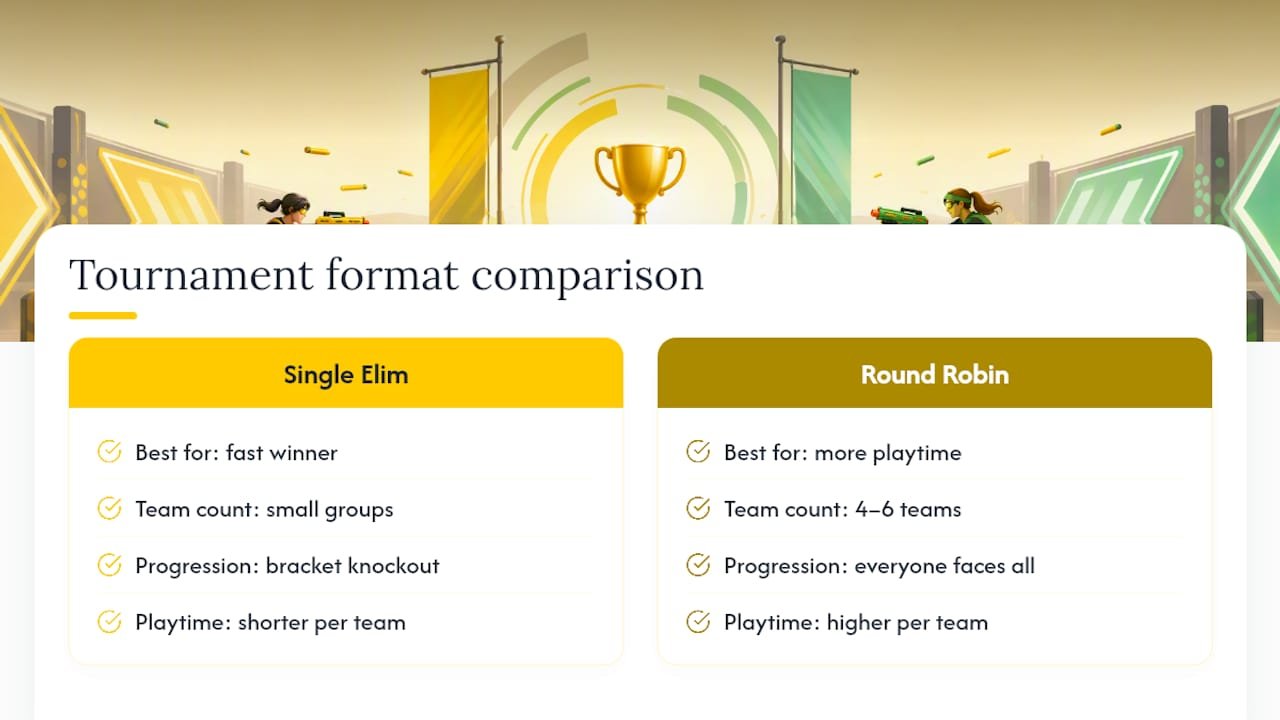
A single afternoon of casual rounds is one thing. A structured tournament with brackets and standings is another, and it needs a bit more planning up front. Start with a format: single elimination brackets work for smaller groups wanting a fast winner, while round robin play (every team faces every other team) suits groups of four to six teams who want more total playtime per team.
Standardize the preset across every round. Switching between single elimination and 5-hit count out mid-tournament makes scoring comparisons meaningless and confuses referees who are tracking multiple games. Pick one preset, one game mode rotation, and stick with it for the whole event.
Build in recovery time between rounds. Ten to 15 minutes lets players rehydrate, swap out spent ammo, and lets referees reset the field and clear stray darts. Skipping this step is how fatigue-driven safety violations creep in during the later rounds of a long event.
Track scores on a visible board, whether that’s a whiteboard, a printed bracket sheet, or a phone note passed between referees. Disputes about standings are just as disruptive as disputes about hits, and a visible running tally heads most of them off before they start.
For larger multi-team events, rotate referees between rounds so nobody’s making calls for six straight hours. Fresh eyes catch safety issues that a tired referee starts missing by round four. If you’re organizing something with a corporate or league feel, a venue built around structured group formats, like team building event packages, already has the referee rotation and scoring infrastructure worked out.
What Actually Matters More Than the Rulebook
Most Nerf rule debates focus on the wrong thing. People argue endlessly about melee mechanics or exact respawn timers when the real driver of a good, safe game is simpler: honest hit-calling and a referee everyone actually respects. A group that lies about hits will ruin the most carefully written rulesheet, and a group that calls fair will make even a loose, improvised ruleset feel great.
The conventional advice out there overindexes on game mode variety, listing 20-plus modes as if novelty is the goal. It isn’t. Three solid presets and two or three well-run modes beat a dozen half-understood ones every time. Complexity is the enemy of a smooth pickup game, especially with kids or mixed-skill groups.
If you’re prioritizing one thing from everything above, make it eye protection and referee authority. Everything else, ammo caps, field size, exact respawn counts, is negotiable and adjustable to your group. Those two aren’t. Get those right and the rest of the rulebook mostly takes care of itself.
— Archers
Book a Supervised Nerf Battle and Skip the Setup
Running your own field means marking boundaries, briefing referees, sourcing eyewear, and hoping nobody argues about a hit call. Archersbattlefield’s Nerf Battle package skips all of that. Every session comes with supervised play, safety gear provided for each player, and a customizable format that scales from a small birthday group to a large corporate outing.
Trained staff referee every round, so disputes get resolved on the spot instead of derailing the game. Families and event organizers who’ve run their own backyard battles often come back specifically for the part where someone else handles the whistle, the eyewear fitting, and the boundary tape. If you’re planning a party, a camp day, or a team outing and would rather show up and play than spend an evening printing rulesheets, book your session now and lock in a time slot.
Where to Find Official Rule Templates and Safety Guidance
Organizers who want more depth than a single article can pull from a few standing resources.
- The Union County YMCA rule PDF offers standard event-ready wording for respawn systems and conduct rules.
- CTV News coverage of eye injury risk lays out the medical case for mandatory eyewear.
- The Nerfguns covers dozens of additional variants beyond the core modes here.
- ToylandEU’s safe-play guidance adds a third-party perspective on toy blaster safety for families.
- Dreamscape Kids Entertainment’s party game guide is useful for warmups and pacing activities around the main battle.
Sources
- Doctors warn about risk of eye injuries from Nerf toy guns – CTV News
- NERF WAR RULES – Union County YMCA (PDF)
- NERF War Game Rules and Variants – Blaster Piece
- Nerfguns


