

A single checklist covers most of what stresses hosts out: budget, guest list, venue, food and cake, entertainment, decor, day-of zones, and post-party wrap-up. Set your budget, date, guest list, and venue first. Those four decisions shape every other choice you’ll make.
Here’s the one-page version: book your venue and set your budget well in advance, send invites and order the cake at 4 weeks, confirm RSVPs and prep decor a couple of weeks before, stage your setup zones the day before, run your schedule on party day, then send thank-you notes and review costs after.
-
Budget ceiling set before anything else
-
Guest list finalized with an RSVP deadline
-
Venue booked (home or external space)
-
Food and cake ordered
-
Entertainment or activities booked
-
Decorations and supplies staged
-
Day-of timeline written and helpers assigned
-
Cleanup and thank-you notes planned
Pro Tip: Print this list and tape it to the fridge. Cross off one line a week starting six weeks out, and the party plans itself.
Key Takeaways
A complete birthday party checklist works because it locks budget, guest list, venue, and timeline decisions early, then breaks execution into weekly checkpoints anyone can follow.
| Point | Details |
|---|---|
| Set budget first | A hard ceiling decided upfront shapes every other choice, from venue size to cake design. |
| Follow the 6/4/2 timeline | Book venue and vendors at 6 weeks, send invites at 4, confirm headcount at 2. |
| Scale lead time to guest count | Small parties need 3-4 weeks; large parties need 8-12 weeks of planning. |
| Limit structured activities | Two to three activities for kids and one signature activity for adults keeps energy balanced. |
| Close the loop after | Thank-you notes within a week and a quick budget review make next year easier. |
Table of Contents
- Birthday Party Checklist by Category
- What’s the Best Timeline for Planning a Birthday Party?
- When Should You Send Party Invitations?
- How Much Food and Cake Should You Order?
- How Many Activities Should You Plan?
- Where Should You Host the Party?
- What Decorations and Supplies Do You Need?
- What Does Day-of Party Execution Look Like?
- How Much Should a Birthday Party Cost?
- What Should You Do After the Party?
- Printable Birthday Party Checklist
- What Most Planning Advice Gets Wrong
- Ready to Book Your Party Activity?
- Frequently Asked Questions
- Sources
Birthday Party Checklist by Category
Breaking the big list into categories keeps you from forgetting the small stuff that causes day-of scrambling.
Invitations: finalize your guest list, set a firm RSVP deadline, add travel notes for out-of-town guests, and include a dietary field so allergies don’t become a last-minute problem.
Decor and supplies: tableware, linens, balloons, lighting, signage, and a trash plan. Save helium balloons for the day before or morning of, since standard latex balloons lose lift within about 24 hours.
Food and cake: decide your menu shape early, plan portions per guest, label dishes for common allergens, and lock in your cake order with enough lead time for custom designs.
Favors and extras: keep kids’ favors simple and low-cost; adults often skip favors entirely or get a small shared takeaway instead.
Safety and first aid: confirm your allergy plan with the caterer, post emergency contacts where helpers can see them, set a clear kid drop-off and pickup policy, and keep a basic first-aid kit on site.
What’s the Best Timeline for Planning a Birthday Party?
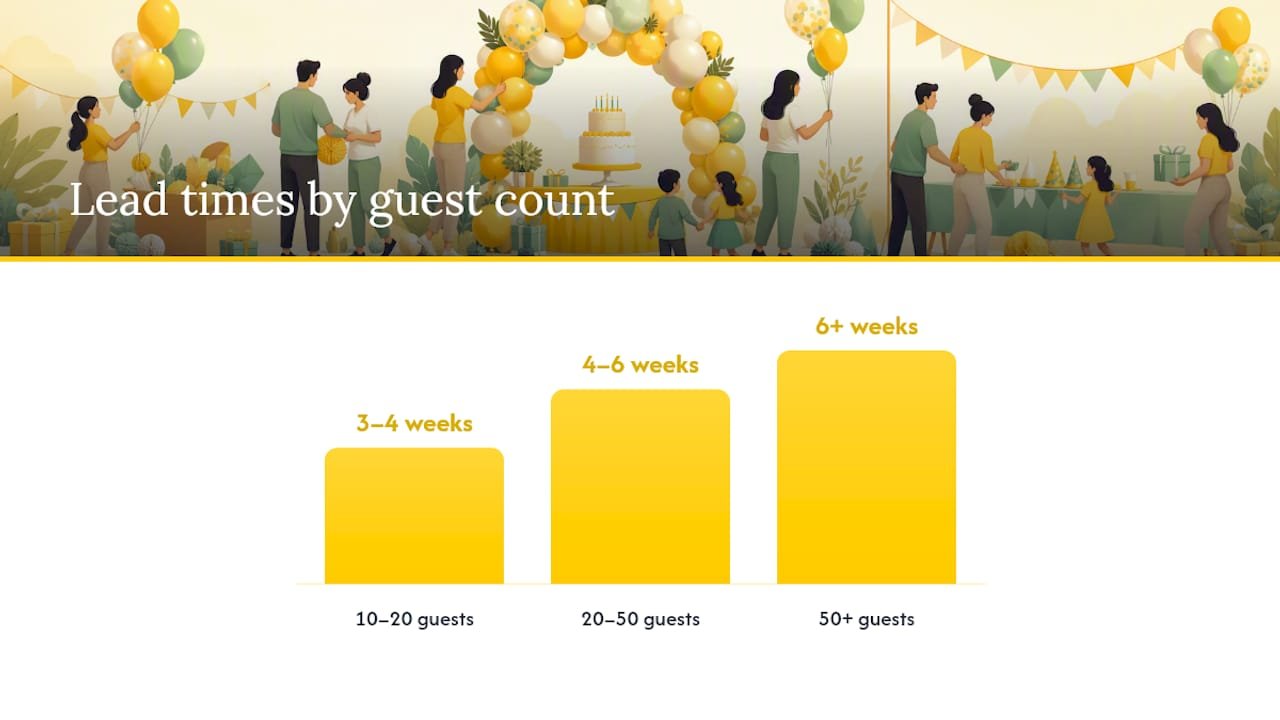
Lead times should scale with your guest count. Small parties of 10 to 20 people can come together in 3 to 4 weeks, medium parties of 20 to 50 need 4 to 6 weeks, and anything over 50 guests deserves a longer planning timeframe so venues and vendors aren’t scrambling to accommodate you.
| Timeframe | Key tasks |
|---|---|
| 6+ weeks out | Set budget, lock date and venue, choose theme, draft guest list |
| 4 weeks out | Send invitations, order cake, book entertainment, order supplies |
| 2 weeks out | Confirm RSVPs, finalize headcount, prep favors, assign helper roles |
| Day before | Pick up cake and perishables, pack day-of kit, inflate balloons, stage zones |
| Party day + after | Run the schedule, manage gifts, send thank-you notes, review budget |
A phased plan built around these five checkpoints keeps every task tied to a deadline instead of floating loose until the week of the party. Popular weekend venues often book up two to three months in advance, so that first checkpoint matters more than people expect.
- Lock your date and venue before announcing anything to guests
- Order the cake and book entertainment at the 4-week mark, not later
- Give yourself a full week of buffer between the RSVP deadline and party day
When Should You Send Party Invitations?
Send invitations 3 to 4 weeks out for a casual local gathering, and push that earlier if guests are traveling or the event is a milestone celebration. Every invite needs the date, time, location, dress code if relevant, plus-one policy, a dietary or allergy question, and a firm RSVP deadline set one to two weeks before the party.
- Set the RSVP cutoff and stick to it, then follow up personally with anyone who hasn’t answered
- Plan food quantities with a 10 to 15% buffer for late additions and no-shows
- Track every response in one spreadsheet or RSVP tool instead of scattered texts and DMs
- Digital invites are faster to track; paper invites feel more personal for milestone birthdays
Pro Tip: A dietary field on the invite itself saves you from discovering a peanut allergy the morning of the party, when your menu is already set.
How Much Food and Cake Should You Order?
Menu shape depends on who’s coming. Kids’ parties do best with finger foods, adult parties usually work better as a buffet or served meal, and mixed-age gatherings need a middle ground of easy snacks and drinks that appeal to everyone.
Custom cakes with detailed designs typically need 2 to 3 weeks of lead time, while a simple grocery store sheet cake can often be ordered with just a few days’ notice. Either way, confirm delivery time, who’s responsible for serving pieces and plates, and your final headcount with the bakery before the week of the party. A caterer’s festive menu list is worth reviewing if you’re planning a larger adult gathering with a served meal.
- Confirm your dietary field responses before finalizing the menu
- Lock in cake design and flavor at least 2 weeks out for custom orders
- Assign one person to handle vendor pickup or delivery timing on party day
Pro Tip: Order 10% more food than your headcount suggests. Leftovers are a much smaller problem than running out during cake time.
How Many Activities Should You Plan?
For a typical 2 to 3 hour kids’ party, plan on two to three structured activities. Adults usually need just one signature activity plus something for background entertainment, like music or lawn games.
Low-effort options work fine for smaller, casual gatherings: a craft table, a single skill-based game, a photo prop setup. For a bigger energy boost, an activity venue package handles the structure for you, which matters most for kids’ parties where unstructured downtime tends to turn into chaos fast. Nerf battles and similar high-engagement formats give kids a built-in win condition without you having to referee.
- Confirm activity timing, equipment needs, and a backup plan for weather or delays
- Ask about insurance and safety requirements before booking any physical activity
- Book entertainers or venue slots at the same 4-week mark as your cake order
Pro Tip: If you’re hosting adults, one well-run signature activity beats three half-hearted party games. Groups remember the thing they actually did together.
Where Should You Host the Party?
Home works well for small, casual gatherings where you control setup and cleanup. An external venue takes the pressure off for larger groups, bad weather, or anything involving equipment you don’t want to store in your garage afterward.
Whichever you choose, map out zones before guests arrive: a welcome area near the entry, a food and cake station, an activity zone, seating for socializing, a gift table, and a spot for trash and recycling. Before booking any venue, confirm availability windows, what furniture is included, power access, restroom locations, and whether cleanup fees apply.
- Count your guest list against the venue’s actual capacity, not its advertised maximum
- Ask about parking and load-in access, especially for larger groups
- Have a weather backup locked in if any part of the event is outdoors
What Decorations and Supplies Do You Need?
Buy non-perishable decorations, tableware, and signage early, then save helium balloons and fresh florals for the day before or morning of the party, since standard helium balloons often lose lift within 24 hours.
Pack a labeled day-of kit ahead of time: tape, scissors, extension cords, trash bags, serving utensils, and a basic first-aid kit. If you’re hosting at a venue instead of home, verify exactly what they supply. Missing a cake knife or a serving tray is a small thing that causes real friction on the day itself.
- Stage non-perishables at least a week ahead so day-before tasks stay light
- Inflate balloons the morning of unless you’re using Mylar or a full-day helium setup
- Keep your day-of kit in one labeled bin so nobody’s hunting for scissors mid-party
What Does Day-of Party Execution Look Like?
A simple, structured schedule keeps guests engaged without feeling over-programmed. Here’s a sample run sheet for a 3-hour party:
- Setup (2 hours before guests arrive)
- Welcome and mingling (30 minutes)
- Structured activities (45 minutes)
- Food service (30 minutes)
- Cake and candles (15 minutes)
- Wind-down, favors, and goodbyes (30 minutes)
Assign roles ahead of time so nobody’s improvising: a greeter to manage arrivals, a food manager, an activity leader, someone taking photos, and a cleanup lead. Keep a pen-and-paper gift log going so thank-you notes are easy to write later, and have a weather backup and extra seating ready just in case.
- Assign each helper role out loud, not just in your head, so everyone knows their job
- Keep the gift log next to the gift table, not in your pocket where it’ll get forgotten
- Stage trash bags and cleanup supplies before guests arrive, not after
How Much Should a Birthday Party Cost?
Set your ceiling before you book anything. That number decides your venue size, your food budget, and how much room you have for entertainment. A professional planner’s typical cost ranges land around $314 for a kids’ party and $800 to $1,500 for adult celebrations, though your actual number depends heavily on guest count and venue choice.
Treat this split as a starting point, not a rule. Spend where guests actually notice, usually food and entertainment, and trim decor or favors first if you need to cut back.
Pro Tip: Do a five-minute budget review right after the party while receipts are still fresh. It’s the single best thing you can do to make next year’s planning faster.
What Should You Do After the Party?
Send thank-you notes within a week, and mention the specific gift or gesture so they don’t read as generic. Compare your planned budget against what you actually spent, and jot down which vendors delivered and which didn’t.
- Send thank-you notes within one week of the party
- Reconcile planned vs. actual spend while details are still fresh
- Save your invite templates, playlist, and vendor contacts for next year
Printable Birthday Party Checklist
Save or print this condensed version for your fridge or planning binder.
- [ ] Set budget and lock the date
- [ ] Finalize guest list and RSVP deadline
- [ ] Book venue and entertainment
- [ ] Order cake and plan the menu
- [ ] Stage decor, supplies, and day-of kit
- [ ] Assign helper roles for party day
- [ ] Send thank-you notes and review budget
| Milestone | Action |
|---|---|
| 6+ weeks | Budget, date, venue locked |
| 4 weeks | Invites sent, cake and entertainment booked |
| 2 weeks | RSVPs confirmed, decor prepped |
| Day before | Zones staged, perishables collected |
| After | Thank-you notes sent, costs reviewed |
What Most Planning Advice Gets Wrong
Most birthday party advice treats kids’ and adult parties as if they need entirely different playbooks. They don’t. Both fail for the same reason: hosts try to program every minute instead of building a loose structure and letting the party breathe.
The overrated piece of advice is the “more activities equals more fun” logic. Two to three well-run activities beat five rushed ones every time, and the same holds for adult parties, where one strong centerpiece activity does more work than a string of forgettable icebreakers. What’s underrated is the budget ceiling. Set it first, and every other decision, venue size, guest count, cake complexity, gets easier to make instead of harder.
If you’re hosting a kids’ party and dreading the “what do we do for 45 minutes” gap, a structured activity format solves that problem better than a Pinterest board full of DIY games. Combat archery and Nerf-style formats give kids a built-in objective, which means less refereeing for you and less standing around for them. That’s the piece most checklists skip entirely, and it’s usually the difference between a party that runs itself and one where you’re improvising games at the last minute.

Ready to Book Your Party Activity?
If the entertainment section of your checklist still has a question mark next to it, an activity-based party package solves it in one booking. Archersbattlefield runs combat archery, Nerf battles, bazooka ball, dodgeball, and axe throwing sessions built specifically for kids’ birthday party packages and adult group celebrations alike. Groups looking for a why entertainment venues work so well for group events consistently point to the same thing: built-in structure means the host actually gets to enjoy the party too.
Whether you’re planning a high-energy kids’ party or an adult celebration that needs one memorable activity, you can check availability and book your session directly, no game-planning required on your end.
Frequently Asked Questions
What should be on a basic birthday party checklist?
A basic birthday party checklist covers budget, date and venue, guest list and invitations, food and cake, decorations, entertainment, a day-of schedule, and post-party tasks like thank-you notes and a budget review.
How far in advance should I start planning a birthday party?
Start 3 to 4 weeks ahead for a small party of 10 to 20 guests, and give yourself more time for larger parties or those requiring booked venues.
When should I send birthday party invitations?
Send invitations 3 to 4 weeks before a casual local party, or 6 to 8 weeks ahead for events involving travel or milestone celebrations, and always include a clear RSVP deadline.
How much food should I order per guest?
Plan your menu around your confirmed headcount plus a 10 to 15% buffer for late additions, and order cake with at least 2 to 3 weeks of lead time for custom designs.
What’s a good number of activities for a kids’ birthday party?
Two to three structured activities work well for a 2 to 3 hour party. Activity-based formats like Nerf battles or combat archery handle the structure for you, so you’re not refereeing games between courses.
Sources
- Birthday Party Checklist & Timeline: A Week-by-Week Plan | GiftList
- Birthday Party Planning Timeline: 4–12 Week Checklist (2026) | Party Genius AI
- How to Plan a Birthday Party in 10 Simple Steps | Paperless Post


