
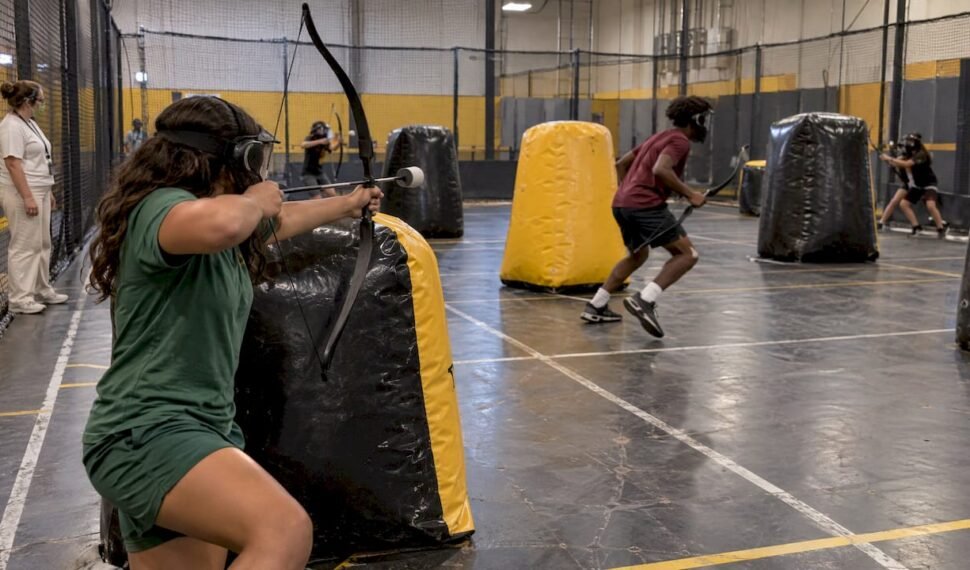
Combat archery works for a school group because it is a team game that gets every student moving, and nobody has to be good at archery to enjoy it. Students split into two teams, shoot foam-tipped arrows at each other from behind inflatable cover and dodge, and the game is built so that a hit player is not stuck on the sideline for long. At Archers Battlefield, we run combat archery in our indoor venue in Ontario for school field trips, youth groups and summer camps, alongside Nerf battles, dodgeball and other group games. This guide covers what teachers, coaches and camp leaders need to know: how a game runs, how to organize a class, what to check on safety, and how to book.
TL;DR
- Combat archery is dodgeball with bows: teams shoot foam-tipped arrows, dodge, and can bring teammates back into play by catching an arrow.
- Official Archery Tag rules use 5 v 5 teams and short 5-minute games, so a big class rotates through quickly and everyone plays often.
- Safety rests on face protection, foam-tipped arrows, strict shooting zones and a clear pregame briefing, all of which a venue should set up before students pick up a bow.
- Combat archery at Archers Battlefield is $35 per person. Group packages for team events start at $399.
- Tell us your group size, age range and time window, and we will help you build the day around them.
Table of Contents
- What combat archery is, in plain terms
- How a game works
- Why schools and youth groups book it
- Safety: what to expect before students shoot
- How to organize a school group, step by step
- Costs and what to budget
- Ideas for different school and youth groups
- What to tell your students before the trip
- Book a school or youth group day
- FAQ
- Sources
What combat archery is, in plain terms
Combat archery, often sold as archery tag, is a team sport that merges dodgeball-style elimination with archery. The International Combat Archery Association describes it as a high-energy team sport where catching an arrow can revive a fallen teammate, and says it is accessible for all skill levels while still rewarding strategy and shooting under pressure.
That last point is why it suits schools. A student who has never held a bow can contribute by dodging, blocking with a shield or cover, picking up arrows and calling out targets. A student who is strong at throwing sports can score. A quiet student can be the one who watches the flank. Unlike a traditional archery lesson, where each person shoots at a target in turn and most of the time is spent waiting, combat archery keeps all students active at once.
It is also not target archery. Nobody is aiming at a bullseye, and nobody shoots at a person who is not wearing protection. The goal is to eliminate opponents on the other side of the arena while staying behind cover.
How a game works
Venues adapt the format, but the published Archery Tag rules give a clear baseline. A regular game is 5 v 5 and lasts one 5-minute period. A hit scores 1 point, and an arrow caught in mid-flight scores 3 points. Players who are hit stay in the game, and shooting is only allowed from your own Action Zone. If a player lingers in the Neutral Zone, the middle strip of the arena, for more than 10 seconds, they get a warning, and a second offence costs the team 2 points.
A few things follow from those rules if you are running a class:
- Short rounds mean fast rotation. A class of 25 or 30 can be split into teams that take turns on the field while others wait, then swap, with only a few minutes between rounds.
- The zone rules protect pace and safety. Students learn quickly that you do not rush the middle of the arena, which keeps play orderly.
- Catching is worth more than hitting. That gives less confident students a reason to watch and react rather than just fire, and it rewards teamwork over raw aim.
For a deeper look at how a facility can vary play, our guide to archery tag game modes covers the formats that venues use. The pregame points we read aloud before every session are collected in combat archery rules.
Why schools and youth groups book it
Teachers and group leaders usually have the same short list of needs, and this activity answers most of them.
Everyone plays. Hit players stay in the game, so nobody sits out for long, which is the biggest complaint about classic elimination games like old-school dodgeball.
It builds the skills schools talk about. Communication, trust and shared tactics come up naturally. Students have to call targets, cover each other while someone retrieves arrows and agree on who pushes forward.
It works across abilities. Because points come from dodging, catching and positioning as well as shooting, mixed-ability groups are not dominated by the strongest athlete.
It makes a good reward or end-of-term day. Summer camps, year-end trips and sports banquets all want a single activity the whole group will talk about afterward.
If you are planning a camp week, you can mix it with other activities at our venue. We also offer Nerf battles, dodgeball, ping pong, axe throwing and arcade games, so a group that wants variety can rotate among several stations. For camps that run longer than a day trip, some leaders also look at a group glamping stay in Kentucky’s Red River Gorge to pair an outing with an overnight.
Safety: what to expect before students shoot
Safety is the first question any teacher or parent asks, and it should be. Combat archery is designed around low-power equipment, but it only works when the setup and the briefing are right. Here is what a school should expect.
Protective gear
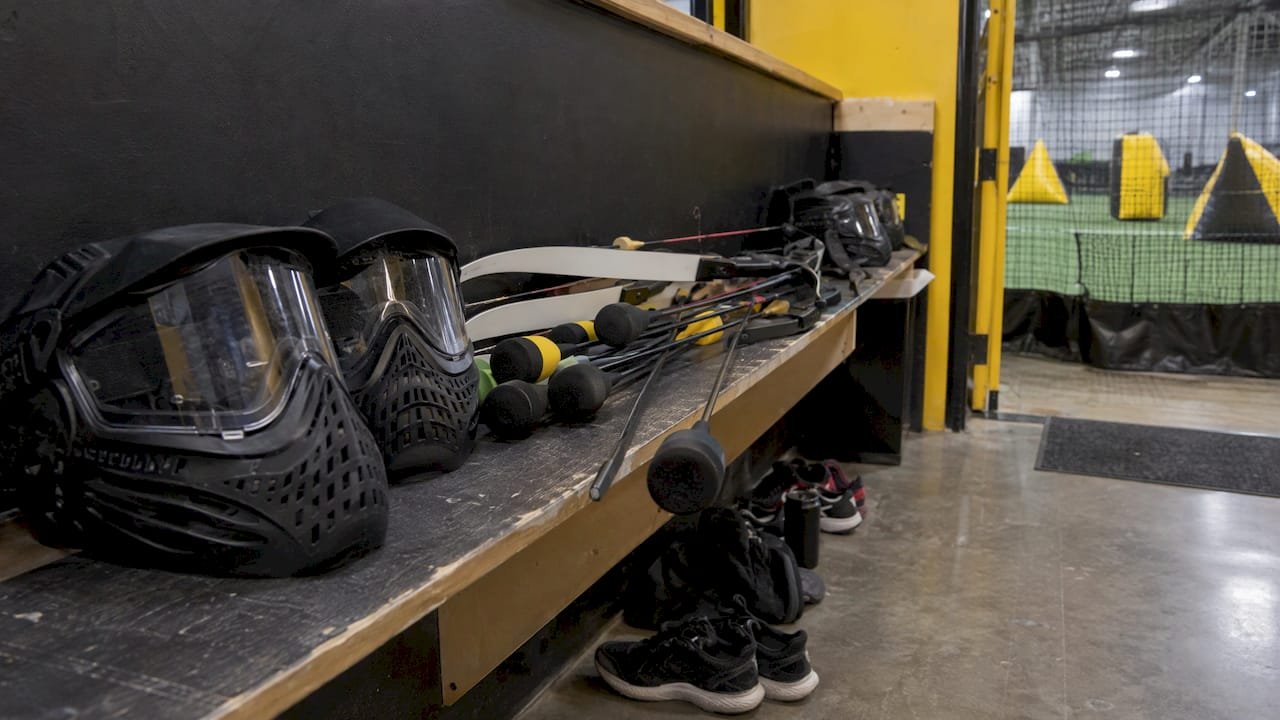
Players wear protective face masks. Published descriptions of the sport also note that the bows are low-draw-weight bows, under 30 lb, and that arrows have foam tips designed to hit without injuring. Closed-toe shoes and comfortable athletic clothing are the sensible choice for students, since they will be running, ducking and changing direction.
The briefing
Before a single arrow is nocked, a facilitator should walk the group through the rules: shoot only from your zone, never aim at an unprotected face, never remove your mask on the field, and stop when a whistle blows. Students should hear this together, and teachers should be nearby to reinforce it. We read our pregame points aloud for exactly this reason, and you can see them in combat archery rules.
The arena
A good arena has marked zones, inflatable cover, and enough room for dodging without collisions. Field dimensions and game length depend on each other, which we explain in combat archery field size. Our full approach to gear, rules and setup is in archery tag safety.
Supervision and health
Teachers stay responsible for their students throughout a trip, so plan chaperone numbers the way you would for any off-site visit and follow your school board’s trip policy. If a student has a medical condition, an injury or a mobility need, talk to the student’s parents or guardians and the school’s administration before the trip, and tell us when you book so we can plan the session with you.
How to organize a school group, step by step
Here is the routine we would follow if we were planning a class trip ourselves.
- Confirm the group size and age range. Numbers decide how many teams you can field and how many rounds each student plays. Give us a head count and the grade or age range when you inquire.
- Pick the format. For a single class, a straight tournament of 5 v 5 rounds works. For a larger group such as a full grade, you can run several brackets or alternate combat archery with a second activity so students are never idle.
- Choose the time window. Decide how long you have on site, including arrival, the pregame briefing, gear fitting and breaks. Our team can tell you what fits.
- Sort permissions and supervision. Collect consent forms under your school’s policy, and assign chaperones.
- Brief students before you arrive. Tell them what to wear, remind them the game is about teamwork, and explain that the venue’s rules are not negotiable.
- Send the group in teams. Mix friend groups so the game builds new connections. Appoint a captain for each team and rotate the role.
- Debrief at the end. Five minutes asking what worked and what the team would change turns a fun day into a team-building lesson.
At step 3 and step 6 we take a lot off a teacher’s hands: our venue provides the planning support, and our team customizes packages to the group size and type, so you are not working out the logistics alone.
Costs and what to budget
Here are the prices we publish for activities and packages. They apply to our venue in Ontario and are the prices as listed on our site.
| Option | What it is | Price |
|---|---|---|
| Combat Archery | Single activity session | $35 |
| Nerf Battle | Single activity session | $35 |
| Dodgeball | Single activity session | $30 |
| Ping Pong | Single activity session | $30 |
| Game On Team Battle | Team event package | from $399 |
| Epic Team Battle Event | Team event package | from $499 |
| Team Collab Package | Team event package | from $699 |
The team packages are on our sports team event page, and the team-building packages, including the Collab Package from $699, are on our team building page. Pricing is tiered by group size and features, so the right number for your class depends on how many students attend and what you add. Ask for a quote with your head count and we will tell you the exact figure.
A tip for budgeting: parent councils and school fundraising groups often cover year-end trips, and a package price shared across a large group usually works out to a modest per-student cost. Give the person managing the budget the package page and the group size, and they can do the math in a minute.
Ideas for different school and youth groups
Elementary and middle school field trips. Keep rounds short, run more of them, and let teams rotate between combat archery and a second activity such as dodgeball or a Nerf battle. Students spend less time waiting and more time playing.
High school teams and clubs. Sports teams use the game for conditioning with a purpose, because dodging, quick starts and communication carry over to their own sport. Leagues and tournaments can be run as brackets with a final.
Summer camps. Camp leaders can build a themed day around it: a tournament with team names, a capture-style round, and a finals match with the whole camp watching.
Student leadership and staff days. Teachers and staff can play too. A staff-versus-students match is a reliable way to close out a term.
Mixed-activity days. If you want to add variety, ask us about pairing combat archery with Nerf battle, dodgeball or axe throwing for older students, where age and supervision allow.
What to tell your students before the trip
A short message to students and parents prevents most problems on the day.
- Wear athletic clothes and closed-toe shoes you can run in.
- Tie back long hair and leave loose jewellery at home.
- Listen to the facilitator during the pregame briefing. The rules are the same for everyone.
- The goal is to play as a team. Calling targets and covering each other wins more than a lone shooter does.
- Our combat archery tips page is a quick read for students who want to know how to aim, move and win as a team.
How we think about school groups
We built Archers Battlefield around group play, and school groups are one of the clearest fits. A class does not need an archery background to get value from combat archery. What it needs is a clear briefing, enough space, protective gear and a format that keeps every student involved.
That is why we put so much weight on safety and on planning support. Teachers should arrive knowing the day is organized, and students should leave remembering the moment their team pulled off a catch or won the final round. Our packages are customized to group size and type, and our team helps you choose the activity mix that fits your class, camp or club.
If you are choosing between a quiet outing and one that gets a whole grade laughing together, we think combat archery is the stronger pick.
Archers
Book a school or youth group day
If you are ready to plan, start with the page that matches your group. Sports teams and leagues can look at our team event packages, where Game On Team Battle starts at $399 and Epic Team Battle Event starts at $499. Leaders who want a broader team-building day can see the Collab Package from $699 on our team building page. For a single combat archery session at $35 per person, or to ask about a field trip or summer camp date, contact us through our homepage with your group size, age range and preferred time.

Send us the basics and we will help you shape the format, the timing and the activity mix.
FAQ
What age can students start combat archery?
The right age depends on the venue’s policy and on the maturity of the group, since students must follow the safety briefing and wear face protection throughout. Tell us the grade or age range of your class when you inquire, and we will advise on how to set up the session for them.
How many students can play at once?
A standard game uses 5 v 5 teams, so ten players are on the field at a time. Larger classes rotate through in short rounds, which is why the game works for groups well beyond ten. Share your head count and we will tell you how the rotation would run.
Is combat archery safe for a school trip?
It is designed around protective face masks, low-power bows and foam-tipped arrows, with marked zones and a pregame briefing. Teachers should still follow their school board’s trip policy, arrange chaperones and tell us about any student medical needs when booking. Our approach is laid out in archery tag safety.
How much does it cost?
Combat archery at Archers Battlefield is $35 per person for a single activity. Team event packages start at $399 for Game On Team Battle, $499 for Epic Team Battle Event and $699 for the Team Collab Package, with final pricing based on group size and features.


