The best combat archery tips come down to four habits: grab arrows without exposing yourself, aim a little higher than feels natural, never stand still in the open, and talk to your team constantly. Get those right and you will outlast players who shoot more but think less.
Combat archery (also called archery tag) is dodgeball with bows. Two teams shoot large foam-tipped arrows at each other across an arena with barriers. It is a game, not a precision sport, so the skills that win are speed, positioning and teamwork. Below you will find what to do before the whistle, in the opening rush, while aiming and moving, and as a squad.
TL;DR
- Treat the opening rush as a resource decision: grab arrows quickly, then get back behind your line before you shoot.
- Foam arrows drop fast, so aim slightly above your target and release cleanly instead of rushing.
- Move between barriers, shoot from cover and never stall in the neutral zone.
- Assign roles (shooters, a runner, a spotter) and call targets out loud.
- Wear your mask, listen to the briefing and ask the referee about the venue’s house rules.
Table of Contents
- How a combat archery game works
- Before the first arrow: gear and mindset
- Win the opening rush
- Aiming tips for foam arrows
- Movement, cover and arrow retrieval
- Team strategies that actually work
- Stay safe and play fair
- Our perspective
- Ready to try it with your group?
- Common mistakes to fix fast
- A simple practice routine
- FAQ
- Sources
How a combat archery game works
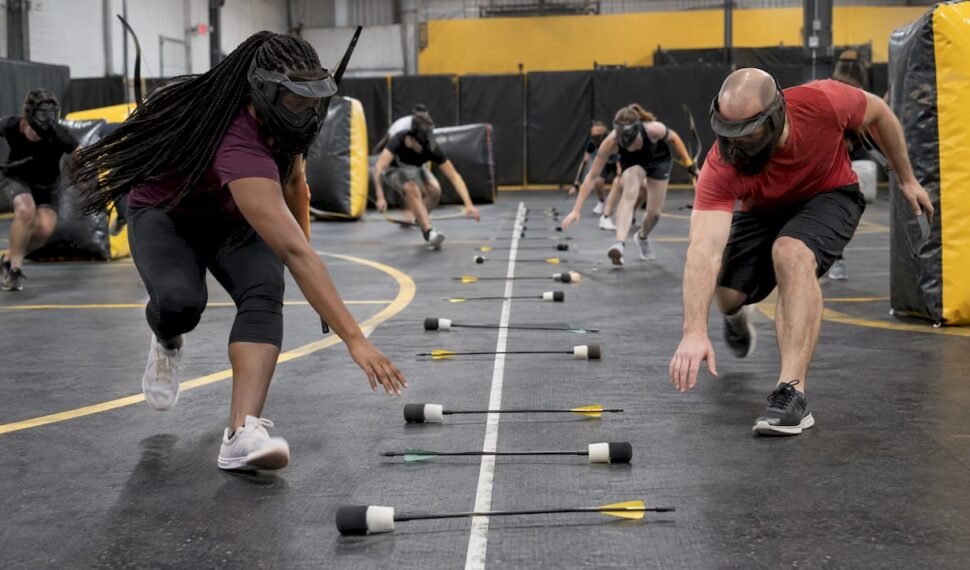
A typical round starts with arrows laid out in the middle of the arena. At the whistle, players run to collect them, then retreat and shoot at the other team. According to the official Archery Tag rules, arrows picked up during the opening rush are not live until the player is back in their own action zone. Players retrieving arrows later must return promptly, and you may not shoot from or at anyone in the neutral zone.
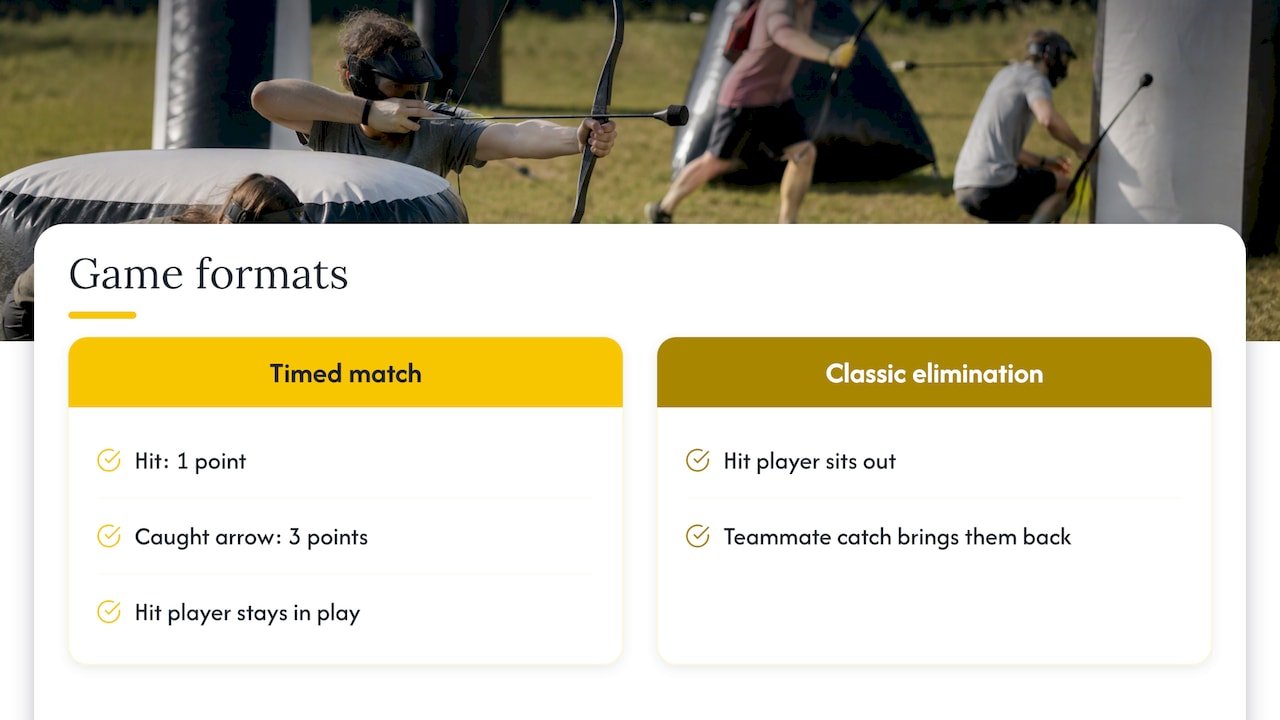
What happens when you are hit depends on the format. In the official timed match, a hit is worth 1 point and a caught arrow 3 points, and the hit player stays in play. In the classic elimination style most venues run for parties, a hit player sits out until a teammate catches an arrow and brings them back. Ask your host which version you are playing before the first whistle, because it changes how aggressive you should be. If you are curious how venues adapt formats, our guide to game modes venues use walks through them.
Before the first arrow: gear and mindset
You need no archery experience. Expect a safety briefing and a gear fitting, then wear a face mask, comfortable athletic clothes and closed-toe shoes. Closed-toe athletic footwear is standard advice for active games, and Nova Scotia’s physical education safety guidelines recommend appropriate athletic footwear and a pre-activity check of equipment and the playing space.
Three quick habits before play starts:
- Check your mask fits snugly. If it slips when you run, tell the referee. Our page on combat archery masks explains what they cover.
- Tie back long hair and secure loose items. Anything that swings will distract you when you sprint.
- Listen to the rules read-aloud. Boundaries, the neutral zone and stop signals matter more than any shooting trick. Our pregame rules checklist covers the seven points worth hearing every time.
Mindset matters too. Foam arrows and light bows make this a low-pressure way to find out whether you enjoy shooting a bow. Expect to miss a lot at first. Everyone does.
Win the opening rush
The first ten seconds set up the next ten minutes. The rush is not a race to grab the most arrows. It is a decision about how much risk you will take for how much ammunition.
- Send your fastest players, not everyone. Two or three runners can collect arrows while the rest hold position and cover them.
- Take one or two arrows at a time. A single player can only carry so many, and a dropped armful costs seconds.
- Return before you shoot. Arrows gathered in the rush are not live until you are back behind your line, so do not stop to fire from the middle.
- Know your side’s supply. Count how many arrows your team holds. When you are low, that is when a planned retrieval beats a desperate one.
If the opposing team over-commits to the rush, you often win simply by staying behind your line, holding arrows and letting them run back into your shots.
Aiming tips for foam arrows
Foam-tipped arrows are heavier at the front than a standard target arrow and the bows are low in draw weight, so the flight is short and curved. A few adjustments help.
Aim above, not at. Beginners hit the ground in front of the target because the arrow dips. Point a bit higher than your instinct says and let the arrow arc in. At close range, aim at the chest; at a longer distance, raise the bow further.
Keep the grip gentle. Squeezing the bow handle pushes the shot off line. Basic archery instruction, such as this school archery guide, recommends a gentle bow grip, drawing with the string fingers without pulling or twisting the arrow, aligning with your dominant eye, and a clean release.
Nock without looking. Practise sliding the arrow onto the string by feel, with your eyes on the opponent. Looking down costs you a second you rarely have.
Take one calm breath, then release. Rushed shots slap the string and fly erratically. A slightly slower, cleaner shot hits more often than three hurried ones.
Shoot at a moving target’s path. Players dodge sideways. Aim where they will be when the arrow arrives, usually a half step ahead of their direction of travel.
Use your dominant eye. If you are unsure which it is, ask the host for a quick test. Lining up with the wrong eye pulls your shots to one side.
Movement, cover and arrow retrieval
After aim, positioning decides most rounds.
Shoot from cover, then move
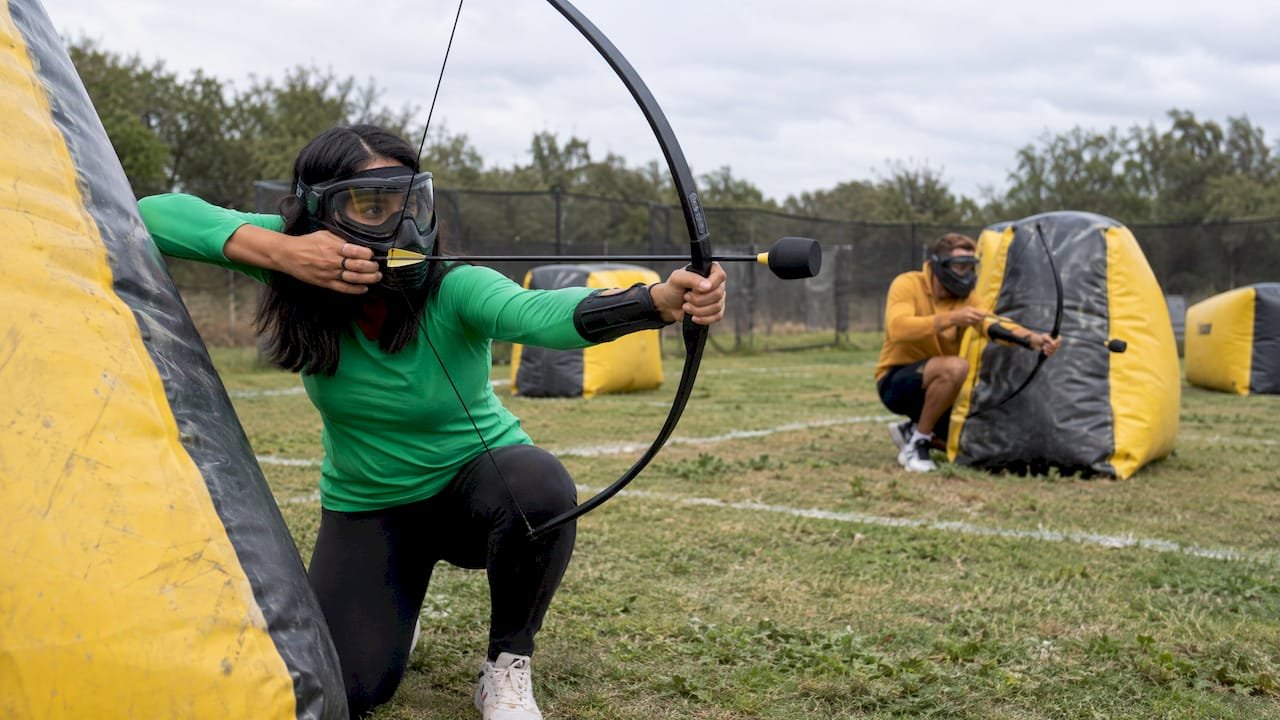
Pop out from behind a barrier, shoot, and drop back. Do not shoot from the same spot twice in a row. Opponents learn where you peek from within a few seconds. Lean out on the opposite side of the barrier from the one you used last time.
Stay low and keep moving
A crouched, moving target is much harder to hit than a standing one. Travel between barriers in short bursts, and cross open gaps only when a teammate is covering you.
Retrieve arrows with a plan
Retrieval is where most games turn. The official rules say to gather arrows in the neutral zone and return immediately to your action zone, never stalling there. A second stalling infraction may cost two points. So:
- Call “going out” so teammates raise their bows.
- Grab one arrow at a time and move straight back.
- Never shoot from or at players in the neutral zone.
- Reload behind cover, not in the open.
Catch to revive
Where your venue uses revivals, catching an incoming arrow brings a teammate back in. It is difficult, and trying to catch with your face turned away is a good way to get hit. Treat it as a bonus, not a plan. In timed formats a catch is worth 3 points, so a confident player at the back can quietly change a score.
Team strategies that actually work
A group of friends who talk will beat a group of better individual shooters who do not. Good team building options in any city rely on the same principle: shared goals and clear communication.
- Pick roles before the whistle. One or two shooters hold the front, one or two runners fetch arrows, and one player acts as a spotter calling out what the other team is doing. Do not force anyone into a role they dislike. Fun comes first.
- Call targets by position. “Left barrier, blue shirt” beats “over there.” Short calls are easier to hear over the noise.
- Focus fire. Two players shooting at the same opponent beats four players each shooting at a different one. A forced dodge opens a gap.
- Cover your retrievers. Before anyone leaves for arrows, two teammates should have eyes on the opposing side.
- Keep one defender back. In objective rounds, such as knocking down targets, someone should always watch your own side so a late sprint does not catch you open.
- Regroup after a setback. If the plan fails, pause behind cover and set a new one rather than all improvising.
Adjust to the game format
| Format | What matters most | Tip |
|---|---|---|
| Elimination | Staying alive | Shoot from cover, avoid the middle |
| Revival rounds | Teammate survival | Keep a catcher near the front |
| Timed scoring | Hits and catches | Keep shooting steadily, never stall |
| Target rounds | Protecting your own target | Split attackers and defenders |
Stay safe and play fair
Safety is part of the skill. Wear the mask for the whole game, stay inside the boundary lines, and do not shoot at players in the neutral zone. If someone is hurt or equipment looks broken, tell the referee so play can stop. Venues also check equipment and the space before play. The New Brunswick safety guideline for school archery, for example, calls for regular equipment inspection, bows matched to the participant, and marked, controlled shooting areas.
For kids, the same rules apply with an adult watching. Our archery tag safety guide covers gear, rules and setup for parents and organizers.
Our perspective
We run combat archery as a group game first. The players who have the most fun are rarely the best shots. They are the ones who talk, laugh and trust their team.
That is why we pair the game with a briefing on the rules, boundaries and gear, and why our packages are built around group size and the kind of day you want. A birthday group, a sports team and an office crew all play the same game differently, and a good host adapts the rounds to each.
If you take only one tip from this page, make it this: decide your roles before the whistle. Everything else gets easier.
Archers
Ready to try it with your group?
Combat archery at Archers Battlefield is $35 per person for a session, and we also run Nerf battles at $35, plus dodgeball and ping pong at $30. For groups, our packages start at $399 for the Game On Birthday Party and $499 for the Epic Birthday Party. Team packages start at $699 for the Collab Package. Browse our kids’ birthday party packages, look at team building events or start at the Archers Battlefield home page to plan your date.

If you are planning a party, our combat archery birthday packages page lays out what is included.
Common mistakes to fix fast
- Staying in the neutral zone. It costs points and exposes you. Grab and go.
- Shooting too early in the rush. Arrows are not live until you are back in your zone.
- Aiming flat. Foam arrows drop. Aim higher.
- Bunching up. Clustered players are easy targets. Spread out between barriers.
- Ignoring the briefing. House rules vary by venue, so listen each time.
- Going silent. Teams that call targets out loud win more rounds.
A simple practice routine
If you play regularly, a short routine speeds up improvement:
- Warm up your shoulders. A few arm circles before the first round help you draw smoothly.
- Shoot ten slow shots at a stationary target behind your own barrier to find your aim point.
- Practise nocking without looking until it takes a second or less.
- Rehearse the rush with your team: who goes, who covers, who calls.
- Debrief after each round. Ask what worked and change one thing.
If you want to widen your skills, our archery page and the Nerf battle page cover other ways to practise movement and teamwork.
FAQ
Do I need experience to play combat archery?
No. Beginners can play with a short briefing and a gear fitting. The bows are low in draw weight and the arrows have large foam tips, so the game rewards movement and teamwork more than technique.
Does it hurt to get hit?
A hit from close range can sting a little, but the game is designed around foam tips, light bows and face masks. Wear your mask all game, keep to the boundaries and follow the referee’s instructions.
What should I wear?
Comfortable athletic clothes that let you run and crouch, and closed-toe shoes. Add the mask the venue provides, and ask whether an arm guard is used. Skip anything loose that could catch on a barrier.
What is the best team strategy for beginners?
Split into shooters, runners and a spotter, call targets by position, and cover anyone retrieving arrows. Keep one player watching your own side so you are not caught by a late rush.
Sources
- Basic Rules of an Archery Tag Game
- Archery instruction guide, School District of Philadelphia
- Physical Education Safety Guidelines Grades Primary–12, Nova Scotia
- Safety Guidelines for Physical Education in New Brunswick


