

Poll your group, shortlist two or three outing types that fit both interest and budget, then book early. That’s the whole process. For high-energy indoor days, a supervised entertainment venue offers built-in structure without the risk of weather or the logistics of a full outdoor trip. Check safety rules, accessibility needs, and your real budget ceiling before you lock anything in.
TL;DR:
- Booking early and choosing activities based on the group’s energy and budget increases engagement and reduces planning stress.
- Indoor venues with safety protocols, such as Archers Battlefield, are ideal for high-energy activities when weather or outdoor logistics pose challenges.
- Activities like escape rooms, adventure parks, and outdoor trips are most effective with adequate supervision, proper gear, and clear safety boundaries.
- Cost savings can be achieved through weekday discounts, group rates, potlucks, public transit, and involving youth in budget decisions.
- Regular post-outing feedback and tracking attendance and participation metrics improve planning and help tailor future events effectively.
Table of Contents
- Youth Group Outing Ideas: 12 Options Worth Booking
- Budget-Friendly Outing Ideas That Don’t Feel Cheap
- Indoor Active Outings: Safety Rules and Booking Tips
- Outdoor Adventures: Planning and Risk Management
- How to Plan a Youth Group Outing: A Step-by-Step Checklist
- Sample Schedules You Can Copy Today
- Emergency Preparedness and First Aid on Outings
- Was the Outing a Success? How to Tell and Improve Next Time
- Archers Battlefield’s Perspective: What Makes Outings Actually Work
- Book an Indoor Outing at Archers Battlefield
- Sources
Youth Group Outing Ideas: 12 Options Worth Booking
The best youth group outings solve a specific problem: not enough time to plan, not enough money to spend, or a group whose energy levels and interests are all over the map. Here’s a working idea bank organized so you can match the outing to your actual constraints, not just what sounds fun on paper.
1. Photo Scavenger Hunt
Split into teams of four or five and send them out with a list of odd photo challenges (a stranger giving a thumbs up, a store window reflection, a group pyramid). Cost: free, since everyone already has a phone camera. Works for any age group and any energy level, indoors or out. Low-cost variant: run it in your own building or block instead of driving anywhere.
2. Escape-Room-Style Challenge
Puzzle-based rooms force quiet kids and loud kids to contribute equally, since brainpower matters more than volume. Booking tip: most escape venues cap rooms at 6 to 10 people, so a group of 20 needs two or three rooms running simultaneously. Budget variant: build your own puzzle trail using printed clues around a park or church basement.
3. Adventure Park or Ropes Course
Nothing tests trust quite like a partner belaying you 30 feet up. Research on high-engagement activities backs this up directly: ropes courses and collaborative puzzle-solving produce measurably stronger communication and trust outcomes than passive or low-engagement activities. Best for ages 10 and up with a minimum height requirement (check the venue). Cost runs higher than most entries here, so this works well as an annual splurge outing rather than a monthly staple.
4. Camping or Hiking Retreat
An overnight trip gives you hours of unstructured bonding time that a three-hour outing simply can’t match. Fits mixed ages if you offer a shorter loop trail alongside the main hike. Cost variant: a single-night car-camping trip at a provincial or state park costs far less than a lodge rental.
5. Beach or Park Picnic With Games
Bring a cooler, a few frisbees, and a soccer ball, and you’ve got a full afternoon. Works for every age and every energy level since kids can drift between active games and blanket conversation. Cost: essentially the food, which you can split potluck-style.
6. Museum or Interactive Science Center
Look for a free-admission day, which most city museums offer monthly. Good fit for reflective or lower-energy groups, and it doubles as a rainy-day backup plan. Booking tip: reserve a group time slot in advance so you’re not competing with school field trips for space.
7. Volunteer or Service Day
Food bank shifts, park cleanups, and community garden work give teens a sense of purpose that a purely recreational outing can’t. Pair the shift with a shared meal afterward so the day still feels social, not just like chores. Cost: usually free, sometimes with a small donation request.
8. Amusement Park or Day-Trip Attraction
High energy, high excitement, and typically the highest cost on this list. Group tickets often unlock a real discount, so call ahead rather than buying online individually. Best suited to groups with a fundraising budget or a per-family cost-sharing agreement in place.
9. Cooking or Culinary Workshop
Splitting into small cooking teams builds the same kind of cooperation as a puzzle challenge, minus the physical risk. Great for mixed-ability groups since everyone can chop, stir, or plate. Budget variant: run it in a church or community kitchen instead of booking a commercial studio.
10. Sports Tournament or Field Day
Dodgeball brackets, relay races, and three-legged sack races work at almost any scale. Setting clear rules matters here more than people expect. Scouts Canada’s event management guidance stresses defined safety boundaries, like aiming below the shoulders, to keep high-energy games both safe and inclusive. A dodgeball session at a dedicated venue handles that structure for you if you’d rather not referee it yourself.
11. Themed Movie Night or Mini Film-Making Challenge
Give teams a phone, 90 minutes, and a genre prompt, then screen the results with popcorn. Low prep, low cost, and it rewards creativity over athleticism. Fits quieter groups or a rain-plan slot on a multi-day retreat.
12. Guided City Exploration or Mural Tour
Walking tours built around street art or local history give older teens a sense of independence within a structured route. Cost is usually just transit fare. Works well as a warm-weather alternative to a full day trip when funds or time are tight.
Budget-Friendly Outing Ideas That Don’t Feel Cheap
You don’t need a big budget to run a memorable outing. Some of the best options on the list above already cost nothing beyond gas money: park picnics, photo scavenger hunts, and free museum days.
A few tactics stretch whatever budget you do have:
- Ask about weekday or off-peak discounts. Many venues, bowling alleys, and attractions drop prices 15 to 30 percent on slow days.
- Negotiate group rates directly instead of buying individual tickets online, especially for groups over 10.
- Run potluck rotations for food instead of catering. Assign families a category (mains, sides, dessert) so nobody carries the full cost.
- Approach local businesses for small sponsorships. Pizza shops and sporting goods stores will sometimes donate food or gear in exchange for a mention.
- Use public transit instead of chartering a bus when your destination allows it. It’s often a fraction of the cost.
- Split transportation costs across families rather than folding it into a flat per-person fee, which can price out lower-income members.
Involving your group in the budget conversation pays off, too. Experience Canada’s guidance on youth exchanges points out that surveying members before finalizing plans increases participation, because kids show up for outings they helped choose. A two-question poll (what type of outing, what price range) takes five minutes and saves you from planning an event nobody wanted.
Indoor Active Outings: Safety Rules and Booking Tips
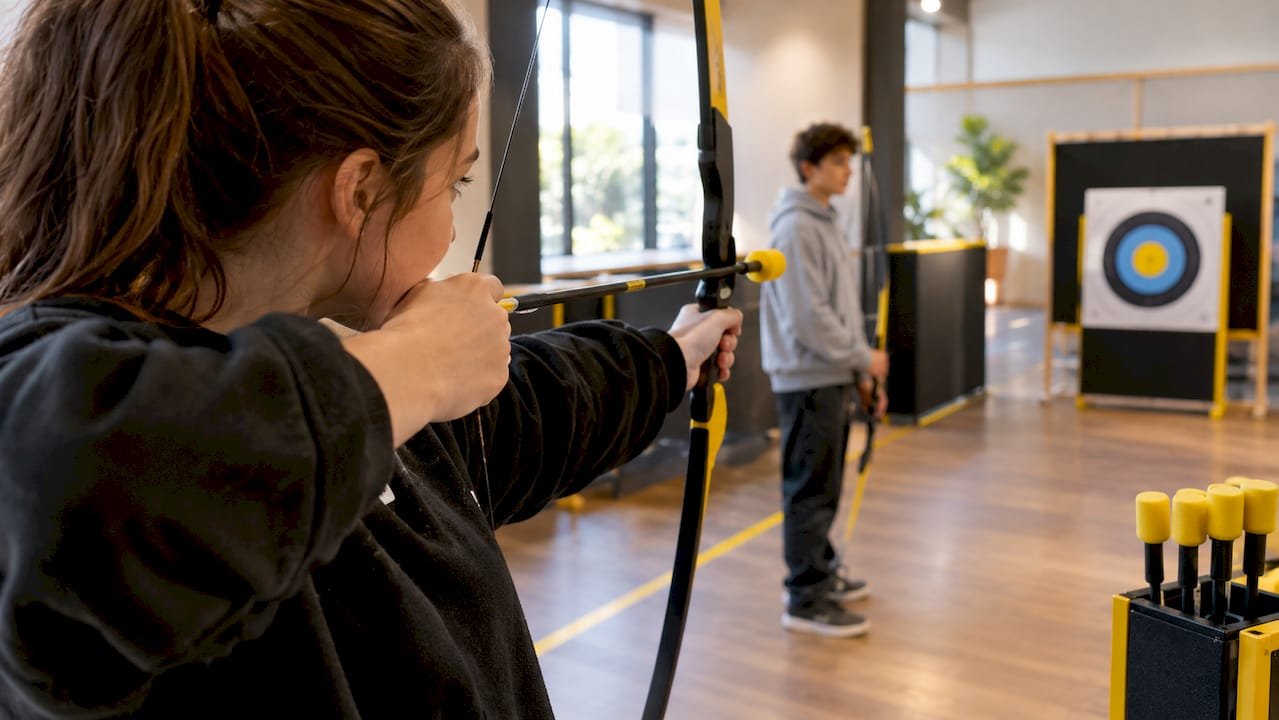
Indoor active venues solve the weather problem entirely, but they come with their own safety checklist. High-energy games like archery tag, dodgeball, and nerf battles need clear boundaries before anyone picks up equipment.
The basics that matter most:
- Closed-toe shoes, mandatory eye protection where applicable, and a pre-game gear check for every participant.
- Aim-below-the-shoulders rules and clear physical boundaries, which Scouts Canada’s event management playbook identifies as central to running safe, inclusive high-energy activities.
- A trained staff member or a designated adult leader running the safety briefing before the first round starts, not after.
- Rotation stations so no one plays the same intense role for the full session, and quieter jobs like scorekeeper or photographer for kids who’d rather sit out the physical part.
Booking advice: call the venue directly once your group tops 10 people. Online booking systems are usually built for small parties and don’t handle multi-activity scheduling or special accommodation requests well. Ask what the venue supplies (referees, first aid kits, safety gear) versus what you need to bring, and confirm the supervision ratio before you show up. A packaged option like Archers Battlefield’s team-building sessions folds most of this into one booking instead of five separate calls.
Pro Tip: If your group has a mix of contact-game lovers and kids who’d rather avoid getting hit with a foam dart, consider running a non-contact variant like target rounds or timed accuracy challenges alongside the main game to keep everyone included.
Outdoor Adventures: Planning and Risk Management
Outdoor trips deliver the biggest payoff and the biggest planning load. Before you commit to a hike, paddle, or overnight trip, work through a short pre-trip checklist.
- Confirm permits and trail difficulty match your group’s actual fitness level, not the level you’re hoping for.
- Set a leader-to-youth ratio appropriate to the activity. Water-based trips need a higher ratio than a flat walking trail.
- Hire a qualified guide for anything involving whitewater or open water. Most youth groups should stick to Class II or III rapids at most, not anything more technical.
- Build a weather contingency plan and an emergency contact tree before you leave, not on the drive there.
- Match hike distance to the least fit member of the group, not the average.
Accessibility matters just as much outdoors as indoors. Short loop trail options let slower hikers turn back early without missing the whole day, and tandem kayaks let a less confident paddler team up with someone stronger. Pairing participants this way also boosts conversation between kids who might not otherwise talk, according to trip-planning research on youth group activities from Trevelus. If your group leans toward a mix of adventure-tourism style activities, Skye Highlands Tours breaks down the deeper case for outdoor challenge trips worth reading before you finalize plans.
How to Plan a Youth Group Outing: A Step-by-Step Checklist
Most planning delays come from skipping steps, not from a lack of good ideas. Run through this sequence in order and you’ll cut weeks off your usual back-and-forth.
- Poll the group first. A two-minute survey (outing type, price range, date preferences) beats guessing. Experience Canada’s research on youth engagement shows involving members in the decision boosts turnout later.
- Shortlist two or three outing types that fit the poll results and your calendar. Don’t present ten options; decision fatigue kills momentum.
- Check capacity and accessibility for each shortlisted option. Call ahead if the group is over 10 people, and ask directly whether the venue can accommodate mobility needs, dietary restrictions, or sensory sensitivities.
- Confirm supervision ratios and permission requirements. Know your organization’s minimum adult-to-youth ratio before you book anything, and send permission and medical forms out at least two weeks ahead.
- Lock transportation and food logistics. Decide bus charter versus public transit versus carpool based on group size and distance, then settle whether food is provided, potluck, or bring-your-own.
- Finalize the date with a backup alternate in case of weather or venue conflict.
For your actual planning document, copy this list of fields and fill them in before you call anyone:
- Primary date and one backup date
- Cost per person, broken down by activity, food, and transport
- Link to waiver and medical form (digital forms save paper and follow-up calls)
- Transportation decision: bus, transit, or carpool, with a named coordinator
- Staff assignments: who runs check-in, who handles first aid, who’s the point of contact for parents
- Emergency contact numbers, saved in every leader’s phone before departure day
When you call a venue, ask directly: What’s your group policy for parties over 10? What’s your supervision staffing look like? What safety equipment and first aid do you provide on-site? A vague answer to any of those three questions is a real red flag. A venue with a clear group policy, trained staff on the floor, and posted safety rules is doing the basic work you need them to do.
Sample Schedules You Can Copy Today
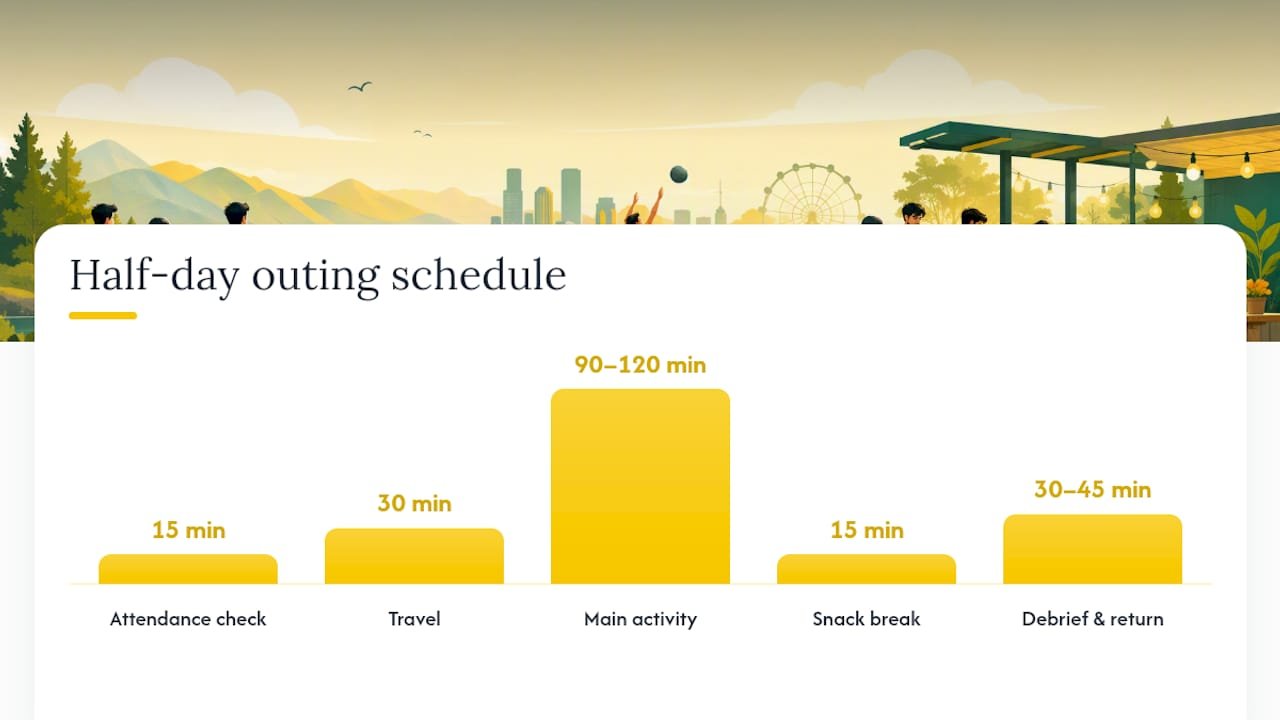
Half-day local outing (3 to 4 hours): Meet and check attendance (15 minutes), travel to venue (30 minutes), main activity block (90 to 120 minutes), snack break (15 minutes), group debrief and return travel (30 to 45 minutes).
Full-day adventure trip (8 to 10 hours): Early meet-up and gear check (30 minutes), travel (60 to 90 minutes), morning activity block, packed lunch with a real rest period, afternoon activity block at a lower intensity than the morning, wrap-up reflection circle before the drive home.
Low-cost service and social day (6 hours): Volunteer shift at a food bank or park cleanup (2.5 to 3 hours), shared potluck meal, short reflection discussion about the experience, optional casual games to close out the day on a lighter note.
Emergency Preparedness and First Aid on Outings
Every outing needs a basic emergency plan, even the low-key ones. Assign one adult leader as the designated first-aid point person for the day and confirm they’re actually carrying a stocked kit, not just assuming someone else packed it.
Before you leave, collect emergency contact numbers and any relevant medical information (allergies, medications, conditions) for every participant, and keep that list on paper and on a phone in case one dies. Know the location of the nearest hospital or urgent care relative to your activity site, especially for outdoor trips in areas with weak cell coverage.
For high-energy indoor activities, ask the venue what their own first-aid protocol looks like before you book. Most established venues carry supplies and train staff on basic response, but you should never assume that without asking directly. For outdoor trips, at least one leader should carry a real first-aid kit rather than relying on a glove-box afterthought, and everyone should know the group’s meeting point if the group gets separated.
Weather is its own emergency category. Build a simple rule ahead of time, like “activity moves indoors or cancels if lightning is within 10 miles,” so nobody has to make that call under pressure on the day.
Was the Outing a Success? How to Tell and Improve Next Time
The clearest sign an outing worked isn’t how tired everyone looks at pickup. It’s whether kids are still talking about it a week later, and whether attendance holds steady for the next event.
A short debrief right after the outing, while the day is still fresh, gives you better data than a survey sent three days later. Ask three quick questions: What was the best part? What would you change? Would you want to do something like this again? Written or verbal, it doesn’t matter, but write down the answers somewhere you’ll actually revisit.
Track a few practical numbers over time: attendance rate compared to your group’s total membership, cost per participant, and how many kids brought a friend along. A rising “brought a friend” number is often a stronger success signal than the attendance count itself, since it means members are excited enough to invite outsiders.
Feed what you learn directly into your next poll. If the escape room outing scored high but the museum day fell flat, that’s real information, not just a one-off result. Planning gets easier every time you actually use what the last outing taught you instead of starting from scratch.
Archers Battlefield’s Perspective: What Makes Outings Actually Work
Shared challenges do more for a group than routine meetings ever will. YMCA Calgary’s youth engagement work backs this up: outings build community and friendship specifically because they push kids outside their normal roles.
What we see work consistently: leaders who book early, run a real safety briefing instead of a rushed one, and offer a quieter role for kids who don’t want to be in the middle of the action. The groups that skip that last part usually lose a few members by the third outing. The ones that build it in keep almost everyone coming back.
— Archers
Book an Indoor Outing at Archers Battlefield
If your shortlist includes a high-energy indoor day, Archers Battlefield gives you the structure, gear, and supervision without you having to referee anything yourself. The venue runs archery tag, nerf battles, dodgeball, and axe throwing under one roof, so a mixed-interest group doesn’t need three separate bookings to keep everyone engaged.

Groups get access to packaged team-building sessions built around rotation and inclusion, plus dedicated kids camp programming if you’re planning something bigger than a single afternoon. Booking tip: call ahead for any group over 10 rather than using the online system, since larger bookings often need custom scheduling and accessibility accommodations that online forms don’t capture well. Ask about packaged pricing when you call, it usually beats booking activities separately.
Ready to lock in a date? Start with archery booking and get your group on the calendar before the good weekend slots fill up.


